

To employ foreign nationals as Specified Skilled Worker (i) (特定技能1号) in the construction field, you need approval of the “Construction Specified Skilled Worker Acceptance Plan” (建設特定技能受入計画; called the “Acceptance Plan” in this article) from the Minister of Land, Infrastructure, Transport and Tourism, separately from the status of residence application to immigration. You can apply to immigration without waiting for approval of the Acceptance Plan, as long as you have already applied for the Acceptance Plan. However, immigration will not grant permission until you submit a copy of the “certificate of approval of the Acceptance Plan” issued by the Ministry of Land, Infrastructure, Transport and Tourism (MLIT). The certificate of approval of the Acceptance Plan is a different document from the “Certificate of Eligibility” (在留資格認定証明書) issued by immigration. MLIT estimates that the review of the Acceptance Plan takes about 1.5 to 2 months (excluding correction periods).
This article puts the whole picture of the Acceptance Plan in one place.
- What the Acceptance Plan is (and how it differs from the support plan), when it is needed, and the requirements for approval
- What to submit to MLIT and to immigration, and in what order
- The attachments for MLIT and the construction-field documents for immigration
- The review period, when to apply, and common reasons for corrections
- The reports, training, and change procedures that continue after approval
Detailed steps such as joining JAC (Japan Association for Construction Human Resources), registering with the Construction Career Up System (CCUS), and how to set wages will be explained in separate articles.
The contents were checked on October 14, 2026 against the operational guidelines (construction field, partially revised January 31, 2025) and MLIT’s application guides (new and change applications, April 4, 2025).
What is the Construction Specified Skilled Worker Acceptance Plan: an MLIT approval that exists only in the construction field
The Construction Specified Skilled Worker Acceptance Plan is an additional system that exists only in the construction field. A company that accepts Specified Skilled Workers prepares an Acceptance Plan and applies for it, and the plan is approved when the Minister of Land, Infrastructure, Transport and Tourism finds that the conditions of acceptance are appropriate. Once approved, a certificate of approval of the Acceptance Plan is issued, and you attach a copy of it to the immigration application. The legal basis is an MLIT notice (MLIT Notice No. 357 of Heisei 31). The review and approval are carried out by each Regional Development Bureau, etc.
The Acceptance Plan is different from the “Support Plan for Specified Skilled Worker (i)” (1号特定技能外国人支援計画; the “support plan”), which companies in all fields prepare when accepting Specified Skilled Worker (i). In the construction field, you need approval of the Acceptance Plan in addition to the support plan.
The operational guidelines explain the purpose of the Acceptance Plan roughly as follows.
- To keep companies with poor working conditions, such as low wages or no social insurance, out of the construction market and protect fair competition
- To set treatment that both the company and the foreign national accept, and prevent disappearances and illegal work
- To protect employment opportunities for foreign nationals as an industry, even when a company’s orders change
The 4 items written in the Acceptance Plan
The Acceptance Plan contains the following 4 items.
- Information about the applying company
- Efforts to secure Japanese workers
- An environment in which the foreign national can work properly (pay, advance explanation, reports, etc.)
- Safety and health education and efforts to help the worker build skills
When an Acceptance Plan is needed
Approval by the Minister of Land, Infrastructure, Transport and Tourism is needed each time you newly sign a Specified Skilled Worker employment contract. The operational guidelines give cases such as the following.
- Hiring a person who passed the test overseas or elsewhere
- Hiring a person who completed technical intern training (whether at the same training company or a different one)
- Hiring a Specified Skilled Worker who changes jobs from another company
- The same company rehiring a person who once left
The overall procedure for changing jobs is summarized in the following article.
Only Specified Skilled Worker (i) is covered. There is no Acceptance Plan approval for Specified Skilled Worker (ii). However, companies that accept (ii) workers are also required to have a construction business license, register with CCUS, and belong to JAC, etc.
The construction field has 3 work categories: “civil engineering,” “building,” and “lifelines and facilities.”
(Sources: Operational guidelines (construction field), MLIT, “Notices [Specified Skilled Worker System (Construction Field)”](https://www.mlit.go.jp/tochi_fudousan_kensetsugyo/tochi_fudousan_kensetsugyo_tk3_000001_00002.html))
Requirements for approval: what is required of the company, and of the foreign national and the contract
To be approved, you must meet both the company requirements and the requirements for the foreign national and the employment contract. The main ones from MLIT’s guide and the operational guidelines are shown in the table.
| Category | Main requirements |
|---|---|
| Company | Has a construction business license |
| Company | Has completed CCUS business registration (you cannot apply while registration is pending) |
| Company | Belongs to JAC or to an organization that is a full member of JAC (you cannot apply while membership is pending). Follows the code of conduct |
| Company | Has not received a supervisory disposition under the Construction Business Act in the 5 years before the application or after the application date |
| Company | Makes efforts to secure Japanese workers, such as recruiting full-time employees for the same job at Hello Work |
| Company | The number of (i) foreign workers does not exceed the number of full-time staff |
| Company | After acceptance, provides safety and health education such as special education, and works to improve skills |
| Foreign national and contract | The foreign national has completed CCUS technician registration (people overseas register after entering Japan) |
| Foreign national and contract | The work is construction work, and the work category matches the test passed or the technical intern training completed |
| Foreign national and contract | Pays at least the same amount as a Japanese worker with the same skills, steadily on a monthly salary basis. Gives raises as skills develop |
| Foreign national and contract | Has explained the conditions to the worker using the advance explanation of important matters (重要事項事前説明書, Notice Form No. 2) |
| Foreign national and contract | Has signed a Specified Skilled Worker employment contract on the conditions explained |
On supervisory dispositions, the guide says that whether it is an instruction, a business suspension, or a revocation, you cannot accept workers for 5 years from the disposition.
How to count staff is written a little differently depending on the document. The operational guidelines exclude “(i) foreign workers and technical intern trainees” from full-time staff. The guide also says not to count people with “Designated Activities (planned transition to Specified Skilled Worker, etc.).” If you are unsure how to count at your company, check with the Regional Development Bureau, etc. where you apply.
MLIT looks at the employment contract and employment conditions in order to approve the Acceptance Plan. This does not mean MLIT confirms that they are lawful under labor laws. The operational guidelines say that if you have questions about labor laws, you should consult the Labor Standards Inspection Office before applying.
(Sources: Guide for new applications, Operational guidelines (construction field))
The flow from approval to acceptance: what to submit to MLIT and to immigration, and when
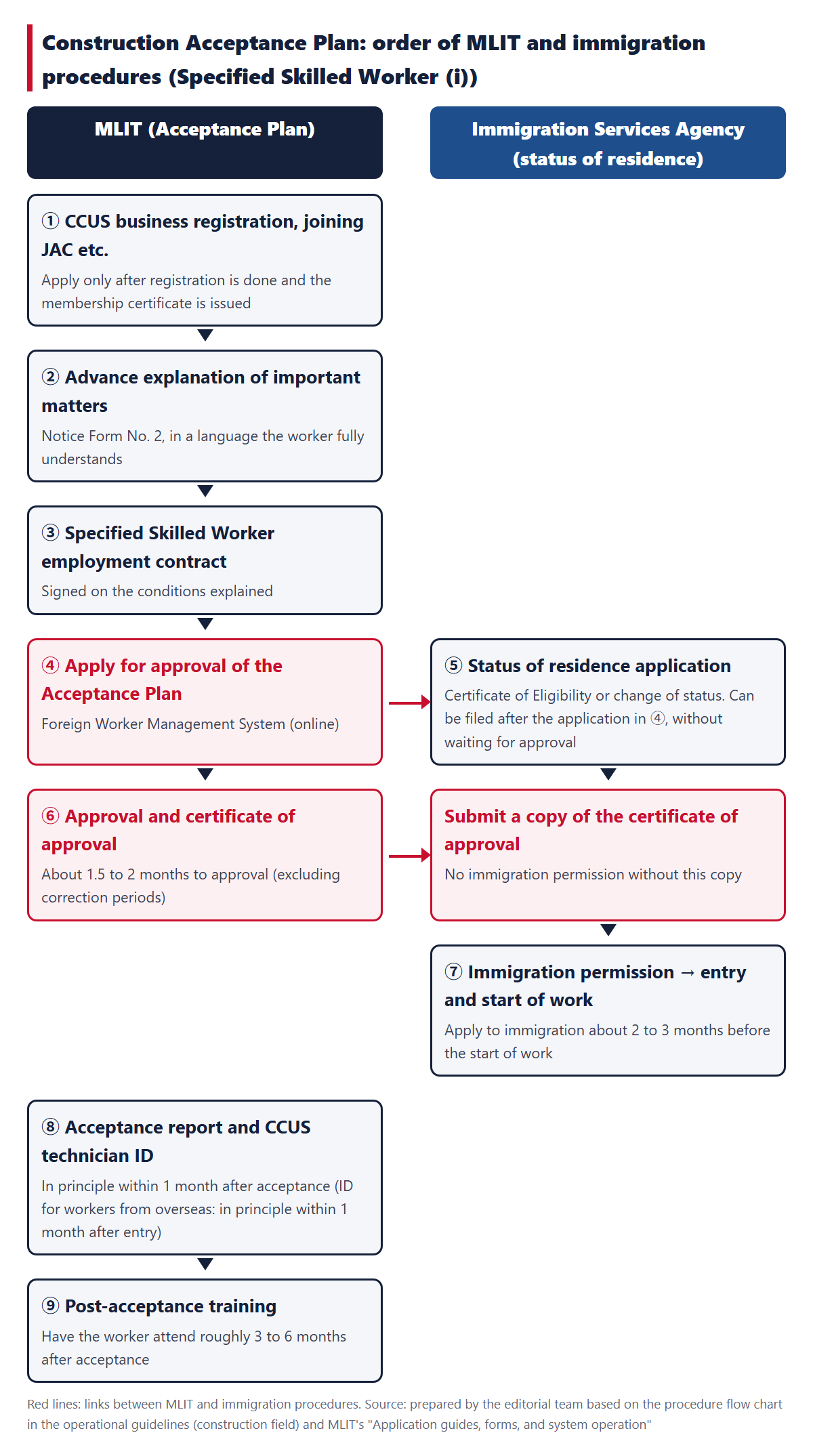
In the construction field, you need both the MLIT procedure (approval of the Acceptance Plan) and the immigration procedure (status of residence application). There is no rule that the two must be filed together. According to the operational guidelines, once you have applied to MLIT for the Acceptance Plan, you can apply to immigration even before the Acceptance Plan is approved. The order is shown in the figure. MLIT is on the left and immigration is on the right.
Sources: Prepared by the editorial team (based on the procedure flow chart in the operational guidelines (construction field) and MLIT’s “Application guides, forms, and system operation”)
The order is as follows.
- Complete CCUS business registration and join JAC, etc.
- Explain the conditions using the advance explanation of important matters (Notice Form No. 2), in a language the worker fully understands
- Sign the Specified Skilled Worker employment contract
- Apply for approval of the Acceptance Plan through the Foreign Worker Management System (MLIT’s online application)
- Apply to immigration for a Certificate of Eligibility (在留資格認定証明書), or for Permission to change status of residence (在留資格の変更許可) (once the application in step 4 has been filed, you can file this without waiting for the approval)
- When the Acceptance Plan is approved, submit a copy of the certificate of approval of the Acceptance Plan to immigration
- When immigration grants permission, the worker enters Japan and starts work
- After acceptance, submit an acceptance report to MLIT, in principle within 1 month. For people who come from overseas, also submit the CCUS technician ID document, in principle within 1 month after entering Japan
- After acceptance, have the worker attend the designated training roughly 3 to 6 months later
You can apply to immigration once you have applied for the Acceptance Plan (immigration permission comes after approval of the Acceptance Plan)
MLIT explains that the application for approval of the Acceptance Plan and the status of residence application to immigration “can be filed in parallel.” According to the operational guidelines, once you have applied to MLIT for the Acceptance Plan, you can apply to immigration even before the Acceptance Plan is approved. You do not need to wait for the Acceptance Plan to be approved before applying to immigration, but you are not required to file both together either. However, the immigration application requires a copy of the certificate of approval of the Acceptance Plan. For this reason, MLIT explains that immigration will not grant permission unless MLIT’s approval has been given. When the certificate of approval is issued, submit a copy to immigration.
Online application, one ID per company
The Acceptance Plan application is, in principle, made through the Foreign Worker Management System. One company cannot use multiple IDs. A company can also hold only one approved Acceptance Plan. MLIT warns that if the same ID is used at the same time on multiple screens or computers, data may be lost.
Who applies
The Acceptance Plan application is made by the accepting company itself, or by an agent, who is limited to an attorney (or law firm) or a gyoseishoshi lawyer (or gyoseishoshi corporation). Even when you use an agent, MLIT asks that the first provisional user registration be done with the company’s email address, and that the company keep track of the ID and password.
Who can submit immigration applications on your behalf is a different rule. It is explained in the following article.
→ How to get and renew the Application Agent Certificate | Application form, required documents, and what registered support organizations can submit [Updated for the revised Gyoseishoshi Lawyer Act](https://kisaragi-office.com/immigration_journal/en/archives/4582)
(Sources: MLIT, “Application guides, forms, and system operation”, MLIT, “Foreign Worker Management System”, Operational guidelines (construction field))
Required documents: documents for MLIT and construction documents for immigration
You submit documents to both MLIT (approval of the Acceptance Plan) and immigration (status of residence).
Attachments for MLIT (the 16 items in the guide for new applications)
In the online application, attach the following documents as PDF or JPEG files. The numbers are the document numbers in the guide.
| Group | No. | Document | Notes |
|---|---|---|---|
| Company | 1 | Certificate of registered matters (for sole proprietors, the representative’s resident record (juminhyo)) | Issued within 3 months before the application date |
| Company | 2 | Construction business license | Within its validity period |
| Company | 3 | Document showing the number of full-time staff (document confirming social insurance enrollment) | Follow the guide’s instructions on how to count |
| Company | 4 | Document showing the CCUS business ID | You cannot apply until you have the ID |
| Company | 5 | Membership certificate of JAC, etc. | You cannot apply until the membership certificate is issued |
| Agent | 6 | Letter of attorney, and attorney ID card or gyoseishoshi lawyer ID card | Only when an agent applies |
| Company | 7 | Hello Work job posting | Within the most recent 1 year from the application date. Recruitment of construction or civil engineering workers |
| Company | 8 | Work rules, wage rules, retirement allowance rules | Not needed if the company does not regularly employ 10 or more people and has not made them |
| Company | 9 | Article 36 agreement notification (agreement on overtime and holiday work) | — |
| Company | 10 | Agreement, notification, and annual calendar for flexible working hours | Only for companies using a flexible working hours system |
| Per foreign national | 11 | Document showing the CCUS technician ID (copy of the card) | People overseas submit it after entering Japan |
| Pay comparison | 12 | Explanation that the pay is at least equal to that of a Japanese worker with equivalent skills | MLIT form |
| Pay comparison | 13 | Wage ledger of the Japanese worker with equivalent skills | The most recent 1 year (including bonuses) |
| Pay comparison | 14 | Document proving the years of practical experience of the Japanese worker with equivalent skills | The “certificate of practical experience” for the construction business license cannot be used instead |
| Per foreign national | 15 | Copies of the Specified Skilled Worker employment contract and employment conditions | For every worker |
| Per foreign national | 16 | Advance explanation of important matters (Notice Form No. 2) | For every worker |
The guide also gives notes on how to prepare the documents.
- Make one file per document, and name it so it is clear what (and whose) document it is (the employment contract and employment conditions may be combined into one file)
- If even one required document is missing, the review may not be able to proceed. Apply only after everything is ready
For the advance explanation of important matters, MLIT’s page has the Japanese form and a filled-in example. For explaining to the foreign national, MLIT advises using the form with 10 languages side by side.
Construction-field documents for immigration (Table 3-5)
In the immigration application, in addition to the documents common to all fields, you submit the construction-field documents (Table 3-5 of the document checklist (提出書類一覧表)).
| Document | Certificate of Eligibility / change application | Notes |
|---|---|---|
| Proof of skills (test pass certificate, or a document showing good completion of Technical Intern Training (ii)) | Whichever applies | Can be omitted if submitted in a past application, with no changes and within the validity period |
| Proof of Japanese (Japanese-Language Proficiency Test N4 or higher, or the Japan Foundation Test for Basic Japanese) | Whichever applies | Can be omitted for people who completed Technical Intern Training (ii) in good standing (a document proving completion is needed) |
| Copy of the certificate of approval of the Construction Specified Skilled Worker Acceptance Plan | Required | One that shows the applicant’s name |
| Written pledge for the construction field (Field Reference Form No. 6-1) | Required | — |
In an application for Permission to extend period of stay (在留期間の更新許可), the copy of the certificate of approval can be omitted if it was submitted before, has not changed, and is within its validity period.
Documents for both
The employment contract and employment conditions are submitted to both MLIT and immigration. How to fill them out is explained in the following article.
For documents common to all fields, such as the support plan, see the following article.
(Sources: Guide for new applications, MLIT, “Application guides, forms, and system operation”, Table 3-5 Construction (for Certificate of Eligibility), Table 3-5 Construction (for change), Table 3-1 (for extension))
Review period and when to apply: when to start preparing
MLIT estimates “about 1.5 to 2 months (excluding correction periods)” from the application to approval. It also says that in some regions it can take several more months.
When you can apply
| Situation | MLIT’s guidance |
|---|---|
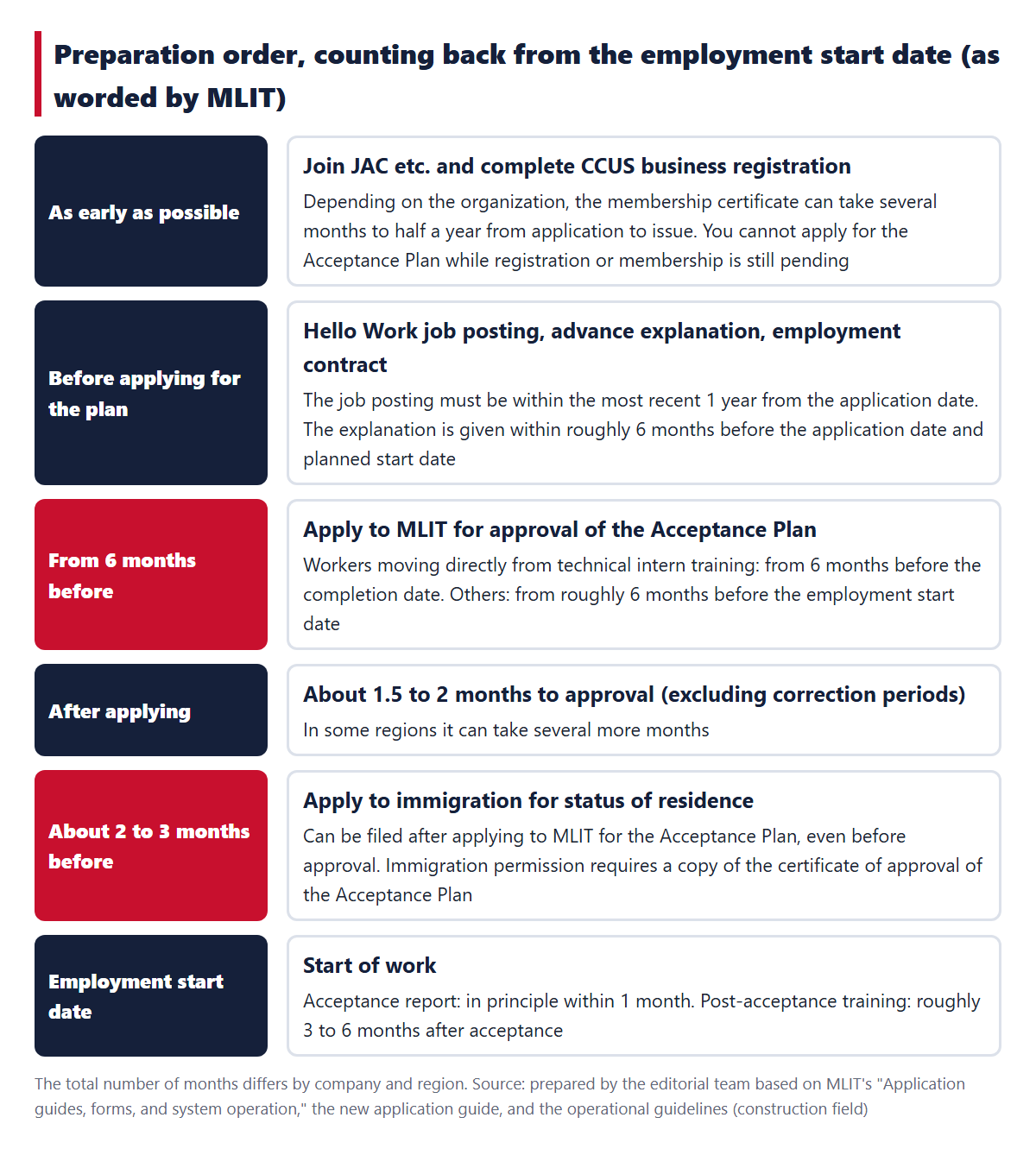
| People moving directly from technical intern training to Specified Skilled Worker | You can apply for approval of the Acceptance Plan from 6 months before the completion date of the technical intern training plan |
| Others | You can apply for approval of the Acceptance Plan from roughly 6 months before the employment start date |
| Application to immigration | Apply about 2 to 3 months before the date you want work to start (check with each Regional Immigration Services Bureau for details) |
| Advance explanation of important matters | Give it within roughly 6 months before the application date and the planned employment start date |
If you “withdraw and re-edit” an application in the system, the review starts in order of the date you resubmitted, not the original application date.
Preparations that take time in advance
Some of the preparations you need to finish before applying take time.
- Membership certificate of JAC, etc.: the guide says that, depending on the organization, it can take several months to half a year from application to issue. There are membership requirements, and some organizations you cannot join
- CCUS business registration: you cannot apply for the Acceptance Plan while registration is pending
- Hello Work job posting: if you have never posted a job, post one once and attach that job posting
The figure shows the order of preparation, counting back from the employment start date. The periods use MLIT’s wording as is; how many months it takes in total differs by company and region.
Sources: Prepared by the editorial team (based on MLIT’s “Application guides, forms, and system operation” and the guide for new applications)
When accepting a person with little time left in their period of stay, it is important to act early. If you are unsure about your specific schedule, consult the Regional Development Bureau, etc., the Regional Immigration Services Bureau, or a professional.
(Sources: MLIT, “Application guides, forms, and system operation”, Guide for new applications, Operational guidelines (construction field))
Points where the review often stalls (to reduce corrections)
When a correction (an instruction to fix documents) is issued, approval is delayed by that much. We have summarized 5 points of caution written in the official materials.
1. Make the contents of 3 documents match
The guide asks that the following 3 be prepared with exactly the same contents. Any difference is subject to correction.
- Specified Skilled Worker employment conditions
- Advance explanation of important matters
- Input in the Foreign Worker Management System
When you fix the employment conditions, it is important to fix the explanation and the system input in the same way.
2. Pay is compared with “the closest Japanese worker”
For the review of pay, an MLIT notice (March 28, Reiwa 4) sets the yardstick.
- It is not approved if, without a legitimate reason, the pay is lower than that of the Japanese technician closest in work content, years of experience, qualifications, etc.
- It is not approved if the scheduled wages of the compared Japanese worker and the foreign national, converted to an hourly amount, fall below 1.1 times the regional minimum wage (or the national weighted average)
- It is not approved if there are no regular raises, or if the expected monthly raise per year is less than 1,000 yen
The monthly salary written in the job posting is also checked in the review. The guide gives an example that if the basic wage is lower than the monthly salary in the job posting, it may not be accepted as equal or higher.
Allowances that can be included in the basic wage for approval are limited to allowances paid every month unconditionally at a fixed amount. Perfect attendance allowances and fixed overtime pay cannot be included. How to set pay will be explained in detail in a separate article.
3. Apply “after” the membership certificate and ID are issued
For JAC, etc., a membership application form or receipt cannot replace the membership certificate. Each organization has a set format for the membership certificate submitted to MLIT, so the guide asks you to check with the organization whether your membership certificate can be used for approval. You also cannot apply until you have obtained the CCUS business ID.
4. How to count full-time staff
The document showing the number of full-time staff is a social insurance document (such as the notice of determination of standard remuneration). The guide instructs you to write a specified mark next to the names of part-time workers, technical intern trainees, and others.
5. Describe the work concretely
The operational guidelines ask that if the worker may be given dangerous or harmful work (such as work at heights or outdoor work in hot conditions), you write it in the work content field of the advance explanation of important matters and explain it. Sign the employment contract only if the worker understands and agrees.
(Sources: Guide for new applications, On approval of pay amounts in the Construction Specified Skilled Worker Acceptance Plan (notice), Operational guidelines (construction field))
What to do after approval: reports, training, and changes
The Acceptance Plan does not end once it is approved. Reports to MLIT and training continue after acceptance.
| Procedure | When | Details |
|---|---|---|
| Acceptance report | In principle within 1 month after starting acceptance | For the “Construction Specified Skilled Worker start date,” write the issue date of the residence card (Specified Skilled Worker (i)) |
| Submission of the CCUS technician ID | For people from overseas, in principle within 1 month after entering Japan | Submit together with the acceptance report |
| Resignation report | Promptly after the employment contract ends | — |
| Report of transition to (ii) | Promptly after moving to (ii) | — |
| Report of a reason that makes continuation impossible | Promptly after non-renewal of employment, revocation of approval of the Acceptance Plan, loss of status of residence, disappearance, etc. | — |
| Post-acceptance training | Roughly 3 to 6 months after acceptance | Training designated by the Minister of Land, Infrastructure, Transport and Tourism. Treated as a working day, and travel time etc. is treated the same as a normal business trip |
| Patrol visits | When contacted by the Foreign Construction Workers Monitoring Organization (FITS) | Not cooperating without a legitimate reason can lead to report requests or guidance |
| Guidance from the prime contractor | When entering a site as a subcontractor | Submit a site entry notification to the prime contractor |
| Change of residence card number | When the period of stay is extended | Correct the number on the acceptance report screen in the system |
Changes to the Acceptance Plan: change applications and change notifications
When the contents of the Acceptance Plan change, you file a change application or a change notification. If you continue accepting workers without making the change, approval of the Acceptance Plan may be revoked.
- Change application (approval needed in advance): the total basic wage decreases, the scheduled working hours increase, the work category changes, a foreign national is added, the number of full-time staff changes, the organization you belong to or the trade name or head office changes, etc.
- Change notification (accepted when sent): changes that do not fall under a change application
When you hire a second or later foreign national, too, it is not a new Acceptance Plan but a change application for your current Acceptance Plan. You cannot file another change application while one is in progress.
Resignation and rehiring
When a (i) worker resigns, the Acceptance Plan for that person ends. If the same company hires the person again, the procedure differs as follows.
- The person leaves temporarily, and at the time of leaving it is already decided that they will return to work at your company on the same conditions: with a “rehiring application,” you can file the resignation report and the change application together
- The employment conditions on return change: file the resignation report, then file a change application to add a new foreign national
- Rehiring a person who left for other reasons and for whom a resignation report was filed: file a change application to add a foreign national as usual
Revocation of approval of the Acceptance Plan
If a reason for revocation in the notice applies, approval of the Acceptance Plan is revoked. A company whose approval is revoked must help the foreign national change jobs to another company. If the company cannot find a new workplace itself, it reports to JAC that job-change support is needed.
Separately from the reports to MLIT, notifications to immigration are also required. The timing of notifications to immigration is summarized in the following article.
(Sources: Operational guidelines (construction field), MLIT, “Application guides, forms, and system operation”, Guide for change applications and notifications, Overview of the rehiring application)
Frequently asked questions
Q Can we apply to immigration before the Acceptance Plan is approved? A Yes. Once you have applied to MLIT for the Acceptance Plan, you can apply to immigration even before the Acceptance Plan is approved. However, immigration will not grant permission until you submit a copy of the certificate of approval of the Acceptance Plan.
Q Is an Acceptance Plan also needed when a technical intern trainee becomes a Specified Skilled Worker at the same company? A Yes. Even when hiring a person who completed technical intern training, approval is needed because you sign a new Specified Skilled Worker employment contract. You can apply from 6 months before the completion date of the technical intern training plan.
Q When we hire a second foreign national, do we submit a new Acceptance Plan? A No. A company can hold only one approved Acceptance Plan. Adding a foreign national is done through a change application for your current Acceptance Plan.
Q Can the company apply by itself? A Yes. MLIT says that agents who can apply on your behalf are limited to attorneys (or law firms) and gyoseishoshi lawyers (or gyoseishoshi corporations).
Q Is it all right if the type of work in our construction business license differs from the work we assign to the foreign national? A The guide says that a match with the licensed type of work is not required. The foreign national can work on any work included in their work category.
(Sources: MLIT, “Application guides, forms, and system operation”, MLIT, “Foreign Worker Management System”, Guide for new applications, Operational guidelines (construction field))
Summary
- In the construction field, you need approval of the Acceptance Plan from the Minister of Land, Infrastructure, Transport and Tourism, separately from the immigration application. Once you have applied for the Acceptance Plan, you can apply to immigration even before it is approved, but immigration will not grant permission without a copy of the certificate of approval of the Acceptance Plan.
- Move forward first with preparations that take time, such as the membership certificate, CCUS, and the job posting. You can apply for the Acceptance Plan from 6 months before, and MLIT estimates about 1.5 to 2 months (excluding correction periods) until approval.
- After approval, procedures such as the acceptance report, post-acceptance training, and change applications continue.
If you need help, contact the following.
- The system in general and how to operate it: JAC help desk (0120-220-353, weekdays 9:00 to 17:30)
- Correction instructions: the Regional Development Bureau, etc. with jurisdiction over the company’s main business office
- Status of residence applications: the Regional Immigration Services Bureau
The documents and schedule you need may change depending on your company’s situation. If you are unsure, consult a professional.
Primary Sources Referenced in Article Creation
- Operational guidelines on accepting Specified Skilled Workers in specific fields: standards for the construction field (partially revised January 31, 2025)
- Immigration Services Agency, “Specified Skilled Worker operational guidelines”
- MLIT, “Application guides, forms, and system operation [Specified Skilled Worker System (Construction Field)”](https://www.mlit.go.jp/tochi_fudousan_kensetsugyo/tochi_fudousan_kensetsugyo_tk3_000001_00005.html)
- MLIT, “Online application for the Construction Specified Skilled Worker Acceptance Plan [New” (April 4, 2025)](https://www.mlit.go.jp/tochi_fudousan_kensetsugyo/content/001603430.pdf)
- MLIT, “Online application for the Construction Specified Skilled Worker Acceptance Plan [Change application and notification” (April 4, 2025)](https://www.mlit.go.jp/tochi_fudousan_kensetsugyo/content/001603432.pdf)
- MLIT, “On approval of pay amounts in the Construction Specified Skilled Worker Acceptance Plan (notice)” (March 28, Reiwa 4)
- MLIT, “Departure of Specified Skilled Worker (i) foreign nationals and procedures with MLIT (rehiring application)”
- MLIT, “Overview and related materials [Specified Skilled Worker System (Construction Field)”](https://www.mlit.go.jp/tochi_fudousan_kensetsugyo/tochi_fudousan_kensetsugyo_tk3_000001_00003.html)
- MLIT, “Foreign Worker Management System [Specified Skilled Worker System (Construction Field)”](https://www.mlit.go.jp/tochi_fudousan_kensetsugyo/tochi_fudousan_kensetsugyo_tk3_000001_00007.html)
- MLIT, “FAQ and contacts [Specified Skilled Worker System (Construction Field)”](https://www.mlit.go.jp/tochi_fudousan_kensetsugyo/tochi_fudousan_kensetsugyo_tk3_000001_00004.html)
- MLIT, “Notices [Specified Skilled Worker System (Construction Field)”](https://www.mlit.go.jp/tochi_fudousan_kensetsugyo/tochi_fudousan_kensetsugyo_tk3_000001_00002.html)
- Document checklist for “Specified Skilled Worker (i)” Table 3-5 Construction (for application for Certificate of Eligibility)
- Document checklist for “Specified Skilled Worker (i)” Table 3-5 Construction (for application for Permission to change status of residence)
- Document checklist for “Specified Skilled Worker (i)” Table 3-1 (for application for Permission to extend period of stay)
- Immigration Services Agency, “Status of residence ‘Specified Skilled Worker'”
This article is a translation of the original Japanese version.