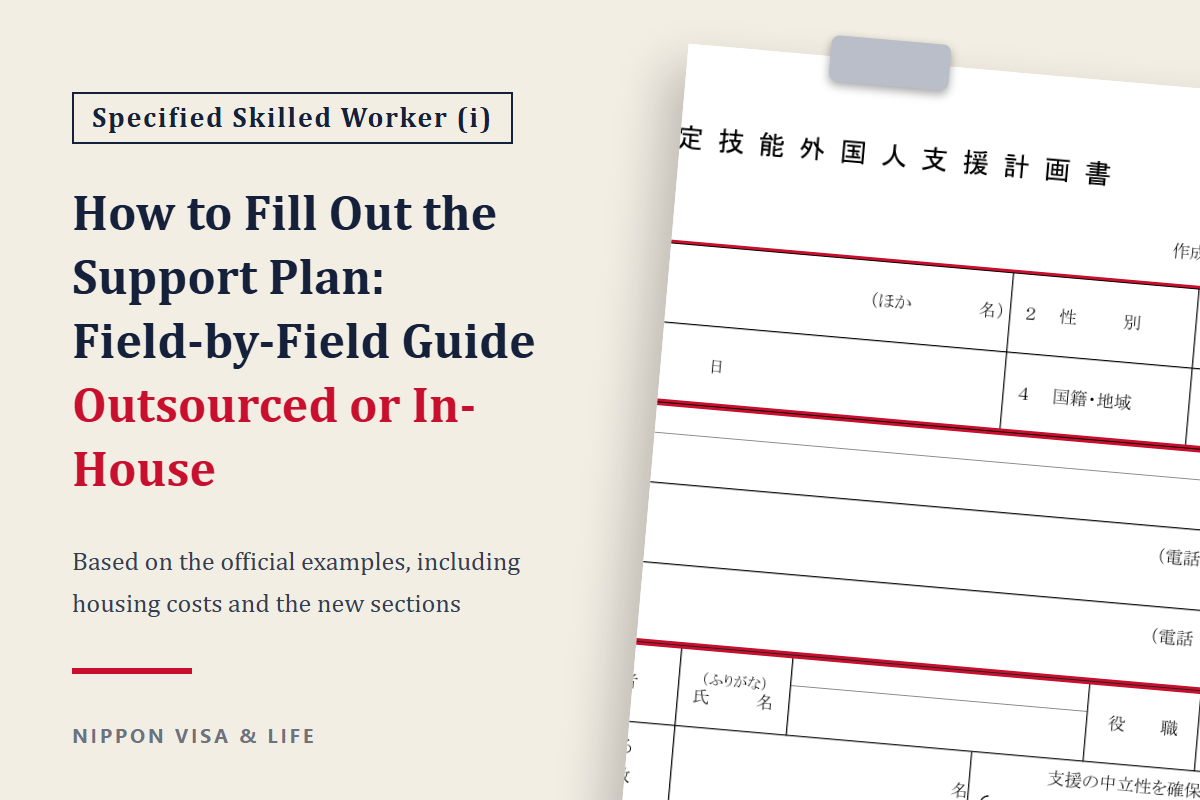


The Support Plan for Specified Skilled Worker (i) (特定技能1号) (Reference Form No. 1-17) is a document submitted with an application for a Certificate of Eligibility (在留資格認定証明書交付申請) (certification) and an application for Permission to change status of residence (在留資格変更許可申請) (change). From April 1, 2025, a new section (V) was added, in which you check and fill in the coexistence measures of the city, ward, town, or village. The costs of mandatory support, including the outsourcing fee paid to a registered support organization, cannot be charged to the foreign national.
The Immigration Services Agency (ISA) publishes the form and three examples (full outsourcing, in-house support, and multiple persons). You can fill out the form based on the examples, but people often get stuck on the following four points.
- The fields you fill in change depending on whether you outsource all support to a registered support organization or provide support in-house
- How to fill in “Planned implementation” and “Outsourced or not” in the support details (IV)
- Explaining housing costs, online interviews, and the coexistence measures section
- Preparing the Japanese version and the translated version, and the foreign national’s signature
How to write the employment contract and the employment conditions document is explained in a separate article.
The contents were checked on October 12, 2026 against the forms, examples, and operational guidelines of the Immigration Services Agency (ISA).
First: When and Who Prepares the Support Plan, and How It Is Used
The support plan is prepared by the company that accepts the Specified Skilled Worker (i) foreign national (the specified skills affiliated organization). Even when all support is outsourced to a registered support organization, the company is, after all, the party that prepares the plan. The registered support organization can assist with the preparation as needed.
| Application | Support Plan (No. 1-17) | Explanation of the Support Outsourcing Contract (No. 1-25) |
|---|---|---|
| Certification | Required | When all support is outsourced to a registered support organization |
| Change | Required | When all support is outsourced to a registered support organization |
| Extension | Not listed in the checklist | Not listed in the checklist |
The checklist (Table 1, revised October 1, 2026) states that the support plan requires “the applicant’s signature” and “being written in a language the applicant can sufficiently understand.” Table 1 for extension does not include the support plan.
The company is obligated to carry out the support written in the plan. All mandatory support must be written in the plan and all of it must be carried out. Even optional support, which is not mandatory, becomes an obligation once it is written in the plan. However, for people changing from Technical Intern Training (ii) or similar, support that is clearly unnecessary given their situation is excluded.
The form is an Excel file and is available on the ISA’s “List of application and notification forms related to Specified Skilled Worker.” As a rule, seals are not required on application documents. For an example of all the documents for an application, see the following article.
→ Required Documents for Specified Skilled Worker “Nursing Care” | Attachments and Where to Submit for Certificate of Eligibility, Change, and Extension [2026 Edition](https://kisaragi-office.com/immigration_journal/en/archives/5167)
(Sources: List of application and notification forms related to Specified Skilled Worker, Table 1 (for certification, revised October 1, 2026), Table 1 (for change, revised October 1, 2026), Table 1 (for extension, revised October 1, 2026), Operational Guidelines on Support for Specified Skilled Worker (i), Operational Guidelines on Accepting Specified Skilled Workers)
Fields That Differ Between Full Outsourcing and In-House Support
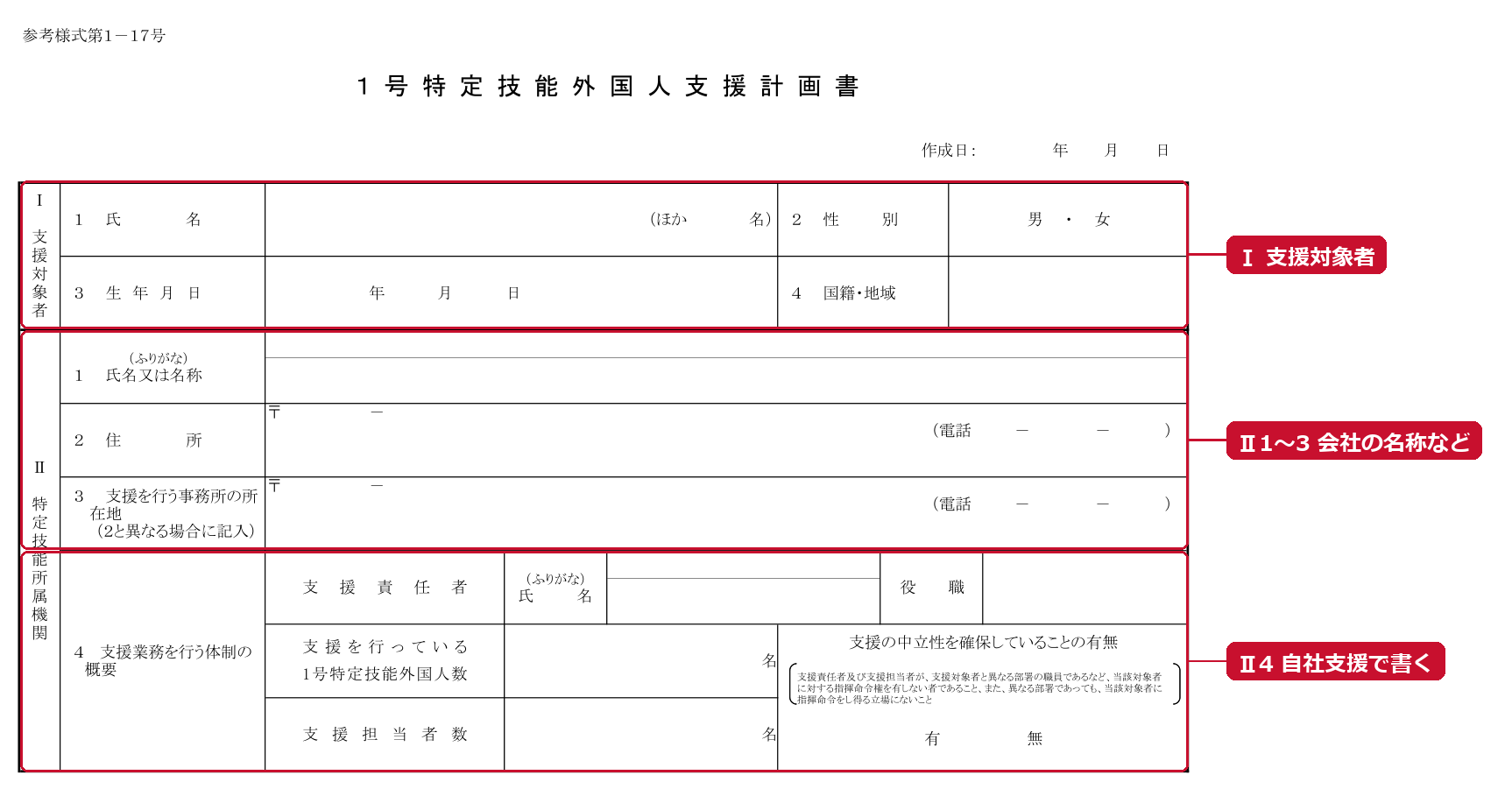
The form consists of I Person receiving support, II Specified skills affiliated organization, III Registered support organization, IV Support details, V Coexistence measures, and the signature section at the end. The fields you fill in change as follows depending on whether you use full outsourcing or in-house support.
| Field | Full outsourcing | In-house support (including partial outsourcing) |
|---|---|---|
| I Person receiving support | Fill in | Fill in |
| II 1–3 Company name, address, etc. | Fill in (in the example, 3 is not required) | Fill in (3 only if different from 2) |
| II 4 Outline of the system for support work | Do not fill in | Fill in |
| III Registered support organization | Fill in | Do not fill in |
| IV Support details 1–9 | Fill in (“Outsourced or not” is “No” for all) | Fill in |
| V Coexistence measures and signature section | Fill in | Fill in |
The first page of the form is shown in the image below. II 4 is a field you fill in only for in-house support.
Sources: Immigration Services Agency, “Reference Form No. 1-17 Support Plan for Specified Skilled Worker (i)”
For Full Outsourcing (III)
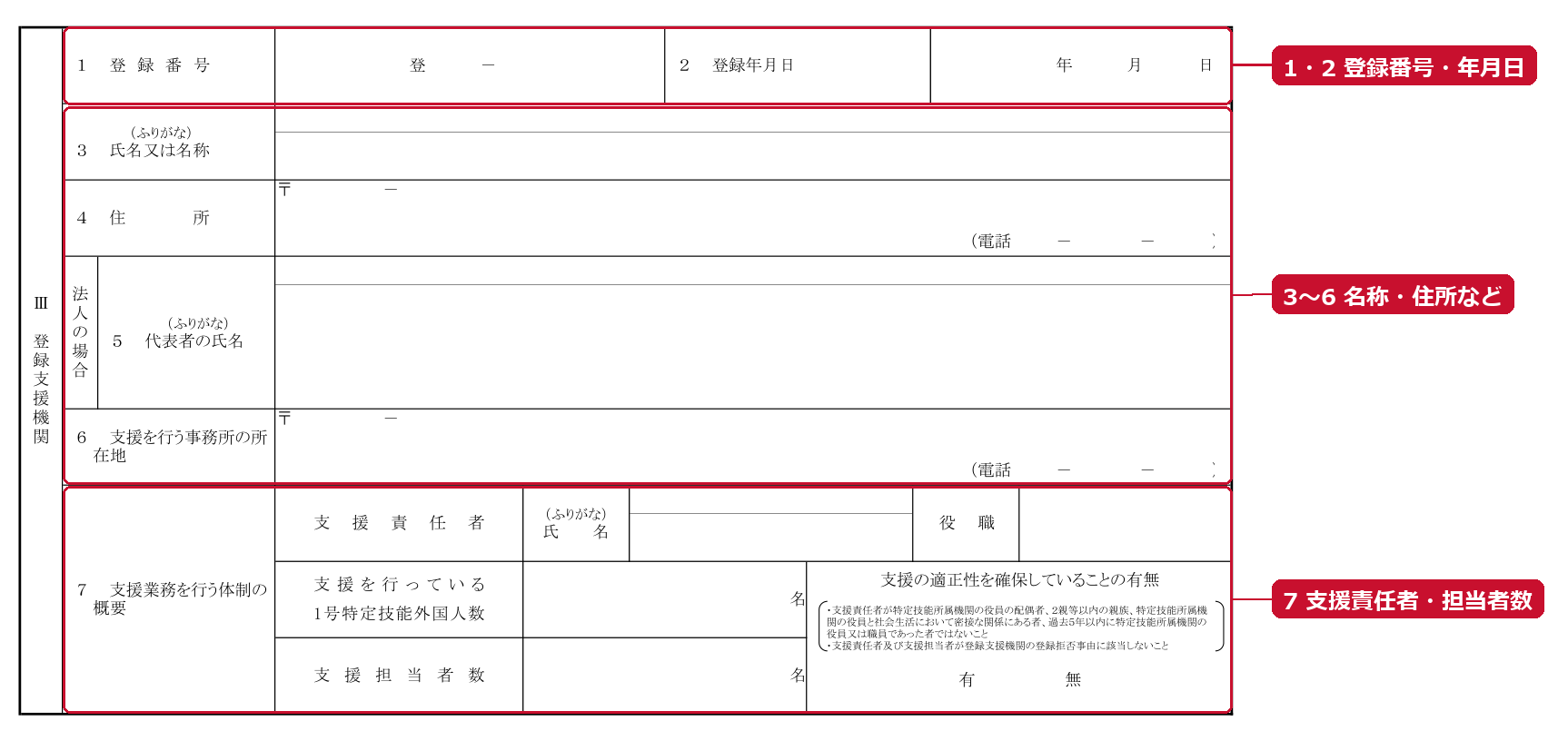
In III, write the information of the registered support organization you outsource to: the registration number, registration date, name, address, representative, office providing support, support manager, number of support staff, and so on. The example advises writing, as the registration date, the “planned start date of support work” shown in the register.
The III fields are shown in the image below. 1 and 2 are the registration number and registration date, 3–6 are the name, address, representative, and office providing support, and 7 covers the support manager, the number of support staff members, and so on.
Sources: Immigration Services Agency, “Reference Form No. 1-17 Support Plan for Specified Skilled Worker (i)”
A registered support organization cannot further outsource the support it has been entrusted with to another party. For this reason, “Outsourced or not” in IV is “No” for all items. You also cannot split all support among multiple registered support organizations.
For In-House Support (II 4)
In II 4, write the name and position of the support manager, the number of support staff, whether support is neutral, and so on. Neutrality means that the support manager and support staff are not in a position to give work instructions to the person they support.
To provide support in-house, the company must meet the standards for a support system. For example, it must have a record of properly accepting foreign nationals with working statuses or similar in the past 2 years, and appoint a support manager and at least 1 support staff member for each workplace. Documents showing these standards are submitted according to another checklist (Table 2). Only companies that meet these standards can outsource part of the support to outside parties.
Field I and Applications for Multiple Persons
In I, write the name, sex, date of birth, and nationality. When applying at the same time for people whose support details are the same, you can write “as per the attached list” in the name field and attach a list. The list needs fields for the signature date and signature. Even in this case, give the plan to every person.
(Sources: Reference Form No. 1-17 (form), Example: full outsourcing, Example: in-house support, Example: multiple persons, Operational Guidelines on Accepting Specified Skilled Workers, Operational Guidelines on Support for Specified Skilled Worker (i))
How to Fill In the Support Details (IV): Common Rules
Each of IV 1–9 is filled in with “Planned implementation,” “Outsourced or not,” and “Person in charge” (the implementation method field exists for 1–4 and 9). The ISA’s page counts mandatory support as 10 items. Their correspondence with the 9 fields of the form is as follows.
| 10 items of mandatory support | Field of the form |
|---|---|
| 1 Pre-arrival guidance | IV 1 |
| 2 Transportation at entry and departure | IV 2 |
| 3 Securing housing and support for contracts needed for daily life | IV 3 |
| 4 Life orientation | IV 4 |
| 5 Accompanying to public procedures, etc. | IV 4 b |
| 6 Providing opportunities to learn Japanese | IV 5 |
| 7 Responding to consultations and complaints | IV 6 |
| 8 Promoting exchange with Japanese people | IV 7 |
| 9 Support for changing jobs (in case of workforce reduction, etc.) | IV 8 |
| 10 Regular interviews and reporting to government agencies | IV 9 |
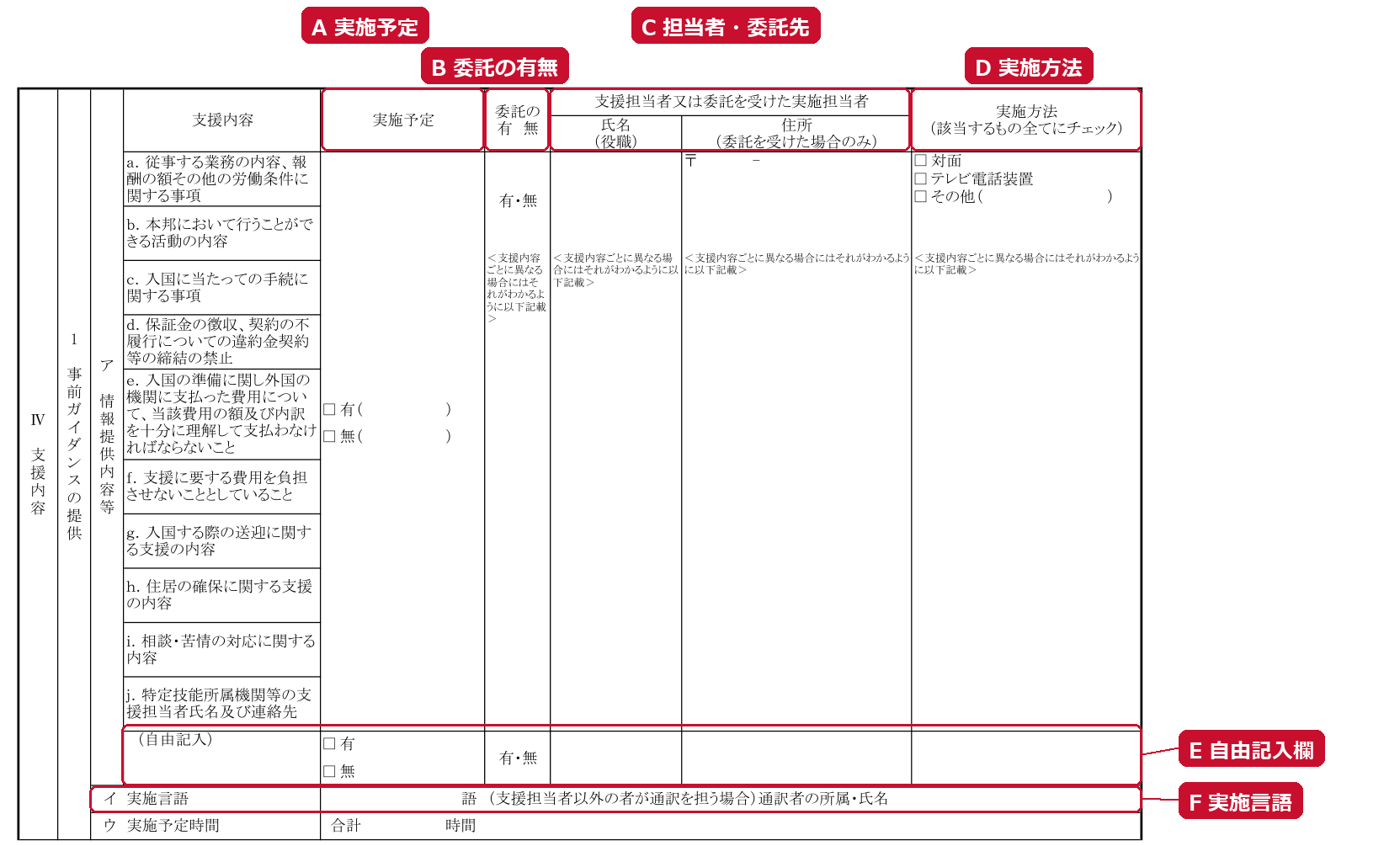
The image below uses the IV 1 (pre-arrival guidance) page to show where the fields are. A Planned implementation, B Outsourced or not, C Person in charge (the outsourcing partner for partial outsourcing), and E the free-entry field are in every item. D Implementation method is in 1–4 and 9, and F Language of implementation is in 1, 4, 6, and 9.
Sources: Immigration Services Agency, “Reference Form No. 1-17 Support Plan for Specified Skilled Worker (i)”
Planned Implementation: Timing for “Yes,” Reason for “No”
If “Yes,” briefly write when it will be carried out. If “No,” write the reason for not carrying it out in parentheses. The reason should be a specific fact showing that it is unnecessary. Examples:
- Yes (within 1 week after permission to change status of residence)
- No (because the person is already staying in Japan and has no plans to enter Japan)
- No (because a bank account in the person’s own name has already been opened and will continue to be used)
- No (because our company has no permit or notification for employment placement business)
The “Outsourced or Not” and “Person in Charge” Fields
“Outsourced or not” is “Yes” only when the company outsources part of the support to a third party. It is “No” when the company does it in-house and when all support is outsourced to a registered support organization.
In the person-in-charge field, for in-house support and full outsourcing, write the name and position of the support staff member. When outsourcing part of the support, write the name and location of the outsourcing partner. For IV 9, write the support manager or a support staff member.
Language of Implementation and the Free-Entry Field
The language-of-implementation field is in IV 1, 4, 6, and 9. These four (for 9, the interviews) must be carried out in a language the person can sufficiently understand. When someone other than the support staff interprets, also write the interpreter’s affiliation and name.
In the free-entry field, write optional support and support based on coexistence measures. Support written there becomes an obligation to carry out.
(Sources: Support for Specified Skilled Worker (i) and Registered Support Organizations, Reference Form No. 1-17 (form), Example: full outsourcing, Operational Guidelines on Support for Specified Skilled Worker (i))
Key Points for Each of IV 1–9
The table below summarizes each field together with the time and frequency guidelines in the operational guidelines.
| Field | What to write | Guideline / caution |
|---|---|---|
| 1 Pre-arrival guidance | Working conditions, activities, entry procedures, ban on deposits and penalties, fees paid to foreign organizations, not charging costs, transportation, housing and consultation system, contact information of support staff (a–j) | Carry out before the application. About 3 hours is considered necessary |
| 2 Transportation | Arrival airport and transportation method, planned departure airport | At departure, accompany the person up to the security checkpoint |
| 3 Housing and contracts | How housing is secured (a–c), outline of the housing, bank account, mobile phone, utilities | Living space of at least 7.5㎡ per person |
| 4 Life orientation | Daily life in general, notification procedures and accompanying, where to consult, medical institutions, disaster and crime prevention, legal protection (a–f) | At least 8 hours or more is considered necessary |
| 5 Japanese learning | Information on Japanese classes, materials and online courses, opportunities for lessons (a–c) | By any of the methods, according to the person’s wishes |
| 6 Consultations and complaints | How to respond, response hours for each day of the week, how to contact in emergencies | At least 3 days a week on working days and at least 1 day a week on days off |
| 7 Promoting exchange | Information on local exchange places and neighborhood associations, information on local events | Accompany as needed |
| 8 Support for changing jobs | Support in finding the next employer (a–d), paid leave (e), information on administrative procedures (f), alternative support provider (g) | When the company terminates the contract for its own reasons |
| 9 Interviews and reporting | Interviews with the person and their supervisor, providing information again, reporting to the Labour Standards Inspection Office and the Regional Immigration Services Bureau | Each at least once every 3 months |
1 Pre-Arrival Guidance
Pre-arrival guidance is carried out before the application for certification (for people already in Japan, before the application for change). It is carried out face to face or by video call, etc., after confirming the person’s identity. Only mailing documents or sending emails is not accepted. It is also required again when a person changes jobs and changes to Specified Skilled Worker (i).
The guidelines consider it necessary to carry it out for about 3 hours. Even when the same company continues to employ a technical intern trainee or similar, guidance of less than 1 hour is not considered properly carried out. After it is carried out, have the person sign the confirmation of pre-arrival guidance (Reference Form No. 5-9) and keep it at the office that provides support.
2 Transportation at Entry and Departure
At entry, transport the person between the airport, etc. and the workplace (or housing). At departure, accompany the person up to the airport security checkpoint. When a person already in Japan changes status, transportation at entry does not apply.
Care is needed when a registered support organization transports people in a company car or similar. Without a permit under the Road Transportation Act, it is highly likely to be a violation (except for transportation carried out together with daily life support, etc.), so the guidelines say to use public transportation.
3 Securing Housing and Contracts Needed for Daily Life
Items a–c of A are methods of securing housing. a is the person renting it, b is the company renting it and providing it, and c is the company providing company housing it owns.
In d, write an outline of the housing: whether it is secured at the time of application, the size of the living space, and the number of people living together (including the person). The living space must be at least 7.5㎡ per person. Even when a person changes from Technical Intern Training (ii) or similar and continues to live in company housing the company has already secured, the bedroom must be at least 4.5㎡ per person. A loft is not included in the living space.
B is assistance with contracts for a bank account, mobile phone, electricity, water, and so on. For people changing from Technical Intern Training (ii) or similar who already have an account, etc., and clearly do not need it, it does not have to be carried out.
4 Life Orientation
Carry it out without delay after entry (for people changing status, after permission to change). The guidelines consider at least 8 hours or more necessary. Even for people whom the same company continues to employ and whose living environment does not change, less than 4 hours is not considered appropriate.
Accompanying to “notifications and other procedures” in b corresponds to “Accompanying to public procedures, etc.” in the 10 items of mandatory support. After it is carried out, have the person sign the confirmation (Reference Form No. 5-8) and keep it.
5–7 Japanese Learning, Consultations, and Exchange
For Japanese learning, support the person using the method among a–c that matches their wishes. Mark methods you will not use as “No” and write the reason.
For consultations and complaints, according to the work pattern, you are required to respond on at least 3 working days and at least 1 day off within a week. You are required to be able to respond outside working hours (at night) as well. A system that can receive contact at any time in emergencies is described as “desirable.”
8 Support for Changing Jobs
This is support for when the company terminates the contract for its own reasons (workforce reduction, bankruptcy, etc.). In addition to any of a–d, both paid leave in e and information on administrative procedures in f must be provided. If you do not have a permit for employment placement, etc., mark d as “No” and write the reason. A company that provides all support in-house secures someone to provide support in its place in case of bankruptcy, etc. (g).
9 Regular Interviews and Reporting to Government Agencies
Hold interviews with the person and with the person in a supervisory position over them (such as a superior), each at least once every 3 months. In planned implementation, write the months of the interviews (example: February, May, August, November). After the interviews, prepare the regular interview report (Reference Forms No. 5-5 and No. 5-6).
(Sources: Operational Guidelines on Support for Specified Skilled Worker (i), Reference Form No. 1-17 (form), Example: full outsourcing, Example: in-house support)
The Housing Cost Field (IV 3): How to Write the Amount and the Explanation of an “Appropriate Amount”
If you collect housing costs, write ① whether you collect them, ② the amount per month, ③ whether the property is owned or rented, and ④ an explanation that the amount is appropriate. ②–④ are written only when ① is “Yes.”
On the form, these are fields ① to ④ on the right side of d (outline of housing) in IV 3 (see the image below).

Sources: Immigration Services Agency, “Reference Form No. 1-17 Support Plan for Specified Skilled Worker (i)”
For Rented Properties
The upper limit is the cost of renting divided by the number of Specified Skilled Workers living there. The cost of renting includes management and common area fees. It does not include security deposits, key money, guarantee deposits, brokerage fees, renewal fees, early termination fees, and so on.
Here is a calculation example (the figures are hypothetical for explanation). Suppose 3 people live in a room rented for 120,000 yen per month, including management and common area fees. The guideline upper limit per person is 120,000 yen ÷ 3 people = 40,000 yen. In ④, it is easier to understand if you write the cost of renting, the number of residents, and the result of the division.
For Owned Properties
Calculate a reasonable amount based on the actual costs of construction, renovation, etc., the useful life of the property, the number of residents, and so on. Do not include the cost of buying or preparing the land. The company must not make a profit by renting out company housing.
Other Cautions
- When regularly collecting for furniture, home appliances, and other equipment, or for fire insurance, etc., the conditions include that the benefit belongs to the person and that the person understands and agrees
- When the person rents the property themselves (a), the security deposit and key money are, as a rule, paid by the person. However, the fee of a rent guarantee company is paid by the company, etc.
- When deducting housing costs in the attachment “Payment of wages” of the employment conditions document, check that it does not conflict with the monthly amount in the plan
(Sources: Operational Guidelines on Support for Specified Skilled Worker (i), Reference Form No. 1-17 (form))
When Holding Regular Interviews Online (IV 9 and the Signature Section at the End)
Interviews can be held online if the person being interviewed agrees. Check “face to face” or “online” in the implementation method of IV 9. The person’s consent is confirmed by what is written in IV 9 and the signature section at the end (the preference for online or face to face). The supervisor’s consent may be confirmed with any form.
When Interviews Must Be Face to Face
- When the other person does not agree to online interviews, or wishes to meet face to face
- When problems with treatment, etc., or the involvement of a third party are suspected in an online interview
Record online interviews and keep the recordings for at least 1 year from the day the employment contract ends. Show them when requested by the Regional Immigration Services Bureau.
The Difference Between Obligations and “Desirable”
The guidelines describe the following points as “desirable.” They are not described as obligations.
- Holding the first interview after acceptance, and the first interview after the interviewer changes, face to face
- Even when using online interviews, holding them face to face at least once a year
Interviews are held by the support manager or a support staff member. Except in the case of full outsourcing, they cannot be outsourced to a third party. An interpreter or similar may attend. If you only switch interviews to online in a plan already being carried out, a notification of change is not required. However, keep the document confirming consent.
(Sources: Operational Guidelines on Support for Specified Skilled Worker (i), Reference Form No. 1-17 (form))
How to Fill In V Coexistence Measures (and the Difference from the Confirmation of Cooperation)
V is a section added in the system revision of April 1, 2025. It is not in older explanations or forms.
Check and write the coexistence measures carried out by the city, ward, town, or village where the workplace is located and where the person lives. Coexistence measures are efforts such as administrative services, rules on transportation and garbage disposal, medical care, disaster prevention, local events, and Japanese classes. Things unrelated to support, such as information for tourists, are not included.
The V fields are shown in the image below. A is the city, ward, town, or village of the workplace location, where you also write the date and method of confirmation. B is the place of residence: if it is the same, choose “same as above”; if it is a different municipality, write its name and the date and method of confirmation.

Sources: Immigration Services Agency, “Reference Form No. 1-17 Support Plan for Specified Skilled Worker (i)”
| Item | How to write |
|---|---|
| Name of city, ward, town, or village | Location of the workplace and place of residence. If the place of residence is the same, “same as above” |
| Date of confirmation | A date on or after April 1, 2025 and on or before the date of the first application for residence |
| Method of confirmation | Basically, viewing the website |
| Remarks | If there are multiple workplaces, write those other than the main one here |
Support based on coexistence measures is written in the free-entry field of each item if it relates to IV 1–9. Example: “If the person asks about learning Japanese, inform them of the Japanese classes held by the city.” Other efforts are written in the remarks field of V.
The Confirmation of Cooperation Is a Separate Document
The confirmation of cooperation is a document submitted to the city, ward, town, or village and is separate from the support plan. When accepting for the first time, submit it after concluding the employment contract and before the application for certification or change. It is submitted to the city, ward, town, or village of the workplace location and the place of residence, which are the same as those written in V. In the application for residence, it is enough to write the submission date and where it was submitted in the application form (for the affiliated organization). You do not need to submit a copy to immigration.
(Sources: Cooperation on local coexistence measures under the Specified Skilled Worker system, Q&A on the same, Operational Guidelines on Support for Specified Skilled Worker (i), Operational Guidelines on Accepting Specified Skilled Workers)
Language and Signature: Prepare Japanese and Translated Versions, Explain, Then Get the Signature
The support plan is prepared both in Japanese and in a language the person can sufficiently understand. Then give a copy to the person, explain the contents, and get their signature showing they understood. The language the person can understand is not limited to their native language, but it must be a language in which they can fully understand the contents.
Prepare the Japanese version using the current form (Reference Form No. 1-17) in the ISA’s list of forms. Forms may be revised, so check the latest version just before applying.
The ISA has translated forms and similar documents that the person needs to understand well and sign into English and 9 other languages and publishes them. The languages are Vietnamese, Tagalog, Indonesian, Thai, Myanmar, Khmer, Mongolian, Nepali, and Chinese. The support plan is one of them. Even for languages without a translated form, the plan must be prepared in a language the person can sufficiently understand.
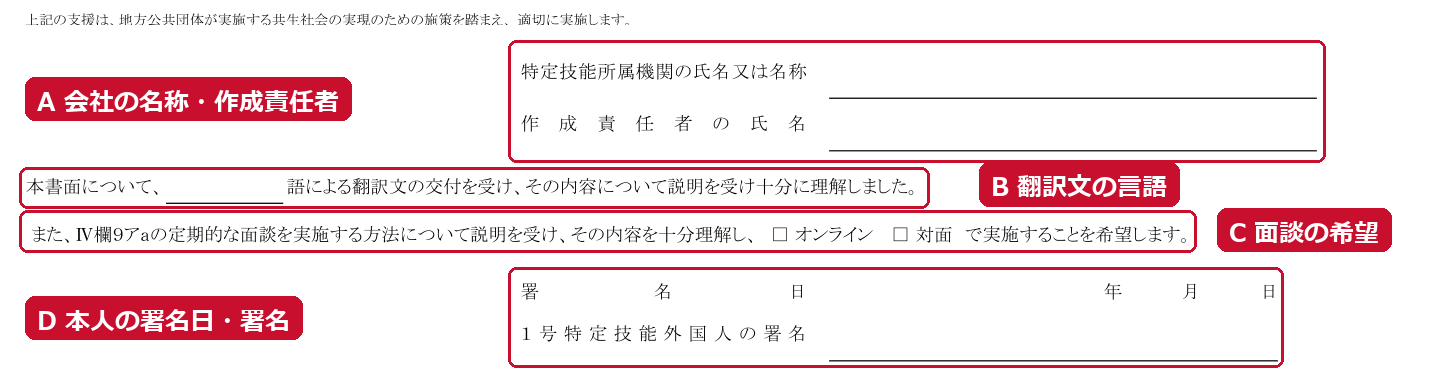
The contents of the signature section at the end are as follows.
- Company: that it will provide support based on coexistence measures, and that it translated, handed over, and explained the plan. The company name and the name of the person responsible for preparation
- Person: a field to receive an explanation of the interview method and choose online or face to face. A field for which language’s translation they received and that they received an explanation and understood. Signature date and signature
In the image, A is the company’s field, and B to D are the person’s fields.
Sources: Immigration Services Agency, “Reference Form No. 1-17 Support Plan for Specified Skilled Worker (i)”
(Sources: Operational Guidelines on Support for Specified Skilled Worker (i), List of application and notification forms related to Specified Skilled Worker, Reference Form No. 1-17 (form))
Checks Before Submission, and When You Change the Plan After Submission
Checks Before Submission
- Did you fill in III for full outsourcing, or II 4 for in-house support?
- Did you write a reason in parentheses for every “No” field?
- Is “Outsourced or not” “Yes” only for partial outsourcing?
- Do the monthly housing cost and its explanation match the employment conditions document?
- Did you write the name of the city, ward, town, or village, the date of confirmation, and the method of confirmation in V?
- In the signature section, are the preferred interview method and the language of translation filled in?
- For full outsourcing, did you attach the explanation of the support outsourcing contract (No. 1-25)?
In the explanation (No. 1-25), write the name of the registered support organization (as in the register) and its registration number, the contract date, the outsourcing fee (monthly amount per person), the contract period, and so on.
When You Change the Plan After Submission
When you change the support plan, except for minor changes, submit a notification within 14 days from the date of the change (notification concerning change of the support plan, Reference Form No. 3-2). Examples where a notification is required:
- A change in the position of the support manager, or a decrease in the number of support staff
- A change in support details, changing planned implementation to “No,” or a change in whether support is outsourced or in the outsourcing partner
- A change in the language of implementation (IV 1, 4, 6, 9), a change in the planned hours of life orientation, or a change in the timing of interviews
- A change in the coexistence measures in V, or in the coexistence measure efforts written in the free-entry field
When you change the registered support organization or switch to in-house support, a notification of the support outsourcing contract is also required. The overall picture of notifications is explained in the following article.
Who Prepares It and Who Submits It
The company prepares the plan, and the registered support organization can assist with its preparation. Who can submit applications for residence on the person’s behalf is explained in the following article.
→ How to get and renew the Application Agent Certificate | Application form, required documents, and what registered support organizations can submit [Updated for the revised Gyoseishoshi Lawyer Act](https://kisaragi-office.com/immigration_journal/en/archives/4582)
How to fill out the form may change depending on individual circumstances. If you are unsure, consult the Regional Immigration Services Bureau where you will submit, or a professional such as a gyoseishoshi lawyer.
(Sources: Operational Guidelines on Accepting Specified Skilled Workers, Reference Form No. 1-25 example, Q&A on cooperation on local coexistence measures under the Specified Skilled Worker system)
Frequently Asked Questions
Q Do we also submit the support plan at extension? A Table 1 for extension, revised October 1, 2026, does not include the support plan. When you change the contents of the plan, except for minor changes, submit a notification within 14 days.
Q For people changing from Technical Intern Training, can we mark transportation at entry and the housing field as “No”? A Transportation at entry does not apply to people already in Japan. Housing and bank accounts can also be marked “No” with a reason if they are clearly unnecessary. However, if the person has to leave their housing, support for securing new housing is required.
Q Can all regular interviews be online? A If the other person agrees, they can be held online. If face to face is requested, hold them face to face. A face-to-face first interview and face-to-face interviews at least once a year are described as “desirable.”
Q Can the outsourcing fee to the registered support organization be deducted from the person’s salary? A No. The costs of mandatory support, including the outsourcing fee to the registered support organization, must not be charged to the person directly or indirectly.
(Sources: Table 1 (for extension, revised October 1, 2026), Operational Guidelines on Support for Specified Skilled Worker (i), Operational Guidelines on Accepting Specified Skilled Workers, Reference Form No. 1-17 (form))
Summary
- Fill in III for full outsourcing and II 4 for in-house support. With full outsourcing, “Outsourced or not” is “No” for all items.
- For planned implementation, write the timing for “Yes” and a specific reason for “No.”
- Pay attention to the housing cost upper limit, consent to online interviews, and the coexistence measures section (V).
- Prepare the plan in Japanese and in a language the person can understand, and get their signature after explaining it.
Primary Sources Referenced in Article Creation
- Immigration Services Agency “List of application and notification forms related to Specified Skilled Worker”
- Reference Form No. 1-17 Support Plan for Specified Skilled Worker (i) (form)
- Reference Form No. 1-17 example (full outsourcing)
- Reference Form No. 1-17 example (in-house support)
- Reference Form No. 1-17 example (multiple persons)
- Reference Form No. 1-25 Explanation of the support outsourcing contract with a registered support organization (example)
- Operational Guidelines on Support for Specified Skilled Worker (i) (partially revised April 1, 2025)
- Operational Guidelines on Accepting Specified Skilled Workers (partially revised August 20, 2026)
- Immigration Services Agency “Support for Specified Skilled Worker (i) and Registered Support Organizations”
- Immigration Services Agency “Cooperation on local coexistence measures under the Specified Skilled Worker system”
- Q&A on cooperation on local coexistence measures under the Specified Skilled Worker system
- Checklist of documents for “Specified Skilled Worker (i)” (for application for Certificate of Eligibility) Table 1 (revised October 1, 2026)
- Checklist of documents for “Specified Skilled Worker (i)” (for application for permission to change status of residence) Table 1 (revised October 1, 2026)
- Checklist of documents for “Specified Skilled Worker (i)” (for application for permission to extend period of stay) Table 1 (revised October 1, 2026)
This article is a translation of the original Japanese version.