

In Japan, the “Categories 1 to 4” for Specified Skilled Worker (特定技能) status divide the companies that employ foreign nationals (affiliated organizations, 所属機関) into 4 groups, and they mainly affect the upper limit of the permitted period of stay. On the other hand, whether a company can omit its own documents (Table 2, 第2表) when applying is decided by a standard separate from the category. The standard is “whether the company has already accepted a foreign national on Specified Skilled Worker status in the same fiscal year” and “whether it is an organization with a certain track record that is expected to accept workers properly.”
This article sets out, for company staff in charge and registered support organizations, the difference between these 2 yardsticks, how to check your company’s category, which documents can be omitted for each type of application, and points to note when omitting documents. It can also help foreign nationals who have been told by their company, “We are Category 4, so your period of stay is 1 year,” to understand how the system works.
The contents of this article were checked on October 17, 2026 against the following materials from the Immigration Services Agency (出入国在留管理庁, ISA): the lists of documents to be submitted (Table 1 revised on October 9, 2026 (Reiwa 8)), the Operational Guidelines on the Acceptance of Specified Skilled Workers, and Part 12 of the Immigration and Residence Examination Guidelines (入国・在留審査要領) (materials disclosed in response to an information disclosure request). For a detailed explanation of how the period of stay is decided, see How is the period of stay for Specified Skilled Worker (i) decided? Limits by company category, and fees that change with a one-month difference.
“Category” and “companies that can omit documents” are different yardsticks
To give the conclusion first: the category is a classification used when deciding the upper limit of the period of stay, while omitting documents is decided by the “certain standards” in the Operational Guidelines and the lists of documents to be submitted. The names are similar and the conditions overlap, but check them as separate things.
| Point of comparison | Categories 1 to 4 | “Certain standards” for omitting documents |
|---|---|---|
| Where it is written | Part 12 of the Immigration and Residence Examination Guidelines (internal examination standards of the immigration authorities) | Operational Guidelines on the Acceptance of Specified Skilled Workers, lists of documents to be submitted |
| What it affects | The upper limit of the permitted period of stay | Omitting the company’s documents (Table 2) and some of the documents in Table 1 |
| Main conditions | Whether there has been a written guidance and recommendation or an improvement order, a pledge to use electronic applications and notifications, types such as listed companies, whether the company has been in excess of liabilities, and whether it is a corporation or a sole proprietor | Whether the company has already accepted a worker in the same fiscal year, or “no written guidance and recommendation or improvement order + making applications by online application and notifications electronically + a type such as a listed company” |
| Treatment of electronic applications | Pledging to use electronic applications and electronic notifications (if support is entrusted to a registered support organization, the registered support organization also pledges) | Actually making applications for residence by online application and the various notifications by electronic notification |
Category 1 and document omission (Table 2-1) cover almost the same types, such as listed companies. However, document omission requires actually using online applications and electronic notifications. The Operational Guidelines state that if user registration has not been completed, the company may not meet the certain standards, and omission may not be allowed.
Note that applications for other statuses of residence, such as Engineer/Specialist in Humanities/International Services (技術・人文知識・国際業務), also have “Categories 1 to 4.” These are classifications for dividing the documents to be submitted, and their standards are different from those for Specified Skilled Worker. Do not apply explanations of the categories for other statuses of residence to Specified Skilled Worker.
(Sources: Immigration Services Agency, “Operational Guidelines on the Acceptance of Specified Skilled Workers (Main Text)”, Immigration Services Agency, “Status of Residence ‘Engineer/Specialist in Humanities/International Services'”, Immigration and Residence Examination Guidelines, Part 12 (2026 (Reiwa 8) edition, materials disclosed in response to an information disclosure request))
Criteria for Categories 1 to 4
The Examination Guidelines divide the categories as follows. Apply them in order starting with Category 1, and if your company does not fit, look at the next category.
| Category | Organizations that fall under it (summary) |
|---|---|
| Category 1 | An organization that has not received a written guidance and recommendation or an improvement order in the past 3 years, has pledged to use electronic applications and electronic notifications, and falls under any of the following: (1) a company listed on a stock exchange in Japan (2) a mutual company engaged in the insurance business (3) an innovation-creating company (4) a company, etc. that meets certain conditions (5) an organization or individual whose withholding tax amount for the previous year was 10,000,000 yen or more (6) a corporation that has a record of 3 years of continuous acceptance as an affiliated organization of Specified Skilled Workers and has not been in excess of liabilities in the past 3 years |
| Category 2 | An organization that falls under neither Category 1 nor Category 4, has not received a written guidance and recommendation or an improvement order in the past 3 years, and has not been in excess of liabilities in the past 3 years (there is also 1 additional requirement that has not been made public) |
| Category 3 | A corporation that falls under none of Categories 1, 2, and 4 |
| Category 4 | A sole proprietor that does not fall under Category 1 or 2. Or a corporation that does not fall under Category 1 and has received a written guidance and recommendation or an improvement order in the past 3 years, etc. (there are also other requirements that have not been made public) |
In the disclosed Examination Guidelines, some of the requirements for Category 2 and Category 4 are blacked out (not disclosed). For this reason, you may not be able to determine whether your company is Category 2 or 3 from published materials alone. If you are unsure, consult a specialist such as a registered support organization or a gyoseishoshi lawyer (行政書士).
The Examination Guidelines also define the meaning of 2 terms.
- Past 3 years: The period from the date 3 years before the application up to the date of application.
- Record of 3 years of continuous acceptance: This applies when, on the date of application, 1 foreign national on Specified Skilled Worker status has continued an employment contract with the same company for 3 years or more. It also applies when the employment contracts of several people, each lasting less than 3 years, have continued without a break for 3 years or more in total.
(Source: Immigration and Residence Examination Guidelines, Part 12 (2026 (Reiwa 8) edition, materials disclosed in response to an information disclosure request))
Steps to check your company’s category
It is easier to sort out your company’s situation if you check it in the following order. What you check here can also be used directly when deciding whether you can omit documents (the next heading).
- Has the company received a written guidance and recommendation or an improvement order in the past 3 years? A corporation that has received one may fall under Category 4.
- Does the company fall under any of the 6 types? These are: listed companies and mutual companies engaged in the insurance business, innovation-creating companies, companies, etc. that meet certain conditions, a withholding tax amount of 10,000,000 yen or more, and a record of 3 years of continuous acceptance (with no excess of liabilities).
- Will the company use electronic applications and electronic notifications? For Category 1, a pledge to use them is a requirement. To omit documents, the company must actually make applications by online application and notifications electronically.
- If it does not fall under these, look at whether it has been in excess of liabilities in the past 3 years and whether it is a corporation or a sole proprietor, to see which of Categories 2 to 4 it is closest to.
The 11 certifications for “companies, etc. that meet certain conditions”
For the type “companies, etc. that meet certain conditions,” the Immigration Services Agency lists the following 11 certifications, registrations, and so on. If the company has received any of them, it falls under this type. A copy of the certificate or similar document is used as proof.
| Ministry or agency in charge | Certifications, registrations, etc. |
|---|---|
| Ministry of Health, Labour and Welfare | Youth Yell certification, Kurumin and Platinum Kurumin certification, Eruboshi and Platinum Eruboshi certification, Excellent Company for Safety and Health, Excellent Employment Placement Business Operator, Excellent and Appropriate Manufacturing Contractor (GJ certification), Excellent Dispatch Business Operator |
| Ministry of Economy, Trade and Industry | Certified Health & Productivity Management Outstanding Organization, Regional Future Driving Company |
| Ministry of Land, Infrastructure, Transport and Tourism | Class 1 and Class 2 on-premises business operators under the airport management regulations |
| Consumer Affairs Agency | Registered business operator under the Whistleblowing Compliance Management System Certification (Self-Declaration of Conformity Registration System) |
How to check the withholding tax amount and the 3-year acceptance record
A withholding tax amount of 10,000,000 yen or more is checked using the withholding tax amount in the summary table of withholding slips for employment income, which is part of the “Summary Table of Statutory Reports such as Withholding Slips for Employment Income” (給与所得の源泉徴収票等の法定調書合計表) for the previous year. When omitting documents, submit a copy of this summary table. Confirm the figures with the person in charge of accounting or a tax accountant.
When omitting documents on the basis of a record of 3 years of continuous acceptance, write the “application date and receipt number” or the “application date and residence card number” of the foreign national on Specified Skilled Worker status whom the company has accepted (or had accepted) for 3 years. Keeping copies of past applications makes preparation easier. Companies accepting a foreign national on Specified Skilled Worker status for the first time cannot use this type.
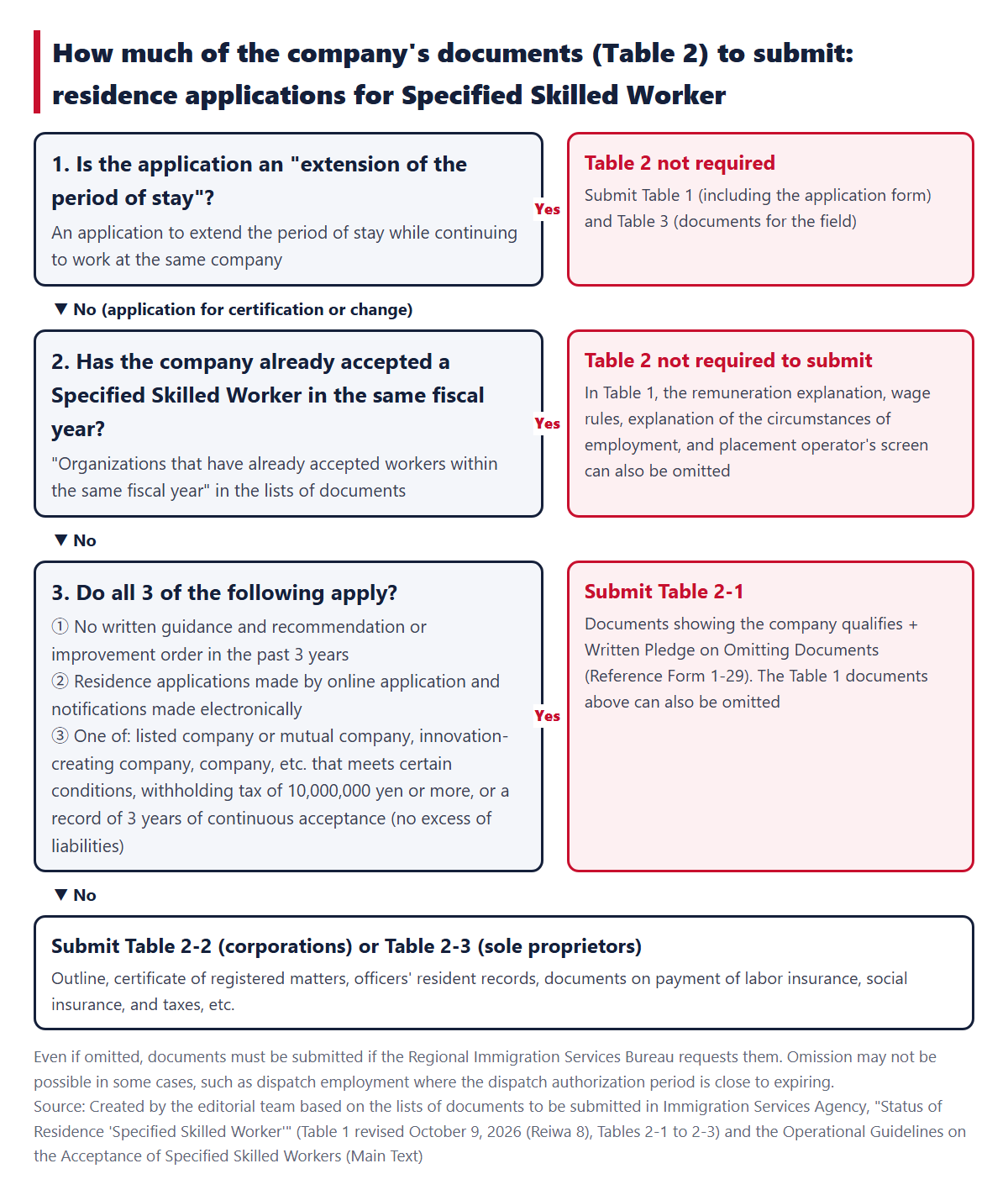
Sources: Created by the editorial team (based on the lists of documents to be submitted and the Operational Guidelines on the Acceptance of Specified Skilled Workers (Main Text) in Immigration Services Agency, “Status of Residence ‘Specified Skilled Worker'”)
The diagram above shows the order for deciding whether documents can be omitted. Check 1 to 3 in the diagram from the top, and the documents to submit are decided at the point where the answer is “yes.”
(Sources: Immigration Services Agency, “About Companies, etc. that Meet Certain Conditions”, Immigration Services Agency, “Required Documents Concerning the Affiliated Organization (Organizations with a Certain Track Record that Are Expected to Accept Workers Properly) Table 2-1”, Immigration and Residence Examination Guidelines, Part 12 (2026 (Reiwa 8) edition, materials disclosed in response to an information disclosure request))
Documents that can be omitted: it depends on the type of application and the company’s situation
How much of the company’s documents (Table 2) must be submitted is decided by the type of application and the company’s situation. For an extension of the period of stay, Table 2 itself is not required. For certification (bringing someone from overseas) and change (changing from another status of residence to Specified Skilled Worker, or changing jobs), it is as shown in the following table.
| Type of application and the company’s situation | Company documents (Table 2) | Some documents in Table 1 (remuneration, wage rules, circumstances of employment, employment placement) |
|---|---|---|
| Certification or change: the company has already accepted a foreign national on Specified Skilled Worker status in the same fiscal year | Not required to submit | Can be omitted |
| Certification or change: an organization with a certain track record that is expected to accept workers properly (Table 2-1) | Table 2-1 (proof of falling under it + written pledge) | Can be omitted |
| Certification or change: falls under neither of the above | Table 2-2 (corporations) or Table 2-3 (sole proprietors) | Submit |
| Extension | Not required | Not included in the Table 1 for extensions in the first place |
The 4 documents in Table 1 that can be omitted
In Table 1 (for certification and for change) revised on October 9, 2026 (Reiwa 8), the following 4 documents are marked “may be omitted by organizations that have already accepted workers within the same fiscal year or organizations with a certain track record that are expected to accept workers properly.”
- Explanation of the remuneration of the Specified Skilled Worker (Reference Form 1-4)
- A copy of the wage rules (if remuneration was determined by the wage rules)
- Explanation of the circumstances of employment (Reference Form 1-16)
- A printout of the employment placement business operator’s screen (if someone acted as an intermediary)
The application form, the employment contract and employment conditions document, health check documents, the support plan, documents for each field (Table 3), and so on are not subject to omission. How to fill out the employment contract is explained in Employment Contract, Employment Conditions, and Wage Payment for Specified Skilled Worker (i)|Filled-in Examples and Points to Note on Allowances and Deductions.
What to submit under Table 2-1
When omitting documents as an organization with a certain track record, instead of Table 2-2 or 2-3, submit documents showing that the company falls under one of the types and the “Written Pledge on Omitting Documents” (Reference Form 1-29).
| Type | Documents to submit |
|---|---|
| Listed companies and mutual companies engaged in the insurance business | A copy of the Shikiho (company quarterly report), or a copy of a document proving the listing |
| Innovation-creating companies | A document proving that the company is an eligible company (such as a copy of a notice of a subsidy grant decision) |
| Companies, etc. that meet certain conditions | A document proving it (such as a copy of the certificate) |
| Withholding tax amount of 10,000,000 yen or more | A copy of the Summary Table of Statutory Reports such as Withholding Slips for Employment Income for the previous year |
| Record of 3 years of continuous acceptance | Outline of the Affiliated Organization of Specified Skilled Workers (Reference Form 1-11-1; items other than “2 Financial results” may be omitted) and the application dates, receipt numbers, etc. of past applications |
If there is no document you can submit, submit the documents in Table 2-2 or 2-3.
What to submit when not omitting documents (Table 2-2 and 2-3)
Table 2-2 for corporations mainly includes the following documents. If the company can omit documents, it does not need to prepare these.
- Outline of the Affiliated Organization of Specified Skilled Workers (Reference Form 1-11-1)
- Documents on the support system when the company provides support itself (such as a list of mid- to long-term residents it has accepted, and the résumés of the support manager and support staff; for the relationship with the support plan, see How to Fill Out the Support Plan for Specified Skilled Worker (i)|Field-by-Field Guide Using the Official Examples for Full Outsourcing and In-House Support)
- Certificate of registered matters, and a copy of the resident record (certificate of residence) of officers involved in executing business
- Written pledge concerning officers (Reference Form 1-23; if there are officers who are not involved in the acceptance work)
- Certificate of payment of labor insurance premiums, etc., response form on the status of social insurance premium payments (or copies of receipts for 24 months of premiums), tax payment certificate (Part 3), and tax payment certificates for corporate inhabitant tax for the most recent 2 fiscal years
Table 2-3 for sole proprietors also lists documents based on the same idea, such as a copy of the resident record and documents on labor insurance, health insurance, pensions, and taxes. In the lists for Specified Skilled Worker (ii) as well, the rule that documents are not required because of acceptance in the same fiscal year and the conditions for Table 2-1 are written in the same way.
In addition, attached documents can also be omitted under similar standards for the periodic notification made once a year. For details, see Annual Guide to Specified Skilled Worker Notifications: Periodic Notification (April–May) and Ad Hoc Notifications (Within 14 Days).
(Sources: Immigration Services Agency, “Status of Residence ‘Specified Skilled Worker'”, List of documents to be submitted for “Specified Skilled Worker (i)”, Table 1 (for applications for a Certificate of Eligibility), Same, Table 1 (for applications for Permission to change status of residence), Same, Table 1 (for applications for Permission to extend period of stay), Required documents concerning the affiliated organization, Table 2-1, Same, Table 2-2 (corporations), Same, Table 2-3 (sole proprietors))
Points to note when omitting documents
Omitting documents is convenient, but if the conditions are not met, it can actually delay the application. The Operational Guidelines ask companies to note the following points.
- Complete user registration early. Online applications and electronic notifications require user registration in advance. It takes a certain period of time for registration to be completed. The Operational Guidelines ask companies to apply for user registration 3 months before the deadline for submitting an online application or electronic notification.
- Omission may not be possible for dispatch employment. When a worker is employed in the form of dispatch, if the expiration date of the company’s dispatch authorization period is within 7 months of the expiration date of the person’s current period of stay (for applications for certification, the date of application), omitting documents is not allowed.
- Submit omitted documents if requested. If the Regional Immigration Services Bureau requests them as necessary, the omitted documents must also be submitted.
Regarding how “the same fiscal year” is counted (in which application or notification the worker must have been accepted), no detailed explanation can be found in Immigration Services Agency materials. If you are unsure, check with the Regional Immigration Services Bureau where you will apply.
When accepting someone who is changing jobs, Table 2 is also decided based on the situation of the new company. The flow of the job change procedure is explained in Changing jobs on Specified Skilled Worker status: the change of status process, processing time, and can you work while your application is pending?.
What changes with the category: the upper limit of the period of stay
In the Examination Guidelines, the approach to the upper limit of the permitted period of stay for Specified Skilled Worker (i) is divided by category. For certification and change, the maximum is 2 years for corporations in Categories 1 to 3, and 1 year for Category 4. For extensions, the maximum is 3 years for corporations in Categories 1 to 3, and 1 year for Category 4. For sole proprietors, Categories 1 and 2 are shorter than for corporations, and Category 4 is 1 year, the same as for corporations (Category 3 is a classification only for corporations).
| Category | Certification and change (corporations) | Certification and change (sole proprietors) | Extension (corporations) | Extension (sole proprietors) |
|---|---|---|---|---|
| Category 1 | 2 years | 1 year | 3 years | 2 years |
| Category 2 | 2 years | 1 year | 3 years | 1 year |
| Category 3 | 2 years | Sole proprietors are not covered by Category 3 | 3 years | Sole proprietors are not covered by Category 3 |
| Category 4 | 1 year | 1 year | 1 year | 1 year |
The period actually granted also depends on the length of the employment contract and how much of the 5-year total remains. For details, see How is the period of stay for Specified Skilled Worker (i) decided? Limits by company category, and fees that change with a one-month difference.
(Source: Immigration and Residence Examination Guidelines, Part 12 (2026 (Reiwa 8) edition, materials disclosed in response to an information disclosure request))
Frequently asked questions
Q. Can a company accepting a foreign national on Specified Skilled Worker status for the first time be Category 1? It may qualify if it falls under a type such as listed companies, companies, etc. that meet certain conditions, or a withholding tax amount of 10,000,000 yen or more, has received no written guidance and recommendation or improvement order, and has pledged to use electronic applications and electronic notifications. It cannot use the type based on a record of 3 years of continuous acceptance. (Basis: Examination Guidelines, Part 12)
Q. Where do I check the withholding tax amount of 10,000,000 yen? Check the withholding tax amount in the summary table of withholding slips for employment income in the “Summary Table of Statutory Reports such as Withholding Slips for Employment Income” for the previous year. (Basis: Table 2-1, Operational Guidelines)
Q. When applying for a second person in the same fiscal year, are the company’s documents not required? For applications for certification or change, a company that has already accepted a foreign national on Specified Skilled Worker status in the same fiscal year is not required to submit the documents in Table 2. However, submit them if the immigration authorities request them. (Basis: lists of documents to be submitted, Operational Guidelines)
Q. Are the company’s documents required for an extension? For an extension of the period of stay, Table 2 is not required. Submit Table 1 (including the application form) and Table 3 (documents for the field). (Basis: Immigration Services Agency’s Specified Skilled Worker page)
Q. Will the immigration authorities tell the company its category? In the materials published by the Immigration Services Agency, no explanation can be found of a system for notifying companies of their category. Check your company’s situation using the steps in this article, and if you are unsure, consult a specialist.
Summary
- The “Categories 1 to 4” for Specified Skilled Worker status are classifications of companies that mainly affect the upper limit of the period of stay. Omitting documents is decided by the “certain standards” in the Operational Guidelines and the lists of documents to be submitted.
- The category is checked in this order: whether there has been a written guidance and recommendation or an improvement order, the 6 types, the pledge to use electronic applications, excess of liabilities, and whether it is a corporation or a sole proprietor. Some requirements have not been made public.
- For certification and change, if the company has already accepted a worker in the same fiscal year, Table 2 is not required to be submitted, and if it is an organization with a certain track record, Table 2-1 and the written pledge are sufficient. For extensions, Table 2 is not required.
- To omit documents, user registration for online applications and electronic notifications is required. Also note the exception for dispatch employment and that you must submit documents if the immigration authorities request them. If you are unsure about your company’s case, consult a specialist.
Primary Sources Referenced in Article Creation
- Immigration Services Agency, “Status of Residence ‘Specified Skilled Worker'”
- Immigration Services Agency, “List of documents to be submitted for ‘Specified Skilled Worker (i)’ (for applications for a Certificate of Eligibility) Table 1 (revised October 9, 2026 (Reiwa 8))”
- Immigration Services Agency, “List of documents to be submitted for ‘Specified Skilled Worker (i)’ (for applications for Permission to change status of residence) Table 1 (revised October 9, 2026 (Reiwa 8))”
- Immigration Services Agency, “List of documents to be submitted for ‘Specified Skilled Worker (i)’ (for applications for Permission to extend period of stay) Table 1 (revised October 9, 2026 (Reiwa 8))”
- Immigration Services Agency, “Required Documents Concerning the Affiliated Organization (Organizations with a Certain Track Record that Are Expected to Accept Workers Properly) Table 2-1”
- Immigration Services Agency, “Required Documents Concerning the Affiliated Organization (Specified Skilled Worker (i), Corporations) Table 2-2”
- Immigration Services Agency, “Required Documents Concerning the Affiliated Organization (Specified Skilled Worker (i), Sole Proprietors) Table 2-3”
- Immigration Services Agency, “About Companies, etc. that Meet Certain Conditions”
- Immigration Services Agency, “Operational Guidelines on the Acceptance of Specified Skilled Workers (Main Text)”
- Immigration Services Agency, “Status of Residence ‘Engineer/Specialist in Humanities/International Services'”
- Immigration and Residence Examination Guidelines, Part 12 (2026 (Reiwa 8) edition, materials disclosed in response to an information disclosure request)
This article is a translation of the original Japanese version.