This article was written by the NIPPON VISA & LIFE editorial team based on information from public organizations such as the national government and local governments. Rules and fees may differ depending on the city, ward, town or village where you live.
When you look for a job in Japan, you can use Hello Work (the national government’s employment service office) free of charge. Before you start working, it is important to check your working conditions in writing, such as your wages and working hours. This article sums up the basics, situation by situation, from looking for a job to leaving it.
The Overall Flow
- Check which jobs you can do with your status of residence
- Look for a job at Hello Work or elsewhere (you do not need to pay money to be introduced to a job)
- Before you start working, check your working conditions (contract period, job content, working hours, wages, etc.) in writing
- Once you start working, learn the rules on wages, working hours and days off
- When you quit your job, follow the company’s rules and the rules set by law
- When you have a problem, use the national government’s consultation services available in foreign languages
(Sources: Immigration Services Agency (ISA) “Guidebook on Living and Working” Chapter 3)
A Map by Situation
| When you… | What to know | Detailed article / where to go |
|---|---|---|
| Want to find a job | You can get advice and job introductions free of charge at Hello Work | See 2 below |
| Are about to start work | Working conditions are to be given to you in writing | See 3 below |
| Have questions about wages | There is a minimum wage, and wages are paid at least once a month | See 4 below |
| Have questions about working hours / overtime | The rule is 8 hours a day and 40 hours a week. Overtime is paid at a premium rate | See 5 below |
| Want to take time off | If you meet the conditions, you get annual paid leave | See 6 below |
| Got injured / have questions about insurance | Workers’ accident compensation insurance, employment insurance, health insurance, etc. | See 7 below |
| Are quitting / were dismissed | Rules on resignation and dismissal, basic allowance of employment insurance | See 8 below |
| Have a problem | There are national government consultation services available in foreign languages | See “Where to Get Help” below |
1. Before You Work: The Jobs You Can Do Depend on Your Status of Residence
Foreign nationals can carry out activities in Japan within the scope of the status of residence they have been granted. In terms of whether you can work, statuses of residence are divided into 3 broad groups.
| Type | Examples of status of residence |
|---|---|
| You can work in jobs within a set scope | Engineer/Specialist in Humanities/International Services (技術・人文知識・国際業務), Skilled Labor (技能), Nursing Care (介護), Specified Skilled Worker (特定技能), Technical Intern Training (技能実習), etc. |
| In principle, you cannot work | Student (留学), Dependent (家族滞在), Cultural Activities (文化活動), Temporary Visitor (短期滞在), Trainee (研修) |
| There are no restrictions on the type of work | Permanent Resident (永住者), Spouse or Child of Japanese National (日本人の配偶者等), Spouse or Child of Permanent Resident (永住者の配偶者等), Long-Term Resident (定住者) |
To do a part-time job, people with Student or Dependent status need permission from the Immigration Services Agency (Permission to Engage in Activity Other Than That Permitted under the Status of Residence Previously Granted (資格外活動許可)). If you are not sure what kind of work you can do with your status of residence, check with the Immigration Services Agency. The status of residence procedures when you change jobs differ depending on the status of residence (example: Changing Jobs on Specified Skilled Worker Status in Japan: What the Worker, the New Company, and the Former Company Must Do, and in What Order).
(Sources: Immigration Services Agency “Guidebook on Living and Working” Chapter 3, Immigration Services Agency “Application for Permission to Engage in Activity Other Than That Permitted”)
2. Looking for a Job
- At Hello Work (Public Employment Security Office), you can get job counseling, introductions to job openings, guidance on writing a résumé, interview practice and more, all free of charge.
- Some Hello Work offices have interpreters. You can also call Hello Work in a foreign language.
- When you use a paid employment placement agency, check that the agency has a license from the national government, and write down its license number. You can check licenses and notifications on the Ministry of Health, Labour and Welfare’s “Comprehensive Human Resource Services Site”.
- You do not need to pay money to be introduced to a job or in order to work. If you have already paid, keep evidence of it.
What to bring to Hello Work, how to register as a job seeker, and referral letters and interviews are explained in detail in How to Use Hello Work: Looking for a Job in Japan as a Foreign Resident (What to Bring, Job Seeker Registration, Interpreters, and Referral Letters).
(Sources: Immigration Services Agency “Guidebook on Living and Working” Chapter 3, Ministry of Health, Labour and Welfare “Hello Work Checklist for Foreign Nationals”)
Types of Employment
| Type of employment | Features |
|---|---|
| Dispatched worker | You sign a contract with a staffing agency, and the staffing agency pays your wages. You work at the client company and follow the client company’s instructions |
| Contract employee | The contract period is fixed. Except in certain cases, a single contract period is up to 3 years |
| Part-time worker | A person whose weekly working hours are shorter than those of regular full-time employees. It is the same even if it is called by a different name, such as “part” or “arubaito” |
| Outsourcing / work contract | In principle, you are not protected as a “worker”. However, depending on how you actually work, you may be judged to be a “worker” |
Part-time and “arubaito” workers can also take annual paid leave if they meet the conditions, and are enrolled in employment insurance, health insurance and employees’ pension insurance. If you are not sure whether you are a “worker”, you can consult a Labour Standards Inspection Office.
(Sources: Immigration Services Agency “Guidebook on Living and Working” Chapter 3)
3. Before You Start: Check Your Working Conditions in Writing
When a company signs a labor contract, it must clearly show the worker the working conditions. The following especially important points are, in principle, to be given in writing (on paper).
- When the contract starts and ends (contract period)
- For a fixed-term contract, the rules on renewal (whether it will be renewed, the maximum number of renewals, etc.)
- Where you will work and what work you will do (including the scope of possible changes)
- Start and finish times of work, whether there is overtime, breaks, days off and leave
- How much your wages are, and when and how they are paid
- The rules for when the contract ends (including the grounds for dismissal)
Names such as “regular employee” or “arubaito” alone do not tell you whether the contract period is fixed. Check the contract period itself. Be sure to read the documents you receive and keep them.
What Must Not Be Included in a Contract
- Deciding in advance on a penalty for breaking the contract or on the amount of compensation for damages
- Lending you money on the condition that you work, and making you repay it by unilaterally deducting it from your monthly wages
- Forcing you to make savings deposits with the company
If the Conditions Are Different from What You Were Promised
If, after you start working, you notice that your working conditions are different from what was promised when you signed the contract, you can end the contract immediately for that reason. Also, working conditions worse than the standards of the Labor Standards Act are invalid, and the standards set by law apply to those parts.
(Sources: Immigration Services Agency “Guidebook on Living and Working” Chapter 3)
4. Rules on Wages
- Minimum wage: This is the lowest amount of wages a company must pay. It applies to all workers regardless of the type of employment. A contract below the minimum wage is invalid, and you can claim the difference later.
- How wages are paid: In principle, wages are paid in cash, directly to you, in full, at least once a month, on a fixed day. If you agree, they can also be paid by bank transfer. Items set by law, such as taxes and social insurance premiums, are deducted from your wages.
- Leave allowance: When you are made to stop working for reasons that are the company’s responsibility, the company must pay a leave allowance of at least 60% of your average wages.
For a bank account to receive your wages by transfer, see How to Open a Bank Account in Japan: What You Need, Why You May Not Be Able to Open One, and Telling Your Bank When Your Address or Period of Stay Changes.
(Sources: Immigration Services Agency “Guidebook on Living and Working” Chapter 3)
5. Working Hours, Breaks, Days Off and Overtime
| Item | What the law says |
|---|---|
| Working hours | In principle, no more than 8 hours a day and 40 hours a week |
| Breaks | At least 45 minutes when you work more than 6 hours a day, and at least 60 minutes when you work more than 8 hours |
| Days off | At least 1 day every week, or at least 4 days in 4 weeks |
| Upper limit on overtime | In principle, 45 hours a month and 360 hours a year |
For a company to make you work beyond the working hours or on days off, the company and a representative of the workers must sign a written agreement (Article 36 Agreement).
Overtime Pay (Premium Wages)
| Hours worked | Premium on wages |
|---|---|
| Overtime beyond the hours set by law | 25% or more (50% or more for the portion exceeding 60 hours a month) |
| Work on days off set by law | 35% or more |
| Work from 10 p.m. to 5 a.m. | 25% or more |
Premium wages are also paid to dispatched workers, contract employees, part-time workers and “arubaito” workers.
(Sources: Immigration Services Agency “Guidebook on Living and Working” Chapter 3)
6. Rules on Time Off
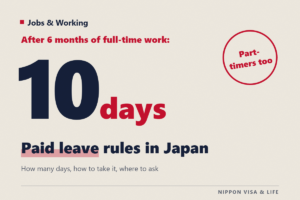
- Annual paid leave: If you have worked continuously for 6 months and have come to work on at least 80% of your working days, you get 10 days off for which you are still paid. The number of days increases the longer you work, up to a maximum of 20 days. Part-time and “arubaito” workers also get it if they meet the conditions.
- Pregnancy, childbirth, childcare and family care: There are systems for prenatal and postnatal leave, childcare leave and family care leave. Treating a worker unfavorably, such as by dismissing them, because of pregnancy, childbirth or a request for leave is prohibited.
The table of the number of days, the number of days for part-time and “arubaito” workers, and how to take leave are explained in detail in Paid Annual Leave Rules in Japan: How Many Days Do You Get? Can Part-Time Workers Take It Too?.
(Sources: Immigration Services Agency “Guidebook on Living and Working” Chapter 3)
7. Injuries, Health Checkups and Insurance
- Workers’ accident compensation insurance: Injuries and illnesses caused by work or by commuting are covered by workers’ accident compensation insurance. Not only regular full-time employees but also part-time and “arubaito” workers are covered, and the company pays all of the premiums. Health insurance cannot be used for injuries or illnesses caused by work. When you have a problem, consult a Labour Standards Inspection Office.
- Health checkups: The company must have a doctor give you a health checkup when you are hired and once a year after that. Workers must undergo these health checkups. Part-time, “arubaito” and other workers are also covered if they meet the conditions on the contract period (for a fixed-term contract, being expected to work for 1 year or more, etc.) and on weekly working hours (at least three-quarters of those of a regular worker doing the same job).
- Employment insurance: People who work 20 hours or more a week and are expected to work for 31 days or more are enrolled (excluding daytime students). Both the worker and the company pay the premiums.
- Health insurance and pension: These are the medical care and pension systems for people working at companies. For National Health Insurance and National Pension, which you join at the city office, see Procedures at the City Office After You Arrive in Japan: The Basics of the Moving-in Notification, My Number, National Health Insurance, National Pension and Resident Tax.
How to see a doctor is summarized in When You Are Sick or Injured in Japan: The Basics of Hospitals, Ambulances, Medicine, Medical Insurance and Where to Get Advice.
(Sources: Immigration Services Agency “Guidebook on Living and Working” Chapter 3)
8. When You Quit or Are Dismissed
Quitting on Your Own (Resignation)
- You are free to quit, but it is also important to follow rules such as telling your supervisor in advance, submitting a written notice, and handing over your work. Check the resignation procedure in the company’s work rules (shugyo kisoku: the company’s rules on how you work).
- For people whose contract period is not fixed, the contract ends, in principle, 2 weeks after you say you will quit.
- People whose contract period is fixed cannot quit in the middle of the period unless there are unavoidable circumstances. However, once 1 year has passed since the contract began, you can quit at any time by giving notice.
Being Let Go by the Company (Dismissal / Non-Renewal of Contract)
- A company cannot dismiss workers freely. A dismissal that has no reasonable grounds and is not considered appropriate in light of social norms is invalid.
- When a company dismisses a worker, in principle it must give notice at least 30 days in advance or pay at least 30 days’ worth of average wages (dismissal notice allowance).
- When a company does not renew the contract of a person whose contract has been renewed 3 times or more, or who has worked continuously for more than 1 year (non-renewal of contract), the company is to give notice at least 30 days in advance.
- When a company goes bankrupt and wages are not paid, there is a system in which the national government pays part of them on the company’s behalf. Please consult a Labour Standards Inspection Office.
After You Leave: Basic Allowance of Employment Insurance
People who were enrolled in employment insurance can receive the basic allowance while they are looking for a job, if they meet the conditions. Register as a job seeker at Hello Work and submit the separation notice (rishokuhyo) you receive from your company. The period for which you can receive it differs depending on the reason you left, your age and other factors, and is, in principle, from 90 days to 330 days.
If you left because of the company’s circumstances but it is recorded as “for personal reasons”, you may be at a disadvantage when receiving the basic allowance. Check the reason for leaving section on the separation notice carefully.
Depending on your status of residence (for example, Engineer/Specialist in Humanities/International Services or Specified Skilled Worker), you need to submit a notification to the Immigration Services Agency when you leave your company or sign a contract with a new company. For details, check the Immigration Services Agency’s information.
(Sources: Immigration Services Agency “Guidebook on Living and Working” Chapter 3, Immigration Services Agency “Notification Concerning the Organization of Affiliation (Contracting Organization)”)
Common Questions
Are Part-Time and “Arubaito” Workers Also Protected by Labor Rules?
Yes, they are. Not only regular full-time employees but also dispatched workers, contract employees, part-time workers and “arubaito” workers are generally “workers”. The minimum wage and premium wages apply regardless of the type of employment.
(Sources: Immigration Services Agency “Guidebook on Living and Working” Chapter 3)
What If I Am Bullied or Harassed at Work?
Companies are required to set up systems to respond to consultations in order to prevent sexual harassment, power harassment and other harassment. You can consult the Employment Environment and Equal Employment Department (Office) of the Prefectural Labour Bureau or a General Labour Consultation Corner. For consultations in person or by phone, an interpretation service supports 13 languages.
(Sources: Immigration Services Agency “Guidebook on Living and Working” Chapter 3, Ministry of Health, Labour and Welfare “Guide to General Labour Consultation Corners”)
What If I Do Not Understand Japanese Words Used at Work?
You can look up the meanings of words related to labor and social insurance in the Ministry of Health, Labour and Welfare’s “Multilingual Glossary Useful for Employment Management”.
(Sources: Immigration Services Agency “Guidebook on Living and Working” Chapter 3)
Where to Get Help
| Service | What you can consult about |
|---|---|
| Consultation Dial for Foreign Workers / Working Conditions Consultation Hotline | Working conditions such as wages and dismissal (by phone in foreign languages) |
| Labour Standards Inspection Office | Working conditions, injuries at work or while commuting, wages unpaid because the company went bankrupt |
| General Labour Consultation Corner | All kinds of problems at work, such as dismissal, bullying and harassment |
| Hello Work | Finding a job, employment insurance procedures |
You can check the phone numbers, languages and hours of the services you can call in foreign languages on the Ministry of Health, Labour and Welfare’s “Consultation Services for Foreign Workers” page. A list of phone numbers by language is also included in the “Consultation Services Available in Foreign Languages” section of Paid Annual Leave Rules in Japan: How Many Days Do You Get? Can Part-Time Workers Take It Too?.
(Sources: Ministry of Health, Labour and Welfare “Consultation Services for Foreign Workers”, Ministry of Health, Labour and Welfare “Guide to General Labour Consultation Corners”, Immigration Services Agency “Guidebook on Living and Working” Chapter 3)
Primary Sources Used for This Article
- Immigration Services Agency “Guidebook on Living and Working” (8th edition) (Chapter 3: Employment and Labor)
- Immigration Services Agency “Application for Permission to Engage in Activity Other Than That Permitted”
- Immigration Services Agency “Notification Concerning the Organization of Affiliation (Contracting Organization)”
- Ministry of Health, Labour and Welfare “Hello Work Checklist for Foreign Nationals”
- Ministry of Health, Labour and Welfare “Consultation Services for Foreign Workers” (Check Working Conditions)
- Ministry of Health, Labour and Welfare “Guide to General Labour Consultation Corners”
This article is a translation of the original Japanese version.