This article was written by the NIPPON VISA & LIFE editorial team based on information from public organizations such as the national government and local governments. Rules and fees may differ depending on the city, ward, town or village where you live.
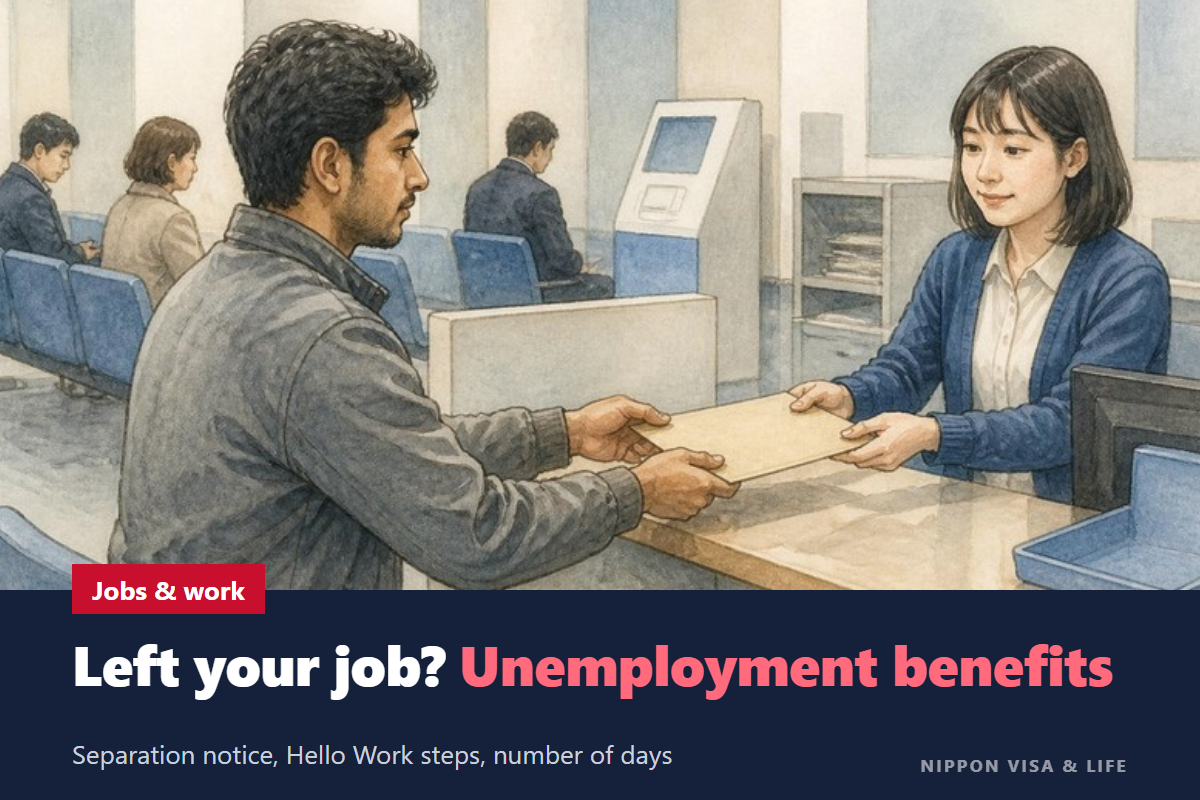
In Japan, if you were enrolled in employment insurance and are looking for your next job after leaving your job, you may be able to receive the “basic allowance” of employment insurance (commonly called unemployment benefits). You receive a “separation notice” (rishokuhyo) from your company and do the procedures at the Hello Work office for the area where you live. This article explains the conditions, the steps of the procedures and what to bring.
The Short Answer: What Happens After You Leave Your Job
- When you leave your company, the company sends you a separation notice (Employment Insurance Separation Notice -1 and -2, 雇用保険被保険者離職票-1・-2)
- Go to the Hello Work office (Public Employment Security Office, the national government’s counter for job consultation) in charge of the area where you live, apply to look for a job (job seeker registration), and submit your separation notice
- Hello Work decides whether you can receive the allowance and the reason you left your job
- Attend the information session (initial briefing session for employment insurance recipients) on the date you are given
- In principle, once every 4 weeks, you receive “certification of unemployment” at Hello Work. After certification, the money is usually transferred to your own bank account within 5 business days
- In principle, the period during which you can receive the allowance is 1 year from the day after the day you left your job. If you are late with the procedures, you may not be able to receive all of it
(Sources: Hello Work Internet Service “Procedures for Receiving the Basic Allowance”)
A list of articles about work is available in The Basics of Finding a Job and Working in Japan: Hello Work, Working Conditions, Wages and Overtime, Paid Leave, Quitting and Where to Get Help.
Who Can Receive the Basic Allowance
People Who Were Enrolled in Employment Insurance
Employment insurance is a national insurance that supports your living and helps you find your next job when, for example, you lose your job. People who meet both of the following conditions are enrolled in employment insurance regardless of the size of the company. The same applies to dispatched workers, contract employees, part-time workers and “arubaito” (casual part-time) workers. However, students attending daytime schools are not enrolled.
- Your weekly working hours (scheduled working hours) are 20 hours or more
- You are expected to be employed continuously for 31 days or more
Enrolling workers in employment insurance is the company’s responsibility. Both the worker and the company pay the premiums. To check whether you are enrolled, look at the “employment insurance premium” (koyo hokenryo) item on your pay slip, or ask your company.
(Sources: Immigration Services Agency (ISA) “Guidebook on Living and Working” Chapter 3)
Conditions for Receiving It
If you were enrolled in employment insurance, left your job, and meet the following 2 conditions, you can receive the basic allowance.
| Condition | Details |
|---|---|
| You are unemployed | You have applied to look for a job at Hello Work, you are willing and able to work, and you are looking for a job, but you cannot find one |
| Period of enrollment in employment insurance | In the 2 years before the day you left your job, you were enrolled in employment insurance for a total of 12 months or more |
The period of enrollment in employment insurance is counted by treating a month in which you worked 11 days or more, or a month in which the working hours used to calculate your wages were 80 hours or more, as 1 month.
People who left their job because the company went bankrupt, because they were dismissed for the company’s reasons, or because their fixed-term contract was not renewed, for example, only need a total of 6 months or more in the 1 year before the day they left their job.
(Sources: Hello Work Internet Service “About the Basic Allowance”, Immigration Services Agency “Guidebook on Living and Working” Chapter 3)
People Who Cannot Start Working Right Away Cannot Receive It
People who cannot start working right away, for example because of illness or injury, pregnancy, childbirth or childcare, or because they left their job to take a break for a while, are not “unemployed” in this sense, so they cannot receive the allowance.
However, if you cannot work for 30 days or more in a row because of illness, injury, pregnancy, childbirth, childcare or similar reasons, you can extend the period during which you can receive the allowance (the benefit period) by the number of days you cannot work. It can be extended up to a maximum of 3 years.
(Sources: Hello Work Internet Service “About the Basic Allowance”)
What You Need
When you do the procedures at Hello Work, bring the following.
| What to bring | Details |
|---|---|
| Separation notice | Employment Insurance Separation Notice -1 and -2 |
| Something that shows your My Number (Individual Number) | One of the following: My Number Card, notification card, or a copy of the resident record (certificate of residence) that shows your My Number |
| Something that proves your identity | One of the following: driver’s license, My Number Card, an identification document with a photo issued by a government office, etc. If you do not have one, 2 documents of different types, such as a public medical insurance card (copies are not accepted) |
| 2 photos | Recent photos, front-facing, upper body, 3.0 cm high × 2.4 cm wide |
| A bankbook or cash card in your own name | Some financial institutions cannot be designated. Japan Post Bank (Yucho Bank) can be designated |
- If you show your My Number Card, you do not need to submit photos. However, you will need to show your My Number Card at this procedure and at every procedure after that
- If you are not sure what you can use, it is a good idea to check with Hello Work before you go
(Sources: Hello Work Internet Service “Procedures for Receiving the Basic Allowance”)
How to Do the Procedures
When You Leave: Receive Your Separation Notice
- While you are still at the company, check that you have your “Employment Insurance Card” (koyo hoken hihokenshasho)
- After you leave, the company sends you the separation notice (-1 and -2). In some cases, you go to the company to receive it
- If the company does not send you the separation notice, consult the Hello Work office in charge of the area where you live
When you receive your separation notice, carefully check the “reason for leaving” (rishoku riyu) section. If you were actually dismissed for the company’s reasons but it says “for personal reasons” (jiko tsugo: you left by your own choice), you will be at a disadvantage, for example in when you start receiving the basic allowance. If you do not agree with the reason written there, you can consult Hello Work.
(Sources: Hello Work Internet Service “Procedures for Receiving the Basic Allowance”, Immigration Services Agency “Guidebook on Living and Working” Chapter 3)
At Hello Work: Application and Information Session
- At the Hello Work office in charge of the area where you live, apply to look for a job and submit your separation notice
- After you apply, the basic allowance is not paid until you have been unemployed for a total of 7 days. This is called the “waiting period” (taiki)
- Attend the information session (initial briefing session for employment insurance recipients) on the date and time you are given. There you receive your “Employment Insurance Benefit Eligibility Card” (jukyu shikakusha sho, 受給資格者証; this is not the “Certificate of Eligibility” used for immigration procedures) and the “Unemployment Certification Declaration Form” (shitsugyo nintei shinkokusho), and you are told the date of your first certification of unemployment
You can look up the location of the Hello Work office for your area in the Ministry of Health, Labour and Welfare’s list (Locations of Hello Work Offices Nationwide).
(Sources: Hello Work Internet Service “Procedures for Receiving the Basic Allowance”, Immigration Services Agency “Guidebook on Living and Working” Chapter 3)
While You Are Receiving It: Certification Once Every 4 Weeks and Looking for a Job
- In principle, certification of unemployment takes place once every 4 weeks. On the date you are given, submit the Unemployment Certification Declaration Form together with your Benefit Eligibility Card
- In principle, for each certification period, you need a record of at least 2 job search activities. For the period until the first certification date, 1 is enough
- After certification, the money is usually transferred to the account you designated within 5 business days
At Hello Work, you can receive job consultations, job introductions, guidance on how to write a resume, interview practice and more, all free of charge.
(Sources: Hello Work Internet Service “Procedures for Receiving the Basic Allowance”, Immigration Services Agency “Guidebook on Living and Working” Chapter 3)
When Does It Start and for How Many Days?
When You Start Receiving It Depends on Why You Left
| Reason for leaving | When you start receiving it |
|---|---|
| Dismissed for the company’s reasons, or left because the company encouraged you to (encouragement to resign) | After you have been unemployed for a total of 7 days following the day your application was made and your separation notice was accepted |
| Left for personal reasons (jiko tsugo) | 1 more month after the 7 days have passed (3 months for the third or later resignation for personal reasons within 5 years) |
| Dismissed for serious reasons for which you are responsible | 3 more months after the 7 days have passed |
The period during which you cannot receive the allowance, for example when you left for personal reasons, is called the “benefit restriction” (kyufu seigen). People with a benefit restriction need, in principle, at least 2 job search activities (at least 3 for people with a 3-month benefit restriction) in total over that period and the certification period right after it.
(Sources: Immigration Services Agency “Guidebook on Living and Working” Chapter 3, Hello Work Internet Service “Procedures for Receiving the Basic Allowance”)
Number of Days You Can Receive It
The number of days you can receive the allowance (prescribed number of benefit days) is decided by your age on the day you left your job, how long you were enrolled in employment insurance, why you left, and other factors, and is between 90 days and 360 days.
For people who left their job for reasons other than the company’s bankruptcy, dismissal and similar reasons (such as people who left for personal reasons), except people considered to have particular difficulty finding a job (people with employment difficulties), the number of days is as follows regardless of age.
| Period of enrollment in employment insurance | Days you can receive it |
|---|---|
| Less than 10 years | 90 days |
| 10 years or more but less than 20 years | 120 days |
| 20 years or more | 150 days |
For people who left because of the company’s bankruptcy, dismissal or similar reasons, it is 90 days to 330 days depending on age and period of enrollment. For people with employment difficulties, it is 150 days to 360 days depending on age and period of enrollment. To find your own number of days, check the table on the Hello Work page or ask at Hello Work.
(Sources: Hello Work Internet Service “Prescribed Number of Benefit Days for the Basic Allowance”, Hello Work Internet Service “About the Basic Allowance”)
Amount You Receive per Day
The amount you receive per day (basic allowance daily amount) is about 50% to 80% (45% to 80% for people aged 60 to 64) of the amount found by dividing the total of the wages regularly paid to you each month in the 6 months before you left (not including bonuses and similar payments) by 180 (the daily wage amount). The lower your wages, the higher the percentage. There is an upper limit on the daily amount for each age group.
(Sources: Hello Work Internet Service “About the Basic Allowance”)
When You Have a Problem and Common Questions
What If My Separation Notice Does Not Arrive?
If the company does not send you your separation notice, contact the Hello Work office in charge of the area where you live.
(Sources: Hello Work Internet Service “Procedures for Receiving the Basic Allowance”)
What If 1 Year Passes Without Doing the Procedures?
In principle, the period during which you can receive the allowance (the benefit period) is 1 year from the day after the day you left your job. Even if you still have days remaining, you cannot receive the allowance after this period has passed. If you are looking for a job, do the procedures at Hello Work as early as possible.
(Sources: Hello Work Internet Service “Procedures for Receiving the Basic Allowance”)
Can I Do Part-Time Work While Receiving the Basic Allowance?
You must report any work you did, including piecework at home, at the time of certification of unemployment. If you do not report it, or if you write false information about your job search activities, it becomes fraudulent receipt (receiving money in violation of the rules). If you plan to work, consult Hello Work in advance.
(Sources: Hello Work Internet Service “Procedures for Receiving the Basic Allowance”)
What If My Company Went Bankrupt and Did Not Pay My Wages?
If your company went bankrupt and can no longer pay wages, there is a system in which the national government pays part of the unpaid wages on behalf of the company (advance payment of unpaid wages). Consult a Labour Standards Inspection Office.
(Sources: Immigration Services Agency “Guidebook on Living and Working” Chapter 3)
Do I Need to Make a Notification About My Status of Residence?
Among people who have a residence card, those with certain statuses of residence must notify a Regional Immigration Services Bureau within 14 days when there is a change in the organization they belong to (such as their company), for example when they leave the company. Check which statuses of residence are covered and the types of notification in “Notifications to Regional Immigration Services Bureaus” in Chapter 1 of the Immigration Services Agency’s “Guidebook on Living and Working”.
(Sources: Immigration Services Agency “Guidebook on Living and Working” Chapter 1)
Consultation Services Available in Foreign Languages
- Some Hello Work offices have interpreters. If you cannot go to Hello Work, you can call some Hello Work offices in foreign languages. For details, see the Ministry of Health, Labour and Welfare’s information (Hello Work Offices with Interpreters, Calling in Foreign Languages). For how to use Hello Work, please read How to Use Hello Work: Looking for a Job in Japan as a Foreign Resident (What to Bring, Job Seeker Registration, Interpreters, and Referral Letters)
- For problems with working conditions such as dismissal or wages, you can consult by telephone in foreign languages through the Ministry of Health, Labour and Welfare’s “Consultation Dial for Foreign Workers” and “Working Conditions Consultation Hotline”. Check the telephone numbers and days for each language on the Ministry of Health, Labour and Welfare’s “Consultation Services for Foreign Workers” page
(Sources: Immigration Services Agency “Guidebook on Living and Working” Chapter 3, Ministry of Health, Labour and Welfare “Consultation Services for Foreign Workers” (Check Working Conditions))
Primary Sources Used for This Article
- Hello Work Internet Service “Procedures for Receiving the Basic Allowance”
- Hello Work Internet Service “About the Basic Allowance”
- Hello Work Internet Service “Prescribed Number of Benefit Days for the Basic Allowance”
- Immigration Services Agency “Guidebook on Living and Working” (8th edition) (Chapter 1: Entry and Residence Procedures, Chapter 3: Employment and Labor)
- Ministry of Health, Labour and Welfare “Introducing Hello Work Offices with Interpreters”
- Ministry of Health, Labour and Welfare “You Can Call Hello Work in Foreign Languages”
- Ministry of Health, Labour and Welfare “Consultation Services for Foreign Workers” (Check Working Conditions)
This article is a translation of the original Japanese version.