This article was written by the NIPPON VISA & LIFE editorial team based on information from public organizations such as the national government and local governments. Rules and fees may differ depending on the city, ward, town or village where you live.
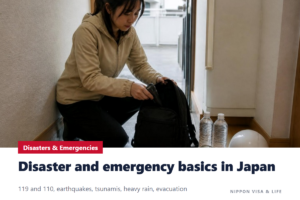
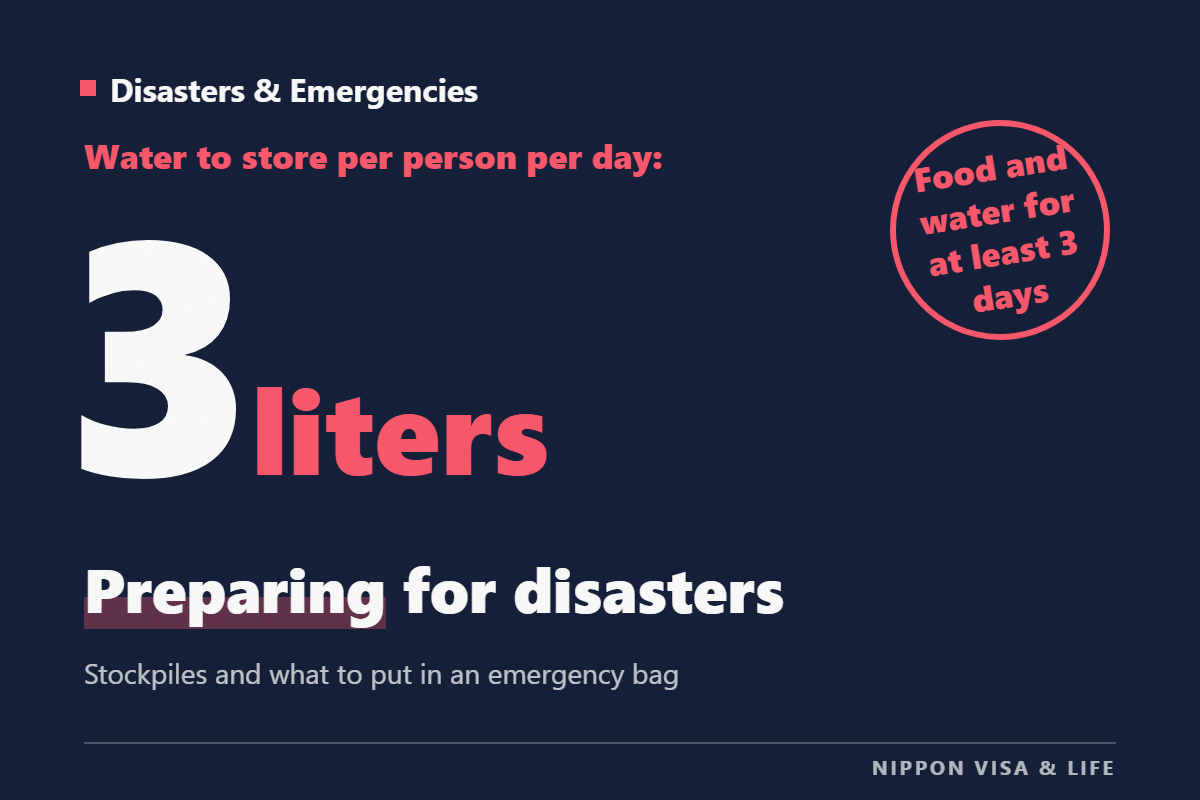
In Japan, disasters such as earthquakes, typhoons and heavy rain can happen. The national government recommends keeping food and water for at least 3 days at home, and 1 week’s worth if you want to prepare for a major disaster. The guideline for water is 3 liters per person per day. Also prepare an “emergency grab bag” (hijoyo mochidashi bukuro) that you can take with you right away when you evacuate.
→ Disasters and Emergencies in Japan: The Basics
The Short Answer: 5 Things You Can Do Starting Today
- Prepare water for each member of your household: 3 liters per person per day × 3 days (1 week if possible)
- Prepare food for 3 days (1 week if possible). You only need to buy a little more of the food you normally eat
- Prepare toilet supplies (portable toilets, toilet paper) and items such as a portable gas stove (cassette konro)
- Put the things you will take when you evacuate in a backpack, and keep it somewhere you can grab it right away
- Decide with your family on a meeting place and ways to contact each other (such as Disaster Emergency Message Dial 171)
(Sources: Prime Minister’s Office of Japan “Preparing for Disasters at Home”, Government Public Relations Online “Prepare for Disasters in Advance”)
Why Do You Need to Prepare?
After a major disaster, electricity, water and gas may stop, and you may not be able to buy things in shops. The Ministry of Agriculture, Forestry and Fisheries (MAFF) introduces an estimate that, in the major earthquake the government anticipates for the Tokyo metropolitan area (an earthquake directly beneath the capital), it would take about 6 days to restore electricity, about 30 days for water and about 55 days for gas.
MAFF also explains that public relief supplies will start to arrive from the 4th day onward. Help from government offices and others may not come right away, so it is important to be prepared to spend several days in your own home.
Things to Keep at Home (Stockpile)
How Much Water and Food to Keep
| Item | Guideline |
|---|---|
| Drinking water | About 3 liters per person per day. For 3 days (1 week to prepare for a major disaster) |
| Food | For 3 days (1 week to prepare for a major disaster) |
| Water for daily use | Separately from drinking water, also prepare water for things such as the toilet (keep tap water in plastic water tanks, keep water in the bathtub, etc.) |
For example, if 2 people live together and prepare for 3 days, the drinking water needed is 3 liters × 2 people × 3 days = 18 liters. That is 9 bottles of 2 liters each.
MAFF gives these 3 liters as the guideline for “water for drinking and cooking”. Water is also used for washing injuries, brushing your teeth, wiping your body and so on, so prepare extra.
(Sources: Prime Minister’s Office of Japan “Preparing for Disasters at Home”, Ministry of Agriculture, Forestry and Fisheries “Food Stock Guide for Disasters: For People Living Alone”)
What Kind of Food Should You Prepare?
It does not have to be special emergency food. MAFF recommends buying a little more of the food you normally eat. Food you can buy at convenience stores or drugstores is fine. For example:
| Type | Examples |
|---|---|
| Staple foods (rice, noodles, etc.) | Packaged cooked rice, cup noodles, dried noodles (udon, soba, pasta, etc.), cereal, energy bars |
| Side dishes | Retort pouch foods (foods you only need to heat), canned foods, fish sausages, cheese |
| Others | Vegetable juice, cup soup, snacks, seasonings |
MAFF also recommends preparing a portable gas stove (cassette konro; a gas stove you can carry) and gas canisters (cassette bombe; cans of gas). The guideline for canisters is about 1 per person per day. Being able to eat something warm is reassuring, and in winter it also helps keep your body warm.
For households with babies, elderly people, people with chronic illnesses or people with food allergies, MAFF’s “Food Stock Guide for Disasters for People Requiring Special Care” is a useful reference.
(Sources: Ministry of Agriculture, Forestry and Fisheries “Food Stock Guide for Disasters: For People Living Alone”, Ministry of Agriculture, Forestry and Fisheries “Household Stockpiling Portal”, Ministry of Agriculture, Forestry and Fisheries “Food Stock Guide for Disasters”)
Rolling Stock (Preparing with the Food You Normally Eat)
Rolling stock is a method where you buy a little more of your usual food, eat the oldest items first, and buy more to replace what you have eaten. This way, you always have a certain amount at home, and you also throw away less food that has passed its best-before date.
Tips for choosing (MAFF):
- Choose from foods you often eat or like that can be stored at room temperature (do not need to be refrigerated)
- Choose at the shops you usually go to, without worrying about how long the best-before date is
- Buy a little more than the amount you usually eat
Toilet Supplies
If water stops or the sewer cannot be used because of a disaster, you may not be able to flush the toilet at home. Government Public Relations Online recommends preparing the following.
- Portable toilets (toilets where you relieve yourself into a bag): 5 to 6 times a day × number of people × 7 days
- Toilet paper: 5 to 6 times a day × number of people × 7 days (about 8 rolls (30m rolls) for a family of 4)
- Wet wipes, disinfectant, deodorizing spray, and a lantern-type light to light up the area around you
(Source: Government Public Relations Online “Prepare for Disasters in Advance”)
Other Useful Things to Have at Home
- For power outages: a flashlight, candles (ones that do not fall over easily), a portable radio, spare batteries, a spare battery (power bank) for your smartphone
- For injuries: first aid supplies such as adhesive bandages, bandages, gauze and disinfectant
- In the kitchen: plastic bags, plastic food wrap (wrapping it over plates saves water for washing), kitchen scissors, aluminum foil
- For cold and heat: blankets, a change of clothes
(Sources: Tokyo Fire Department “Things to Keep as Emergency Supplies”, Prime Minister’s Office of Japan “Preparing for Disasters at Home”, Government Public Relations Online “Prepare for Disasters in Advance”)
Emergency Grab Bag (Things to Take When You Evacuate)
An emergency grab bag is a bag containing the minimum things you need when you evacuate. Put them in a backpack so that both hands are free, and keep it somewhere you can grab it right away, such as near the entrance or in your bedroom.
Examples of What to Put Inside
| Type | Examples |
|---|---|
| Food and water | Emergency food (3 days), drinking water |
| Light and information | Flashlight, portable radio, spare batteries, a spare battery (power bank) for your smartphone |
| Injuries and health | First aid supplies, the medicine you usually take, masks, a thermometer, disinfectant |
| Daily necessities | A change of clothes, towels, wet wipes, tissues, rain gear, warm clothing, gloves, sanitary products |
| Money and documents | Cash, bankbook, copies of identification documents, medicine notebook (okusuri techo), a note with your family’s contact details |
| Children and elderly people | Formula milk, diapers, baby carrier / dentures, hearing aids, glasses, etc. |
What to take differs from person to person. The Fire and Disaster Management Agency (FDMA) advises people with chronic illnesses who take medicine to prepare things such as a copy of their prescription in case they cannot go to a hospital. A medicine notebook (okusuri techo; a record of the medicines you take) is also useful.
(Sources: Fire and Disaster Management Agency, Ministry of Internal Affairs and Communications “Disaster Prevention and Crisis Management e-College: Preparing Emergency Take-Out Items”, Tokyo Fire Department “Things to Keep as Emergency Supplies”, Government Public Relations Online “Prepare for Disasters in Advance”)
Do Not Make It Too Heavy
Government Public Relations Online gives a guideline for the weight you can carry: about 15kg for adult men, about 10kg for adult women, and about 6kg for children and elderly people. If it is too heavy, you cannot evacuate quickly. You can also keep things you can come back for later, such as water, separately.
Carry Your Identification with You
Government Public Relations Online advises carrying identification documents such as your driver’s license or My Number (Individual Number) card with you at all times. Disasters can also happen while you are out, so Government Public Relations Online advises that it is a good idea to also keep your smartphone, a spare battery (power bank), a small light, a note with your family’s contact details and so on in your bag.
(Sources: Government Public Relations Online “Prepare for Disasters in Advance”, Fire and Disaster Management Agency, Ministry of Internal Affairs and Communications “Disaster Prevention and Crisis Management e-College: Preparing Emergency Take-Out Items”)
Decide How to Contact Your Family
During a disaster, it becomes hard to get through on the phone. Decide the following with your family and friends in advance.
- Meeting place: Decide with the type of disaster and the time of day in mind. Check not only places near your home but also evacuation sites near your workplace or school
- Ways to contact each other: Decide on several ways, not just one
Disaster Emergency Message Dial “171”
This is a system that lets you record and play back voice messages during a major disaster. Call “171” and follow the voice guidance to record or listen to messages. NTT East recommends deciding in advance among family and friends which phone number to record messages under.
There is also the “Disaster Emergency Message Board” (saigaiyo dengonban), where you can leave text messages on the internet.
Even in normal times, you can practice (trial use) on the following days.
- The 1st and 15th of every month
- January 1 to 3
- January 15 to 21 (Disaster Prevention and Volunteer Week)
- August 30 to September 5 (Disaster Prevention Week)
(Sources: Prime Minister’s Office of Japan “Preparing for Disasters at Home”, NTT East “How to Use the Disaster Emergency Message Dial (171)”, Government Public Relations Online “Prepare for Disasters in Advance”)
Things to Do Inside Your Home Too
- Fix furniture to the wall so it does not fall over
- Put as little furniture as possible in the room where you sleep. If you do put furniture there, choose low pieces
- Place furniture so that the doorway is not blocked even if it falls over
- Keep a flashlight, slippers and a whistle within reach of where you sleep
(Source: Prime Minister’s Office of Japan “Preparing for Disasters at Home”)
Check where to evacuate on the hazard map for your address. How to look it up is explained in How to Find Evacuation Sites, Evacuation Shelters and Hazard Maps in Japan: What to Check for Your Address Before a Disaster.
When You Are in Trouble: Common Questions
What If My Room Is Small and I Cannot Store Much?
Start with 3 days’ worth. MAFF also recommends first trying to prepare 3 days’ worth and aiming for 1 week’s worth. With rolling stock, where you buy a little more of your usual food, you do not need much special storage space.
Do I Have to Buy Expensive Emergency Food?
No. MAFF explains that it is fine to just buy a little more of the food you normally eat.
Can I Fix Furniture to the Wall in a Rented Apartment?
In a rented room, before making holes in the wall, check your rental contract and talk to your landlord or management company. Government Public Relations Online explains that there are various ways to fix furniture depending on the type of home (such as boards placed under furniture or adhesive mats).
Can I Receive Disaster Information Even If I Do Not Understand Japanese?
There are ways to receive disaster information in many languages, such as the app “Safety tips”. For details, see Disasters and Emergencies in Japan: The Basics | Calling 119 and 110, Earthquakes, Tsunami, Heavy Rain, Volcanoes, Evacuation and Multilingual Information.
Primary Sources Used for This Article
- Prime Minister’s Office of Japan “Preparing for Disasters at Home”
- Government Public Relations Online “Disaster Prevention Special: ACTION01 Prepare for Disasters in Advance”
- Ministry of Agriculture, Forestry and Fisheries “Food Stock Guide for Disasters: For People Living Alone” (PDF)
- Ministry of Agriculture, Forestry and Fisheries “Household Stockpiling Portal”
- Ministry of Agriculture, Forestry and Fisheries “Food Stock Guide for Disasters”
- Fire and Disaster Management Agency, Ministry of Internal Affairs and Communications “Disaster Prevention and Crisis Management e-College: Preparing Emergency Take-Out Items”
- Tokyo Fire Department “Things to Keep as Emergency Supplies”
- NTT East “How to Use the Disaster Emergency Message Dial (171)”
This article is a translation of the original Japanese version.