This article was written by the NIPPON VISA & LIFE editorial team based on information from public organizations such as the national government and local governments. Rules and fees may differ depending on the city, ward, town or village where you live.
Japan is one of the regions in the world with many earthquakes. When you feel shaking, first protect your head and wait under a sturdy table or similar place until the shaking stops. When the shaking stops, put out any fires, and if it is dangerous, evacuate to the evacuation site designated by your city, ward, town or village.
What to Remember First
- When the ground shakes, first protect yourself (protect your head)
- Indoors, get under a sturdy table or similar, and wait until the shaking stops
- When the shaking stops, put out any fires in the kitchen, heaters and so on
- If it is dangerous, evacuate to the evacuation site designated by your city, ward, town or village. Before you leave, turn off the breaker (the switch that cuts off all the electricity in your home at once)
- Check for accurate information on TV, radio, your smartphone and so on
During the Shaking: What to Do Depending on Where You Are
What you should do in an earthquake depends on where you are at the time. Stay calm and act as follows.
| Where you are | What to do |
|---|---|
| Inside a home or building | To protect your head from falling objects, get under a sturdy table or similar, and wait until the shaking stops |
| Outside (on the street, etc.) | Near buildings, signboards, walls and window glass may fall. Protect your head with a bag or similar, and move to a safe place |
| In a car | Do not panic. Stop the car on the left side of the road and turn off the engine. Leave the key in the car, get out, and walk to a safe place |
When an Earthquake Early Warning Sounds
When strong shaking is expected, the Japan Meteorological Agency issues an “Earthquake Early Warning” (information telling you that strong shaking is coming very soon). Earthquake Early Warnings are broadcast on TV, radio, mobile phones, and the municipal disaster radio system (announcements from loudspeakers set up around town). When you see or hear one, do not panic, and first make sure you are safe.
What to Do After the Shaking Stops
1. Put Out Fires
If a fire breaks out because of an earthquake, the damage becomes even greater.
- When the shaking stops, put out any fires in the kitchen, heaters and so on
- If a fire starts, use a fire extinguisher or similar to put it out as much as you can
- Gas may be leaking after an earthquake, so do not light any fire
2. Evacuate If It Is Dangerous
An earthquake can make your surroundings dangerous, for example if your home is damaged or a fire breaks out.
- In places such as near mountains, cliffs may collapse. When the shaking stops, evacuate right away to the evacuation site designated by your city, ward, town or village
- When electricity that stopped because of the earthquake comes back on, fires caused by electricity can occur. Turn off the breaker before you evacuate
- Always put out any fires before you evacuate
- Keep your belongings to a minimum, and carry them on your back or in a similar way so that both hands are free
3. Help Your Neighbors
In a disaster, it is important for neighbors to help one another. In particular, speak to elderly people living alone, people with disabilities and others, and work together to help each other.
4. Check for Accurate Information
After a big earthquake, a lot of information spreads. Check for the latest accurate information on TV, radio, mobile phones, the municipal disaster radio system and so on, and act calmly.
Watch Out for Tsunami When You Are Near the Sea
When a big earthquake occurs under the sea, a tsunami (large waves that surge in from the sea) may come. If you start to escape only after you see the tsunami coming, you will not make it in time.
- If you feel strong shaking near the sea or a river mouth (where a river flows into the sea), or if you feel weak but long, slow shaking, leave the coast or river mouth right away and escape to a high place such as high ground or an evacuation building
- Even if you do not feel any shaking, escape to a high place right away when the Japan Meteorological Agency issues a tsunami warning or your city, ward, town or village issues an evacuation instruction
- Tsunami come again and again, so do not go near the coast or river mouths until the warnings and advisories are lifted
At beaches and similar places, there is an effort to use the “tsunami flag,” a red and white checkered flag, to let people know that a tsunami warning or similar has been issued.
The Difference Between Seismic Intensity and Magnitude
The words “seismic intensity” (shindo) and “magnitude” are often used in the news.
| Word | Meaning |
|---|---|
| Seismic intensity (shindo) | How strong the shaking is at a particular place. The Japan Meteorological Agency divides it into 10 levels: 0, 1, 2, 3, 4, 5 lower, 5 upper, 6 lower, 6 upper and 7 |
| Magnitude | The size of the earthquake itself. When the number goes up by 1, the energy becomes about 32 times greater |
Even for the same earthquake, the seismic intensity differs from place to place. You can get this information from TV, radio, the internet and so on.
Contacting Family and Friends: Disaster Message Services
After a big earthquake, phone calls may be hard to get through. At such times, “disaster message services” are made available so that you can let people know whether you are safe.
| Service | How to use it |
|---|---|
| Disaster Emergency Message Dial (171) | Call “171” from a landline or mobile phone, and follow the voice guidance to record or play back a message |
| Disaster Emergency Message Board (web171) | Enter a phone number on a computer or smartphone to register or check whether someone is safe (English, Chinese, Korean and Japanese) |
| Mobile phone companies’ disaster message boards | Each mobile phone company also provides a message board service |
If you talk with your family in advance about how to use these services, you will feel more at ease in an emergency.
(Sources: Immigration Services Agency (ISA) “Guidebook on Living and Working” Chapter 10: Emergencies and Disasters, Ministry of Internal Affairs and Communications “Disaster Message Services”)
Everyday Preparation
To protect your life from earthquakes, do the following in everyday life.
- Talk with your family about where to go when an earthquake happens
- Take part in local disaster drills
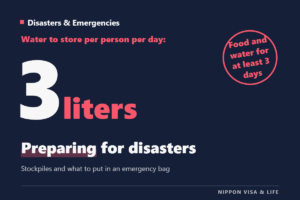
- Prepare food and drinking water for at least 3 days (if possible, about 1 week), and things to treat injuries
- Fix furniture so that it does not fall over. Also be careful where you put it so that it is not dangerous even if it falls
How to Find Your Evacuation Site
Evacuation sites (places or facilities where you go temporarily in a disaster) differ depending on the area where you live. Check the website of your city, ward, town or village, or a hazard map (a map showing places where disasters may occur). To find it, search for “(name of your city, ward, town or village) 避難場所” (evacuation site), or ask at the counter of your local municipal office. On the Ministry of Land, Infrastructure, Transport and Tourism’s “Hazard Map Portal Site,” you can check disaster risks by address and view the hazard maps of cities, wards, towns and villages.
(Sources: Immigration Services Agency (ISA) “Guidebook on Living and Working” Chapter 10: Emergencies and Disasters, Ministry of Land, Infrastructure, Transport and Tourism “Hazard Map Portal Site”)
Getting Disaster Information in Foreign Languages
The “Safety tips” App
There is a free app called “Safety tips” for foreign travelers that gives useful information in a disaster. If you install it on your smartphone, you will receive notifications such as Earthquake Early Warnings and tsunami warnings. You can also use diagrams that show what to do in a disaster, and communication cards for talking with the people around you.
Multilingual Information from the Japan Meteorological Agency
The Japan Meteorological Agency publishes information on earthquakes, heavy rain and so on on its website in many languages.
(Sources: Japan Meteorological Agency “Multilingual Information”)
Troubles and Common Questions
What should I do if someone is injured or a fire breaks out?
If someone is injured or a fire breaks out, call 119. For how to call 119 and what to tell them, please read How to Call an Ambulance in Japan: How to Dial 119, What to Say, and Where to Get Advice When You Are Unsure (#7119).
What if I cannot use my mobile phone?
You can call 119 and 110 from a public phone. You do not need money or a telephone card. On a public phone with a red emergency call button, lift the receiver, press the button, and then dial the number. On a public phone without the button, lift the receiver and dial the number directly.
What if I think going to the evacuation site is more dangerous?
Depending on the situation around you, going to the evacuation site may actually be more dangerous. In that case, move to a place that is even a little safer, such as a nearby sturdy building or the second floor or higher of your home, and take action to protect your life.
Primary Sources Used for This Article
- Immigration Services Agency (ISA) “Guidebook on Living and Working” (8th edition) (Chapter 10: Emergencies and Disasters)
- Ministry of Internal Affairs and Communications “Disaster Message Services”
- Japan Meteorological Agency “Multilingual Information”
- Ministry of Land, Infrastructure, Transport and Tourism “Hazard Map Portal Site”
This article is a translation of the original Japanese version.