This article was written by the NIPPON VISA & LIFE editorial team based on information from public organizations such as the national government and local governments. Rules and fees may differ depending on the city, ward, town or village where you live.
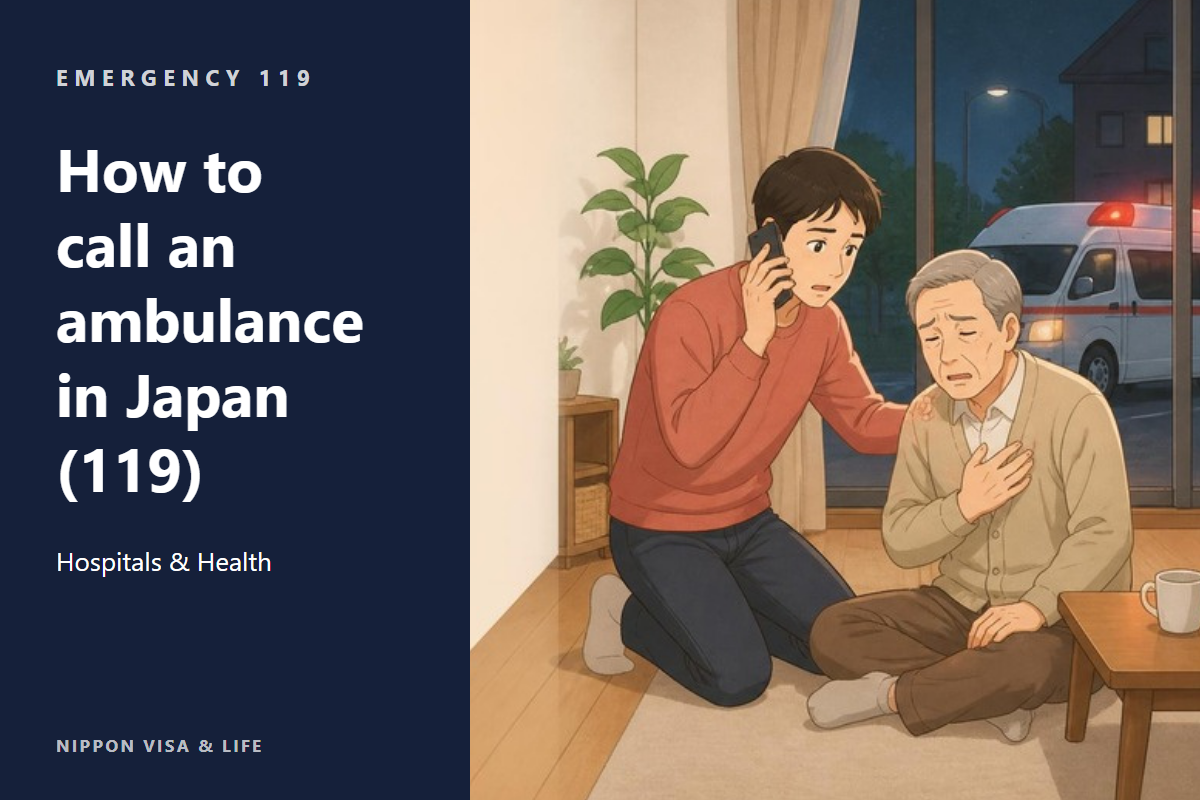
In Japan, the phone number for calling an ambulance is “119.” When the call connects, first say “It’s an emergency (medical)” (“Kyukyu desu” / 救急です), and then tell them the location, the symptoms, the age, and your name and contact information. If you are not sure whether to call an ambulance, you can get advice by phone from your local emergency consultation line (such as #7119).
What to Remember First
- The number for an ambulance is 119 (119 is also used for fires)
- When the call connects, say “Kyukyu desu” (救急です, “It’s a medical emergency”)
- Tell them the place where you want the ambulance to come (say the address starting with the name of the city, town or village)
- Tell them the symptoms and age of the person who is sick or injured
- Tell them your name and a phone number where you can be reached even after the call
The number for calling the police (for traffic accidents, being a victim of a crime, etc.) is 110. It is a different number from 119.
(Sources: Immigration Services Agency (ISA) “Guidebook on Living and Working” Chapter 10: Emergencies and Disasters, Fire and Disaster Management Agency “Let’s Use Ambulances Wisely”)
What You Will Be Asked When You Dial 119
When you dial 119, a dispatcher (a fire department staff member who answers the call) will ask you, in order, what they need to know to send an ambulance. Stay calm and answer slowly. When the situation is very urgent, an ambulance may be sent out even before all the questions are finished.
| Order | What you will be asked | Example answers |
|---|---|---|
| 1 | “Is it a fire? Or a medical emergency?” (“Kaji desu ka? Kyukyu desu ka?” / 火事ですか?救急ですか?) | “Kyukyu desu” (救急です, “It’s a medical emergency”) |
| 2 | “What is the address?” | “It’s ○○-shi, ○-chome, ○-banchi” (say it starting with the name of the city, town or village) |
| 3 | “What happened?” | Say briefly who, how, and what happened. Also say, as far as you know, whether the person is conscious and breathing |
| 4 | “How old is the person?” | Say the age. If you do not know, an estimate such as “in their 60s” is fine |
| 5 | “Please tell me your name and contact information” | Say your name and a phone number where you can be reached even after the 119 call |
You may also be asked about the person’s condition in more detail, any chronic illness (an illness they have been treated for over a long time), or their regular hospital (the hospital they usually go to). Answer as much as you can.
If you do not know the address
If you do not know the address, tell them about a landmark nearby, such as a large building or an intersection.
You may be asked to give first aid
To help the injured or sick person, the dispatcher may explain over the phone how to give first aid (care given on the spot until the ambulance arrives) and ask you to do it. If there is an AED (a machine that gives an electric shock to the heart) nearby, ask someone to bring it.
(Sources: Fire and Disaster Management Agency “Let’s Use Ambulances Wisely”)
Examples of Symptoms That Need a 119 Call Right Away
The Fire and Disaster Management Agency asks people to call an ambulance without hesitation when there are symptoms like the ones below. These are only some of the examples.
| Body part, etc. | Examples of symptoms in adults |
|---|---|
| Face | Half of the face is hard to move or feels numb / one side of the mouth or face droops when smiling / speech is slurred and it is hard to talk properly / the field of vision becomes narrower / suddenly seeing double |
| Head | Sudden severe headache / sudden high fever / suddenly so dizzy that the person cannot stand without support |
| Chest or back | Sudden severe pain / sudden shortness of breath or difficulty breathing / pain in the center of the chest that feels like squeezing or pressure and lasts 2 to 3 minutes |
| Arms and legs | Sudden numbness / suddenly losing strength in one arm or leg |
| Consciousness | Unconscious (no response) or not normal (in a daze) / limp and weak |
| Injuries and accidents | Injury with heavy bleeding / burns over a large area / being in a traffic accident (receiving a strong impact) / drowning / falling from a high place |
For children (15 years old or younger), the examples also include purple lips, weak breathing, seizures that do not stop, and difficulty breathing because something is stuck in the throat. In addition, when the person is different from usual or something seems wrong, this is also given as a guide for calling an ambulance.
(Sources: Fire and Disaster Management Agency “Let’s Use Ambulances Wisely”)
What to Prepare Before the Ambulance Arrives
After calling an ambulance, it is helpful to have the following ready.
- My Number Card
- Health insurance card and patient registration card (the card you get at a hospital)
- Money
- Shoes
- Medicines you usually take (medication notebook / okusuri techo)
- For infants (babies and small children): Maternal and Child Health Handbook, disposable diapers, baby bottle, towel
When the ambulance arrives, tell the crew how the accident happened or how the person became sick, any changes until the ambulance team arrived, what first aid was given, any chronic illness and regular hospital, and the medicines the person usually takes. It is helpful to write down chronic illnesses and your regular hospital in a memo in advance.
If there are other people with you, having someone go outside and guide the ambulance when its siren comes close will help it arrive sooner.
(Sources: Fire and Disaster Management Agency “Let’s Use Ambulances Wisely”)
When You Are Not Sure Whether to Call an Ambulance
With a sudden illness or injury, you may not be sure whether you should call an ambulance or go to a hospital on your own. In such cases, you can get advice by phone from the emergency consultation line of your prefecture or city, town or village.
| Number | Service | What it does |
|---|---|---|
| #7119 | Emergency Consultation Center Service (Kyukyu Anshin Center Jigyo / 救急安心センター事業) | You can get advice by phone when you are not sure whether to call an ambulance or go to a hospital right away. Available only in areas that run this service |
| #8000 | Children’s Medical Telephone Consultation Service (Kodomo Iryo Denwa Sodan Jigyo / 子ども医療電話相談事業) | Advice about a child’s sudden illness (mainly on holidays and at night). Each prefecture has a line |
#7119 is not available in all areas. The areas that run it, the hours it accepts calls, and the ages it covers differ by area. Check the line for your area on the Fire and Disaster Management Agency website.
The Fire and Disaster Management Agency also offers a free app called “Q-suke” (Q助). When you choose symptoms on the screen, it gives you a guide such as whether you should call an ambulance.
(Sources: Fire and Disaster Management Agency “What Is the Emergency Consultation Center Service (#7119)?”, Fire and Disaster Management Agency “Let’s Use Ambulances Wisely”, Fire and Disaster Management Agency “National Emergency Medical Consultation App (nickname “Q-suke”)”)
If You Cannot Speak Japanese Well
When you call 119 in a foreign language
Many fire departments have introduced a system for handling 119 calls in foreign languages through interpreters at a telephone interpretation center (three-way simultaneous interpretation). The command center connects the call to the interpretation center, and you talk through an interpreter. As of January 1, 2025, 673 of the 720 fire departments had introduced it. Some areas have not introduced it.
Multilingual “Ambulance Usage Guide”
The Fire and Disaster Management Agency has published an “Ambulance Usage Guide” that explains how to call an ambulance and more, in 16 languages including English, Chinese, Korean, Vietnamese, Tagalog, Portuguese, Nepali, Indonesian, Thai and Burmese. Reading the version in your language in advance will give you peace of mind in case of an emergency.
(Sources: Fire and Disaster Management Agency “Ambulance Usage Guide for Foreign Visitors to Japan”)
Troubles and Common Questions
What if I do not have a mobile phone?
You can call 119 from a public phone. You do not need money or a telephone card. On a public phone with a red emergency call button, lift the receiver, press the button, and then dial 119. On a public phone without the button, lift the receiver and dial 119 directly.
What if someone is injured in a traffic accident?
If someone is injured, call an ambulance by dialing 119. Until the ambulance arrives, do not move the injured person more than necessary, and follow the dispatcher’s instructions to give care as much as you can. Whether or not someone is injured, you must also contact the police (110).
(Sources: Immigration Services Agency (ISA) “Guidebook on Living and Working” Chapter 9: Transportation)
Can I call an ambulance even if the injury or illness is not serious?
There is a limited number of ambulances. The Fire and Disaster Management Agency says that about half of the people taken by ambulance had mild symptoms that did not need hospitalization, and asks people to use ambulances when they are truly needed. If you think it may not be urgent, you can also get advice from a consultation line such as #7119 or from your regular doctor. However, if the person has any of the “Symptoms That Need a 119 Call Right Away” above, call 119 without hesitation.
(Sources: Fire and Disaster Management Agency “Let’s Use Ambulances Wisely”)
Primary Sources Used for This Article
- Fire and Disaster Management Agency “Let’s Use Ambulances Wisely: When Do You Need an Ambulance?” (published October Reiwa 7 (2025))
- Fire and Disaster Management Agency “Ambulance Usage Guide for Foreign Visitors to Japan”
- Fire and Disaster Management Agency “What Is the Emergency Consultation Center Service (#7119)?”
- Fire and Disaster Management Agency “National Emergency Medical Consultation App (nickname “Q-suke”)”
- Fire and Disaster Management Agency “Three-Way Simultaneous Interpretation through a Telephone Interpretation Center”
- Immigration Services Agency (ISA) “Guidebook on Living and Working” (8th edition) (Chapter 9: Transportation, Chapter 10: Emergencies and Disasters)
This article is a translation of the original Japanese version.