This article was written by the NIPPON VISA & LIFE editorial team based on information from public organizations such as the national government and local governments. Rules and fees may differ depending on the city, ward, town or village where you live.
When you have a minor illness or injury, first go to a clinic near you. At reception, show your My Number health insurance card (a My Number card registered for use as a health insurance card) or your eligibility certificate (shikaku kakuninsho). If you do not show one, you will have to pay the full medical cost. If you go to a large hospital without a referral letter, you may be charged a “special fee.”
The Overall Flow
- Choose a medical institution (for a minor illness or injury, a clinic near you)
- If possible, call before you go to check the consultation hours and whether they can speak a foreign language
- At reception, show your My Number health insurance card or eligibility certificate
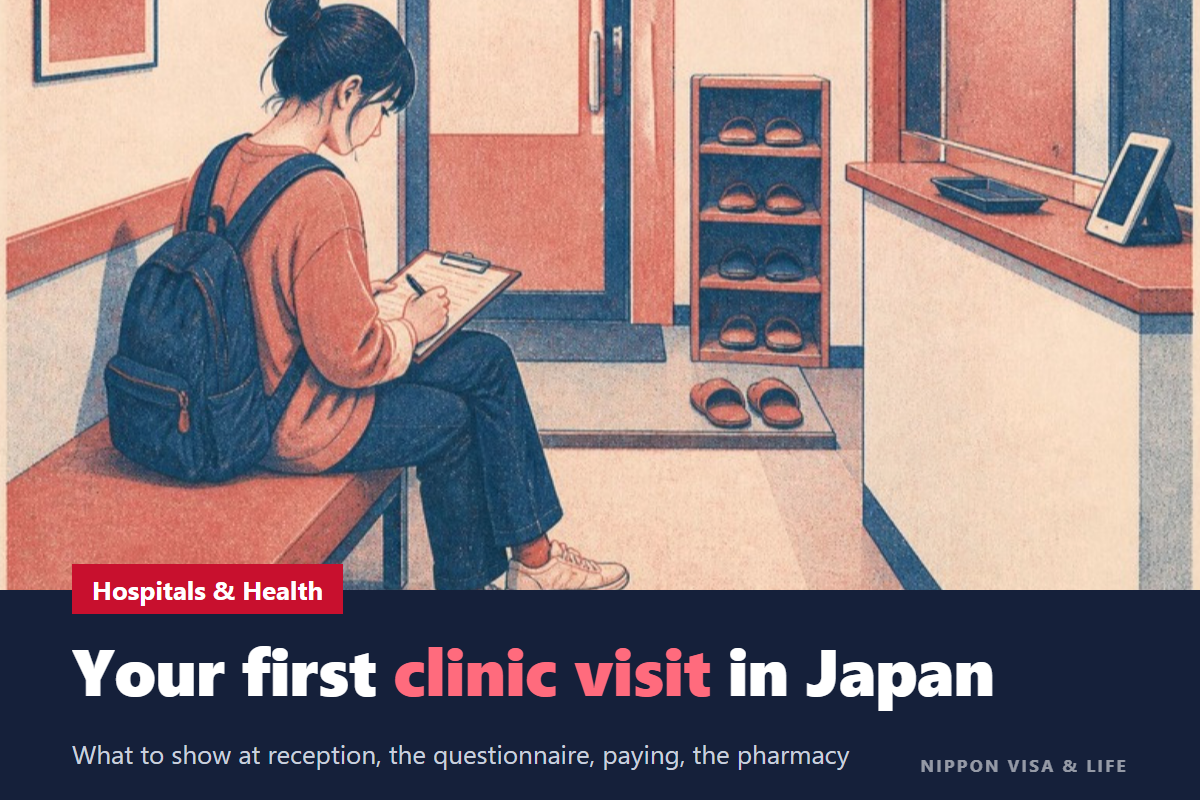
- Fill in the medical questionnaire (a form where you write your current symptoms and other details)
- Receive the examination, tests and treatment
- Pay at the cashier
- If you need medicine, take your prescription (a written instruction for medicine from the doctor) to a pharmacy and receive your medicine
(Sources: Immigration Services Agency “Guidebook on Living and Working”, Japan National Tourism Organization (JNTO) “Guide to Using Medical Institutions”)
If you suddenly become sick or injured and are not sure whether to call an ambulance, see How to Call an Ambulance in Japan: How to Dial 119, What to Say, and Where to Get Advice When You Are Unsure (#7119).
The Difference Between Clinics and Hospitals
There are many medical institutions in Japan, and each has a different role. For a minor illness or injury, go to a clinic near you.
| Medical institution | When to go |
|---|---|
| Clinic | Treatment of everyday illnesses and injuries |
| Small and medium-sized hospital | When you need surgery or hospitalization, or when you need emergency medical care |
| Large hospital | Patients with serious emergencies, or when advanced medical care is needed |
(Sources: Immigration Services Agency “Guidebook on Living and Working”)
Going to a Large Hospital Without a Referral Letter May Cost a “Special Fee”
To prevent too many outpatients from going to certain hospitals, under a national system, the following hospitals are to charge a “special fee,” in addition to the normal co-payment (such as 30%), to patients who come for an outpatient visit without a referral letter (a letter of introduction written by a doctor at another medical institution).
- Advanced treatment hospitals (such as university hospitals)
- Regional medical care support hospitals with 200 or more general beds
- Medical institutions focusing on referral-based outpatient care with 200 or more general beds
| Type | Special fee (from October 1, Reiwa 4) |
|---|---|
| First visit (when you see the hospital for the first time), medical | 7,000 yen or more |
| First visit, dental | 5,000 yen or more |
| Return visit (when you keep visiting the same hospital even though it gave you a referral letter to another medical institution), medical | 3,000 yen or more |
| Return visit, dental | 1,900 yen or more |
- The amounts include consumption tax. Hospitals charge a special fee of at least these amounts.
- Hospitals are not supposed to ask emergency patients and certain others for the special fee.
- The Ministry of Health, Labour and Welfare asks people to first see a medical institution in the area where they live, and to get a referral when necessary.
(Sources: Ministry of Health, Labour and Welfare “Revision of the ‘Special Fee’ When Visiting Certain Hospitals Without a Referral Letter”, Ministry of Health, Labour and Welfare “System Information Leaflet”)
Which Department Should I Go To?
The department you see (medical department) depends on your illness or injury. The Immigration Services Agency’s guidebook gives the following departments as examples.
| Department | Examples of what they treat |
|---|---|
| Internal medicine | Diseases of the internal organs. Also diagnoses and treats common illnesses such as colds |
| Surgery | Treats diseases of the internal organs caused by cancer or injury, mainly with surgery |
| Pediatrics | Children’s illnesses |
| Orthopedics | Problems with the parts of the body that move, such as bones, joints and muscles |
| Ophthalmology | Eye diseases |
| Dentistry | Dental problems (treatment, orthodontics, etc.) |
| Obstetrics | Matters related to pregnancy and childbirth |
If you do not know which department to go to, call the medical institution and ask before you go.
(Sources: Immigration Services Agency “Guidebook on Living and Working”)
How to Find a Medical Institution
The Immigration Services Agency’s guidebook introduces the following ways to find one.
- Public relations magazines (newsletters) published by your city, ward, town or village
- The internet
- Medical Information Net (Navii): A Ministry of Health, Labour and Welfare website where you can search medical institutions throughout Japan
- The Japan National Tourism Organization (JNTO) website: You can search for medical institutions in foreign languages (such as core medical institutions chosen by prefectures to accept foreign patients)
On the JNTO website, you can narrow down your search by area, medical department, languages available (English, Chinese, Korean, Portuguese, Spanish, etc.), credit cards accepted, and so on. However, you need to check the languages available and consultation hours with each medical institution. JNTO advises you to contact the medical institution by phone before your visit whenever possible.
(Sources: Immigration Services Agency “Guidebook on Living and Working”, Medical Information Net (Navii), Japan National Tourism Organization (JNTO) “Guide to Using Medical Institutions”)
What to Show at Reception
My Number Health Insurance Card or Eligibility Certificate
Everyone living in Japan, regardless of nationality, joins public medical insurance (such as Health Insurance or National Health Insurance). At hospitals and clinics, you show one of the following to confirm that you are insured.
- If you have a My Number health insurance card: your My Number health insurance card
- If you do not have a My Number health insurance card: your eligibility certificate
The old-style health insurance cards expired on December 1, 2025.
If you do not show your My Number health insurance card or similar, you will have to pay the full medical cost yourself.
(Sources: Ministry of Health, Labour and Welfare “How Your Eligibility Is Confirmed”, Immigration Services Agency “Guidebook on Living and Working”)
What Is a My Number Health Insurance Card?
A My Number card that has been registered for use as a health insurance card (use registration) is a My Number health insurance card. You can do the use registration with devices such as the card readers with face recognition at the reception of medical institutions and pharmacies.
- Be careful of the expiration date of the electronic certificate in your My Number card. The electronic certificate is valid for 5 years (this is different from the expiration date of the card itself).
- Since September 19, 2025, you can use your smartphone as a My Number health insurance card at medical institutions and pharmacies that have the equipment ready.
Check with your city, ward, town or village for how to get a My Number card. Your My Number (Individual Number) is notified to you by your city, ward, town or village after you submit your moving-in notification (address notification) (Moving-in Notification and Resident Record: Go to Your City Office Within 14 Days After Your Address in Japan Is Decided (What to Bring, Steps, and When You Move)).
(Sources: Ministry of Health, Labour and Welfare “How Your Eligibility Is Confirmed”, Immigration Services Agency “Guidebook on Living and Working”)
What Is an Eligibility Certificate?
For the time being, people who do not have a My Number card, or who have not registered their My Number card for use as a health insurance card, and certain others, receive an eligibility certificate free of charge, without applying, from the insurer of their medical insurance (such as their company’s health insurance association, or their city, ward, town or village for National Health Insurance). You can see a doctor with the eligibility certificate alone.
- The form and the way it is issued differ depending on the insurer.
- The insurer decides the expiration date, within 5 years.
- If you have questions, ask the insurer of your medical insurance.
When Reception Cannot Be Done With the My Number Health Insurance Card
If your eligibility cannot be confirmed with the My Number health insurance card, for example because the machine is broken, it is confirmed in one of the following ways.
- Your My Number card + the eligibility information screen on Mynaportal (the national government’s online service) (a downloaded PDF is also fine)
- Your My Number card + the “Notice of Eligibility Information” (a paper sent to people who have a My Number health insurance card. Only a paper printout can be used. Showing it on a smartphone screen or similar is not valid)
- If you have neither of the above, fill in an “Insured Person Eligibility Declaration Form” at the medical institution or pharmacy you visit for the first time
(Sources: Ministry of Health, Labour and Welfare “How Your Eligibility Is Confirmed”)
When You Have Just Started Working and Do Not Have Anything Yet
The Immigration Services Agency’s guidebook explains that, for example, when you have just started a job, your My Number health insurance card registration is not yet complete, and you do not have an eligibility certificate with you, you pay the full cost first, and if you apply later and it is approved, you can receive the money minus your co-payment as “medical expenses (ryoyohi).” Ask the insurer of your medical insurance how to apply.
(Sources: Immigration Services Agency “Guidebook on Living and Working”)
The Medical Questionnaire and the Examination
- After reception, you may be asked to fill in a medical questionnaire (a form where you write your current symptoms and other details).
- The JNTO website has a sheet where you can write down your medical information, and a sheet you can use to show your symptoms by pointing with your finger (pointing sheet). Filling them in beforehand helps when you write the medical questionnaire.
- During the examination, listen carefully to the doctor’s explanation. If there is anything you do not understand, ask right then.
(Sources: Japan National Tourism Organization (JNTO) “Guide to Using Medical Institutions”)
Paying (at the Cashier)
When you use public medical insurance, you pay only part of the medical cost (the co-payment) at the counter.
| Age | Co-payment rate |
|---|---|
| Under 6 (before starting elementary school) | 20% |
| Under 70 | 30% |
| 70 to 74 | 20% (30% for people with an income at the level of working people) |
- Depending on your city, ward, town or village, there may be subsidies for children’s medical costs, and in some places medical care is free until children finish high school.
- There is a system called “high-cost medical expense benefits” (kogaku ryoyohi) that returns the amount over a certain limit when the medical costs you paid in one month exceed that limit. The limit differs depending on your age and income.
- JNTO notes that credit cards can often be used at large hospitals, while at clinics it is common to pay in cash.
(Sources: Immigration Services Agency “Guidebook on Living and Working”, Japan National Tourism Organization (JNTO) “Guide to Using Medical Institutions”)
Getting Your Medicine (Pharmacies and Drugstores)
- When the doctor gives you a prescription, take it to a pharmacy. At the pharmacy, a pharmacist prepares your medicine according to the prescription, explains how to take it, and then gives it to you.
- You usually pay for the medicine at the pharmacy, separately from the hospital. However, some medical institutions give out medicine inside the hospital.
- At a drugstore, you can buy medicine that does not need a prescription (OTC medicine), but drugstores do not accept prescriptions.
- Medicine has side effects, so you need to be careful how you use it. If you have questions, ask a pharmacist or registered seller at a pharmacy or drugstore.
(Sources: Immigration Services Agency “Guidebook on Living and Working”, Japan National Tourism Organization (JNTO) “Guide to Using Medical Institutions”)
Common Questions
What If I Forget My My Number Health Insurance Card or Eligibility Certificate?
The Immigration Services Agency’s guidebook explains that if you do not show your My Number health insurance card or similar, you will have to pay the full medical cost yourself. Ask the medical institution you are visiting what to do if you forget it.
Do I Need an Appointment?
It depends on the medical institution. JNTO advises you to contact the medical institution by phone before your visit whenever possible.
Can I Go Directly to a Large Hospital?
You can be seen, but at the hospitals described above, you may be charged a “special fee” if you do not have a referral letter. For a minor illness or injury, first go to a clinic near you.
Where to Get Help If You Are Worried About Japanese or Have a Problem
- Your city, ward, town or village
- The international association in your area
- NPOs (some may offer consultations in foreign languages)
- Medical Safety Support Centers: There are about 400 centers in prefectures and in cities and special wards that have a public health center. You can get advice about medical care.
- The Ministry of Health, Labour and Welfare publishes a list of consultation services for foreign nationals in each prefecture (languages supported and hours).
(Sources: Immigration Services Agency “Guidebook on Living and Working”, Medical Safety Support Centers, Ministry of Health, Labour and Welfare “Prefectural Consultation Services”)
Primary Sources Used for This Article
- Immigration Services Agency “Guidebook on Living and Working” (Chapter 6: Medical Care)
- Ministry of Health, Labour and Welfare “How Your Eligibility Is Confirmed”
- Ministry of Health, Labour and Welfare “About the Eligibility Certificate (How to See a Doctor Without Using the My Number Health Insurance Card)”
- Ministry of Health, Labour and Welfare “Revision of the ‘Special Fee’ When Visiting Certain Hospitals Without a Referral Letter”
- Ministry of Health, Labour and Welfare “System Information Leaflet” (special fee)
- Ministry of Health, Labour and Welfare “Prefectural Consultation Services”
- Medical Information Net (Navii)
- Japan National Tourism Organization (JNTO) “Guide to Using Medical Institutions”
- Medical Safety Support Centers
This article is a translation of the original Japanese version.