This article was written by the NIPPON VISA & LIFE editorial team based on information from public organizations such as the national government and local governments. Rules and fees may differ depending on the city, ward, town or village where you live.
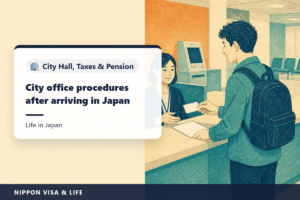
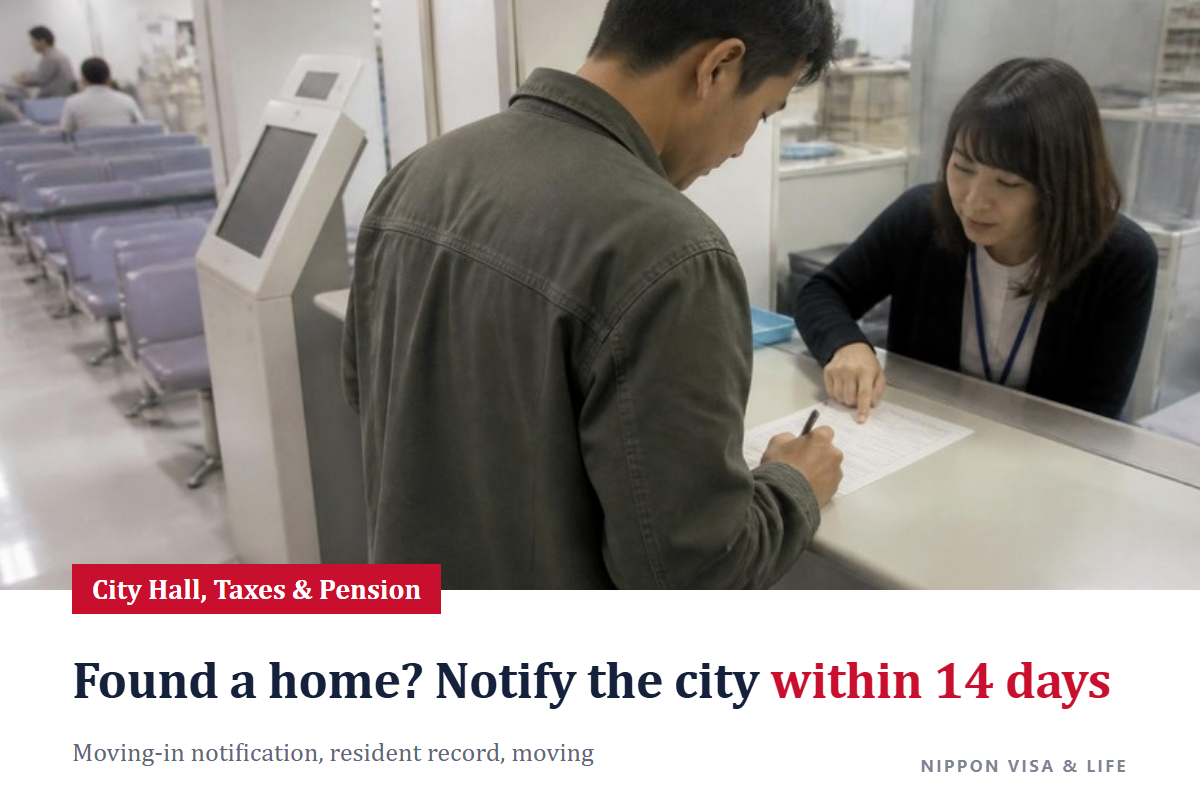
When you come to Japan and your place to live (your address) is decided, you must submit a “moving-in notification” (転入届, tennyū todoke: a notification that you have started living in a new place) at the office of the city, ward, town or village where you live, within 14 days from the day you started living there. What you need to bring is your residence card. When you submit the notification, your resident record (juminhyo) (住民票: the record of people who live in the area) is created, and the address on your residence card is also registered.
The Overall Flow First
- Decide where to live (an apartment, a dormitory, a share house, etc.)
- Within 14 days after you start living there, go to the office of the city, ward, town or village where your address is
- Submit the moving-in notification at the counter (show your residence card)
- The address registered on your residence card (your place of residence, 住居地) is also registered at the same time
- Your resident record is created
- Later, a notice of your My Number (Individual Number) (マイナンバー: a 12-digit number) is sent to you
Who Must Submit the Notification
Among foreign nationals, the following people must notify the city, ward, town or village office of their address.
- People who have a residence card (mid- to long-term residents: for example, people who live in Japan for more than 3 months)
- Special permanent residents
- People who have received permission for temporary refuge or provisional stay permission
- People who are in Japan because they were born in Japan or lost Japanese nationality (transitional stayers)
People with the “Temporary Visitor” status, such as tourists, and people whose period of stay is 3 months or less are not issued a residence card, so they are not covered by this notification.
(Sources: Ministry of Internal Affairs and Communications “Basic Resident Registration System for Foreign Residents”, Immigration Services Agency “Guidebook on Living and Working” Chapter 2)
Deadline, What to Bring, and Fees
| Item | Details |
|---|---|
| Deadline | Within 14 days from the day you started living there |
| Where to go | The office of the city, ward, town or village where your address is (the counter in charge of resident registration) |
| What to bring | Residence card (passport for people who did not receive a residence card at the airport) |
| If you live with family | Official documents that prove the family relationship, such as a marriage certificate or birth certificate (with a Japanese translation) |
| Fee | There is no fee for the notification of place of residence to immigration |
- People who did not receive a residence card at the airport (people who entered Japan at an airport or seaport other than Narita, Haneda, Chubu, Kansai, New Chitose, Kobe, Hiroshima and Fukuoka) bring their passport. The residence card will be sent by mail after the notification.
- Documents that prove the family relationship must be issued by a public organization in your home country. Attach a Japanese translation to documents in a foreign language.
- There is no fee for the immigration “notification of place of residence.”
(Sources: Immigration Services Agency “Notification of Place of Residence after New Landing”, Ministry of Internal Affairs and Communications “Move in / Move out”, Immigration Services Agency “Guidebook on Living and Working”)
The name of the counter, the opening hours, and the form of the notification differ by city, ward, town or village. Before you go, search the website of your city, ward, town or village with words such as “転入届 外国人” (moving-in notification, foreign nationals) or “住民異動届” (notification of change of residents).
How to Do It at the Office
1. Fill in the notification form
At the counter, get a “住民異動届” (jūmin idō todoke: notification of change of residents, i.e. the moving-in notification) form, and write your name, date of birth, nationality, new address, the date you started living there, and so on. The name of the form and how to fill it in differ by city, ward, town or village, so if you do not understand something, ask the staff at the counter.
2. Show your residence card
Show your residence card at the counter. When you submit the moving-in notification, the notification of place of residence for your residence card is also completed at the same time. You do not need to go separately to immigration (the Regional Immigration Services Bureau).
3. Your resident record is created
After the notification, your resident record is created. It contains your name, date of birth, sex, address, and other information. You will be able to get a copy of the resident record (certificate of residence) (住民票の写し, jūminhyō no utsushi: a certified copy) at the office as a document that proves where you live (there is a fee; the amount differs by city, ward, town or village).
You may be asked for a copy of the resident record for work, at a bank, when signing a mobile phone contract, and so on.
4. You receive a notice of your My Number
After your resident record is created, the city, ward, town or village sends you a notice of your My Number (a 12-digit number used in Japan for procedures related to social security, taxes and disaster measures). If you want to make a My Number Card, you can apply using the application form sent together with the notice. The first application is free.
(Sources: Immigration Services Agency “Guidebook on Living and Working” Chapter 2)
5. You may be told about other procedures
The Ministry of Internal Affairs and Communications explains that it has made procedures simpler by allowing residents to do notifications such as the moving-in notification together with notifications for various administrative services such as National Health Insurance (国民健康保険). Which procedures you need depends on how you work and on your family. At the counter, try asking, “Are there any other procedures I need to do?”
When You Move
You also need to submit a notification when you move within Japan.
| Type of move | What to do |
|---|---|
| Moving to a different city, ward, town or village | Before you move, submit a moving-out notification (転出届, tenshutsu todoke) at your current city, ward, town or village → within 14 days after you move, submit a moving-in notification at your new city, ward, town or village |
| Moving within the same city, ward, town or village | Within 14 days after you move, submit a change-of-address notification (転居届, tenkyo todoke) at your current city, ward, town or village |
| Leaving Japan and moving abroad | Before you move, submit a moving-out notification at your current city, ward, town or village |
- When you submit a moving-out notification, you receive a “moving-out certificate” (転出証明書). Bring it when you submit the moving-in notification at your new city, ward, town or village.
- When you submit a moving-in notification or a change-of-address notification, it is treated as also having notified the change of address on your residence card (notification of change of place of residence to immigration).
(Sources: Ministry of Internal Affairs and Communications “Move in / Move out”, Immigration Services Agency “Notification of Change of Place of Residence”, Basic Resident Registration Act Articles 22 to 24)
Changing the address on your residence card and other residence card procedures are summarized in What Is a Residence Card? How to Read the New-Style Card and the Specified Residence Card, and Procedures for Renewal, Address Changes, and Loss.
Troubles and Common Questions
What if more than 14 days have passed?
Submit the notification at your city, ward, town or village office as soon as possible. The Basic Resident Registration Act states that people who do not submit a notification without a legitimate reason, or who submit a false notification, are subject to an administrative fine (karyo) (過料: a penalty in which you pay money) of up to 50,000 yen.
In addition, notifying the address for your residence card is also an obligation set by the immigration law (the Immigration Control and Refugee Recognition Act).
(Sources: Basic Resident Registration Act Article 52, Immigration Services Agency “Notification of Place of Residence after New Landing”)
What if I cannot go to the office myself?
Under the Basic Resident Registration Act, the head of household (世帯主, setainushi: the representative of a household) can submit the notification on behalf of people in the same household (household members). When you ask someone outside your household (such as a family member or friend who lives somewhere else), you will be asked for a document showing that you asked them (such as a letter of attorney). The person who goes to the counter also brings their own identification document.
The documents needed differ by city, ward, town or village, so check the website of your city, ward, town or village before you go.
(Sources: Basic Resident Registration Act Articles 26 and 27)
What happens to my resident record if my period of stay expires?
If your period of stay expires without your doing procedures such as an extension of the period of stay, and you lose your status of residence, your resident record is also deleted. Do not forget the expiration date of your period of stay.
(Sources: Immigration Services Agency “Guidebook on Living and Working” Chapter 2)
What if I do not understand Japanese at the counter?
Some cities, wards, towns and villages offer interpreters or guidance in multiple languages. The Ministry of Internal Affairs and Communications call center (multilingual interpretation service) answers questions about the basic resident registration system, and also interprets between foreign residents and staff at the counter when requested by the staff of a city, ward, town or village.
- Phone number: 050-1720-0849
- Hours: 8:30 to 17:30 (except Saturdays, Sundays, national holidays and the year-end and New Year holidays)
- Service period: April 1, Reiwa 8 to March 31, Reiwa 9 (Japanese calendar)
- Languages: Japanese, English, Chinese, Korean, Spanish, Portuguese, Vietnamese, Thai, Indonesian, Tagalog, Nepali, Myanmar
For individual questions about your own resident record, you will be told to ask at the counter of the city, ward, town or village where you live.
Primary Sources Used for This Article
- Ministry of Internal Affairs and Communications “Basic Resident Registration System for Foreign Residents”
- Ministry of Internal Affairs and Communications “Basic Resident Registration System for Foreign Residents | Move in / Move out”
- Immigration Services Agency “Notification of Place of Residence after New Landing”
- Immigration Services Agency “Notification of Change of Place of Residence”
- Immigration Services Agency “Guidebook on Living and Working”
- e-Gov Laws and Regulations Search “Basic Resident Registration Act” (住民基本台帳法)
This article is a translation of the original Japanese version.