This article was written by the NIPPON VISA & LIFE editorial team based on information from public organizations such as the national government and local governments. Rules and fees may differ depending on the city, ward, town or village where you live.
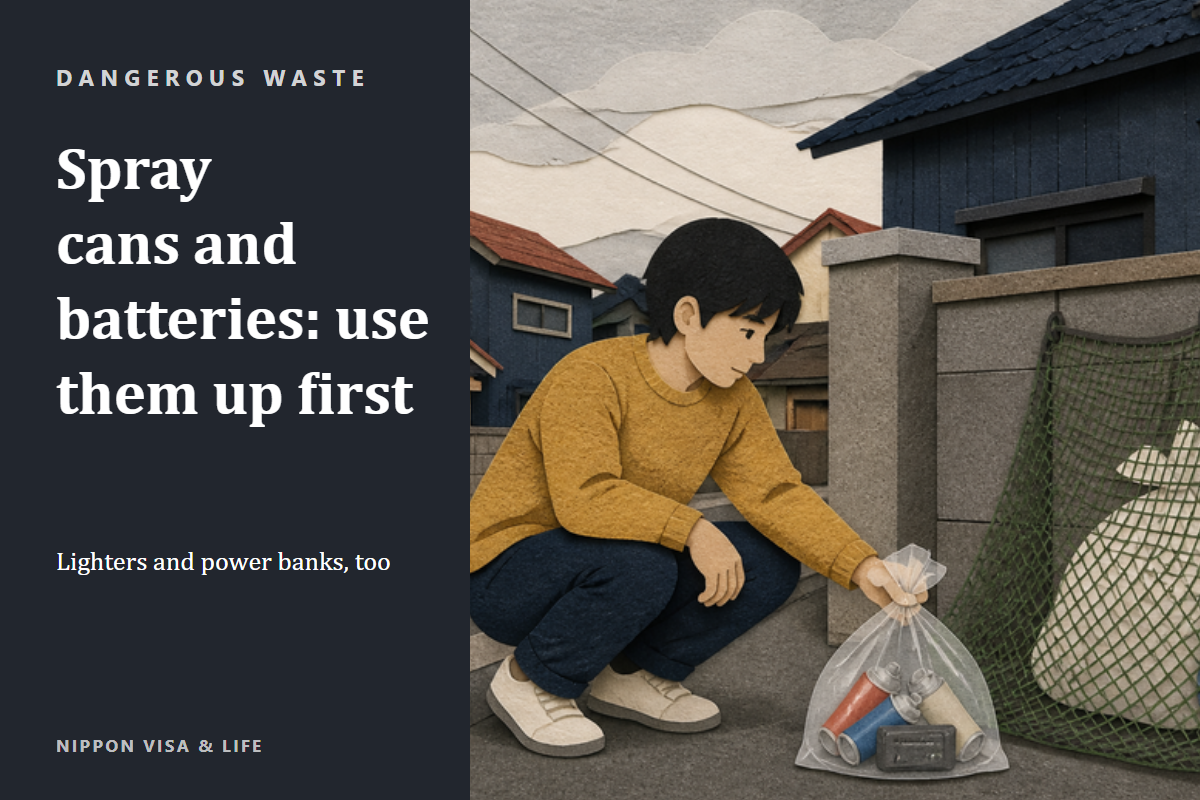
In Japan, spray cans, portable gas canisters (cassette gas cylinders), batteries and lighters can cause fires in garbage trucks and waste treatment facilities if they are mixed with other garbage. Before throwing them away, use up the contents or the battery power, and put them out in the way your city, ward, town or village has decided. The names of the garbage categories and the collection days differ from place to place, so please check the rules of the municipality where you live.
The overall rules for sorting garbage are summarized in How to Sort and Put Out Garbage in Japan: Basic Rules for Burnable, Recyclable and Oversized Garbage.
The Short Answer: Steps for Putting Out Dangerous Waste
- Check what kind of waste it is: spray cans and gas canisters, products with rechargeable batteries inside, dry-cell batteries, lighters, and so on.
- Use up the contents or the battery power: use up the contents of spray cans, and use rechargeable products until they stop working.
- Look up how your municipality collects it: search online for “(name of your city/ward) スプレー缶 出し方” or “(name of your city/ward) リチウムイオン電池 捨て方”.
- Put it out separately from other garbage: put it in the specified bag and put it out on the specified day. For batteries, you may need to cover the terminals (the metal parts) with tape.
Types of Dangerous Waste and What to Do Before Throwing Them Away
| Type | Examples | What to do before throwing away (main examples) |
|---|---|---|
| Spray cans and portable gas canisters | Insecticide, antiperspirant spray, hair spray, gas for portable gas stoves | Use up the contents. Whether to make a hole depends on your municipality’s instructions (example: Nagoya City, Osaka City and Shinjuku City say not to make a hole) |
| Products with lithium-ion batteries (rechargeable batteries) inside | Power banks (mobile batteries), smartphones, heated tobacco devices, cordless vacuum cleaners, handheld fans | Use up the power until the product stops working. Do not force the battery out |
| Dry-cell batteries and button batteries | AA and AAA batteries, button batteries for watches | Cover the terminals with tape (follow your municipality’s instructions) |
| Lighters | Disposable lighters | Use up the gas inside |
(Sources: Government Public Relations Online “Lithium-Ion Batteries: Throwing Them Away the Wrong Way Causes Fires!”, Nagoya City “How to Sort and Put Out Ignitable Hazardous Items”, Shinjuku City “How to Put Out Bottles, Cans, PET Bottles, Spray Cans, Gas Canisters, Dry-Cell Batteries, etc.”, Osaka City “How to Put Out Recyclable Garbage”)
Lithium-Ion Batteries (Rechargeable Batteries)
Why Are They Dangerous?
Lithium-ion batteries are batteries that can be recharged and used many times. If strong force is applied to them, they may catch fire. When they are put out mixed with other garbage, they can be crushed inside garbage trucks or broken up by machines at waste treatment facilities, and this can cause fires.
According to Government Public Relations Online, the number of cases in which fire broke out from garbage containing lithium-ion batteries and fire brigades or others put it out increased from 4,260 in fiscal year Reiwa 4 (FY2022) to 8,543 in fiscal year Reiwa 5 (FY2023). The products that caused them most often were power banks, followed by heated tobacco devices and cordless vacuum cleaners.
In a survey by the Ministry of the Environment in fiscal year Reiwa 6 (FY2024), the garbage category where fires occurred most often was “non-burnable garbage” (funen gomi, garbage that does not burn). Do not think “it does not burn, so it is non-burnable garbage”; check your municipality’s rules.
If You Are Not Sure Whether a Product Has a Battery
Products that can be recharged and used many times, and products that work or light up without being plugged into an outlet, may contain lithium-ion batteries. With small, cheap products or products with a plastic surface, it can be hard to tell whether there is a battery inside.
How to Throw Them Away
- Use up the power: use the product until it stops working.
- Do not take it apart: it is dangerous to force the battery out of products that have a battery built in, such as smartphones and handheld fans. Throw them away as they are.
- Check how your municipality collects them: the names of the categories, such as “dangerous garbage” (kiken gomi), “hazardous garbage” (yugai gomi), “batteries” (denchi) or “non-burnable garbage” (funen gomi), differ by municipality. The way to put them out may also differ depending on whether the battery can be removed from the product or not.
- You can also use collection boxes in stores: JBRC (a general incorporated association of manufacturers of rechargeable batteries and others) places “Small Rechargeable Battery Recycling Boxes” (kogata juden-shiki denchi recycle BOX) at public facilities, electronics stores and other places. They collect batteries removed from products and power banks. They do not collect damaged batteries, swollen batteries, or batteries from manufacturers that are not JBRC members. Before taking batteries there, check the collection locations and the batteries they accept on the JBRC website.
Example: In Shinjuku City, Tokyo: small rechargeable batteries and power banks are collected at the recycling and garbage collection points on the weekly recyclables day. Put tape over the terminals and cable sockets, and put only the rechargeable batteries in a see-through bag. Batteries that cannot be removed from the product are put out not as recyclables but as “metal, ceramics and glass garbage”.
(Sources: Government Public Relations Online “Lithium-Ion Batteries: Throwing Them Away the Wrong Way Causes Fires!”, Shinjuku City “How to Put Out Small Rechargeable Batteries”)
Spray Cans and Portable Gas Canisters
- Use up the contents. Shake the can and check that it makes no sound.
- Whether to make a hole depends on your municipality’s rules. Nagoya City, Osaka City and Shinjuku City instruct residents to put them out without making a hole. Yokohama City says “there is no need to make a hole.”
- Put them out separately from other garbage. The type of bag and what they can be put out with differ by municipality (see the examples in the table below).
Examples by municipality (as checked in October 2026):
| Municipality | Example of collection day and how to put them out |
|---|---|
| Yokohama City | Put them in a clear or semi-transparent bag and put them out on the “spray cans” collection day (the same day as “burnable garbage”) |
| Nagoya City | Put them in a designated bag for recyclables or a colorless clear bag, and put them out on the burnable garbage day as “ignitable hazardous items,” a little apart from the burnable garbage |
| Osaka City | Put them in a clear or semi-transparent bag and put them out on the recyclable garbage day, in a separate bag from cans, bottles, etc. |
| Shinjuku City | Put them in a see-through bag and put them out on the recyclables day. If you cannot use up the contents, attach a paper saying “中身あり” (contents remaining) |
How to deal with cans whose contents cannot be used up also differs by municipality. Nagoya City asks residents to consult the ward’s Environmental Services Office, and Yokohama City asks residents to consult the ward’s Resources and Waste Recycling Bureau office.
(Sources: Yokohama City “How to Put Out Spray Cans and Gas Canisters”, Nagoya City “How to Put Out Spray Cans”, Osaka City “How to Put Out Recyclable Garbage”, Shinjuku City “How to Put Out Bottles, Cans, PET Bottles, Spray Cans, Gas Canisters, Dry-Cell Batteries, etc.”)
Is It OK to Release the Gas Indoors?
Please do not do this. The Osaka Municipal Fire Department explains that even if a can makes no sound when shaken, there is still gas left inside. Gas is heavier than air and collects near the floor, so turning on a ventilation fan has only a limited effect. There have been cases where the gas caught fire from a kitchen stove flame and caused a fire. Osaka City advises that if you release gas, you should do it outdoors in a well-ventilated place with no fire nearby.
About gas canisters with contents remaining, you can contact the “Cassette Gas Canister Customer Center” of the Japan Gas Appliances Industry Association (phone 0120-14-9996) (according to Osaka City’s information).
(Sources: Osaka City “Be Careful When Handling Gas Canisters and Spray Cans!”, Osaka City “How to Put Out Recyclable Garbage”)
Dry-Cell Batteries and Button Batteries
How to put out dry-cell batteries (manganese batteries, alkaline batteries, etc.) and button batteries also differs by municipality.
- Example: In Shinjuku City, Tokyo: on the recyclables day, put dry-cell batteries and button batteries in a see-through bag, separately from other recyclables. Put tape or something similar over the terminals.
- Example: In Osaka City: dry-cell batteries are not collected on garbage days; they are collected at reception points designated by the city (collection at drop-off points). Check the locations on Osaka City’s website.
(Sources: Shinjuku City “How to Put Out Bottles, Cans, PET Bottles, Spray Cans, Gas Canisters, Dry-Cell Batteries, etc.”, Osaka City “How to Put Out Recyclable Garbage”)
Lighters and Other Things That Catch Fire Easily
Example: In Nagoya City: disposable lighters are put out as “ignitable hazardous items” after the contents are used up. The main units and chargers of heated tobacco and e-cigarettes are also “ignitable hazardous items.” Fireworks and matches are soaked in water and put out as burnable garbage. Kerosene and gasoline cannot be put out as garbage, so consult the store where you bought them or a gas station.
(Source: Nagoya City “How to Sort and Put Out Ignitable Hazardous Items”)
When You Are in Trouble: Common Mistakes
What If a Battery Is Swollen or Hot?
On a government radio program, an official of the Ministry of the Environment advises that if a product with a lithium-ion battery is “hot,” “swollen,” “leaking liquid,” or “making a strange smell or sound,” you should stop using and charging it right away and consult the manufacturer’s repair service or a similar contact. Swollen batteries cannot be put into JBRC collection boxes.
Example: Shinjuku City asks residents to take deformed or swollen rechargeable batteries to the Shinjuku Cleaning Office or one of the cleaning centers. Ask the garbage section of your municipality how to put them out.
(Sources: Government Public Relations Online “Convenient, But Be Careful! How to Use Lithium-Ion Batteries Safely”, Shinjuku City “How to Put Out Small Rechargeable Batteries”)
What If a Battery Catches Fire?
First, move away from the product and keep yourself safe. If the fire is large and you cannot put it out yourself, call 119 (the phone number for fire and ambulance) right away. The government radio program explains that pouring only a little water on it can actually make the fire stronger.
What About Things That Can Cause Injuries, Such as Knives and Glass?
Example: In Osaka City: glass cups, light bulbs, and sharp things such as kitchen knives and scissors are wrapped in thick paper, the bag is marked “キケン” (danger), and they are put out as ordinary garbage. How to put them out differs by municipality.
(Source: Osaka City “How to Put Out Recyclable Garbage”)
How Do I Throw Away Home Appliances?
Televisions, refrigerators, washing machines and air conditioners have separate rules from everyday garbage. See How to Throw Away a TV, Refrigerator, Washing Machine or Air Conditioner in Japan: Disposal Methods and Fees for the 4 Items Covered by the Home Appliance Recycling Act. Large furniture and similar items are covered in How to Put Out Oversized Garbage in Japan: Basics of Applying, Disposal Tickets (Stickers), and the Day and Place to Put It Out.
Where to Ask
- How to sort garbage and collection days: the garbage section of your city, ward, town or village (cleaning office, environmental services office, etc.). Many municipalities provide information on their websites, in printed materials, and in garbage-sorting apps.
- Collection locations for rechargeable batteries: JBRC (phone 03-6403-5673; according to Shinjuku City’s information).
- Gas canisters with contents remaining: “Cassette Gas Canister Customer Center” of the Japan Gas Appliances Industry Association (phone 0120-14-9996; according to Osaka City’s information).
Primary Sources Used for This Article
- Government Public Relations Online “Lithium-Ion Batteries: Throwing Them Away the Wrong Way Causes Fires!”
- Government Public Relations Online “Convenient, But Be Careful! How to Use Lithium-Ion Batteries Safely”
- Ministry of the Environment “Special Website on Lithium-Ion Batteries, etc.”
- Shinjuku City “How to Put Out Bottles, Cans, PET Bottles, Spray Cans, Gas Canisters, Dry-Cell Batteries, etc.”
- Shinjuku City “How to Put Out Small Rechargeable Batteries”
- Yokohama City “How to Put Out Spray Cans and Gas Canisters”
- Nagoya City “How to Sort and Put Out Ignitable Hazardous Items”
- Nagoya City “How to Put Out Spray Cans”
- Osaka City “How to Put Out Recyclable Garbage (Cans, Bottles, PET Bottles, Metal Household Goods, and Spray Cans and Gas Canisters)”
- Osaka City “Be Careful When Handling Gas Canisters and Spray Cans!”
This article is a translation of the original Japanese version.