This article was written by the NIPPON VISA & LIFE editorial team based on information from public organizations such as the national government and local governments. Rules and fees may differ depending on the city, ward, town or village where you live.
Large items such as furniture, futons and bicycles (oversized garbage, sodai gomi) cannot be put out on regular garbage days. In many cities, wards, towns and villages, there are 3 steps: apply first, pay and attach a disposal ticket (sticker), and put it out on the morning of the set day. The detailed rules differ by municipality, so check the website of the city, ward, town or village where you live.
The overall rules for sorting and putting out garbage are summarized in How to Sort and Put Out Garbage in Japan: Basic Rules for Burnable, Recyclable and Oversized Garbage.
What Is Oversized Garbage?
Oversized garbage is large garbage that comes from everyday life. Your city, ward, town or village decides from what size an item becomes oversized garbage.
- Example: Shinjuku City, Tokyo: Furniture, bedding, electrical appliances, bicycles, etc. with one side longer than about 30cm
- Example: Osaka City: Items whose longest side or diameter is more than 30cm, or stick-shaped items longer than 1m
The Immigration Services Agency’s “Guidebook on Living and Working” lists furniture such as tables and chairs, bicycles, and futons as examples of oversized garbage. When you throw them away, you may have to pay for disposal or recycling.
(Sources: Immigration Services Agency (ISA) “Guidebook on Living and Working”, Shinjuku City “How to Put Out Oversized Garbage”, Osaka City “About Oversized Garbage Collection”)
The Overall Flow First
- Apply to your municipality’s oversized garbage reception (such as a reception center) by phone or online
- Buy a disposal ticket (a sticker called “sodai gomi shori-ken,” “tesuryo-ken,” etc.) for the amount you were told at reception, at a convenience store or other shop
- Write your reception number or name, etc. on the disposal ticket and attach it to the item
- On the morning of the collection day, put the item out at the place you chose when you applied
(Sources: Shinjuku City “How to Put Out Oversized Garbage”, Osaka City “About Oversized Garbage Collection”)
Step 1: Apply
You need to apply before putting out oversized garbage. In the examples below, Shinjuku City and Osaka City, you can apply by phone or online. Online, you can apply 24 hours a day.
| Example: Shinjuku City | Example: Osaka City | |
|---|---|---|
| Phone | Monday to Saturday, 8:00 a.m. to 7:00 p.m. | Monday to Saturday, 9:00 a.m. to 5:00 p.m. |
| Online | Accepted 24 hours a day | 24 hours a day, 365 days a year |
| Changes and cancellations | Cancellations and changes: online, until 11:59 p.m. 3 days before the collection day | Changes: until 5:00 p.m. 3 days before the collection day (excluding Sundays and the year-end and New Year holidays) |
In Osaka City, you can choose a collection day at the earliest 3 days after the day you apply (4 days or more if a Sunday falls in between). Depending on how many bookings there are, you may not get the day you want. If your date is fixed, for example because you are moving, apply early.
When you apply, tell them what you want to put out (the items). Reception will tell you the collection day, your reception number, and the fee for each item. Osaka City advises you to have a memo ready when you apply by phone. When you apply online, your reception number and other details are sent by email.
The phone line may be hard to get through on Mondays, the day after a public holiday, etc. (according to Osaka City). If you cannot get through, you can also apply online.
(Sources: Shinjuku City “How to Put Out Oversized Garbage”, Osaka City “About Applying for Oversized Garbage Collection”)
Step 2: Buy Disposal Tickets (Stickers)
Oversized garbage collection is not free. The fee is decided by the type and size of the item. Buy disposal tickets for the amount you were told at reception.
- Where to buy: Convenience stores, supermarkets and other shops with a sign (such as a sticker) showing that they sell disposal tickets. In some municipalities, you can also buy them at the municipal office. Shops without the sign do not sell them.
- Only for that municipality: Disposal tickets differ by city, ward, town or village. For example, in Shinjuku City you use disposal tickets “for Shinjuku City only.” Disposal tickets from other municipalities cannot be used.
- For each item: Prepare the necessary number of disposal tickets for each piece of oversized garbage.
- Refunds may not be possible: In Osaka City, disposal tickets cannot be refunded or reissued. Once attached, they cannot be peeled off. Check the amount and the number of tickets before you buy.
In Osaka City, when you apply online, you can also pay the fee by credit card or smartphone payment (cashless). In that case, instead of a disposal ticket, you write your reception number on a piece of paper and attach it. Payment methods differ by municipality.
(Sources: Shinjuku City “How to Put Out Oversized Garbage”, Osaka City “About Oversized Garbage Collection”, Osaka City “About Applying for Oversized Garbage Collection”)
Step 3: Attach the Disposal Ticket and Put the Item Out on the Morning of the Collection Day
- Write your reception number or name, etc. on the disposal ticket (in Shinjuku City, you write your name or reception number and the scheduled collection date. If you live in an apartment or condominium, also write your room number).
- Attach a disposal ticket to each piece of oversized garbage where it can be seen easily.
- On the morning of the collection day, put the item out at the place decided when you applied.
- Time: In Osaka City, put it out by 8:30 a.m. on the collection day. Do not put it out the night before; put it out on the morning of that day.
- Place: Put it out at the place decided when you applied. The rules on where to put it out differ by municipality.
- Example: Shinjuku City: In front of the house for a detached house, and near the entrance on the 1st floor for an apartment or condominium, etc. The place for oversized garbage may be different from the place for regular garbage.
- Example: Osaka City: If the collection truck cannot get to the front of your home, in principle the regular garbage collection point is designated.
- Receipt: Osaka City advises you to keep the “purchaser’s copy (receipt)” of the disposal ticket until collection is finished.
If your reception number cannot be confirmed, the item may not be collected. If you want to put it out in advance at the oversized garbage area of your apartment or condominium, consult the building manager or similar person.
(Sources: Shinjuku City “How to Put Out Oversized Garbage”, Osaka City “About Oversized Garbage Collection”, Osaka City “About Applying for Oversized Garbage Collection”)
Items That Cannot Be Put Out as Oversized Garbage
The following items often cannot be put out as oversized garbage, so throw them away in a different way.
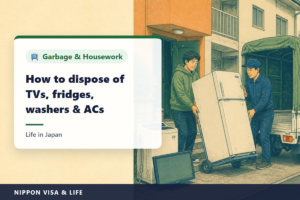
- Air conditioners, TVs, refrigerators/freezers, washing machines/clothes dryers (4 types of home appliances): These are covered by the Home Appliance Recycling Act. The basic way is to ask for pickup at the store where you buy the new product if you are replacing it, or at the store where you bought the product if you are only throwing it away. A recycling fee and a collection and transportation fee are charged.
- Personal computers: Under a law (the Act on the Promotion of Effective Utilization of Resources), manufacturers and others collect and recycle them.
- Cars, motorcycles, tires, pianos, fireproof safes, etc.: Shinjuku City says the city cannot collect them. Ask your city, ward, town or village what to do.
If you do not know how to throw away home appliances, first ask the garbage section of the city, ward, town or village where you live.
(Sources: Shinjuku City “How to Put Out Oversized Garbage”, Osaka City “About Oversized Garbage Collection”, Ministry of the Environment “Do Not Use ‘Unlicensed’ Collectors to Dispose of Waste!”, National Consumer Affairs Center of Japan “Troubles with Unwanted Item Collection Services”)
Troubles and Common Mistakes
If I take it apart into small pieces, can I put it out as regular garbage?
It depends on the municipality. Shinjuku City advises that you put it out as oversized garbage even if you take it apart. In Osaka City, even if you take apart an item whose fee depends on its size, the fee is decided by its size before it was taken apart. Before taking something apart to put it out, check the rules of your city, ward, town or village.
I will have a lot of oversized garbage because I am moving
Osaka City says it also collects garbage that comes out in large amounts for a short time, such as when moving or doing a big clean-up, as oversized garbage. Collection days can be fully booked, so once your moving date is decided, apply early. Procedures before and after moving are summarized in Checklist for Moving Within Japan: Moving-out and Moving-in Notifications, Residence Card, Electricity, Gas and Water, and Mail Forwarding.
Can I use flyers or trucks that say “we collect for free”?
You need to be careful. To collect household garbage, a business needs a general waste disposal business permit from the city, ward, town or village, or a contract from the municipality. An “industrial waste disposal business permit” or a “secondhand dealer permit” alone does not allow a business to collect household garbage (Ministry of the Environment).
The National Consumer Affairs Center of Japan receives many consultations about unwanted item collection services, and the number exceeded 2,000 in fiscal year 2021. In some cases, the price in the advertisement was low, but a high price was demanded after the work was done.
If you ask someone other than your municipality, check the following (advice from the National Consumer Affairs Center of Japan).
- Look for businesses with a general waste disposal business permit on your municipality’s website, etc.
- Get estimates from several businesses
- Check whether there are additional fees or cancellation fees
- Ask them to clearly show the work to be done and the price
If you have trouble, you can consult the Consumer Hotline “188” (a nationwide number that connects you to a nearby consumer affairs center or similar office).
(Sources: Ministry of the Environment “Do Not Use ‘Unlicensed’ Collectors to Dispose of Waste!”, National Consumer Affairs Center of Japan “Troubles with Unwanted Item Collection Services”)
It feels wasteful to throw away things that can still be used
Instead of throwing away furniture and home appliances that can still be used, you can also reuse them (have someone else use them again). The Ministry of the Environment advises that when you sell items as secondhand goods, you should use a trustworthy reuse shop or similar business that has a secondhand dealer permit. Shinjuku City and Osaka City also encourage people to consider reuse before putting items out as oversized garbage.
(Sources: Ministry of the Environment “Do Not Use ‘Unlicensed’ Collectors to Dispose of Waste!”, Shinjuku City “How to Put Out Oversized Garbage”, Osaka City “About Oversized Garbage Collection”)
How to Find the Rules of Your Municipality
- Search online for “(name of your city, ward, town or village) 粗大ごみ” and open the official website of your municipality.
- Some municipalities have garbage sorting apps (example: Osaka City’s garbage sorting app for smartphones).
- If you are unsure, contact the garbage section of your municipality (such as the sanitation office or the environment division).
Primary Sources Used for This Article
- Immigration Services Agency (ISA) “Guidebook on Living and Working” (Chapter 12: Rules and Customs in Daily Life)
- Shinjuku City “How to Put Out Oversized Garbage”
- Osaka City “About Oversized Garbage Collection”
- Osaka City “About Applying for Oversized Garbage Collection”
- Ministry of the Environment “Do Not Use ‘Unlicensed’ Collectors to Dispose of Waste!”
- National Consumer Affairs Center of Japan “Troubles with Unwanted Item Collection Services” (November 2, 2022)
This article is a translation of the original Japanese version.