This article was written by the NIPPON VISA & LIFE editorial team based on information from public organizations such as the national government and local governments. Rules and fees may differ depending on the city, ward, town or village where you live.
If you feel unwell in Japan, go to a clinic near you for everyday illnesses and injuries, and call 119 for an ambulance for a sudden illness or injury that may be life-threatening. If you are not sure whether to call an ambulance, there are phone lines where you can get advice (such as #7119). This article sums up, situation by situation, “where to go and what to use.”
Where to Go in Each Situation (Overview)
| Situation | Where to go / what to use | Detailed article |
|---|---|---|
| Everyday illnesses and injuries, such as a cold or a minor injury | A clinic near you | How to see a doctor |
| A sudden illness or injury that may be life-threatening | 119 (ambulance) | How to call an ambulance |
| You are not sure whether to call an ambulance | #7119, #8000 (advice about children) | How to call an ambulance |
| You received a prescription (a written instruction for medicine) from a doctor | Pharmacy | How to see a doctor |
| You want to buy medicine without a prescription | Pharmacy or drugstore | This article |
| You want to lower your medical costs or learn about insurance | The public medical insurance you belong to (your company’s Health Insurance, National Health Insurance, etc.) | This article |
| You found out you are pregnant | Your city, ward, town or village (pregnancy notification) | This article |
| You want to talk about your worries or painful feelings | Phone and social media consultation services | This article |
(Sources: Immigration Services Agency “Guidebook on Living and Working”, Fire and Disaster Management Agency “Let’s Use Ambulances Wisely”)
Everyday Illnesses and Injuries: First Go to a Clinic Near You
Medical institutions in Japan have different roles. For a minor illness or injury, go to a clinic near you. Small and medium-sized hospitals handle cases that need surgery or hospitalization, and large hospitals handle patients with serious emergencies or cases that need advanced medical care.
- At reception, show your My Number health insurance card (a My Number card registered for use as a health insurance card) or a similar document. If you do not show one, you will have to pay the full medical cost yourself. For the time being, people who do not have a My Number health insurance card receive an eligibility certificate from the medical insurance they belong to.
- The department you go to (internal medicine, surgery, pediatrics, orthopedics, ophthalmology, dentistry, obstetrics, etc.) depends on your illness or injury. If you do not know, call the medical institution and ask before you go.
- You can find medical institutions in the public relations magazine of your city, ward, town or village, on the internet, and on the Ministry of Health, Labour and Welfare’s Medical Information Net (Navii). On the Japan National Tourism Organization (JNTO) website, you can search for medical institutions in foreign languages.
The steps from reception, the medical questionnaire (a form where you write your symptoms and other details), and paying to getting your medicine are explained in detail in How to See a Doctor in Japan: Choosing Between Hospitals and Clinics, What to Show at Reception, the Medical Questionnaire, Paying, and Getting Your Medicine at a Pharmacy.
(Sources: Immigration Services Agency “Guidebook on Living and Working”, Ministry of Health, Labour and Welfare “About the Eligibility Certificate”, Medical Information Net (Navii), Japan National Tourism Organization (JNTO) “Guide to Using Medical Institutions”)
Sudden Illness or Injury: 119 and Phone Lines for When You Are Not Sure
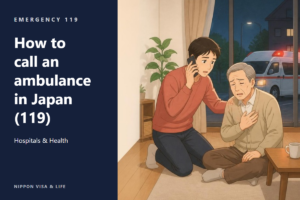
- The number to call an ambulance is 119 (119 is also the number for a fire). When the call connects, say “It’s an emergency (medical)” (“Kyukyu desu”), and tell them the location, the symptoms, the age, and your name and contact information.
- When you call 119 in a foreign language, many fire departments can provide three-way interpretation through a telephone interpretation center.
- If you are not sure whether to call an ambulance, you can get advice by phone from the emergency consultation lines of prefectures and municipalities. There is #7119 (Emergency Consultation Center Service) and #8000 (Children’s Medical Telephone Consultation Service) for advice about a child’s condition. #7119 can be used only in areas that run this service. The hours and the ages covered differ by area.
- To call the police (for a traffic accident, if you are the victim of a crime, etc.), dial 110.
For what you will be asked when you dial 119, examples of symptoms that need an ambulance right away, and what to prepare before the ambulance arrives, see How to Call an Ambulance in Japan: How to Dial 119, What to Say, and Where to Get Advice When You Are Unsure (#7119).
(Sources: Immigration Services Agency “Guidebook on Living and Working”, Fire and Disaster Management Agency “Let’s Use Ambulances Wisely”, Fire and Disaster Management Agency “Emergency Consultation Center Service (#7119)”, Fire and Disaster Management Agency “119 Calls with Three-Way Simultaneous Interpretation”)
Medicine: The Difference Between Pharmacies and Drugstores
| Store | What you can do |
|---|---|
| Pharmacy | A pharmacist prepares the medicine on the prescription from your doctor, explains how to take it, and then gives it to you. You can also buy medicine that does not need a prescription (OTC medicine) |
| Drugstore | You can buy medicine that does not need a prescription (OTC medicine). Drugstores do not accept prescriptions |
- Medicine has side effects, so you need to be careful how you use it.
- If you have questions, ask a pharmacist or a registered seller (a person who can sell some types of medicine that do not need a prescription) at a pharmacy or drugstore.
(Sources: Immigration Services Agency “Guidebook on Living and Working”)
How Medical Insurance and Medical Costs Work
Everyone living in Japan, regardless of nationality, joins public medical insurance. Which insurance you join depends on how you work and other factors.
| Insurance | Who joins (main examples) |
|---|---|
| Health Insurance | Regular employees and others working at companies that are required to have Health Insurance. Part-time workers who meet certain conditions also join |
| National Health Insurance | People under 75 who are registered as residents and are not covered by Health Insurance at work |
| Medical Care System for the Elderly Aged 75 and Over | People aged 75 and over who are registered as residents, and certain others |
- You join and leave National Health Insurance and the Medical Care System for the Elderly Aged 75 and Over at your city, ward, town or village.
- People whose period of stay is 3 months or less, people with the status of residence “Temporary Visitor” (短期滞在), and certain others may not be able to join National Health Insurance. For details, ask your city, ward, town or village.
- If you are in National Health Insurance and move to another city, ward, town or village, or join Health Insurance at work, you need to go through the procedure to leave National Health Insurance.
- At the counter, you pay only part of the medical cost (the co-payment). People under 70 pay 30%, and children under 6 (before starting elementary school) pay 20%.
- There is a system called high-cost medical expense benefits (kogaku ryoyohi) that returns the amount over a certain limit when the amount you paid at the counters of medical institutions and pharmacies in one month exceeds that limit. The limit differs depending on your age and income.
- For example, when you have just started a job or just joined the insurance and have neither a registered My Number health insurance card nor an eligibility certificate, you pay the full cost first, and if you apply later and it is approved, you can receive the amount over your co-payment as medical expenses (ryoyohi).
You register as a resident (moving-in notification) at your city, ward, town or village within 14 days after your address in Japan is decided. Joining National Health Insurance is also a procedure at your city, ward, town or village (Moving-in Notification and Resident Record: Go to Your City Office Within 14 Days After Your Address in Japan Is Decided (What to Bring, Steps, and When You Move)).
(Sources: Immigration Services Agency “Guidebook on Living and Working”)
When You Become Pregnant
- When you find out you are pregnant, submit a pregnancy notification to your city, ward, town or village as early as possible.
- After you submit it, your city, ward, town or village gives you a Maternal and Child Health Handbook (boshi kenko techo, a notebook for recording the health of the mother and child). You also receive vouchers or subsidy tickets so that you can have prenatal checkups (health checkups during pregnancy) with public subsidies. You can also get advice from public health nurses and others.
- After your child is born, there are vaccinations recommended by your city, ward, town or village, and they may be free. For details, ask your city, ward, town or village.
(Sources: Immigration Services Agency “Guidebook on Living and Working”, Children and Families Agency “Maternal and Child Health Handbook Information Support Site”)
Health Checkups at Your Company
Companies are required to have a doctor give workers a health checkup when they hire them, and once a year after that. Workers must receive these health checkups. Not only regular employees, but also dispatched workers, contract employees, part-time workers and others who meet certain conditions are covered.
(Sources: Immigration Services Agency “Guidebook on Living and Working”)
When You Want to Talk About Painful Feelings or Worries
If you are carrying worries or anxiety alone, there are services where you can talk by phone or on social media. On the Ministry of Health, Labour and Welfare’s “Mamorouyo Kokoro” page, you can choose a service.
| Service | Phone number | Hours and other details |
|---|---|---|
| Yorisoi Hotline | 0120-279-338 (free) | 24 hours. You can also choose support in foreign languages from the voice guidance |
| Kokoro no Kenko Sodan Unified Dial (mental health consultation) | 0570-064-556 (call charges apply) | Days and hours differ by prefecture |
- For the Yorisoi Hotline, call 0120-279-226 from Fukushima Prefecture, and 050-3655-0279 from an IP phone number starting with 050.
- For people who find it hard to talk on the phone, there are also services where you can get advice on LINE or by chat.
- For a sudden illness or injury, call 119.
(Sources: Ministry of Health, Labour and Welfare “Mamorouyo Kokoro”, Immigration Services Agency “Guidebook on Living and Working”)
Where to Get Help If You Are Worried About Japanese or Have a Problem
- Your city, ward, town or village
- The international association in your area
- NPOs (some may offer consultations in foreign languages)
- Medical Safety Support Centers: There are about 400 centers in prefectures and in cities and special wards that have a public health center. You can get advice about medical care.
(Sources: Immigration Services Agency “Guidebook on Living and Working”, Medical Safety Support Centers)
Primary Sources Used for This Article
- Immigration Services Agency “Guidebook on Living and Working” (Chapter 3: Employment and Labor, Chapter 4: Childbirth and Childcare, Chapter 6: Medical Care, Chapter 10: Emergencies and Disasters)
- Fire and Disaster Management Agency “Let’s Use Ambulances Wisely”
- Fire and Disaster Management Agency “Emergency Consultation Center Service (#7119)”
- Fire and Disaster Management Agency “119 Calls with Three-Way Simultaneous Interpretation”
- Ministry of Health, Labour and Welfare “About the Eligibility Certificate (How to See a Doctor Without Using the My Number Health Insurance Card)”
- Ministry of Health, Labour and Welfare “Mamorouyo Kokoro”
- Children and Families Agency “Maternal and Child Health Handbook Information Support Site”
- Medical Information Net (Navii)
- Japan National Tourism Organization (JNTO) “Guide to Using Medical Institutions”
- Medical Safety Support Centers
This article is a translation of the original Japanese version.