This article was written by the NIPPON VISA & LIFE editorial team based on information from public organizations such as the national government and local governments. Rules and fees may differ depending on the city, ward, town or village where you live.
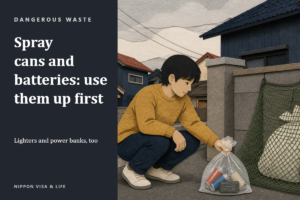
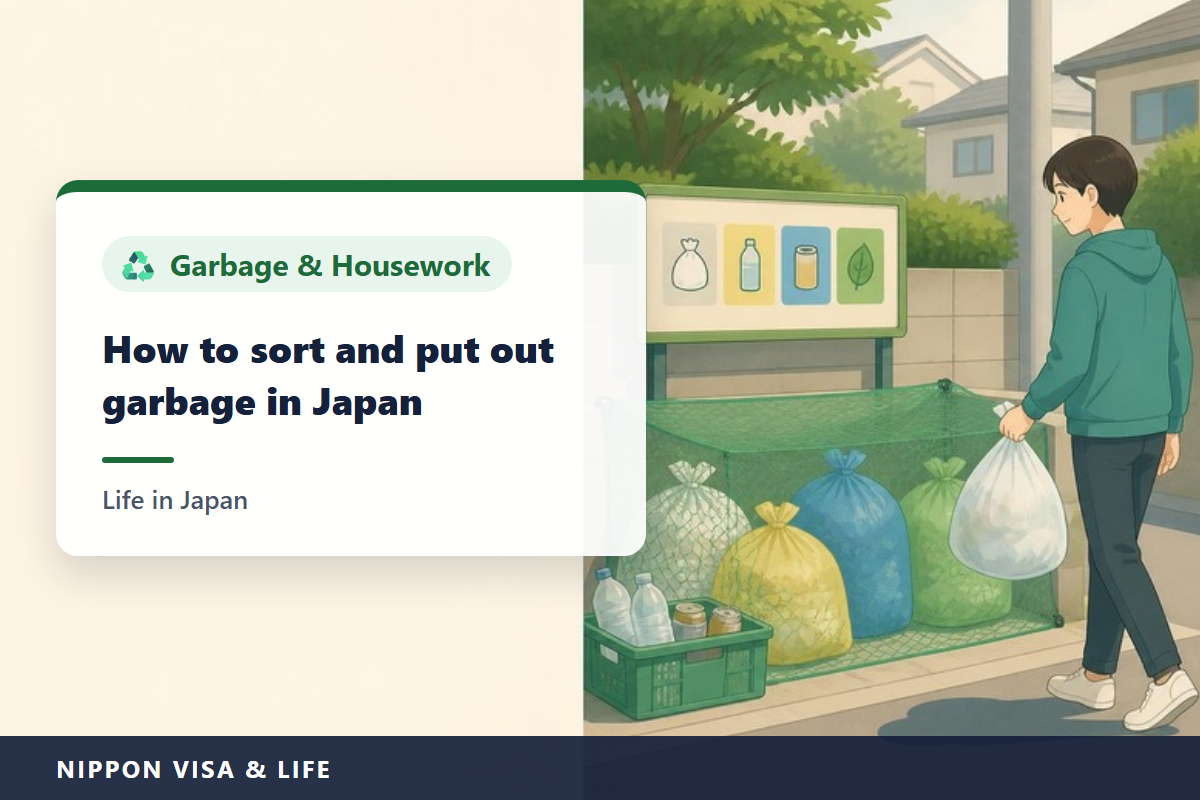
In Japan, garbage is sorted by type and put out on set days at set places. How to sort it and on which day of the week to put it out are decided by your local municipality (the office of your city, ward, town or village). Start by getting the rules of your municipality.
Three Basic Rules to Know First
When you put out garbage, follow these three rules.
- Sort by type: Sort your garbage into the types decided by your municipality, such as burnable garbage and recyclable garbage.
- Put it out on the set day (day of the week): Each type has its own day. In general, you put garbage out on the morning of the collection day.
- Put it out at the set place: Each building or area has a set place for putting out garbage (garbage collection point).
Garbage that is not one of the set types, or garbage put out somewhere other than the set place, will not be collected. Some municipalities require you to use paid garbage bags designated by the municipality.
Examples of Garbage Types
The names of garbage types and how to sort them differ by municipality. The table below shows common examples. Always check the rules of the municipality where you live.
| Garbage type | Examples |
|---|---|
| Burnable garbage (also called “moeru gomi” or “kanen gomi”) | Food waste from the kitchen, paper waste, etc. |
| Non-burnable garbage (also called “moenai gomi” or “funen gomi”) | Broken plates and cups, metal, glass, etc. |
| Recyclable garbage (shigen gomi) | Bottles (bin), cans, PET bottles, newspapers, books, plastic containers, cardboard, etc. |
| Oversized garbage (sodai gomi, large garbage) | Furniture such as tables and chairs, bicycles, futons, etc. |
| Home appliance garbage | Air conditioners, TVs, refrigerators/freezers, washing machines/clothes dryers, etc. |
When you throw away oversized garbage and home appliance garbage, you may have to pay for disposal or recycling.
How to Find the Rules of Your Municipality
Rules differ by municipality, so when you move, be sure to check the rules for your new address. Here is how to find them.
- Your municipality’s website: Search for “(name of your municipality) ごみ 分け方” (garbage sorting). Some municipalities provide information in foreign languages.
- Garbage sorting charts and calendars: You may be able to get these at the municipal office counter. They show which type to put out on which day of the week.
- The management company or landlord of your apartment: If you do not know where your building’s garbage area is or how to use it, ask them.
- The counter at your municipal office: If you are unsure, contact the counter in charge of garbage and recycling.
How to Throw Away Oil After Cooking
Do not pour cooking oil down the kitchen sink. Soak up the oil by putting paper towels in the pot, or harden it with an oil-solidifying agent (gyokozai), and then throw it away following the rules of your municipality.
How to Dispose of Air Conditioners, TVs, Refrigerators and Washing Machines (Home Appliance Garbage)
The following 4 types of home appliances are covered by a law (the Home Appliance Recycling Act). They must be thrown away in a different way from other garbage.
- Air conditioners
- TVs
- Refrigerators/freezers
- Washing machines/clothes dryers
When you replace or throw away these appliances, you pay a recycling fee and a fee for transporting them (collection and transportation fee). To throw them away, you need to ask a business that has a permit to collect and transport waste.
Where to ask for pickup:
- When you buy a new product to replace the old one: The store where you buy the new product. Pickup methods differ by store, so ask the store.
- When you are only throwing it away without buying a new one: The store where you bought the product. If you do not know which store you bought it from, contact your municipality.
If you do not know which business to ask, also contact your municipality.
(Sources: Immigration Services Agency (ISA) “Guidebook on Living and Working” Chapter 12: Rules and Customs in Daily Life, Ministry of the Environment “Home Appliance Recycling Act Q&A (3)”)
Throwing Garbage Away Outside Set Places Is Illegal
Wherever you are, you must not carelessly throw garbage away anywhere other than the set places. This is called “illegal dumping” (fuho toki), and you may receive a criminal penalty.
Also, many municipalities ban “littering” (poi-sute), such as throwing empty cans or cigarette butts on the street, by local ordinance (rules of the municipality). You may be punished, so do not litter.
(Sources: Immigration Services Agency (ISA) “Guidebook on Living and Working” Chapter 12: Rules and Customs in Daily Life, e-Gov Law Search “Waste Management and Public Cleansing Act”)
Troubles and Common Questions
Can I put garbage out the night before?
In general, garbage is put out on the morning of the collection day. Check your municipality’s or building’s rules to see whether you may put it out the day before.
The garbage I put out was left behind. What should I do?
Garbage that is not one of the set types, or garbage put out somewhere other than the set place, will not be collected. Check your municipality’s rules again to make sure you sorted it correctly and put it out on the right day.
I will have a lot of garbage because I am moving
Sort it by type and put it out on the set days, just like your everyday garbage. Large items such as furniture go out as oversized garbage, and air conditioners, TVs, refrigerators and washing machines are thrown away using the “home appliance garbage” method above. If you have a lot of garbage or do not know how to put it out, consult your municipality early.
Primary Sources Used for This Article
- Immigration Services Agency (ISA) “Guidebook on Living and Working” (8th edition)
- Ministry of the Environment “Home Appliance Recycling Act Q&A (3)”
- e-Gov Law Search “Waste Management and Public Cleansing Act”
This article is a translation of the original Japanese version.