This article was written by the NIPPON VISA & LIFE editorial team based on information from public organizations such as the national government and local governments. Rules and fees may differ depending on the city, ward, town or village where you live.
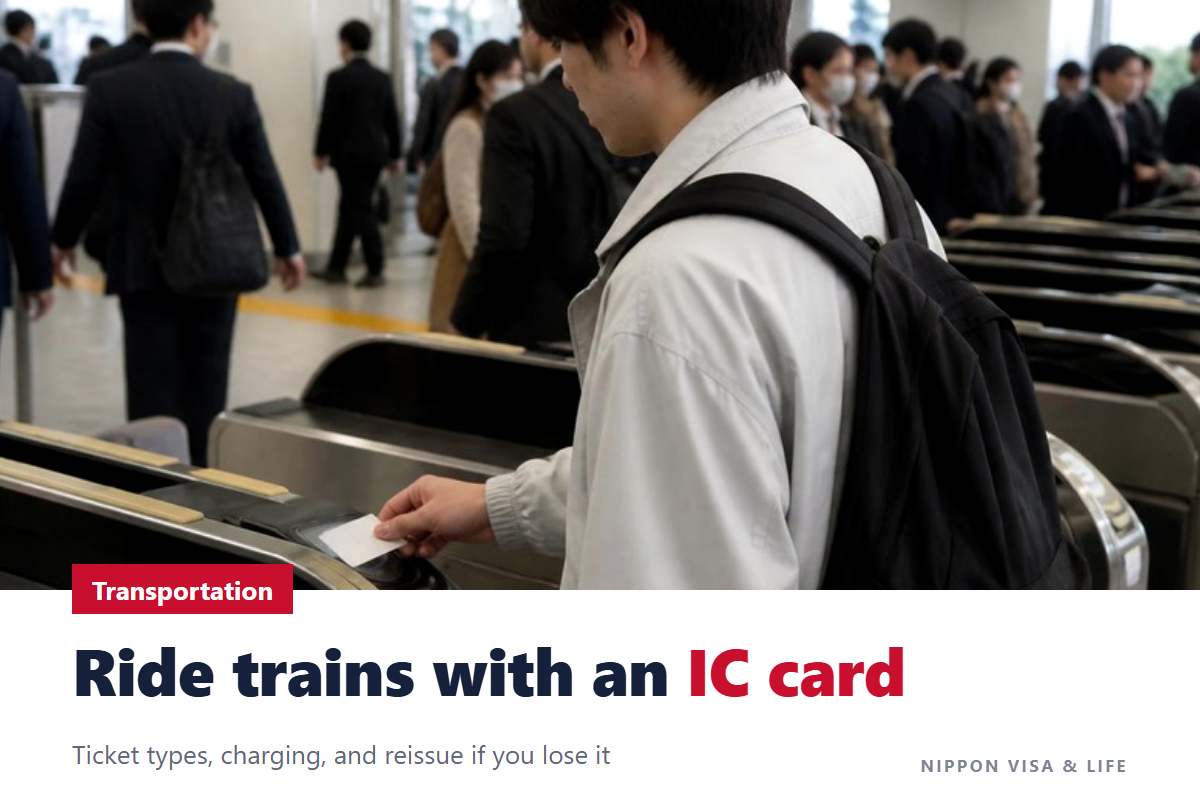
When you ride a train in Japan, you either buy a ticket or use an IC transit card (a card that you put money on in advance and touch at the ticket gate to pay the fare). With an IC card, you do not have to buy a ticket every time. This article explains the basics of riding trains, and how to buy an IC card, charge it (add money), and what to do if you lose it.
The Overall Flow
The Immigration Services Agency’s “Guidebook on Living and Working” explains the basic steps for riding a train as follows.
- Check your destination on the route map
- At the station, buy a ticket to your destination and go through the ticket gate (the machine at the station entrance). At stations where IC cards can be used, hold your card over the automatic ticket gate to go through
- Look at the signs in the station and go to the platform “track number” (the number of the platform) where the train going in your direction arrives
- On the platform, wait for the train behind the white line or the yellow blocks (tactile paving)
- At the station where you get off, go through the ticket gate to exit. If you use an IC card, the fare is deducted from the money left on your card when you hold it over the ticket gate
(Source: Immigration Services Agency, “Guidebook on Living and Working”)
Differences Between Tickets and IC Transit Cards
| Ticket | IC transit card | |
|---|---|---|
| How to pay | Before riding, buy a ticket to your destination at a ticket machine or elsewhere | Put money on the card (charge it) in advance and touch it at the ticket gate |
| Fare | The ticket fare | May be cheaper than buying a ticket with cash |
| Where you can use it | The section you bought | Trains and buses of many different companies |
| Where to buy | Ticket machines at stations, etc. | Ticket machines and counters at stations, bus offices, etc. |
The guidebook explains that by putting money on an IC card in advance, you can save the trouble of buying a ticket at a ticket machine.
(Sources: Immigration Services Agency, “Guidebook on Living and Working”, PASMO, “Buying a PASMO card”)
Buying an IC Transit Card
There are IC cards with many different names depending on the region and the company. For example, in the Tokyo metropolitan area, Suica and PASMO are used. Here, we explain using PASMO’s official information as an example.
Registered Cards and Unregistered Cards
| Registered card | Unregistered card | |
|---|---|---|
| Name on the card | Printed | Not printed |
| Registration when buying | Name, date of birth, gender, phone number | None |
| If you lose it | Can be reissued | Cannot be reissued |
If you use it every day, a registered card, which can be reissued if you lose it, gives you peace of mind.
(Sources: Immigration Services Agency, “Guidebook on Living and Working”, PASMO, “Buying an adult PASMO (unregistered / registered)”)
Where and How to Buy
- Ticket machines at stations: For PASMO, on the ticket machine screen, select “PASMO” → “Buy a new PASMO” → “Buy an unregistered PASMO” or “Buy a registered PASMO”, and follow the instructions on the screen (the operation differs depending on the type of ticket machine).
- Station counters: At the commuter pass counter, fill in an application form and buy the card.
- You cannot buy it with a credit card (for PASMO). Have cash ready.
Deposit
When you buy an IC card, you generally pay a deposit. This is money that is returned to you when you give the card back. The deposit for PASMO is 500 yen.
(Sources: Immigration Services Agency, “Guidebook on Living and Working”, PASMO, “Buying an adult PASMO (unregistered / registered)”, PASMO, “How to charge at stations”)
Charging (Adding Money)
To ride a train with an IC card, you need to put money on the card first. This is called charging.
For PASMO, you charge at a station as follows.
- Insert your card into a ticket machine or charging machine that can be used for charging
- On a ticket machine, press the “PASMO” button
- Choose the amount you want to add and put in cash
- Take your card (you can get a receipt if you need one)
- You cannot charge so that the balance on the card goes over 20,000 yen.
- If you charged by mistake, you can cancel it at the station where you charged, etc., on the same day as the charge and only if you have not used it yet.
- Besides stations, you may also be able to charge on buses, at bus offices, at convenience stores, etc.
(Sources: PASMO, “How to charge at stations”, PASMO, “Charging a PASMO card”)
Going Through the Ticket Gate (IC Card)
- Touch your card flat and firmly on the reader with the IC mark on the ticket gate.
- Always touch your card when you get off, not only when you get on. The fare is deducted when you touch your card at the station where you get off.
- For PASMO, you will hear a “beep” or “beep-beep” sound and a message will appear on the screen.
- Do not insert your card into the ticket slot of the ticket gate.
- One card cannot be used by several people at the same time (according to PASMO). One card per person.
If you do not touch your card firmly, you may be charged the fare for a different route from the one you took, or you may not be able to use the card next time.
(Sources: Immigration Services Agency, “Guidebook on Living and Working”, PASMO, “How to use it on trains”, PASMO, “How train fares are calculated”)
Types of Tickets
The guidebook introduces the following tickets.
- Regular ticket (passenger ticket): The ordinary ticket you need to ride a train.
- Commuter pass: A ticket for when you ride the same section many times for commuting to work or school. There are 1-month, 3-month, 6-month passes and so on, and they are set cheaper than riding the same section with regular tickets.
- Limited express ticket: Needed in addition to the passenger ticket when you ride the shinkansen or a limited express train.
- Reserved seat ticket: Needed when you use a reserved seat (a seat that is assigned to you). Some come as a set with a limited express ticket.
- Green ticket: Needed when you use a car of a higher class than ordinary cars (Green Car).
When you ride the shinkansen or a limited express train, or use a reserved seat or Green Car, you need to buy these additional tickets as well as the passenger ticket.
(Source: Immigration Services Agency, “Guidebook on Living and Working”)
Things to Be Careful About When Getting On and Off
The guidebook asks you to be careful about the following points.
- When getting on and off, do not push other people; let people getting off go first, and get on and off in order
- When there is a signal that the doors are closing, or when the doors are starting to close, do not force your way on or off; wait for the next train
- Do not go down from the platform onto the tracks
- Do not talk loudly on the train. Talking on a mobile phone is considered bad manners in Japan
- Do not let sound leak from your earphones
- When the train is crowded, do not keep your backpack on your back (because it bumps into other people)
(Source: Immigration Services Agency, “Guidebook on Living and Working”)
When You Have a Problem / Common Mistakes
At the station where I got off, there was not enough money on my card
If you cannot get out through the ticket gate, charge your card or pay the difference at the fare adjustment machine near the ticket gate (according to PASMO). If you are not sure what to do, ask the station staff.
There is money on my card, but it does not work at the ticket gate
PASMO says the cause may be one of the following.
- You touched it together with another IC card (for example, two cards in your pass holder)
- You touched it together with something that blocks radio waves, such as aluminum foil
- You had not used it for a while
- The fare adjustment from the last time you used it has not been completed, or the card is broken
If it still does not work when you touch it with only that one card, tell the station staff.
(Sources: PASMO, “Buying a PASMO card” (FAQ), PASMO, “How to use it on trains”)
Can I ride all the way to Osaka with a card I bought in Tokyo?
With PASMO, you cannot ride across different areas, such as from the Tokyo metropolitan area to the Kansai area. In regions with mutual use (a system that lets you ride with cards from other regions), you can use it within each area. When you travel far, buy a ticket.
(Source: PASMO, “Buying a PASMO card” (FAQ))
I lost my card
A registered card can be reissued. An unregistered card cannot be reissued.
Here are the steps for PASMO.
- At a station or bus counter, etc. in the PASMO/Suica area (with some exceptions), report that you lost the card and fill in an application form. Show an official document that proves your identity
- The staff will register the reissue and give you a “reissue slip” (keep it safe)
- Within 14 days starting from the day after the registration, at a station or bus counter, etc. in the PASMO area (with some exceptions), hand over the reissue slip, show your identity document, and pay a total of 1,020 yen: a 500-yen deposit and a 520-yen reissue fee
The money and commuter pass that were on the card when you reported the loss are transferred to the new card. If 14 days pass, you need to apply again.
(Source: PASMO, “Reissuing a lost PASMO”)
I no longer need my card (for example, when going back to my home country)
This is for PASMO. If you take your card to a station or bus counter, etc. in the PASMO area (except for some counters), you can get a refund. For a registered card, you need an official document that proves your identity. The card will be collected.
- You cannot get a refund of only the remaining money (you will return the card).
- A handling fee is charged for the refund. If the remaining money is less than the fee, the remaining money becomes the fee.
(Source: PASMO, “PASMO refunds”)
How to Find Out About the Card Used in Your Area
- Look at the “IC card” page on the official website of the railway company or bus company in the area where you live. It shows the names of the cards you can use, where to buy them, and how to charge them.
- If you are not sure, tell the station staff, “I want to buy an IC card.”
The overall way to ride trains and buses in Japan is explained in Basics of Riding Trains and Buses in Japan. For the rules for riding a bicycle, read Rules for Riding a Bicycle in Japan: Keep Left, Helmets, Bicycle Crime Prevention Registration, and Blue Tickets (Fines).
Primary Sources Referred to for This Article
- Immigration Services Agency, “Guidebook on Living and Working” (Chapter 12: Rules and Customs in Daily Life)
- PASMO, “Buying a PASMO card”
- PASMO, “Buying an adult PASMO (unregistered / registered)”
- PASMO, “Charging a PASMO card”
- PASMO, “How to charge at stations”
- PASMO, “How to use it on trains”
- PASMO, “How train fares are calculated”
- PASMO, “Reissuing a lost PASMO”
- PASMO, “PASMO refunds”
This article is a translation of the original Japanese version.