This article was written by the NIPPON VISA & LIFE editorial team based on information from public organizations such as the national government and local governments. Rules and fees may differ depending on the city, ward, town or village where you live.
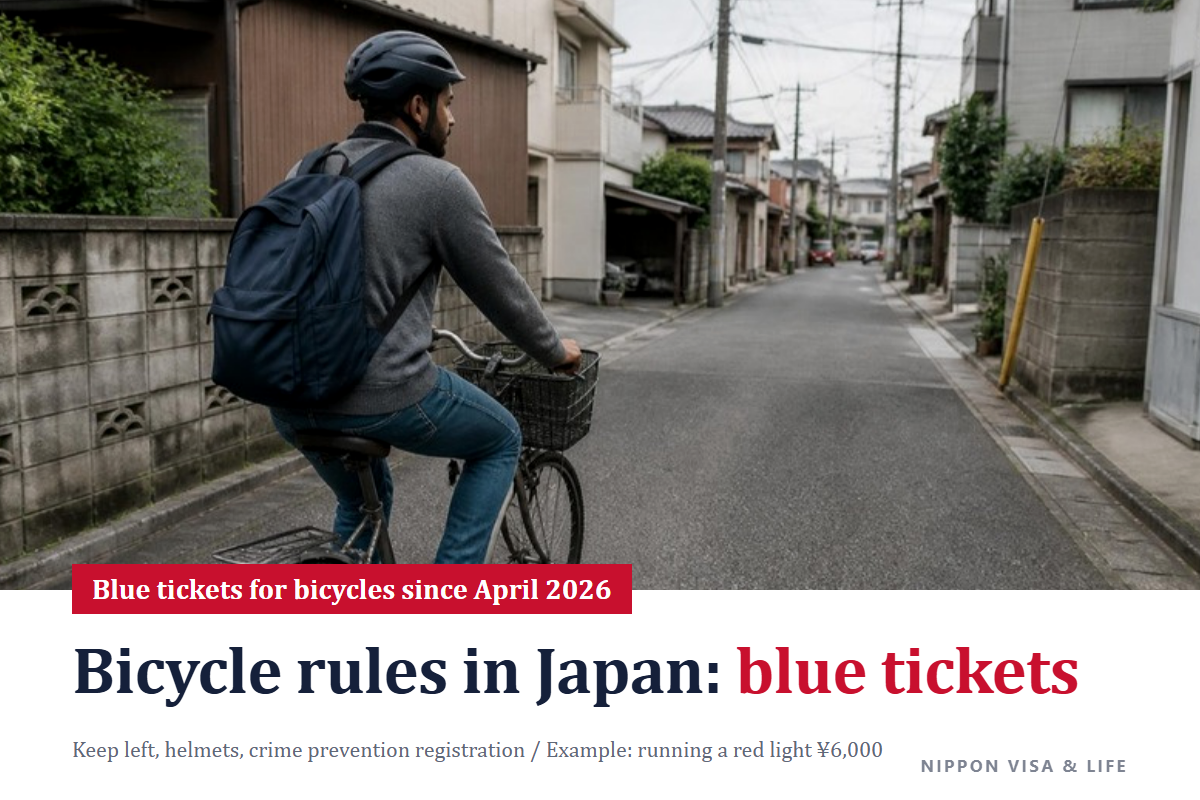
In Japan, a bicycle is a “vehicle” (in the same group as cars). You ride on the left side of the road, obey traffic lights and stop signs, and turn on your light at night. Since April 1, 2026, the “blue ticket” system (a system where you pay a fine) has been used for bicycle traffic violations by people aged 16 or older.
What to Remember First: The Five Rules for Safe Bicycle Use
The National Police Agency has summarized the basic rules that bicycle riders must follow as the “Five Rules for Safe Bicycle Use.”
- As a rule, ride on the road, on the left side. Sidewalks are the exception, and pedestrians have priority
- At intersections, obey traffic lights and stop signs, and check for safety
- Turn on your light at night
- Drunk riding is prohibited (do not ride a bicycle after drinking alcohol)
- Wear a helmet
(Sources: National Police Agency “Bicycles Are Vehicles, Like Cars: Follow the Rules and Ride Safely”)
Where to Ride: The Left Side of the Road Is the Basic Rule
Ride on the left side of the road
- As a rule, bicycles must keep to the left side of the road. Riding on the right side (riding against traffic) is a violation.
- Where there is a bicycle lane (a road for bicycles), you ride in the bicycle lane.
- You may also ride on the roadside strip on the left side of the road (on a road without a sidewalk, the part outside the white line). However, you must not get in the way of people walking.
When you may ride on the sidewalk
You may ride on the sidewalk only in cases like the following.
| When you may ride on the sidewalk | Examples |
|---|---|
| When a sign or road marking shows that bicycles may ride on the sidewalk | A sidewalk with a “sidewalk riding permitted” sign |
| When the rider is under 13, 70 or older, or has a physical disability that makes riding on the road difficult | Children, elderly people |
| When it is unavoidable for safety, considering the road and traffic conditions | The road is under construction, etc. |
When you ride on the sidewalk, follow these rules.
- Ride slowly on the side closer to the road, at a speed at which you can stop immediately
- When you are likely to get in the way of people walking, stop (pedestrians have priority)
(Sources: National Police Agency “Bicycles Are Vehicles, Like Cars”, Immigration Services Agency (ISA) “Guidebook on Living and Working” Chapter 9: Transportation)
How to Go Through Intersections
- At an intersection with traffic lights, go after the light turns green and after checking that it is safe.
- At an intersection with a “Stop” (止まれ) sign, always stop and check that it is safe.
- When turning right, do not turn right inside the intersection like a car. Stay on the left side of the road, go straight to the far side of the intersection, stop there, and change direction. If there is a traffic light, go after the light in front of you turns green.
- When turning left, check behind you for safety, slow down enough, and turn without getting in the way of pedestrians who are crossing.
- If there is a bicycle crossing zone (a marking where bicycles cross) at or near the intersection, use it.
(Sources: Immigration Services Agency “Guidebook on Living and Working” Chapter 9: Transportation)
Things You Must Not Do
| Things you must not do | Explanation |
|---|---|
| Riding while holding and using a smartphone | You must not ride while talking on the phone or while keeping your eyes on the screen |
| Riding after drinking alcohol | Drunk riding is prohibited on a bicycle too |
| Riding with two people | You must not carry another person on a bicycle (exceptions are below) |
| Riding side by side | Bicycles must not ride next to each other side by side |
| Riding while holding an umbrella | Prohibited in all prefectures |
| Riding while you cannot hear the sounds around you because of earphones, etc. | Prohibited in all prefectures |
| Not turning on your light at night | You must turn on your light at night |
| Entering an expressway | Bicycles cannot enter expressways |
- Exception for carrying another person: Prefectural rules allow, for example, a parent or guardian aged 16 or older to ride with a child who has not yet started elementary school in a child seat.
- Exception for earphones: It is not a violation when you wear an earphone in only one ear, or when you use earphones that do not cover your ears and you can hear the sounds and voices needed for safe riding.
(Sources: National Police Agency “Bicycle Rule Book”, Immigration Services Agency “Guidebook on Living and Working” Chapter 9: Transportation)
Wear a Helmet
- The law says that you must try to wear a bicycle helmet when you ride a bicycle (an obligation to make efforts).
- When a child rides a bicycle, or when you carry a small child in a child seat, the parent or guardian should have the child wear a helmet.
- Fasten the chin strap tightly and wear the helmet correctly.
(Sources: National Police Agency “Bicycles Are Vehicles, Like Cars”, Immigration Services Agency “Guidebook on Living and Working” Chapter 9: Transportation)
If You Break the Rules: Blue Tickets and Fines (from April 2026)
Since April 1, 2026, the “blue ticket” system (the traffic violation notification system) has also been used for bicycle traffic violations.
- It applies to people aged 16 or older. As a rule, people under 16 receive guidance and a warning (a caution).
- When the police find a violation, they basically give guidance and a warning on the spot. They take enforcement action for malicious or dangerous violations that could cause accidents.
- If you receive a blue ticket, you pay a fine. If you pay the fine, the case does not go to criminal procedures such as a trial, and you do not get a criminal record (a record of having received a criminal punishment).
- Pay the fine at a bank or post office counter, using the “payment slip” given to you together with the blue ticket. If you admit the violation, as a rule you pay within 7 days from the day after you received the enforcement action (provisional payment).
- If you do not pay within 7 days, go to the Traffic Violation Notification Center on the date written on the blue ticket, receive the notice and payment slip, and as a rule pay within 10 days from the day after you received the notice.
- If you still do not pay the fine, the case goes to criminal procedures.
Examples of fines
| Violation | Fine |
|---|---|
| Riding while holding and using a smartphone (use of a mobile phone, etc. holding) | 12,000 yen |
| Entering a closed railroad crossing (entering a railroad crossing while the alarm is ringing or while the barrier is down or coming down) | 7,000 yen |
| Ignoring traffic lights | 6,000 yen |
| Violation of traffic lane rules (riding against traffic, riding on a sidewalk where it is not allowed, etc.) | 6,000 yen |
| Obstructing pedestrians crossing, etc. (getting in the way of people crossing at a crosswalk, etc.) | 6,000 yen |
| Violation of the duty to drive safely (riding with no hands, etc.) | 6,000 yen |
| Failure to stop at a designated place, etc. (not stopping at a “Stop” sign) | 5,000 yen |
| No light (not turning on your light at night) | 5,000 yen |
| Defective bicycle brakes (riding a bicycle whose brakes do not work) | 5,000 yen |
| Riding while holding an umbrella, riding while you cannot hear the sounds around you because of earphones | 5,000 yen |
| Riding with two people, riding side by side | 3,000 yen |
(Sources: National Police Agency “Introduction of Blue Tickets for Bicycles” leaflet, National Police Agency “Bicycle Violations and Fine Amounts”, National Police Agency “Bicycle Rule Book”, Government of Japan Public Relations Online)
Serious violations are subject to criminal punishment, not blue tickets
Serious violations, such as drunk riding or causing an accident while using a smartphone, are subject to criminal procedures (such as a red ticket), not blue tickets.
| Violation | Penalty |
|---|---|
| Drunk riding (riding while intoxicated by alcohol) | Imprisonment of up to 5 years or a fine of up to 1,000,000 yen |
| Riding under the influence of alcohol (0.15 mg or more of alcohol per liter of breath) | Imprisonment of up to 3 years or a fine of up to 500,000 yen |
| Causing traffic danger, such as causing an accident while using a smartphone | Imprisonment of up to 1 year or a fine of up to 300,000 yen |
(Sources: Immigration Services Agency “Guidebook on Living and Working” Chapter 9: Transportation)
Repeating dangerous violations leads to a training course
If you receive enforcement action 2 or more times within 3 years for specified dangerous violations, such as ignoring traffic lights or not stopping, you may be ordered by the Prefectural Public Safety Commission to take the “Bicycle Rider Training Course.” If you do not follow the order, you face a fine of up to 50,000 yen.
(Sources: Government of Japan Public Relations Online, National Police Agency “Bicycles Are Vehicles, Like Cars”)
What to Do When You Get a Bicycle
Complete crime prevention registration
The law says that people who use a bicycle must get crime prevention registration (bōhan tōroku: a registration that makes it possible to identify the owner, for example when the bicycle is stolen) for that bicycle.
- Crime prevention registration is done by organizations designated by the Prefectural Public Safety Commission. For where to apply and the fee, ask at the shop where you buy the bicycle, or search for “防犯登録” (crime prevention registration) on the website of the prefectural police where you live.
Park in designated places
- Park your bicycle at a bicycle parking area (a place for parking bicycles). The law says that you must try not to leave your bicycle in places that are not bicycle parking areas.
- Bicycles left in front of stations and other places may be removed (taken away) and stored by the city, ward, town or village based on local ordinances. When you get it back, you may have to pay the cost of removal and storage.
- Places where you must not park, and how to get back a removed bicycle, differ by city, ward, town or village. Search for “放置自転車” (abandoned bicycles) or “駐輪場” (bicycle parking) on the website of the city, ward, town or village where you live.
Check your bicycle insurance
- Even in a bicycle accident, if you injure another person, you may be asked to pay a large amount of compensation for damages (money paid to the other person).
- In many areas, such as Tokyo and Osaka, you must join “bicycle liability insurance, etc.,” which covers damage you cause to others in a bicycle accident. Check the rules of the prefecture where you live.
(Sources: Immigration Services Agency “Guidebook on Living and Working” Chapter 9: Transportation, Ministry of Land, Infrastructure, Transport and Tourism “Promoting Enrollment in Bicycle Liability Insurance, etc.”)
Troubles and Common Questions
Do I need a license for an electric-assist bicycle?
An electric-assist bicycle with a TS mark (a mark showing that the bicycle has received the national type approval) is treated the same as a bicycle, and you do not need a license. Even if it has pedals, a vehicle that moves by itself without pedaling, or whose assist power exceeds the standard, is a “pedal-equipped electric motorcycle” (moped). You need a license to ride it, and you also need compulsory automobile liability insurance (insurance that all cars and motorcycles must have) and a license plate.
(Sources: Immigration Services Agency “Guidebook on Living and Working” Chapter 9: Transportation, Government of Japan Public Relations Online)
What if I cause an accident on my bicycle?
- Stop your bicycle immediately and move to a safe place where you will not get in the way of other traffic.
- If someone is injured, call an ambulance (119).
- Whether or not anyone is injured, report it to the police (110). Do not leave the scene until a police officer arrives.
- Even if you think you are not injured, you may find out later that you have a serious injury. See a doctor early.
For how to call 119, please read How to Call an Ambulance in Japan: How to Dial 119, What to Say, and Where to Get Advice When You Are Unsure (#7119).
(Sources: Immigration Services Agency “Guidebook on Living and Working” Chapter 9: Transportation)
I have a car driver’s license. Will bicycle violations reduce the points on my license?
Bicycle violations do not affect the points on your car driver’s license. However, if you cause a serious accident on a bicycle, such as a hit-and-run, or commit a particularly malicious or dangerous violation such as riding under the influence of alcohol, your driver’s license may be suspended.
(Sources: Government of Japan Public Relations Online)
Primary Sources Used for This Article
- National Police Agency “Bicycles Are Vehicles, Like Cars: Follow the Rules and Ride Safely”
- National Police Agency “Introduction of Blue Tickets for Bicycles” leaflet
- National Police Agency “Bicycle Violations and Fine Amounts”
- National Police Agency “For Safe and Secure Use of Bicycles (Bicycle Rule Book)”
- Government of Japan Public Relations Online “Blue Tickets for Bicycle Traffic Violations from April 2026: What Will Change?”
- Immigration Services Agency “Guidebook on Living and Working” (8th edition) (Chapter 9: Transportation)
- e-Gov Laws and Regulations Search “Act on Promoting the Safe Use of Bicycles and Comprehensive Measures for Bicycle Parking”
- Ministry of Land, Infrastructure, Transport and Tourism “Promoting Enrollment in Bicycle Liability Insurance, etc.”
This article is a translation of the original Japanese version.