This article was written by the NIPPON VISA & LIFE editorial team based on information from public organizations such as the national government and local governments. Rules and fees may differ depending on the city, ward, town or village where you live.
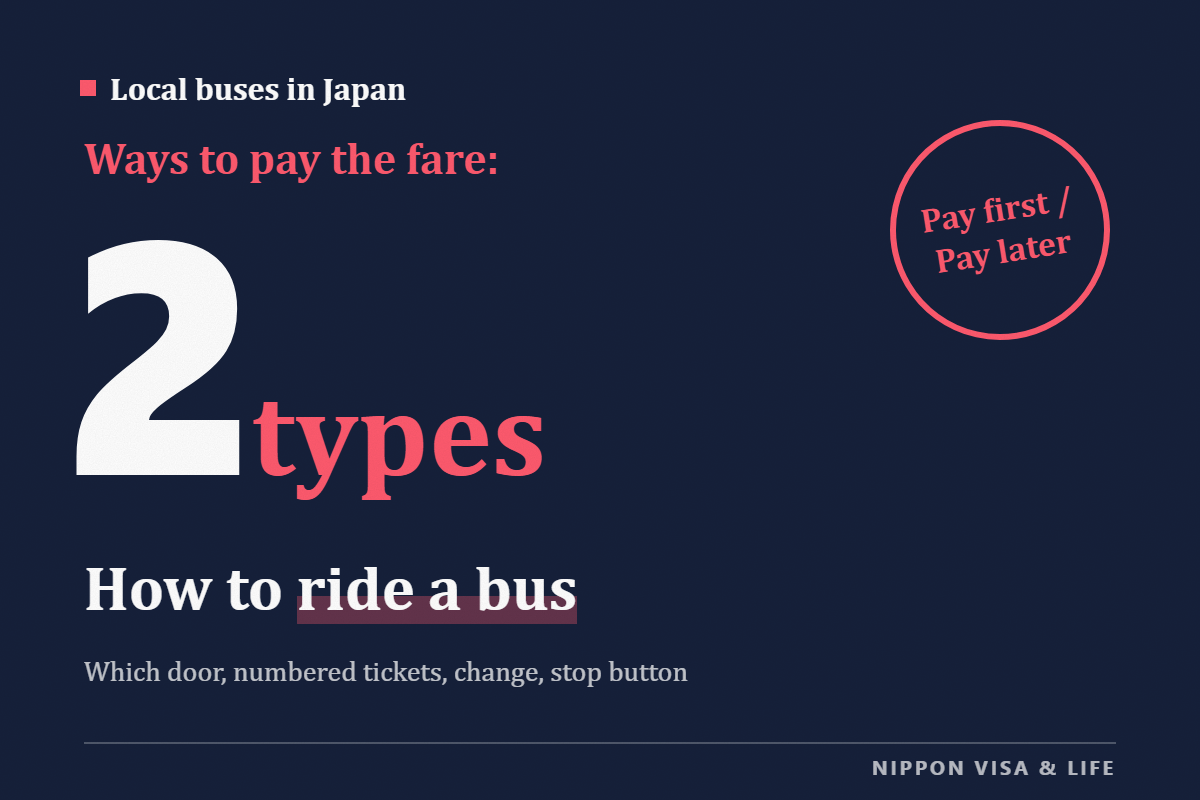
On local buses in Japan (buses that run on fixed routes within a town or city), the door you get on by and when you pay the fare differ depending on the region and the bus company. Broadly, there are two types: “pay first,” where you pay when you get on, and “pay later,” where you pay when you get off. This article explains the basics of riding a bus so that you will not have trouble with either type.
The Overall Flow
- At the bus stop, check the destination and the route number (the number of the bus line) shown on the front or side of the bus
- Get on by the designated door
- On a pay-first bus, pay the fare when you get on. On a pay-later bus, take a numbered ticket (seiriken) or touch your IC card
- When the name of the bus stop where you want to get off is announced on the bus, press the stop button (the button you press to tell the driver you want to get off)
- Stay seated and wait until the bus stops
- On a pay-later bus, pay the fare when you get off
(Sources: Immigration Services Agency, “Guidebook on Living and Working”, Sapporo City, “How to pay fares and how to transfer”)
The Difference Between “Pay First” and “Pay Later”
The Immigration Services Agency’s “Guidebook on Living and Working” explains that there are two ways of paying on local buses, as follows.
| Buses with the same fare no matter how far you ride | Buses where the fare changes depending on the distance you ride | |
|---|---|---|
| When you pay | When you get on (pay first) | When you get off (pay later) |
| With cash | Put the money in the fare box when you get on | Take a numbered ticket when you get on, and pay the fare when you get off |
| With an IC card | Touch once when you get on | Touch twice: when you get on and when you get off |
However, in some regions you pay when you get off even if the fare is the same no matter how far you ride (for example, Kagoshima City buses have the same fare on all routes, and you pay when you get off). Before riding, check at the bus stop or on the bus company’s website.
(Sources: Immigration Services Agency, “Guidebook on Living and Working”, Kagoshima City, “Please tell me how to ride the city bus.”)
Which Door Do I Get On By?
The doors for getting on and getting off differ depending on the bus.
- Get on at the front, get off at the back: You get on by the front door and get off by the back door. For example, Yokohama City buses work this way, and you pay the fare first.
- Get on in the middle, get off at the front: You get on by the middle (back) door and get off by the front door. For example, Sendai City buses and Kagoshima City buses work this way, and you pay the fare later.
According to Sapporo City’s information, on a bus with two doors you get on by the middle (back) door, and on a bus with only one door you get on by that door. If you are not sure, ask the driver.
(Sources: Yokohama City Transportation Bureau, “How to ride the city bus”, Sendai City Transportation Bureau, “How to ride and use the city bus”, Sapporo City, “How to pay fares and how to transfer”)
How to Ride a Pay-First Bus (Example: Yokohama City Bus)
Yokohama City buses are “get on at the front, get off at the back,” and you pay the fare first. The fare is the same no matter how far you ride (as of October 2026 when we checked: 220 yen for adults and 110 yen for children, the same for cash and IC cards).
- Get on by the front door
- With an IC card, touch it firmly on the reader. The fare is deducted automatically
- With cash, put the money in the fare box. Change is given automatically
- Before the bus stop where you want to get off, press the stop button, and get off by the back door
If you are riding at the child fare, or paying for two or more people at once, tell the driver before you pay.
(Source: Yokohama City Transportation Bureau, “How to ride the city bus”)
How to Ride a Pay-Later Bus (Examples: Sendai City Bus and Sapporo City)
When Getting On
- If you pay in cash, take a numbered ticket from the numbered ticket machine near the entrance. A numbered ticket (seiriken) is a small piece of paper with a number printed on it. When you get off, this number is used to check your fare.
- If you use an IC card, touch your card on the reader near the entrance. You do not need to take a numbered ticket (according to Sapporo City).
- On some routes and sections, numbered tickets are not issued. In that case, just get on (according to Sapporo City).
When Getting Off
- When the name of the bus stop where you want to get off is announced on the bus, press the stop button (a button with words such as “とまります” (stopping) written on it)
- On the fare display at the front of the bus (an electronic board that shows the fares), check the amount shown under the number on your numbered ticket
- Wait until the bus stops and the door opens before you stand up from your seat
- Put your numbered ticket and the fare into the fare box near the front door. If you use an IC card, touch it on the reader of the fare box
Keep your numbered ticket without folding it so that the number can be read.
(Sources: Sendai City Transportation Bureau, “How to ride and use the city bus”, Sapporo City, “How to pay fares and how to transfer”, Fukui Prefecture, “Let’s go out by public transportation: How to ride a bus”)
Changing Money (Buses That Do Not Give Change)
On pay-later buses, the fare box may not give change. In that case, first use the money changer (ryogae-ki) attached to the fare box to break your bills or coins into smaller money, and then put in the exact amount.
- The bills that can be changed may differ depending on the bus. According to Sendai City buses and Sapporo City, only 1,000-yen bills can be changed; two-thousand-yen bills, five-thousand-yen bills and 10,000-yen bills cannot be changed.
- Change money while the bus is stopped (according to Sapporo City).
- If you only have large bills, break them into smaller money at a station or shop before getting on.
On the other hand, some buses, such as Yokohama City buses, give change automatically from the fare box.
(Sources: Sendai City Transportation Bureau, “How to ride and use the city bus”, Sapporo City, “How to pay fares and how to transfer”, Yokohama City Transportation Bureau, “How to ride the city bus”)
Things to Be Careful About When Riding With an IC Card
On local buses, you can sometimes pay with an IC transit card. The cards you can use differ depending on the region and the bus company (for example, Suica and PASMO in the Tokyo metropolitan area, icsca on Sendai City buses, and RapiCa on Kagoshima City buses). Check the information from the company of the bus you ride. PASMO’s official information asks you to be careful about the following points.
- Touch your card firmly on the reader with the IC mark. If it is not read correctly, you will be notified by a sound and a red light, so touch it again
- On a pay-first bus, touch when you get on; on a pay-later bus, touch both when you get on and when you get off
- If you bring an IC card you are not using close to the reader, money may be deducted from that card
- If you are riding at the child fare, etc., tell the driver before you pay
How to buy an IC card and how to charge it (add money) are explained in How to Ride Trains in Japan and Use IC Transit Cards: Buying Tickets, Going Through Ticket Gates, Charging, and What to Do If You Lose Your Card.
(Source: PASMO, “How to use it on buses”)
When You Have a Problem / Common Mistakes
There was not enough money on my IC card
According to PASMO’s information, if there is not enough money when you pay, you can tell the driver and charge your card on the bus.
- You can charge in units of 1,000 yen (1,000-yen bills only)
- Charge while the bus is stopped
- If the remaining money on the card is 10,001 yen or more, you cannot charge
How to charge differs depending on the bus company. For example, on Yokohama City buses, the amount you can charge depends on the type of bill (for 1,000 yen, a 1,000-yen bill). According to Sapporo City, you either charge at the fare box or pay the missing amount in cash. Charging on the bus takes time, so if possible, charge your card at a station or convenience store, etc. before getting on (a request from the Yokohama City Transportation Bureau).
(Sources: PASMO, “How to use it on buses”, Sapporo City, “How to pay fares and how to transfer”, Yokohama City Transportation Bureau, “How to ride the city bus”)
I forgot to press the stop button
The stop button is a button that tells the driver you will get off at the next bus stop. According to Fukui Prefecture’s information, you press it before getting off at the next bus stop. When the name of the bus stop where you want to get off is announced, press it early. If you forgot to press it and could not get off, tell the driver.
Can I stand up from my seat while the bus is moving?
Please do not stand up. The Sendai City Transportation Bureau asks passengers to stand up from their seats only after the bus has arrived at the bus stop and the door has opened, because if you leave your seat while the bus is moving, you may fall and get hurt. If you are standing, hold on firmly to a hanging strap or handrail.
(Sources: Sendai City Transportation Bureau, “How to ride and use the city bus”, Fukui Prefecture, “Let’s go out by public transportation: How to ride a bus”)
I am worried whether the bus goes to my destination
The Yokohama City Transportation Bureau explains that the destination display on the front or side of the bus does not show all the bus stops where it stops, so if you are not sure, ask the driver when you get on. On Yokohama City buses, the next bus stop is shown on the display at the front inside the bus.
Try to talk to the driver when the bus is stopped, such as at a traffic light (a request from the Yokohama City Transportation Bureau).
(Source: Yokohama City Transportation Bureau, “How to ride the city bus”)
What about express buses and long-distance buses that go far?
Unlike local buses in town, for long-distance buses the basic rule is to finish paying before you get on, for example by buying a ticket (Guidebook on Living and Working).
(Source: Immigration Services Agency, “Guidebook on Living and Working”)
Manners on the Bus
The guidebook asks you to be careful about the following points on trains and buses.
- Do not talk loudly. Talking on a mobile phone is considered bad manners in Japan
- Do not let sound leak from your earphones
- When it is crowded, do not keep your backpack on your back
What the bus companies say about turning off mobile phones differs. The Yokohama City Transportation Bureau asks you to turn off your phone near the priority seats when the bus is crowded. The Sendai City Transportation Bureau asks you to turn off your phone near the priority seats. Fukui Prefecture’s information asks you to give up priority seats to elderly people, pregnant women and others.
(Sources: Immigration Services Agency, “Guidebook on Living and Working”, Yokohama City Transportation Bureau, “How to ride the city bus”, Sendai City Transportation Bureau, “How to ride and use the city bus”, Fukui Prefecture, “Let’s go out by public transportation: How to ride a bus”)
Useful Japanese Phrases
Fukui Prefecture’s information introduces the following Japanese phrases you can use on the bus.
- 「〇〇に行くバスはどれですか?」 (Which bus goes to 〇〇?)
- 「両替をしたいです。」 (I would like to change money.)
- 「ここで降ります。」 (I will get off here.)
How to Find Out About Buses in Your Area
- Look at the “how to ride” page on the official website of the transportation bureau or bus company in the city, ward, town or village where you live. It may show which door to get on by, whether you pay first or later, which IC cards you can use, the fares, and so on.
- When searching, you can use “(name of your city) バス 乗り方” (bus, how to ride).
- If you are not sure, ask at the bus company’s office, or at your city, ward, town or village office or a consultation desk for foreign residents.
The overall way to ride trains and buses in Japan will be explained in Basics of Riding Trains and Buses in Japan. For the rules for riding a bicycle, read Rules for Riding a Bicycle in Japan: Keep Left, Helmets, Bicycle Crime Prevention Registration, and Blue Tickets (Fines).
Primary Sources Referred to for This Article
- Immigration Services Agency, “Guidebook on Living and Working” (Chapter 12: Rules and Customs in Daily Life)
- Yokohama City Transportation Bureau, “How to ride the city bus”
- Sendai City Transportation Bureau, “How to ride and use the city bus”
- Sapporo City, “How to pay fares and how to transfer”
- Kagoshima City, “Please tell me how to ride the city bus.”
- Fukui Prefecture, “Let’s go out by public transportation: How to ride a bus” (leaflet)
- PASMO, “How to use it on buses”
This article is a translation of the original Japanese version.