

To work in nursing care as a Specified Skilled Worker (i) (特定技能1号), you generally need to pass two tests of the “Nursing Care Specified Skills Evaluation Test” (介護特定技能評価試験), Skills and Japanese, plus a Japanese language test (JFT-Basic or the Japanese-Language Proficiency Test at N4 or higher). For the two nursing care tests, from tests taken on or after April 1, 2026, the fee is about 2,000 yen each (it varies slightly depending on the country where you take the test), and new passing criteria apply. Prometric generally holds the tests every month, and you can also take them in Japan.
The names of the tests changed from the April 2026 tests. The former names were the “Nursing Care Skills Evaluation Test” (介護技能評価試験) and the “Nursing Care Japanese Language Evaluation Test” (介護日本語評価試験). The operational guidelines of the Immigration Services Agency and its nursing care field page still use the former names, but they refer to the same tests. This article uses the new names.
The overall conditions for accepting workers are summarized in the following article.
→ [2026 Edition Conditions and Process for Accepting Specified Skilled Workers in the “Nursing Care Field” | Tests, Council, and Home-Visit Care](https://kisaragi-office.com/immigration_journal/en/archives/2886)
The content was checked on the official pages of the Ministry of Health, Labour and Welfare and Prometric on October 15, 2026.
There are three tests to take (nursing care skills, nursing care Japanese, and general Japanese)
You need to pass three tests: nursing care skills, nursing care Japanese, and general Japanese.
| Item | Nursing Care Specified Skills Evaluation Test (Skills) | Nursing Care Specified Skills Evaluation Test (Japanese) | Japanese language test |
|---|---|---|---|
| What it checks | Nursing care skills (about the same level as completing Technical Intern Training (ii) in the nursing care job category) | Enough Japanese to work in a nursing care workplace without difficulty | Japanese needed for daily life (Japan Foundation Test for Basic Japanese <JFT-Basic> or the Japanese-Language Proficiency Test at N4 or higher) |
| Number of questions and time | 45 questions, 60 minutes | 15 questions, 30 minutes | Depends on each test |
| Languages available | 13 languages | Japanese only | Depends on each test |
| Test fee | About 2,000 yen | About 2,000 yen | The fee for JFT-Basic in Japan is 10,000 yen (Prometric’s table) |
| Passing criteria | 60% or more of the total score | 73% or more of the total score | The criteria of each test |
| Schedule | Generally every month (CBT) | Generally every month (CBT) | Decided by the organization running each test |
CBT is a format in which you read the questions on a computer screen at the test center and answer on the screen. The passing criteria have applied since April 1, 2026.
What the Skills test covers
The Skills test has 40 written questions and 5 practical questions.
- Written: basics of nursing care (10 questions), mechanisms of the mind and body (6 questions), communication skills (4 questions), daily life support skills (20 questions)
- Practical: daily life support skills (5 questions). You look at photos and other materials and judge the correct nursing care procedure
The test is available in 13 languages: Japanese, English, Vietnamese, Indonesian, Thai, Burmese, Mongolian, Nepali, Khmer, Chinese, Uzbek, Bengali, and Urdu.
What the nursing care Japanese test covers
The Japanese test has 15 questions: nursing care vocabulary (5 questions), conversation and verbal prompts in nursing care (5 questions), and nursing care documents (5 questions). The questions are in Japanese only, with furigana (reading aids).
Even if you have N4 of the Japanese-Language Proficiency Test, you still need to take the nursing care Japanese test separately. What Japanese levels such as N4 and A2 mean is explained in the following article.
Note that the field-specific operational policy of January 2026 sets the Japanese level as a level equivalent to A2.2 or higher of the “Reference Framework for Japanese Language Education,” together with the Nursing Care Specified Skills Evaluation Test (Japanese). The Ministry of Health, Labour and Welfare page still states JFT-Basic or N4 or higher as of October 15, 2026. Before taking a test, check the latest information on the Ministry of Health, Labour and Welfare page.
(Sources: Ministry of Health, Labour and Welfare “Acceptance of Specified Skilled Workers in the Nursing Care Field”, Implementation guidelines for the “Nursing Care Specified Skills Evaluation Test (Skills)”, Implementation guidelines for the “Nursing Care Specified Skills Evaluation Test (Japanese)”, Ministry of Health, Labour and Welfare “Notice on the revision of test fees”, Prometric “Nursing Care Specified Skills Evaluation Test”, Prometric “Test fees by country”, Field-specific operational policy (nursing care field))
People exempt from the tests
The following people are exempt from all or some of the tests. First, check whether you need to take them.
| Who | Tests exempted |
|---|---|
| People who have satisfactorily completed Technical Intern Training (ii) in the nursing care job category | All three tests |
| People who have satisfactorily completed Technical Intern Training (ii) in a job category other than nursing care | JFT-Basic and N4 are exempted. The nursing care skills test and the nursing care Japanese test are required |
| People who have completed a training institution for certified care workers | All three tests |
| People who properly engaged in work and training for 4 years as EPA certified care worker candidates | All three tests (on condition that, in the most recent national examination for certified care workers, they scored at least 50% of the passing score and scored in all subject groups) |
When you claim the exemption based on completing Technical Intern Training (ii) in the nursing care job category, you submit the certificate of passing the practical test of the Nursing Care Technical Intern Training Evaluation Test (specialist level) taken at completion. For detailed conditions, such as what happens if you did not pass, see the following article.
(Sources: Operational guidelines (nursing care field), Ministry of Health, Labour and Welfare “Acceptance of Specified Skilled Workers in the Nursing Care Field”, Ministry of Health, Labour and Welfare “Transition of EPA certified care worker candidates to Specified Skilled Worker (i)”)
Who can take the tests and where
You can take the tests if you are 17 or older on the test date (18 or older for Indonesian nationals). Japanese nationals cannot take them.
Taking the tests in Japan
According to the Ministry of Health, Labour and Welfare, the tests in Japan are open to people aged 17 or older who have a status of residence (在留資格). In addition, they are limited to people who hold a passport of a country or region designated by the Minister of Justice in a public notice.
Prometric states that you can take the tests even with “Temporary Visitor” (短期滞在) status. People without a status of residence (such as people who have overstayed) cannot take them. It is safer to check with Prometric’s contact center before booking whether your country’s passport is eligible.
Tests in Japan are held only at some test centers that have an environment for strict identity checks. Since February 2025, test centers have been checking residence cards with residence card readers and taking face photos, and the photo appears on the score report.
Host countries and period
In fiscal 2026, the tests are held in the following 14 countries, including Japan.
- Bangladesh, Cambodia, India, Indonesia, Japan, Mongolia, Myanmar, Nepal, the Philippines, Sri Lanka, Thailand, Uzbekistan, Vietnam, Pakistan
For fiscal 2026, bookings are accepted from April 22, 2026 to March 5, 2027, and the tests are held from April 27, 2026 to March 10, 2027. Check the schedule for each test center in Prometric’s “Test schedule” and “List of test centers.”
(Sources: Ministry of Health, Labour and Welfare “Acceptance of Specified Skilled Workers in the Nursing Care Field”, Implementation guidelines for the “Nursing Care Specified Skills Evaluation Test (Skills)”, Ministry of Health, Labour and Welfare “Notice on the Nursing Care Japanese Language Evaluation Test”, Prometric “Nursing Care Specified Skills Evaluation Test”)
How to apply (Prometric ID → booking → payment)
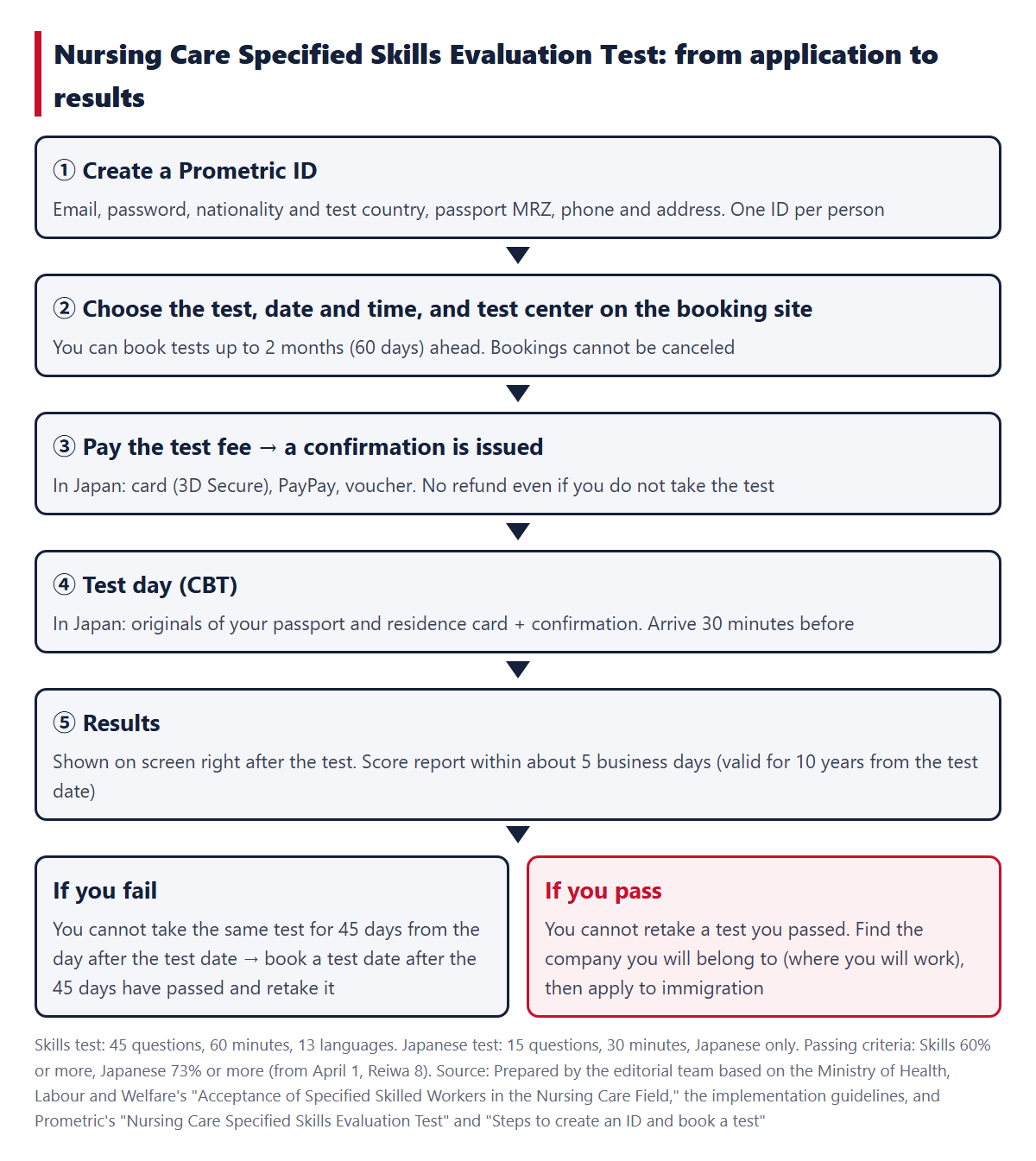
You apply on Prometric’s website.
Sources: Prepared by the editorial team (based on the Ministry of Health, Labour and Welfare’s “Acceptance of Specified Skilled Workers in the Nursing Care Field” and Prometric’s “Steps to create an ID and book a test”)
① Create a Prometric ID
First, create a Prometric ID. You enter information such as the following.
- Email address and password (6 to 14 alphanumeric characters)
- Nationality and the country where you will take the test
- The two lines of letters and numbers at the bottom of your passport (MRZ). Even if they differ from the characters printed on the passport, enter them exactly as in the MRZ
- Phone number and address
Each person may have only one ID. If you already have an ID and take a test with another ID, your result may be invalidated. The name you register appears as is on the confirmation and the score report.
② Choose the test, date and time, and test center
Log in to the booking site and choose the type of test and language, the date and time, and the test center. According to the Ministry of Health, Labour and Welfare, you can book tests up to 2 months (60 days) ahead. You can book or change a booking until 23:59 (Japan time) 3 business days before the test date. For tests on Saturdays, Sundays, and public holidays, the deadline is 4 business days before.
Even if you choose the wrong type of test or language, you cannot cancel after booking.
③ Pay the test fee
If you take the test in Japan, there are three payment methods.
- Credit card, debit card, or prepaid card (one that supports 3D Secure)
- PayPay
- Voucher (a number that a company or other organization buys in bulk and gives to test takers)
When the payment is complete, the booking is complete and a confirmation is issued. The test fee you paid will not be refunded even if you do not take the test.
(Sources: Prometric “Steps to create an ID and book a test”, Prometric “Payment methods by country”, Prometric “Nursing Care Specified Skills Evaluation Test”, Ministry of Health, Labour and Welfare “Acceptance of Specified Skilled Workers in the Nursing Care Field”, Ministry of Health, Labour and Welfare “Application steps for tests in Japan”)
The test day and receiving your results
What to bring on the test day (when taking the test in Japan)
At test centers in Japan, you cannot take the test without the following two items.
- Original identity documents: your passport and residence card (在留カード). If you do not have a residence card, your status of residence must be shown in your passport. Copies are not accepted
- Confirmation: a printout, a screenshot, or the confirmation displayed on the booking site are all acceptable
Arrive at the test center at least 30 minutes before the test starts. If you are late, you cannot take the test. At test centers in Japan, you can take notes during the test, but you cannot at test centers outside Japan.
How to receive your results
When the test ends, your result appears on the computer screen. As a guideline, within 5 business days after the test, you will be able to view the score report on the dedicated site (My Page). The score report shows your name, the test name, the test date, your face photo, your overall score, and whether you passed.
The score report is valid for 10 years from the test date. Until then, you can get it from the dedicated site.
If you cheat
If you take the test by improper means, your pass may be canceled, or you may be banned from taking the test for a certain period. In 2025, there was a case of suspected cheating at a test in Japan, which led to a police investigation.
(Sources: Prometric “[Important What to bring on the test day”](https://www.prometric-jp.com/ssw/news/archives/370), Prometric “Nursing Care Specified Skills Evaluation Test”, Implementation guidelines for the “Nursing Care Specified Skills Evaluation Test (Skills)”, Ministry of Health, Labour and Welfare “Notice on the Nursing Care Japanese Language Evaluation Test”)
If you fail (the 45-day rule) and pass rates as a guide
If you fail, you cannot take the same test for 45 days, counting from the day after the test date. Even if you change the language, it is treated as the same test if the subject is the same. If you retake the test within 45 days and pass, your pass may be canceled.
You cannot take a test you have already passed again. If you passed only the Skills test, you retake only the Japanese test.
Pass rates by country (August 2026 tests)
From the results of the August 2026 tests published by the Ministry of Health, Labour and Welfare, we made a table of the main countries (the results for all 14 countries are in the PDF in the sources).
| Country where the test was held | Skills (test takers, passers, pass rate) | Japanese (test takers, passers, pass rate) |
|---|---|---|
| Japan | 1,403, 831, 59.2% | 1,162, 762, 65.6% |
| Myanmar | 2,801, 2,674, 95.5% | 2,903, 2,153, 74.2% |
| Nepal | 1,475, 1,152, 78.1% | 1,609, 1,006, 62.5% |
| Indonesia | 1,418, 1,295, 91.3% | 1,576, 1,043, 66.2% |
| Philippines | 186, 152, 81.7% | 196, 109, 55.6% |
| Vietnam | 94, 85, 90.4% | 123, 80, 65.0% |
The pass rate of the Skills test at test centers in Japan was 59.2% in this month. Pass rates vary by country and month, so check the latest results, published every month, on the Ministry of Health, Labour and Welfare page.
(Sources: Prometric “Nursing Care Specified Skills Evaluation Test”, Ministry of Health, Labour and Welfare “Results of the Nursing Care Specified Skills Evaluation Test, August 2026”, Ministry of Health, Labour and Welfare “Acceptance of Specified Skilled Workers in the Nursing Care Field”)
The flow after passing (until you start working)
Passing the tests alone does not allow you to work. You apply to immigration, and you start working after permission is granted. The Ministry of Health, Labour and Welfare and the Immigration Services Agency state that passing the tests does not guarantee permission for a status of residence or the issuance of a visa.
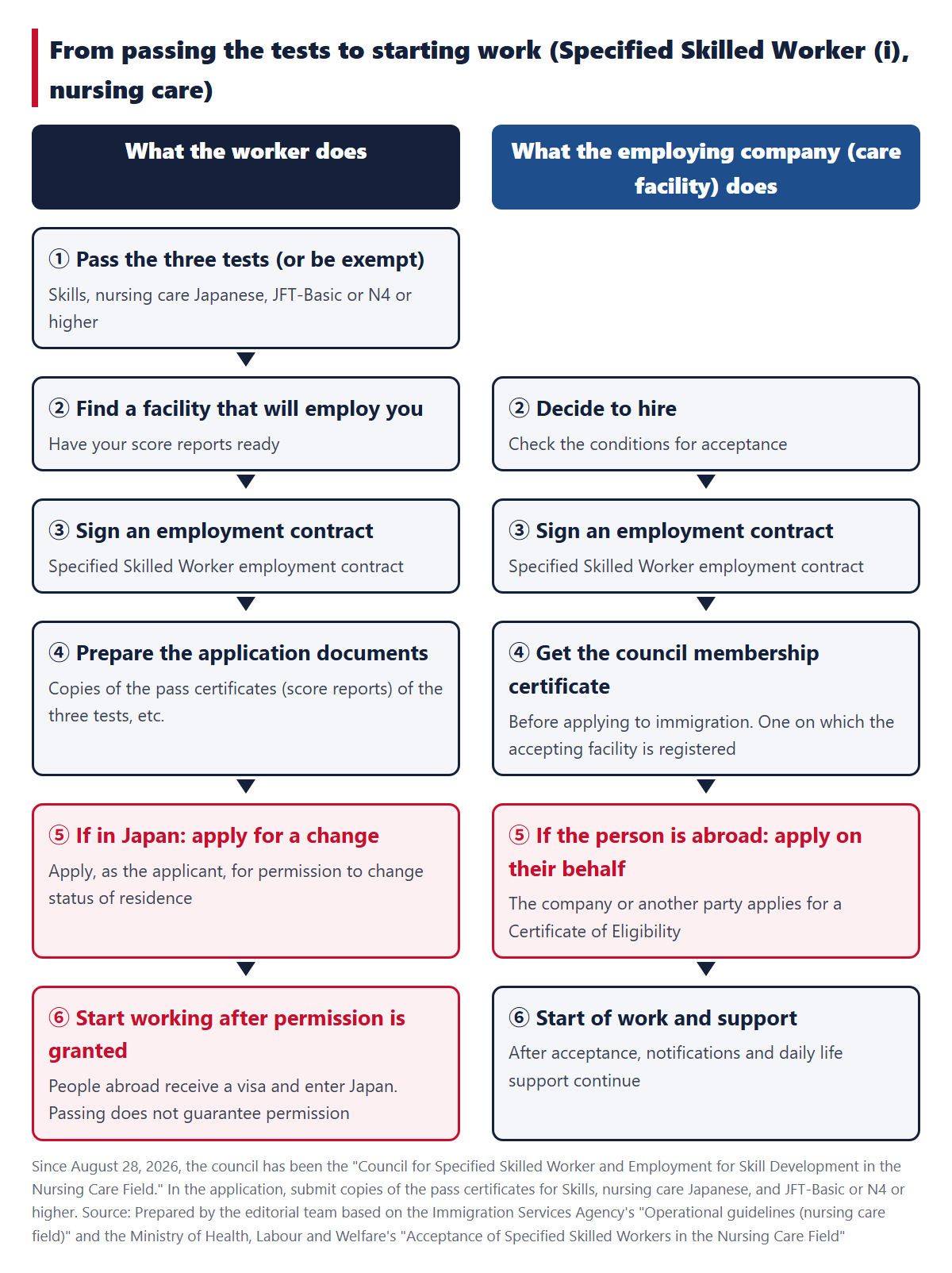
We made a chart showing the order of steps, divided into the worker and the company.
Sources: Prepared by the editorial team (based on the Immigration Services Agency’s “Operational guidelines (nursing care field)” and the Ministry of Health, Labour and Welfare’s “Acceptance of Specified Skilled Workers in the Nursing Care Field”)
- Pass the three tests (or fall under an exemption)
- Find a nursing care facility that will employ you
- Sign a Specified Skilled Worker employment contract (雇用契約)
- Before applying to immigration, the company becomes a member of the council of the Ministry of Health, Labour and Welfare and receives a membership certificate on which the accepting facility is registered
- Apply to immigration. For a person living abroad, the company or another party applies on their behalf for the issuance of a Certificate of Eligibility (在留資格認定証明書). A person in Japan applies, as the applicant, for permission to change status of residence
- Start working as a Specified Skilled Worker after permission is granted. A person living abroad receives a visa and enters Japan
Since August 28, 2026, the name of the council has been the “Council for Specified Skilled Worker and Employment for Skill Development in the Nursing Care Field” (介護分野における特定技能・育成就労協議会). On the Immigration Services Agency’s pages and elsewhere, it may still be written with its former name, the “Council for Specified Skilled Worker in the Nursing Care Field” (介護分野における特定技能協議会).
Pass certificates to submit with the application
In the application to immigration, you submit copies of documents showing that you passed the tests.
- The pass certificate of the Nursing Care Specified Skills Evaluation Test (Skills)
- The pass certificate of the Nursing Care Specified Skills Evaluation Test (Japanese)
- The pass certificate of JFT-Basic or the Japanese-Language Proficiency Test (N4 or higher)
How to submit the documents is explained in the following article.
The full set of application documents the company submits is summarized in the following article.
→ List of Required Documents for Specified Skilled Worker “Nursing Care” | Attachments and Where to Submit for Certificate of Eligibility, Change, and Renewal [2026 Edition](https://kisaragi-office.com/immigration_journal/en/archives/5167)
For joining the council, see the following article.
Notes for people currently in Japan
People with another status of residence, such as student, and people working as Specified Skilled Workers in another field need permission to change status of residence. You cannot start nursing care work as a Specified Skilled Worker before permission is granted.
Timing of the change and other details differ from person to person. If you are unsure, consult a Regional Immigration Services Bureau or a professional.
(Sources: Operational guidelines (nursing care field), Ministry of Health, Labour and Welfare “Acceptance of Specified Skilled Workers in the Nursing Care Field”, Immigration Services Agency “Nursing care field”, Prometric “Nursing Care Specified Skills Evaluation Test”)
Frequently asked questions
Q Can I take the Skills test in my native language? A You can choose from 13 languages (see “What the Skills test covers” above for the languages). The nursing care Japanese test is in Japanese only.
Q Can I take the Skills test and the Japanese test on the same day? A Yes, you can take them on the same day. One confirmation is issued for each test, so on the day, show the confirmations for all the tests you are taking that day.
Q Can I come to Japan as a Temporary Visitor and take the test? A Prometric states that you can take the test even with “Temporary Visitor” status of residence. However, which status of residence procedure you go through after passing is a separate matter. Procedures differ from person to person, so consult a Regional Immigration Services Bureau or a professional.
(Sources: Prometric “Nursing Care Specified Skills Evaluation Test”, Prometric “[Important What to bring on the test day”](https://www.prometric-jp.com/ssw/news/archives/370), Implementation guidelines for the “Nursing Care Specified Skills Evaluation Test (Skills)”, Ministry of Health, Labour and Welfare “Acceptance of Specified Skilled Workers in the Nursing Care Field”)
Summary
- For Specified Skilled Worker “nursing care,” you generally pass three tests: the Nursing Care Specified Skills Evaluation Test (Skills) (45 questions, 60 minutes), the Nursing Care Specified Skills Evaluation Test (Japanese) (15 questions, 30 minutes), and JFT-Basic or N4 or higher. The two nursing care tests cost about 2,000 yen each and are generally held every month.
- You apply with Prometric in the order: create an ID → book → pay. At test centers in Japan, bring the originals of your passport and residence card, and your confirmation.
- If you fail, you cannot take the same test for 45 days from the day after the test date.
- After passing, you sign an employment contract, get the council membership certificate ready, and apply to immigration. You start working after permission is granted.
The overall conditions for accepting workers are summarized in the following article.
→ [2026 Edition Conditions and Process for Accepting Specified Skilled Workers in the “Nursing Care Field” | Tests, Council, and Home-Visit Care](https://kisaragi-office.com/immigration_journal/en/archives/2886)
Primary Sources Referenced in Article Creation
- Ministry of Health, Labour and Welfare “Acceptance of Specified Skilled Workers in the Nursing Care Field”
- Ministry of Health, Labour and Welfare “Notice on the revision of the test fees for the Nursing Care Skills Evaluation Test and the Nursing Care Japanese Language Evaluation Test”
- Ministry of Health, Labour and Welfare Implementation guidelines for the “Nursing Care Specified Skills Evaluation Test (Skills)” (partially revised June 2026)
- Ministry of Health, Labour and Welfare Implementation guidelines for the “Nursing Care Specified Skills Evaluation Test (Japanese)” (partially revised June 2026)
- Ministry of Health, Labour and Welfare “Results of the Nursing Care Specified Skills Evaluation Test, August 2026”
- Ministry of Health, Labour and Welfare “Notice on the Nursing Care Japanese Language Evaluation Test”
- Ministry of Health, Labour and Welfare “Transition of EPA certified care worker candidates to Specified Skilled Worker (i)”
- Ministry of Health, Labour and Welfare “Nursing Care Skills Evaluation Test and Nursing Care Japanese Language Evaluation Test: Application steps for tests in Japan”
- Immigration Services Agency “Operational Guidelines for the Acceptance of Specified Skilled Workers in Specified Fields (Nursing Care Field)”
- Immigration Services Agency “Nursing care field”
- Policy on the Operation of the System for the Specified Skilled Worker Status of Residence in the Nursing Care Field (January 23, 2026)
- Prometric “Nursing Care Specified Skills Evaluation Test”
- Prometric “Test fees by country”
- Prometric “Payment methods by country”
- Prometric “Steps to create an ID and book a test”
- Prometric “[Important What to bring on the test day” (September 18, 2026)](https://www.prometric-jp.com/ssw/news/archives/370)
This article is a translation of the original Japanese version.