

Even on Specified Skilled Worker (特定技能) status, you can change jobs to a different company. However, each time you change companies, you need Permission to change status of residence (在留資格変更許可), and you cannot work at the new company until permission is granted. The standard processing period for the examination is 1 to 2 months.
When you change jobs, each of three parties has procedures to follow in a fixed order: the worker, the new company (the company you are moving to), and the former company (the company you are leaving). This article sets out the whole picture with a table and a diagram, and guides you to the articles that explain each procedure in detail.
The contents of this article were checked against materials from the Immigration Services Agency (出入国在留管理庁, ISA) on October 14, 2026 (the explanation of notifications on October 16).
Conclusion first: changing jobs on Specified Skilled Worker status requires Permission to change status of residence
When a person with Specified Skilled Worker status changes companies, they must obtain Permission to change status of residence. You cannot change jobs with a notification alone.
The reason is the “designation document” (指定書) issued together with the residence card. The designation document states the company you are allowed to work for (the affiliated organization, 所属機関) and the field (the specified industrial field, 特定産業分野). Because changing jobs changes the company or the field, you need permission to change this designation. The same applies to Specified Skilled Worker (ii) (特定技能2号).
There is one more important rule. While your application for Permission to change status of residence is being examined, you are not allowed to work at the company you plan to move to. The steps from application to permission, and how you can work while your application is pending, are explained in detail in the following article.
If you apply for Permission to change status of residence while still employed at your current company, and change jobs after receiving permission, neither the worker’s “Notification on the affiliated (contracting) organization” (所属(契約)機関に関する届出) nor the company’s “Notification of termination or conclusion of a Specified Skilled Worker employment contract” (特定技能雇用契約の終了・締結の届出) is required. Notifications become necessary in cases such as when you quit before receiving Permission to change status of residence (see “What the worker does” and “What the former company does” below).
Also, even if your contract ends, it does not mean you must immediately return to your home country. If you sign a Specified Skilled Worker employment contract with a new company and obtain Permission to change status of residence, you can continue to live in Japan.
(Sources: Immigration Services Agency, “Operational Guidelines on the Acceptance of Specified Skilled Workers,” pp. 12–13, 107, Immigration Services Agency, “Q&A on the Specified Skilled Worker System,” Q13, Q42, Immigration Services Agency, “Q&A on Notifications Concerning Affiliated Organizations and Notifications by Affiliated Organizations”)
Can you change jobs? Check with 3 questions
Before looking for a new job, check the following 3 points. If the answer to any of them is “no,” there is something you need to do first.
| Question | If “yes” | If “no,” what to do first |
|---|---|---|
| 1 Is the next job in the same job category as your current one? | No additional exam needed | If the categories are confirmed to share a common skill level, you can change jobs as is. Otherwise, pass the exam for the new category or field (you may be exempted in some cases) |
| 2 Do you have enough of your 5-year total period left? | Continue your preparations | Check the remaining period and plan your application early |
| 3 Is the next company able to accept Specified Skilled Workers? | Move on to preparing the contract and application | Have the company prepare for acceptance, for example by joining the council for its field or, in construction, obtaining approval of its acceptance plan |
Question 1: Job category Within each field, the work is divided into “job categories” (業務区分) according to its content. Under the government’s basic policy, job changes are allowed “within the same job category” or “between job categories confirmed through exams or other means to share a common skill level.” Job categories and exams are set for each field, so check them in the operational guidelines for that field.
Question 2: 5-year total On Specified Skilled Worker (i) (特定技能1号), you can stay in Japan for a total of 5 years in principle. These 5 years also include periods when you are not working and the “special period” (特例期間) while your application for Permission to change status of residence is pending (the period during which you can stay in Japan until the result comes out, even after your period of stay has expired; up to 2 months from the expiration date). If you have little time left, the period of stay you receive after changing jobs may also be shorter. How the period of stay is decided is explained in How is the period of stay for Specified Skilled Worker (i) decided? Limits by company category, and fees that change with a one-month difference.
Question 3: Preparing for acceptance A company that accepts Specified Skilled Workers must be a member of the council (協議会) for its field. According to the ISA’s Q&A, the company must become a member before the residence applications are filed. In the construction field, approval of a “Construction Specified Skilled Worker Acceptance Plan” (建設特定技能受入計画) by the Minister of Land, Infrastructure, Transport and Tourism is required even when hiring a Specified Skilled Worker who is already working in Japan as a job changer.
Changing jobs into the food service industry In the food service field, applications to change from other statuses of residence accepted on or after April 13, 2026 are, in principle, not permitted (with some exceptions, such as a change from Technical Intern Training (Meal Preparation Work at Medical and Welfare Facilities)). On the other hand, the ISA states that all applications from people working in the food service industry to change jobs within the food service industry are being examined as usual (posted September 10, 2026). The situation may change, so check the ISA’s official website before applying.
(Sources: Immigration Services Agency, “Q&A on the Specified Skilled Worker System,” Q13, Q14, Immigration Services Agency, “Operational Guidelines on the Acceptance of Specified Skilled Workers,” p. 25, Immigration Services Agency, “Total Period of Stay”, Immigration Services Agency, “Operational Guidelines on the Acceptance of Specified Skilled Workers in Specific Fields (Construction Field),” p. 23, Immigration Services Agency, “Examination Status of Residence Applications for Specified Skilled Worker (i) (Food Service Industry Field)”)
The overall flow: who does what and when (table)
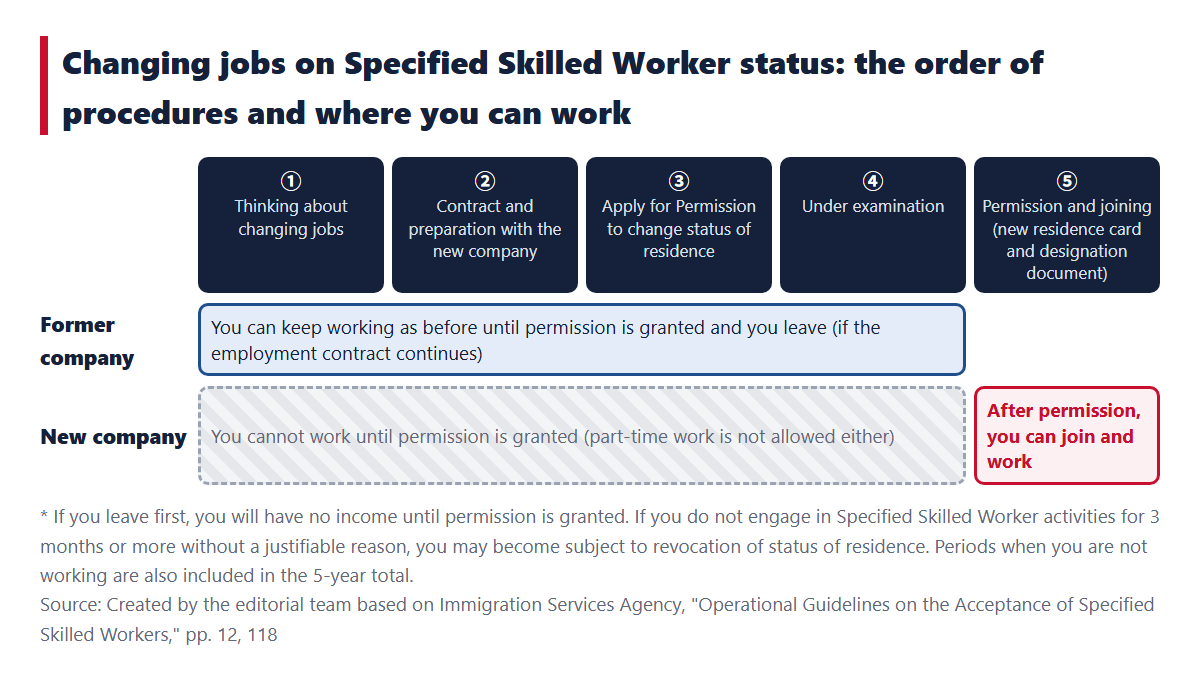
The basic way to avoid a gap is to “apply for Permission to change status of residence for the new company while still working at your current company.” The diagram below shows the order of the procedures and at which company you can work at each stage.
Sources: Created by the editorial team (Immigration Services Agency, “Operational Guidelines on the Acceptance of Specified Skilled Workers” (https://www.moj.go.jp/isa/content/001468647.pdf))
The upper row of the diagram (the former company) shows that you can keep working as before until you leave. The lower row (the new company) shows that you cannot work there until permission is granted. What the three parties do at each stage is shown in the table below.
| Stage | Worker | New company / registered support organization | Former company |
|---|---|---|---|
| ① Thinking about changing jobs | Check your period of stay’s expiration date and the remaining time of the 5-year total, and look for a new job | Check the job category, exams, and the company’s own preparations for acceptance | Receives the worker’s notice of resignation and discusses the leaving date |
| ② Contract and preparation | Understand the contract terms and sign | Prepare the employment contract, the employment conditions document, and the support plan. Give the pre-guidance before the application. If outsourcing support, sign a contract with a registered support organization | If the leaving is not at the worker’s own convenience, submit the notification of difficulty in acceptance in advance. If the reason is not the worker’s fault, provide job change support |
| ③ Applying for Permission to change status of residence | Apply at the immigration office for the area where you live (you can also ask an application agent) | Prepare the company’s documents | ― |
| ④ Under examination | Do not work at the new company yet | Do not let the worker work until permission is granted | If the contract continues, the worker works as before |
| ⑤ Permission | Receive your new residence card and designation document, and check the company name | Confirm the start date with the worker. After permission, give the life orientation without delay | ― |
It is important not to reverse the order. If the worker works at the new company before permission is granted, they may become subject to revocation of status of residence or deportation.
(Sources: Immigration Services Agency, “Operational Guidelines on the Acceptance of Specified Skilled Workers,” pp. 12, 116–118, Immigration Services Agency, “Operational Guidelines on Support for Specified Skilled Workers (i),” pp. 8–9, 18–19, Immigration Services Agency, “Application for Permission to Change Status of Residence”)
What the worker does
These are the things the worker who is changing jobs must do themselves.
- Look for a new job. You can also search through public services such as Hello Work. How to use it is explained in How to Use Hello Work: Looking for a Job in Japan as a Foreign Resident (What to Bring, Job Seeker Registration, Interpreters, and Referral Letters).
- Do not work at the new company until permission is granted. If you work without permission, you may become subject to revocation of status of residence or deportation.
- Check whether you need to notify immigration. If you apply for Permission to change status of residence while still employed at your current company and change jobs after receiving permission, the worker’s “Notification on the affiliated (contracting) organization” is not required. A notification becomes necessary in cases such as when you leave your former company before receiving Permission to change status of residence (see “Points to note if you quit first” below).
- If you move, notify your city, ward, town, or village. If your place of residence changes because of the job change, notify your municipality within 14 days.
Points to note if you quit first You can also look for a job after quitting. However, please be careful about the following points.
- When you quit, you, the worker, must notify immigration within 14 days that your contract with the former company has ended (Notification on the affiliated (contracting) organization). Even if you plan to apply for Permission to change status of residence with a new company later, the notification is required at the time you leave. You can notify through the electronic notification system, at the counter, or by mail.
- If you do not engage in Specified Skilled Worker activities for 3 months or more without a justifiable reason, you may become subject to revocation of status of residence.
- Periods when you are not working are also included in the 5-year total.
- If you have to leave because of the company’s circumstances, you can receive job change support from the former company (see “What the former company does” below).
(Sources: Immigration Services Agency, “Notification on the Affiliated (Contracting) Organization”, Immigration Services Agency, “Q&A on Notifications Concerning Affiliated Organizations and Notifications by Affiliated Organizations”, e-Gov Law Search, “Immigration Control and Refugee Recognition Act,” Article 19-16, Immigration Services Agency, “Operational Guidelines on the Acceptance of Specified Skilled Workers,” p. 118, Immigration Services Agency, “Q&A on the Specified Skilled Worker System,” Q38)
What the new company (the company you move to) and the registered support organization do
A company hiring a Specified Skilled Worker mid-career meets the acceptance standards and prepares the documents and support in the same way as when accepting a worker for the first time.
What to check before hiring Check the “3 questions” above (job category, remaining time of the 5-year total, and the company’s own preparations for acceptance) together with the worker. One of the acceptance standards is that the company has not made employees doing the same type of work leave for the company’s own reasons (has not caused involuntary job losses).
Preparing documents In the application for Permission to change status of residence, the company submits documents such as the employment contract, the employment conditions document, and the Specified Skilled Worker (i) Support Plan. How to fill them out is explained in the following articles.
The application can be filed by the worker, or submitted on their behalf by staff of an organization approved as an application agent (申請等取次者), or by a gyoseishoshi lawyer or attorney who has notified the Regional Immigration Services Bureau. Who can submit on someone’s behalf, and to what extent, is explained in How to get and renew the Application Agent Certificate|Application form, required documents, and what registered support organizations can submit 【Updated for the revised Gyoseishoshi Lawyer Act】.
Redoing the support People who join through a job change must also be given the pre-guidance and the life orientation. Even if they received them at the former company, the new company gives them again. The pre-guidance (an explanation of the contract terms, the conditions of stay, and so on) is given before the application for Permission to change status of residence, and preferably before the employment contract is signed. The life orientation (an explanation of life in Japan, notifications, where to get advice, and so on) is given without delay after Permission to change status of residence is received. On the other hand, meeting the worker at the airport on entry does not apply to people who are already in Japan (this is the approach set out in the operational guidelines for people who changed from Technical Intern Training (ii) and similar statuses).
Contract with a registered support organization If the company outsources all support to a registered support organization, the new company signs a support outsourcing contract with the registered support organization. This contract is between the company and the registered support organization, so it does not carry over the former company’s contract. In the application, the company submits an explanation of that contract (Reference Form No. 1-25).
After permission Once the acceptance begins, the new company, as an affiliated organization of a Specified Skilled Worker, submits periodic and ad hoc notifications and provides support. The overall picture of notifications is summarized in Annual Guide to Specified Skilled Worker Notifications: Periodic Notification (April–May) and Ad Hoc Notifications (Within 14 Days).
Points to note when choosing a registered support organization From April 1, 2027, the requirements for the support system will change. These include choosing the support manager and support staff for each office from full-time officers and employees, and limiting the people who carry out support work to them. When choosing an organization to outsource to, it is reassuring to check in advance whether it can meet the revised requirements.
(Sources: Immigration Services Agency, “Operational Guidelines on the Acceptance of Specified Skilled Workers,” pp. 59–60, 99, 112, Immigration Services Agency, “Application for Permission to Change Status of Residence”, Immigration Services Agency, “Operational Guidelines on Support for Specified Skilled Workers (i),” pp. 8–9, 12–13, 18–19, Immigration Services Agency, “Revision of the Requirements for the Support System for Specified Skilled Workers (i) (Effective April 1, 2027)”)
What the former company (the company you leave) does
The former company’s notifications differ depending on whether the worker moves after receiving Permission to change status of residence while still employed, or leaves before Permission to change status of residence.
When the worker moves after receiving permission while still employed If the worker applies for Permission to change status of residence for the new company while working at the current company and moves after receiving permission, the former company’s “Notification of termination of a Specified Skilled Worker employment contract” (an ad hoc notification) is not required.
When the worker leaves before Permission to change status of residence When the contract simply ends because the worker leaves, the company submits the “Notification of termination of a Specified Skilled Worker employment contract” (Reference Form No. 3-1-2) within 14 days from the day it ended. If all support is outsourced to a registered support organization and the outsourcing contract also ends because the worker leaves, it is enough to fill in the “c” box under “A Termination of contract” on this notification form. A notification of the end of the support outsourcing contract or a notification of a change to the support plan is not required.
When the leaving is not at the worker’s own convenience When ending the contract, submit the “Notification concerning difficulty in acceptance” (受入れ困難に係る届出, Reference Form No. 3-4) in advance. This covers not only the company’s circumstances such as workforce reductions, but also dismissal for serious misconduct by the worker (重責解雇). If the worker leaves at their own convenience, this notification is not required. In the explanatory document attached to the notification, write the content of the job change support and whether information was provided to the worker. The operational guidelines give the following as examples of information to provide.
- That the worker can look for a new job at Hello Work and other places
- That an Application for Permission to change status of residence is required to change jobs
- That working without permission makes the worker subject to revocation of status of residence or deportation
- That the worker also needs to notify immigration of the end of the contract within 14 days
Job change support When the contract ends for reasons that are not the worker’s fault, the company checks whether the worker wants to keep working. If the worker wishes to, the company must provide job change support. The support is one of the following.
- Collecting and passing on information about the next employer through industry associations or related companies
- Referring the worker to Hello Work or employment placement businesses, and accompanying them if necessary
- Writing a letter of recommendation
- If the company holds a license for employment placement business or similar, introducing the worker to an employer
In addition, both of the following are required: giving paid leave for job-seeking activities, and providing information on the procedures needed when leaving, such as National Health Insurance and National Pension. The company is asked to continue the support, as far as possible, until the next employer is decided.
Effect on the company’s own acceptance If the company makes employees leave for its own reasons (causes involuntary job losses), it no longer meets the acceptance standards. This applies to full-time employees who were doing the same type of work as the Specified Skilled Worker. Even one such case is considered failing to meet the standards, and it also affects future acceptance. The operational guidelines say that if you are unsure whether a leaving is at the worker’s own convenience or for the company’s reasons, you should first consult the Regional Immigration Services Bureau.
How to fill out the notifications and what to do when a deadline has passed are explained in the following article.
(Sources: Immigration Services Agency, “Operational Guidelines on the Acceptance of Specified Skilled Workers,” pp. 59–60, 106–107, 115–118, Immigration Services Agency, “Operational Guidelines on Support for Specified Skilled Workers (i),” pp. 30–31)
When the next company’s preparations are not ready in time, or when you lose your job
When preparations are not ready in time (Designated Activities (transition preparation)) There is a system for people whose preparations take time, for example because the documents for Permission to change status of residence cannot be gathered before their period of stay expires. It is “Designated Activities (6 months, work permitted)” (特定活動(6月・就労可)), under which you can prepare while working at the company you plan to work for. However, note the following points.
- The period of stay can be extended only once, and only when it is recognized that there are unavoidable circumstances.
- In principle, you are not allowed to change companies during this Designated Activities period and apply for this Designated Activities status again. The only exception is when you became unable to work at the former company for reasons that are not your fault and wish to change companies.
- This period is also included in the 5-year total. People whose total exceeds 4 years and 6 months are not eligible, and it is recommended that you have 8 months or more remaining.
- You must have passed the skills exam and the Japanese language exam (including exemptions).
The ISA says that applications for this Designated Activities status have increased and the examination is taking longer, and asks people to apply directly for a change to Specified Skilled Worker (i) as far as possible. Details will be explained in What is Designated Activities (preparation for transition to Specified Skilled Worker (i))?|Eligibility, requirements, application flow, and how to use it and points to note when changing jobs.
When you lose your job due to the company’s circumstances or similar reasons (Designated Activities (Employment Continuation Support)) There is also special treatment for people who became unable to work due to unavoidable circumstances, such as dismissal because of the company’s bankruptcy or downsizing, or harassment. It is for people such as those who have not found a new employer even after 3 months have passed since they became unable to work, and who have not yet passed the exam for the field they want to move to. Until they take the exam, they can work at the company they plan to move to. The period of stay is 1 year, and it can be extended up to 2 times only in certain cases.
Which system you can use depends on your period of stay’s expiration date and your exam status. If you are unsure, consult a specialist early.
(Sources: Immigration Services Agency, “Designated Activities related to Specified Skilled Worker (when wishing to transition to ‘Specified Skilled Worker (i)’)”, Immigration Services Agency, “When it is difficult to continue activities due to unavoidable circumstances (‘Designated Activities’ (Employment Continuation Support))”)
Frequently asked questions
Q1. Can I quit before my new job is decided?
Yes, you can quit. However, you cannot work at the new company until permission is granted. When you quit, you must notify immigration of the end of the contract within 14 days. If you do not engage in Specified Skilled Worker activities for 3 months or more without a justifiable reason, you may become subject to revocation of status of residence. That period is also included in the 5-year total. If you leave because of the company’s circumstances, you can receive job change support from the former company.
Q2. How long does the examination take?
The standard processing period for an Application for Permission to change status of residence is 1 to 2 months. The actual average number of days is published every month. The latest figures are introduced in Changing jobs on Specified Skilled Worker status: the change of status process, processing time, and can you work while your application is pending?.
Q3. Can the former company’s registered support organization support me at the next company too?
A support outsourcing contract is a contract between a company and a registered support organization. The former company’s contract does not simply continue. When the new company outsources support, the new company signs a contract with a registered support organization. Discuss with the new company which registered support organization to use.
Q4. Can I change jobs within the food service industry?
Yes, you can. The ISA states that applications from people working in the food service industry to change jobs within the food service industry are being examined as usual (posted September 10, 2026). For changes from other statuses of residence to the food service industry, applications accepted on or after April 13, 2026 are, in principle, not permitted, with some exceptions.
Q5. What if my former company does not submit its notification?
If you quit first and your contract ended, your own notification is required separately from the company’s notification. Even if the company has not submitted its notification, you can submit yours yourself through the electronic notification system, at the counter, or by mail. If you move after receiving Permission to change status of residence while still employed, your notification is not required. If you are in a dispute with the company over the terms of leaving or similar matters, the response depends on the individual circumstances, so consult a specialist or a public consultation service.
(Sources: Immigration Services Agency, “Application for Permission to Change Status of Residence”, Immigration Services Agency, “Operational Guidelines on the Acceptance of Specified Skilled Workers,” p. 112, Immigration Services Agency, “Notification on the Affiliated (Contracting) Organization”, Immigration Services Agency, “Examination Status of Residence Applications for Specified Skilled Worker (i) (Food Service Industry Field)”, Immigration Services Agency, “Q&A on the Specified Skilled Worker System,” Q38)
For those who want to learn more (articles on changing jobs on Specified Skilled Worker status)
Summary
- Each time a person with Specified Skilled Worker status changes companies, they need Permission to change status of residence. They cannot work at the new company until permission is granted.
- The worker, the new company, and the former company each have procedures to follow in a fixed order. Applying while still working at your current company is the basic way to avoid a gap.
- If you change jobs after receiving Permission to change status of residence while still employed, neither the worker’s notification nor the company’s notification of termination or conclusion of the contract is required. If you quit before Permission to change status of residence, both the worker and the former company submit notifications within 14 days after the contract ends.
- If preparations are not ready in time or you lose your job, there are Designated Activities systems. If you are unsure what to do in your own case, consult a specialist.
Primary Sources Referenced in Article Creation
- Immigration Services Agency, “Operational Guidelines on the Acceptance of Specified Skilled Workers (August 2026)”
- Immigration Services Agency, “Operational Guidelines on Support for Specified Skilled Workers (i)”
- Immigration Services Agency, “Operational Guidelines on the Acceptance of Specified Skilled Workers in Specific Fields (Construction Field)”
- Immigration Services Agency, “Specified Skilled Worker Operational Guidelines”
- Immigration Services Agency, “Q&A on the Specified Skilled Worker System”
- Immigration Services Agency, “Application for Permission to Change Status of Residence”
- Immigration Services Agency, “Notification on the Affiliated (Contracting) Organization”
- Immigration Services Agency, “Q&A on Notifications Concerning Affiliated Organizations and Notifications by Affiliated Organizations”
- Immigration Services Agency, “Total Period of Stay”
- Immigration Services Agency, “Designated Activities related to Specified Skilled Worker (when wishing to transition to ‘Specified Skilled Worker (i)’)”
- Immigration Services Agency, “When it is difficult to continue activities due to unavoidable circumstances (‘Designated Activities’ (Employment Continuation Support))”
- Immigration Services Agency, “Examination Status of Residence Applications for Specified Skilled Worker (i) (Food Service Industry Field) (posted September 10, 2026)”
- Immigration Services Agency, “Revision of the Requirements for the Support System for Specified Skilled Workers (i) (Effective April 1, 2027)”
- e-Gov Law Search, “Immigration Control and Refugee Recognition Act”
This article is a translation of the original Japanese version.