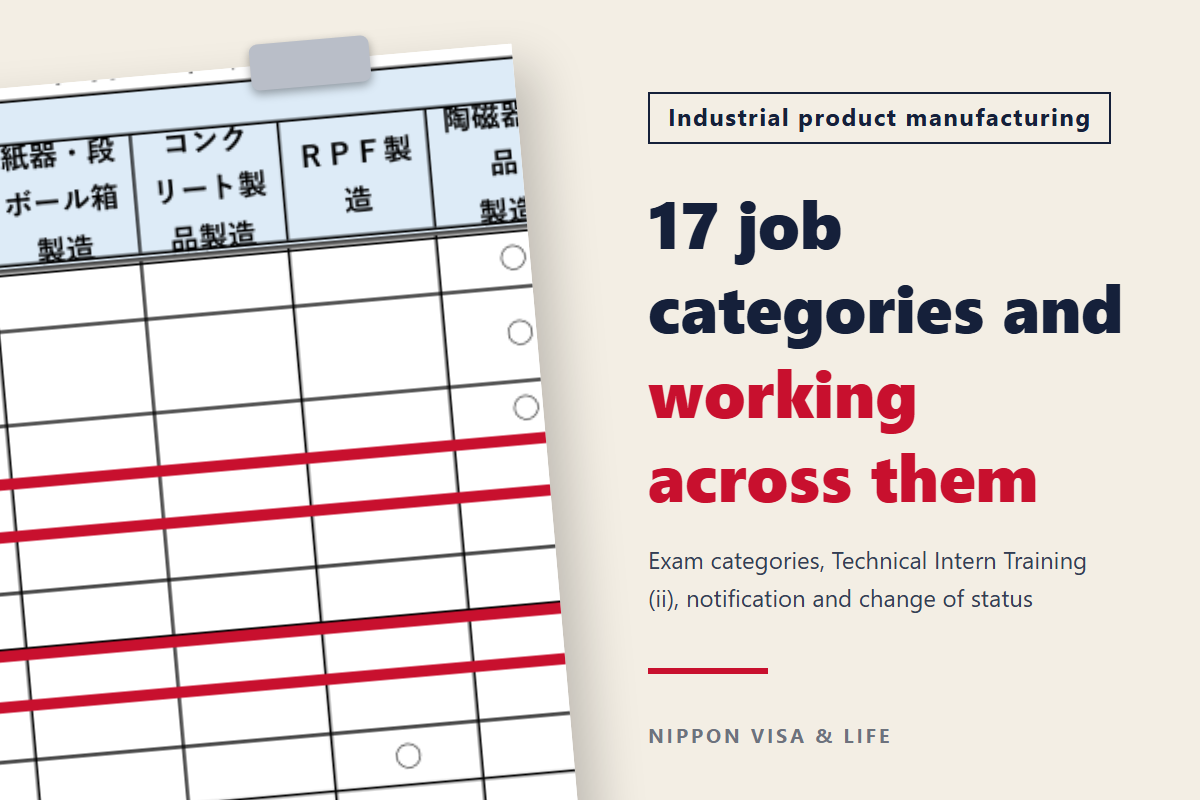


Foreign nationals working in Japan on Specified Skilled Worker (特定技能) status in the industrial product manufacturing field mainly engage in the work of the “job category” (業務区分) for which their skills were confirmed by an exam or other means. There are 17 job categories for (i) and 3 for (ii).
Those granted permission on the basis of passing an exam can work only in the category they passed. Those who moved from Technical Intern Training (ii) (技能実習2号) can work in the categories that correspond to their occupation. Changing to another category within the same field requires a notification to immigration, and changing to a different field requires permission to change status of residence (在留資格変更許可).
The contents of this article were checked on October 17, 2026 against the operational guidelines (運用要領) (industrial product manufacturing field, partially revised June 25, Reiwa 8), materials from the Immigration Services Agency (出入国在留管理庁), and the FAQ of JAIM (Japan Association for Industrial Manufacturing Human Resources, 工業製品製造技能人材機構) (version as of September 18, Reiwa 8). The overall picture of the field (eligible workplaces, joining JAIM, and application documents) is summarized in Guide to Accepting Specified Skilled Workers in the Industrial Product Manufacturing Field in Japan|Eligible Industry Classifications, 17 Job Categories, Exams, and Joining JAIM.
What a job category is: the rule on the side of “the foreign national’s work”
Whether a company can accept a worker depends on both ① whether the workplace falls under an eligible industry classification and ② whether the foreign national’s work falls under an eligible job category. This article is about ②, the job categories. How to judge the workplace is explained in the article below.
The job category decides three things.
- The category of the exam to take (the Manufacturing Field Specified Skilled Worker (i) Evaluation Test has 17 exam categories, one for each job category)
- The scope of work the foreign national can do
- Whether the foreign national can move on to Specified Skilled Worker (ii) (only 3 categories have (ii))
Work under (i), in every category, is work in manufacturing processes done “while understanding the instructions of a supervisor, or by one’s own judgment.” Work under (ii) is work done “while guiding multiple skilled workers,” including managing the processes.
The foreign national may incidentally engage in related work that Japanese employees doing the same work usually do (transporting raw materials and parts, preceding and following processes, operating forklifts, cleaning, etc.). However, they cannot be made to do only related work.
(Sources: Immigration Services Agency, “Industrial Product Manufacturing Field”, Operational Guidelines (industrial product manufacturing field) p.14)
List of the 17 job categories: the scope of the exams and the Technical Intern Training (ii) occupations exempt from the exams
For each category, we have set out side by side the work covered by the exam (JAIM’s “correspondence between exam categories and work”) and the Technical Intern Training (ii) occupations exempt from the exams (the appended table of the operational guidelines). These are two different documents, and their contents differ slightly.
| Job category | Scope of manufacturing process work | Main work covered by the exam (JAIM) | Technical Intern Training (ii) occupations exempt from the exams (Operational Guidelines) | (ii) |
|---|---|---|---|---|
| Machinery and metal processing | Formed and fabricated material products, industrial machinery, etc. | Casting, forging, die casting, machining such as lathe work, metal pressing, ironwork, sheet metal work, finishing, machine inspection and maintenance, electrical equipment assembly, plastic molding, painting, welding, industrial packaging, heat treatment, etc. | Casting, forging, die casting, machining, metal press working, ironwork, factory sheet metal work, finishing, plastic molding, machine inspection, machine maintenance, electronic equipment assembly, electrical equipment assembly, painting, welding, industrial packaging, reinforced plastic molding, aluminum rolled and extruded product manufacturing, metal heat treatment | ○ |
| Electrical and electronic equipment assembly | Electrical and electronic equipment, etc. (manufacturing and assembly processes) | Machining, finishing, machine inspection and maintenance, electronic equipment assembly, electrical equipment assembly, printed wiring boards, plastic molding, industrial packaging, etc. | Machining, finishing, plastic molding, printed wiring board manufacturing, electronic equipment assembly, electrical equipment assembly, machine inspection, machine maintenance, industrial packaging, reinforced plastic molding | ○ |
| Metal surface treatment | Surface treatment, etc. | Electroplating, hot-dip galvanizing, anodizing, buffing | Plating, aluminum anodizing | ○ |
| Paper container and corrugated box manufacturing | Paper containers and corrugated boxes | Die-cutting of printed boxes, box making of printed boxes, set-up box manufacturing, corrugated box manufacturing | Paper container and corrugated box manufacturing | - |
| Concrete product manufacturing | Concrete products | Concrete product manufacturing | Concrete product manufacturing | - |
| RPF manufacturing | Crushing, molding, etc. | RPF manufacturing | RPF manufacturing | - |
| Ceramic product manufacturing | Ceramic products | Machine wheel forming, pressure casting, pad printing, drain casting, tile forming, sanitary ware forming | Ceramic industrial product manufacturing | - |
| Printing and bookbinding | Offset printing, gravure printing, bookbinding | Offset printing, gravure printing, bookbinding | Printing, bookbinding | - |
| Textile product manufacturing | Textile products | Spinning operation, weaving operation, dyeing, knitting, carpets, net making, etc. | Spinning operation, weaving operation, dyeing, knit product manufacturing, warp knit fabric manufacturing, carpet manufacturing | - |
| Sewing | Sewing processes | Sewing of ready-made clothing, underwear, bedding, canvas products, dress shirts, car seats, towels, curtains, etc. | Women’s and children’s clothing manufacturing, men’s clothing manufacturing, underwear manufacturing, bedding making, canvas product manufacturing, cloth sewing, car seat sewing, towel manufacturing | - |
| Electric wire and cable manufacturing | Electric wire or cable | Electric wire and cable manufacturing | None | - |
| Prefabricated housing product manufacturing | Prefabricated housing products | Carpentry work, tiling, ordinary lathe work, metal pressing, ironwork, sheet metal work, painting, welding, concrete product manufacturing | Building carpentry, tiling, machining, metal press working, ironwork, factory sheet metal work, painting, welding, concrete product manufacturing | - |
| Furniture manufacturing | Furniture products | Furniture hand processing, metal pressing, sheet metal work, plastic molding, painting, industrial packaging, welding, furniture assembly, mattress manufacturing, furniture seat sewing | Metal press working, factory sheet metal work, furniture making, plastic molding, painting, industrial packaging, welding | - |
| Shaped and unshaped refractory manufacturing | Refractory products | Shaped refractory manufacturing, unshaped refractory manufacturing | None | - |
| Ready-mixed concrete manufacturing | Ready-mixed concrete | Ready-mixed concrete manufacturing | None | - |
| Rubber product manufacturing | Rubber products | Molding, extrusion, kneading and calendering, composite laminating | Rubber product manufacturing | - |
| Bag manufacturing | Bags | Bag manufacturing | None (see the note below) | - |
The “Technical Intern Training (ii) occupations” in the table are those for which the skills and Japanese language exams will remain exempt for the time being, even on and after April 1, Reiwa 9. For some occupations, the exemption covers only some operations (for example, “machining” for prefabricated housing product manufacturing covers only ordinary lathe work).
The 7 categories from electric wire and cable manufacturing to bag manufacturing were newly added in 2026. Applications for the added or expanded parts can be made only once the METI (Ministry of Economy, Trade and Industry, 経済産業省) public notice took effect on June 1, 2026 and the evaluation exam has been held.
Note: For bag manufacturing, the column for exempt Technical Intern Training (ii) is blank in the appended table of the operational guidelines (partially revised June 25, Reiwa 8). On the other hand, the Immigration Services Agency’s “On the relationship between occupations eligible for transition to Technical Intern Training (ii) and the fields (job categories) of Specified Skilled Worker (i)” (as of June 1, Reiwa 8) states that people can move from the bag manufacturing occupation to the bag manufacturing category. If you accept a person who completed Technical Intern Training (ii) in bag manufacturing, please check with the regional immigration services bureau (地方出入国在留管理官署).
The Immigration Services Agency’s page explaining the duties (job descriptions) lists the newly added categories as “in preparation” (checked on October 17, 2026).
(Sources: Operational Guidelines (industrial product manufacturing field), appended table, JAIM, “Manufacturing Field Specified Skilled Worker (i) Evaluation Test: Exam Overview”, Immigration Services Agency, “On the relationship between occupations eligible for transition to Technical Intern Training (ii) and the fields (job categories) of Specified Skilled Worker (i)”, Immigration Services Agency, “Industrial Product Manufacturing Field”)
The 3 categories that also have (ii): machinery and metal processing, electrical and electronic equipment assembly, and metal surface treatment
Of these 3 categories, machinery and metal processing and electrical and electronic equipment assembly cover a wide range of work, and many of their skills overlap. However, the exams are separate for each category.
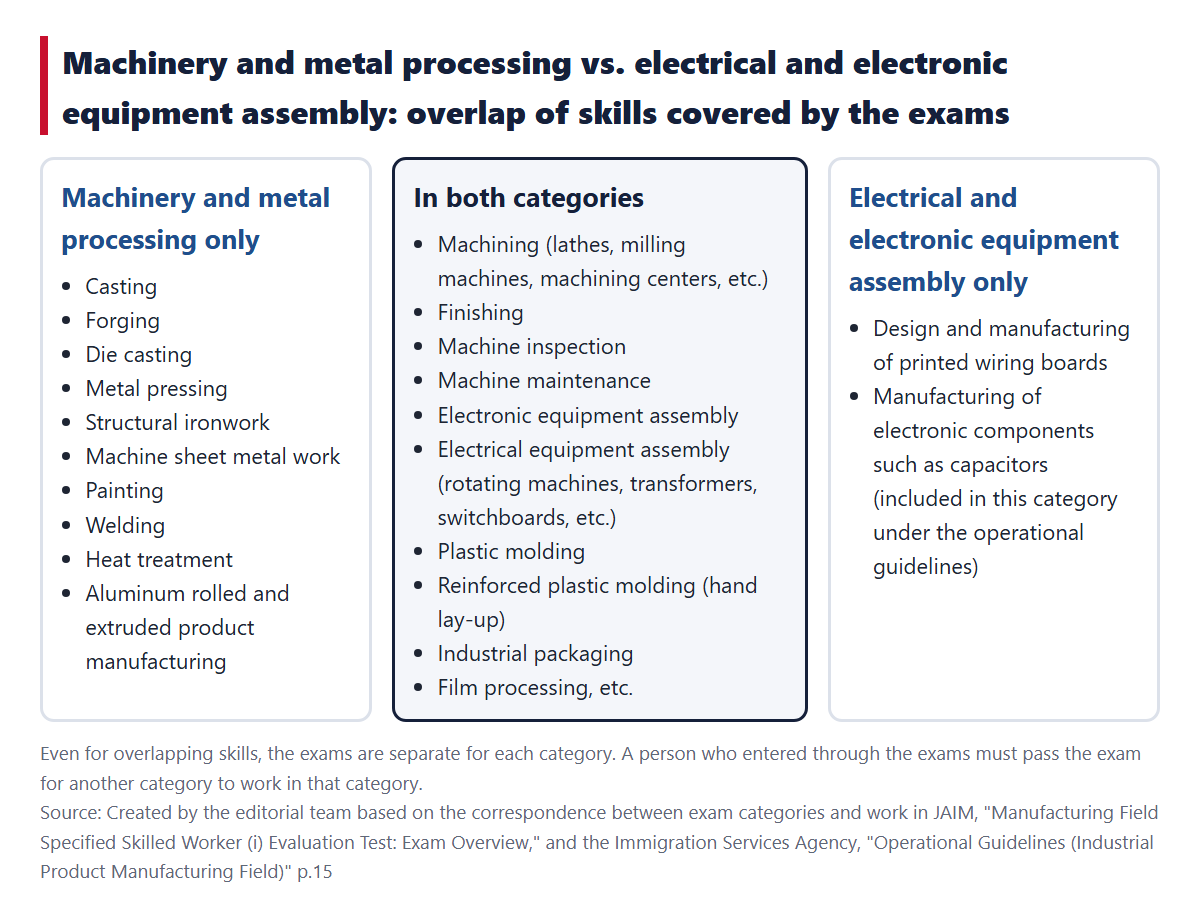
Sources: Created by the editorial team (based on JAIM, “Manufacturing Field Specified Skilled Worker (i) Evaluation Test: Exam Overview” and the Operational Guidelines (industrial product manufacturing field))
As shown in the center of the figure, machining, finishing, machine inspection, machine maintenance, electrical equipment assembly, plastic molding, industrial packaging, and others are covered by the exams of both categories. Casting, forging, painting, welding, heat treatment, and others appear only in machinery and metal processing, and printed wiring boards appear only in electrical and electronic equipment assembly.
The operational guidelines state that the work of electrical and electronic equipment assembly also includes making electronic components such as capacitors.
Metal surface treatment is the category for plating, anodizing, and buffing. If the worker will work in plating processes, this is the category.
Those who passed the former exam categories
Before the review of the system in August 2022 (Reiwa 4), there were exam categories for each skill, such as casting, welding, and painting. The operational guidelines state that those who passed these former exam categories are deemed to have passed the evaluation test of the corresponding category among machinery and metal processing, electrical and electronic equipment assembly, and metal surface treatment.
The exams and work experience for (ii) are explained in the article below.
(Sources: Operational Guidelines (industrial product manufacturing field) p.15 and appended table, JAIM, “Manufacturing Field Specified Skilled Worker (i) Evaluation Test: Exam Overview”)
Categories for paper containers, printing, textiles, sewing, furniture, and bags
Paper and printing are separate categories. A worker in the paper container and corrugated box manufacturing category may incidentally engage in printing processes if these are included in the related work that Japanese employees usually do. However, they cannot be made to do only printing processes. If printing processes will be their main work, they should be a worker in the printing and bookbinding category.
Textiles are divided into textile product manufacturing, which makes thread and cloth, and sewing, which sews clothing and other items. Because inspection work is not included in the sewing category, accepting a worker only to do inspection is not allowed (JAIM FAQ).
Furniture manufacturing covers not only furniture hand processing but also work on metal and resin furniture, such as metal pressing, sheet metal work, plastic molding, painting, welding, and industrial packaging. JAIM’s exam also lists furniture assembly, mattress manufacturing, and furniture seat sewing as covered work.
Workplaces in the textile industry, printing, and others have additional requirements for the field. Details are explained in the article below.
(Sources: JAIM, “FAQ on Acceptance” 2-37-7 and 4-2-3, Operational Guidelines (industrial product manufacturing field), appended table)
Categories for ceramics, building materials, and materials: concrete, ceramics, refractories, prefabricated housing, RPF, electric wire, and rubber
Concrete product manufacturing and ready-mixed concrete manufacturing are separate categories. A workplace that makes concrete products such as walls and pillars for buildings falls under industry classification 2123 (concrete product manufacturing), and a workplace that makes ready-mixed concrete falls under 2122 (ready-mixed concrete manufacturing).
For ceramic product manufacturing, the exam covers wheel forming, casting, and pad printing, as well as the forming of tiles and sanitary ware.
Prefabricated housing product manufacturing is the category for making housing components in a factory. It includes work close to construction, such as carpentry work, tiling, welding, painting, and metal pressing. Work at construction sites falls under the construction industry and is therefore not covered (JAIM FAQ).
RPF manufacturing is the category for work such as crushing and molding. In terms of the workplace’s industry classification, it falls under RPF manufacturing within “other manufacturing industries not elsewhere classified.”
For the newly added categories of electric wire and cable manufacturing, shaped and unshaped refractory manufacturing, and ready-mixed concrete manufacturing, there is no Technical Intern Training (ii) occupation that exempts the exam. To work in these 3 categories, the worker must pass the exam for that category. For rubber product manufacturing, workers can move from Technical Intern Training (ii) in the rubber product manufacturing occupation.
(Sources: JAIM, “FAQ on Acceptance” 2-11 and 2-35-1, Operational Guidelines (industrial product manufacturing field), appended table)
Which category is the work at your factory? Check the combination with the industry classification
If you are unsure, look at METI’s “Expected combinations of industry classifications and job categories.” The rows are the workplace’s industry classification, the columns are the 17 job categories, and the expected combinations are marked with ○.
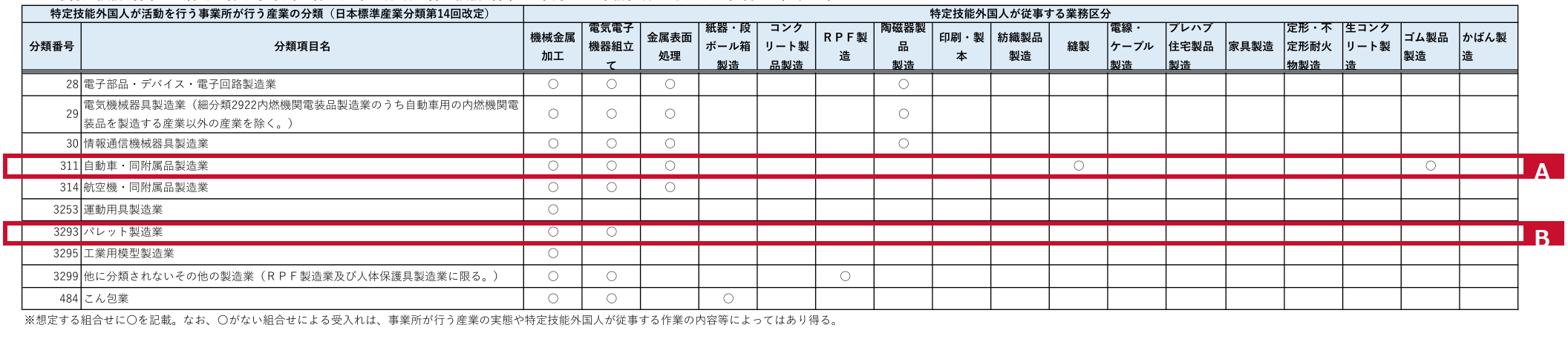
Sources: METI, “Expected combinations of industry classifications and job categories” (Manufacturing Industry Specified Skilled Foreign Workers Acceptance Council Decision No. 2, partially revised May 8, Reiwa 8)
For the auto parts factory in A of the image (311), in addition to machinery and metal processing, electrical and electronic equipment assembly, and metal surface treatment, sewing (car seats, etc.) and rubber product manufacturing are also marked with ○. For pallet manufacturing in B (3293), the categories are machinery and metal processing and electrical and electronic equipment assembly. A note to the table states that even combinations without ○ may be accepted depending on the actual situation of the workplace and the content of the work.
Here are some examples from JAIM’s FAQ to be careful of when judging the category.
- Even if the workplace is eligible, a worker cannot be accepted if the work does not fall under any job category. For example, there is a case where work that only involves receiving already-processed parts and assembling them was found not to fall under the work of a category.
- Even in the same factory and on the same line, the worker cannot do work that makes non-eligible products.
- If you are unsure how to judge the category, you can ask JAIM’s consultation desk for businesses. Whether status of residence (在留資格) is finally granted is decided in the immigration review.
(Sources: METI, “Expected combinations of industry classifications and job categories”, JAIM, “FAQ on Acceptance” 2-1-2, 2-13-3, 2-46, and 4-2-1, JAIM, “Supporting Member / Employment for Skill Development Member Membership” (consultation desk))
Which categories can a worker work in? The difference between those who entered through the exams and those who moved from Technical Intern Training (ii)
Those who entered through the exams can work only in the job category of the exam category they passed. Those who moved from Technical Intern Training (ii) can work in any category that corresponds to the occupation and operation they completed.
Those who entered through the exams
The exams are separate for each of the 17 exam categories. For example, a person who passed the exam for the machinery and metal processing category must newly pass the exam for the electrical and electronic equipment assembly category to work in that category, even though machining skills are common to both.
If a person has passed the exams for 2 categories, they can engage in the work of either category they passed (JAIM FAQ).
Those who moved from Technical Intern Training (ii)
A person who has satisfactorily completed Technical Intern Training (ii) can work without an exam in the categories that correspond to their occupation and operation. Within industrial product manufacturing, the categories that the main occupations can move to are as follows.
| Technical Intern Training (ii) occupation | Job categories the worker can move to (within industrial product manufacturing) |
|---|---|
| Machining | Machinery and metal processing, electrical and electronic equipment assembly (ordinary lathe work also prefabricated housing product manufacturing) |
| Finishing, machine inspection, machine maintenance, electronic equipment assembly, electrical equipment assembly, reinforced plastic molding | Machinery and metal processing, electrical and electronic equipment assembly |
| Plastic molding, industrial packaging | Machinery and metal processing, electrical and electronic equipment assembly, furniture manufacturing |
| Metal press working, factory sheet metal work, welding | Machinery and metal processing, prefabricated housing product manufacturing, furniture manufacturing |
| Ironwork | Machinery and metal processing, prefabricated housing product manufacturing |
| Painting | Machinery and metal processing (building painting also prefabricated housing product manufacturing; metal painting and spray painting also prefabricated housing product manufacturing and furniture manufacturing) |
| Concrete product manufacturing | Concrete product manufacturing, prefabricated housing product manufacturing |
| Furniture making | Furniture manufacturing |
| Printed wiring board manufacturing | Electrical and electronic equipment assembly |
| Plating, aluminum anodizing | Metal surface treatment |
To work in a category that does not correspond to the occupation, the worker needs the exam for that category. For example, a person who completed welding can move to machinery and metal processing without an exam, but to work in the concrete product manufacturing category, they must pass the exam for that category.
A person who has satisfactorily completed Technical Intern Training (ii) in an occupation outside industrial product manufacturing (excluding accommodation) is exempt from the Japanese language exam but must pass the skills evaluation test.
What “satisfactorily completed” means (completing at least 2 years and 10 months, etc.) is explained in the article below.
(Sources: Immigration Services Agency, “On the relationship between occupations eligible for transition to Technical Intern Training (ii) and the fields (job categories) of Specified Skilled Worker (i)” pp.3–4, Operational Guidelines (industrial product manufacturing field), appended table, JAIM, “FAQ on Acceptance” 2-35-3, 3-8, 8-1, and 8-2-1)
Working across categories: another skill in the same category, a different category, or a different field
When you want to have the worker do different work, first check “Is it a skill within the current category?” and then “Is it a category within the same field?” What is needed differs depending on the situation.
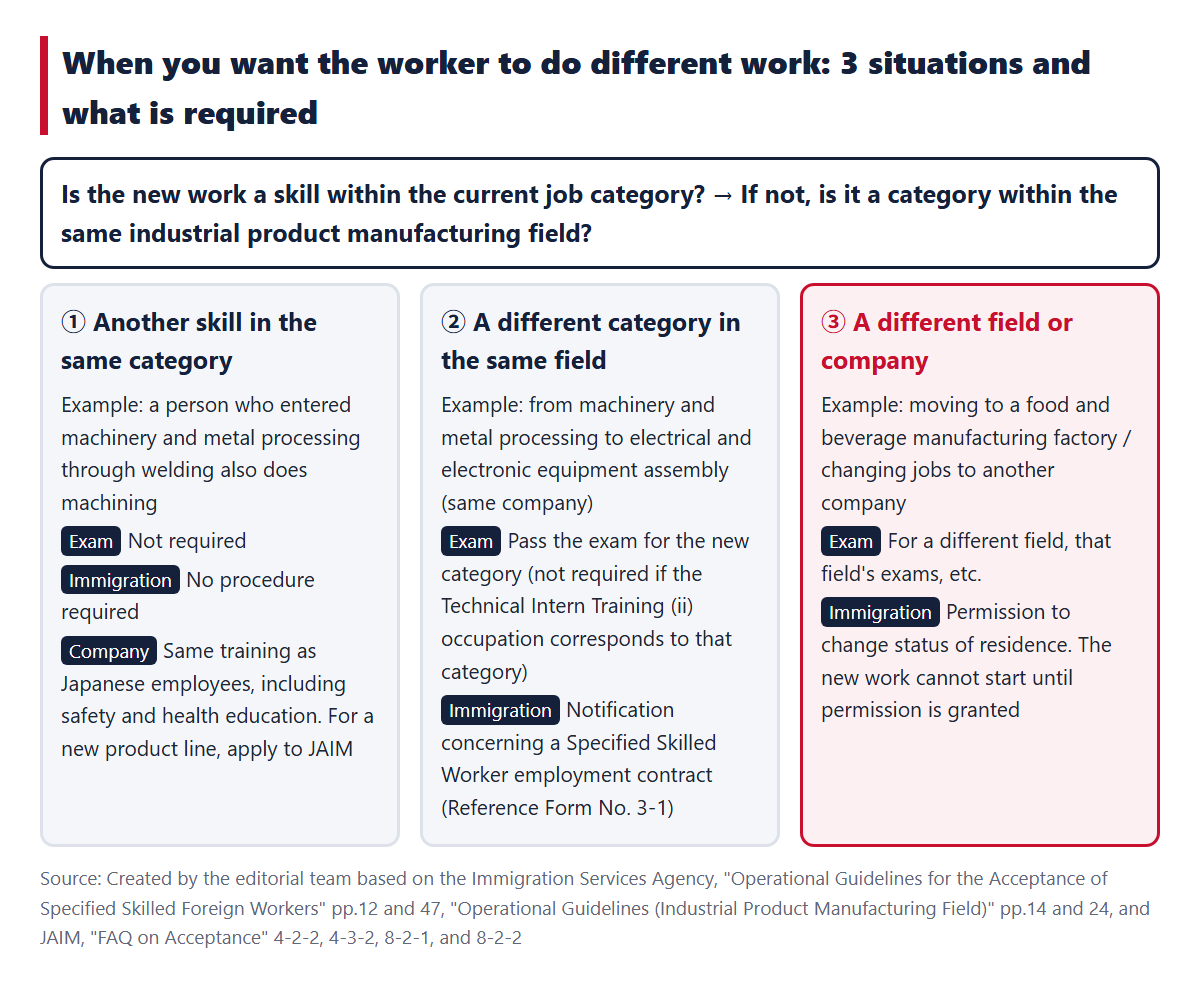
Sources: Created by the editorial team (based on the Immigration Services Agency, “Operational Guidelines for the Acceptance of Specified Skilled Foreign Workers,” and JAIM, “FAQ on Acceptance”)
① Another skill within the same category
This is ① in the figure. An example is having a person who entered machinery and metal processing through welding also do machining. Within the same job category, the worker can do work involving another skill without retaking the exam. For work that uses a new skill, to prevent injuries, the company provides the same training as for Japanese employees, including safety and health education. When putting the worker on a line for another product, apply to JAIM to confirm whether that product falls under an eligible industry classification.
② A different category in the same field
This is ② in the figure. The worker must pass the exam for the new category. The company changes the job description in the employment conditions document (雇用条件書) and, within 14 days of the change, notifies immigration with the “Notification Concerning a Specified Skilled Worker Employment Contract (Reference Form No. 3-1)” (特定技能雇用契約に係る届出書(参考様式第3-1号)). Attach materials showing that the worker has the skills for the new category. The operational guidelines list a copy of the certificate of passing the skills exam.
When a person who moved from Technical Intern Training (ii) changes to another category that corresponds to their occupation, no exam is required, but the procedure for status of residence is still required. It is safer to check with the regional immigration services bureau before the notification about what to attach.
③ The field or the company changes
When the worker changes to work in another field, permission to change status of residence is required, even at the same company. Changing companies also requires permission to change status of residence. Food factories belong to a different field (food and beverage manufacturing).
Whether the job description can be changed, and whether a notification is enough, may vary depending on individual circumstances. If you are unsure, please consult the Immigration Services Agency, JAIM, a gyoseishoshi lawyer (行政書士), or another professional.
(Sources: Immigration Services Agency, “Operational Guidelines for the Acceptance of Specified Skilled Foreign Workers” pp.12, 47, and 101–103, Operational Guidelines (industrial product manufacturing field) p.24, JAIM, “FAQ on Acceptance” 4-2-2, 4-3-2, 8-2-1, and 8-2-2)
Frequently asked questions
Q. If a worker has passed the exams for 2 categories, can they be given work in both? A. JAIM’s FAQ states that they can engage in the work of the job categories they passed.
Q. Can workers take the exams for the new categories (rubber products, bags, etc.)? A. JAIM’s exam page lists 17 categories, including the 7 new ones, as exam categories. The 2nd exam period is November 9 to 15, 2026. Please check the schedule and how to apply on JAIM’s page. The exam fee is 8,000 yen.
Q. Can a worker be given only inspection or packing work? A. They cannot be made to do only related work. The sewing category does not include inspection work, and accepting a worker only to do inspection is not allowed. Industrial packaging is work covered by the exams for machinery and metal processing, electrical and electronic equipment assembly, and furniture manufacturing.
(Sources: JAIM, “FAQ on Acceptance” 2-37-7 and 3-8, JAIM, “Manufacturing Field Specified Skilled Worker (i) Evaluation Test: Exam Overview”, Operational Guidelines (industrial product manufacturing field) p.14 and appended table)
Summary and where to get help
- The job category decides the scope of the foreign national’s work and which exam they take.
- Those who entered through the exams can work only in the category they passed, and those who moved from Technical Intern Training (ii) can work in the categories that correspond to their occupation.
- For another skill in the same category, training is enough. A different category requires an exam and a notification, and a different field requires permission to change status of residence.
- If you are unsure, look at METI’s table of combinations and ask JAIM’s consultation desk.
For the overall picture of the field, please see Guide to Accepting Specified Skilled Workers in the Industrial Product Manufacturing Field in Japan|Eligible Industry Classifications, 17 Job Categories, Exams, and Joining JAIM.
Primary sources used for this article
- Immigration Services Agency, “Operational Guidelines for the Acceptance of Specified Skilled Foreign Workers in Specified Fields (Industrial Product Manufacturing Field)” (partially revised June 25, Reiwa 8)
- Immigration Services Agency, “Operational Guidelines for the Acceptance of Specified Skilled Foreign Workers”
- Immigration Services Agency, “On the relationship between occupations eligible for transition to Technical Intern Training (ii) and the fields (job categories) of Specified Skilled Worker (i)” (as of June 1, Reiwa 8)
- Immigration Services Agency, “Industrial Product Manufacturing Field”
- Immigration Services Agency, “Job Descriptions for Each Field of Specified Skilled Worker (i)”
- METI, “Expected combinations of industry classifications and job categories” (partially revised May 8, Reiwa 8)
- JAIM, “Manufacturing Field Specified Skilled Worker (i) Evaluation Test: Exam Overview”
- JAIM, “FAQ on Acceptance” (version as of September 18, Reiwa 8)
(All checked on October 17, 2026)
This article is a translation of the original Japanese version.