This article was written by the NIPPON VISA & LIFE editorial team based on information from public organizations such as the national government and local governments. Rules and fees may differ depending on the city, ward, town or village where you live.
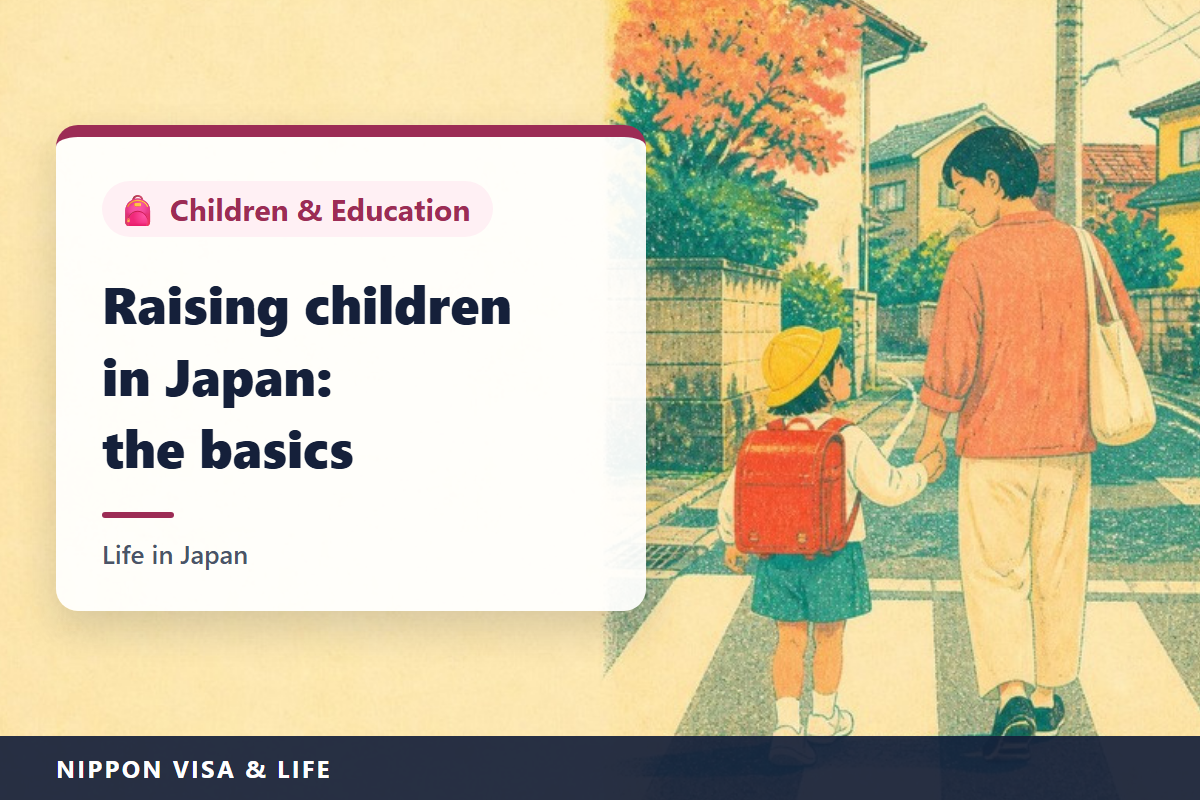
In Japan, most child-rearing procedures are done at the counter of the city, ward, town or village where you live. There are notifications and applications to make when you become pregnant, when your child is born, and when your child starts nursery school or school. This article lists the procedures for child-rearing and education by situation and guides you to more detailed articles.
The Short Answer: Go to Your City, Ward, Town or Village for Each Situation
| Situation | Main procedures | Where to go |
|---|---|---|
| When you become pregnant | Pregnancy notification → receive the Maternal and Child Health Handbook | The city, ward, town or village where you live |
| When your child is born | Birth registration (within 14 days), application for the child allowance, application for your child’s status of residence (if your child does not have Japanese nationality and will stay in Japan for more than 60 days; within 30 days after birth) | City, ward, town or village; Regional Immigration Services Bureau |
| From age 0 until starting school | Health checkups for infants and young children, vaccinations, use of nursery schools, kindergartens and certified centers for early childhood education and care | City, ward, town or village; hospitals and clinics |
| Ages 6 to 15 | Entering a public elementary or junior high school | City, ward, town or village (board of education) |
| When you are in trouble | Advice on child-rearing | Children and Family Centers, etc. (city, ward, town or village) |
The names and order of the procedures, and the names of the counters, may differ depending on the city, ward, town or village. If you are not sure, tell the staff at your city, ward, town or village office, “I want to know about the procedures for child-rearing.”
1. When You Become Pregnant: The Pregnancy Notification and the Maternal and Child Health Handbook
When you find out you are pregnant, submit a pregnancy notification to the city, ward, town or village where you live as early as possible. When you submit it, you can receive the following:
- Maternal and Child Health Handbook (boshi kenko techo: a handbook that records the health of the mother from pregnancy to after childbirth, and of the child from birth until early childhood)
- Vouchers or subsidy tickets for receiving prenatal health checkups (checks of your health during pregnancy) with public financial support
- Advice from public health nurses (professionals who give health advice) and others
- Information on parenting classes (classes where you learn about pregnancy, childbirth and child care)
You will use the Maternal and Child Health Handbook every time for later checkups and vaccinations. Keep it safe so you do not lose it. Information on child-rearing is also available on the Children and Families Agency’s “Maternal and Child Health Handbook Information Support Site.”
It is considered desirable to receive prenatal health checkups roughly at the following frequency.
| Stage of pregnancy | Approximate frequency |
|---|---|
| From the start of pregnancy to week 23 | Once every 4 weeks |
| From week 24 to week 35 | Once every 2 weeks |
| From week 36 to childbirth | Once every week |
(Source: Guidebook on Living and Working Chapter 4, 1-1 and 1-2)
2. When Your Child Is Born: The Birth Registration and Your Child’s Status of Residence
Birth Registration (Within 14 Days After Birth)
When your child is born in Japan, the father or mother submits a birth registration (shussei todoke).
- Deadline: within 14 days from the day your child was born
- Where to submit: the city, ward, town or village where your child was born, or where the person submitting it is located
- What you need: a birth certificate (a document filled in by the hospital or other place where your child was born), etc. For anything else you need, ask the city, ward, town or village where you submit it
Your Child’s Status of Residence (If Your Child Does Not Have Japanese Nationality)
If both the father and mother have foreign nationality, your child cannot acquire Japanese nationality even if born in Japan. If a child without Japanese nationality will stay in Japan for more than 60 days after birth, apply for acquisition of status of residence at a Regional Immigration Services Bureau within 30 days from the day of birth.
- For the application, you need documents such as a “certificate of the matters stated in the birth registration” (shussei todokesho kisai jiko shomeisho) that you receive from the city, ward, town or village. Complete the birth registration first, and then apply
- If your child has not acquired a status of residence after 60 days from birth, your child’s resident record (juminhyo) may be deleted, and your child may not be able to receive administrative services such as National Health Insurance and the child allowance
Check what you need for the application in the Immigration Services Agency’s information. For the status of residence when living in Japan with your family, please also read Which statuses of residence can bring family to Japan on a Dependent visa? Whether Specified Skilled Worker, Student, and Engineer/Specialist in Humanities/International Services qualify, and the conditions.
Notification to Your Home Country and Passport
Also notify the country of the father or mother that your child was born. Get your child’s passport at the same time. For the procedures, contact the embassy or consulate in Japan of the country of nationality.
(Source: Guidebook on Living and Working Chapter 1, 2-4, Chapter 4, 2-1 and 2-2)
Costs of Childbirth
Pregnancy and childbirth are not illnesses, so as a rule health insurance cannot be used (health insurance can be used for surgery such as a Caesarean section). Instead, when a person enrolled in health insurance or National Health Insurance gives birth, 500,000 yen is paid as the lump-sum allowance for childbirth and child care (shussan ikuji ichijikin) (488,000 yen if the birth is not covered by the Japan Obstetric Compensation System for Cerebral Palsy, for example when the pregnancy has not reached 22 weeks). There is also a method in which the medical institution receives the lump-sum allowance directly (such as the direct payment system); in that case, you do not need to pay the full cost of childbirth when you leave the hospital. For details, ask the health insurance you are enrolled in, or the National Health Insurance counter of your city, ward, town or village.
People enrolled in health insurance or employment insurance through their company can also receive benefits while taking time off work for childbirth or child care (such as the maternity allowance and the child care leave benefit). Consult the person in charge at your company.
(Source: Guidebook on Living and Working Chapter 4, 3-1 to 3-3)
3. Allowances and Money: The Child Allowance and Children’s Medical Expenses
Child Allowance
The child allowance (jido teate) is an allowance paid to people who are raising children. The national government’s information for foreign families explains that you can receive it if both the child and the person raising the child live in Japan.
- Eligible children: children up to the first March 31 after their 18th birthday (up to high school age)
- Application: apply to the city, ward, town or village where you live (public servants apply at their workplace). As a rule, it is paid from the month after the month you apply. When your child is born, apply as early as possible
- When you need to apply again: when a new child is born, or when you move to another city, ward, town or village
| Child | Monthly amount per child |
|---|---|
| Under 3 years old | 15,000 yen |
| From 3 years old to high school age | 10,000 yen |
| Third child and later (from age 0 to high school age) | 30,000 yen |
- Payment months: every year in February, April, June, August, October and December, you receive 2 months’ worth together, up to the previous month
- There are rules on how to count the first, second and third child (children up to the first March 31 after their 22nd birthday for whom you bear financial costs are also counted)
(Sources: Children and Families Agency “Guide to the Child Allowance System”, Guidebook on Living and Working Chapter 4, 3-4)
Children’s Medical Expenses
If your child is enrolled in health insurance, the out-of-pocket share of medical expenses for children before entering elementary school is 20%. In addition, some cities, wards, towns and villages provide their own extra subsidies, and in some places medical care is free until graduation from high school. The details of the subsidy and how to apply differ depending on the city, ward, town or village. Search the website of your city, ward, town or village for “子ども 医療費 助成” (kodomo iryohi josei: children’s medical expense subsidy), or ask at the counter.
For how to use hospitals, please read How to See a Doctor in Japan: Choosing Between Hospitals and Clinics, What to Show at Reception, the Medical Questionnaire, Payment and Medicine.
(Source: Guidebook on Living and Working Chapter 4, 4-4)
4. Health Checkups and Vaccinations
Health Checkups for Infants and Young Children
Cities, wards, towns and villages provide free health checkups for children aged 1 year and 6 months and aged 3 years. These include examinations of physical growth and development, measurement of height and weight, and advice on child care. Some cities, wards, towns and villages also have checkups at other ages. For details, contact the city, ward, town or village where you live.
Vaccinations
Children’s vaccinations include those recommended by the city, ward, town or village (which may be free) and those you choose to get yourself (which you pay for yourself). The types, timing and what to bring are summarized in Children’s Vaccinations in Japan: Free Routine Vaccinations, Types, Timing, How to Get Them and What to Bring.
Other Support
There are also postpartum care services through which mothers and children within 1 year after childbirth can receive physical and mental care and support for child care. There are also home visits (free of charge) in which a public health nurse or midwife comes to your home to give advice. The details differ depending on the city, ward, town or village.
(Source: Guidebook on Living and Working Chapter 4, 1-3 and 4-1 to 4-3)
5. Nursery Schools, Kindergartens and Certified Centers for Early Childhood Education and Care
There are mainly the following 3 types of facilities for children before entering elementary school.
| Facility | What it is | Eligible children |
|---|---|---|
| Nursery school (hoikusho / hoikuen) | Takes care of children who cannot be cared for at home, for example because their parents or guardians are working. Standard care time is 8 hours a day | Children before entering elementary school |
| Kindergarten (yochien) | An educational facility where children learn through play. Standard education time is 4 hours a day (some kindergartens look after children until the evening) | From age 3 until entering elementary school |
| Certified center for early childhood education and care (nintei kodomoen) | Has the roles of both a nursery school and a kindergarten. Can be used whether or not the parents or guardians are working | Children before entering elementary school |
- Childcare fees are free for children aged 3 to 5 who use kindergartens, nursery schools, certified centers for early childhood education and care, etc.
- Some facilities offer “temporary childcare” (ichiji azukari), which looks after children temporarily when you have urgent business or short-time work
- There are also facilities that are not licensed under the Child Welfare Act (unlicensed childcare facilities, including babysitters)
- Check where to apply, when to apply and the documents required for nursery schools and other facilities on the website or at the counter of your city, ward, town or village
Even after your child starts elementary school, if parents or guardians are not at home during the day because of work, you can use an after-school children’s club (gakudo hoiku: a place where children spend time after school). There is also the Family Support Center, where local people help each other with taking children to and from places and looking after them (if you use it, you pay a fee to the person who helped).
(Source: Guidebook on Living and Working Chapter 4, 4-5 to 4-7)
6. Elementary and Junior High School
The basic structure of schools in Japan is 6 years of elementary school, 3 years of junior high school, 3 years of high school and 4 years of university. Elementary school and junior high school are compulsory education.
Children of foreign nationality can also enter public elementary and junior high schools free of charge (tuition and textbooks) if they wish. When you tell the city, ward, town or village where you live that you want your child to attend a public school, the enrollment procedures begin. The procedures, what to bring and costs are summarized in How to Enroll Your Foreign National Child in Elementary or Junior High School in Japan: Procedures, What to Bring and Costs at Public Schools.
- School attendance assistance (shugaku enjo): Families with low incomes may receive part of the money needed for school supplies (uniforms, school backpacks (randoseru) and stationery) and school lunches. The conditions and amounts differ depending on the city, ward, town or village
- Japanese language support: You can find information that supports the learning of children who do not understand Japanese on “CASTA-NET” by the Ministry of Education, Culture, Sports, Science and Technology (MEXT). For support at school, consult the school or the board of education
- Night junior high schools: There are also “night junior high schools” (yakan chugaku) that people who have not completed compulsory education and others can attend. If you want to attend, consult the board of education of your city, ward, town or village
(Sources: Guidebook on Living and Working Chapter 5, 1-1, 1-4 and 2-1, MEXT “School Enrollment Guidebook”)
7. High School and Beyond
- As a rule, you enter high school by taking an entrance examination. There are full-time, part-time and correspondence courses
- Money for high school tuition (High School Enrollment Support Fund, koto gakko to shugaku shienkin) is paid. With the revision of the system from April 2026, the income limit has been removed. You need to apply to receive it, and the school your child attends will give you information
- For families with low incomes, there is also money for costs other than tuition, such as textbooks and school supplies (scholarship benefit for high school students, koko seito shogaku kyufukin)
(Sources: Guidebook on Living and Working Chapter 5, 1-2, 2-2 and 2-3, MEXT “Support for High School Students’ Education”)
When You Are in Trouble or Want Advice
- Children and Family Centers (kodomo katei center), etc.: Cities, wards, towns and villages have counters where you can talk about worries about pregnancy, childbirth and child-rearing, and problems at home or at school. Public health nurses and counselors will listen to you. They also give advice to families in which children interpret for their parents at hospital visits or during procedures at government offices
- Local child-rearing support centers: Places in public facilities, nursery schools, children’s centers and elsewhere where parents and children can gather and interact, and where you can also get advice on child-rearing
- 24-Hour Children’s SOS Dial: A phone line where children can talk about worries such as bullying. The phone number is 0120-0-78310, and calls are free
(Sources: Guidebook on Living and Working Chapter 4, 5-1 and 5-2, MEXT “24-Hour Children’s SOS Dial”)
If your child suddenly becomes ill or gets injured, please read When You Are Sick or Injured in Japan: The Basics of Hospitals, Ambulances, Medicine, Medical Insurance and Where to Get Advice.
Common Questions
Can We Use the Child Allowance and Nursery Schools Even If We Have Foreign Nationality?
The national government’s information for foreign nationals (Guidebook on Living and Working) explains that you can receive the child allowance if both the child and the person raising the child live in Japan. Check the conditions for using and applying to nursery schools and other facilities at the counter of your city, ward, town or village.
What Should I Do When We Move?
For the child allowance, you need to apply again when you move to another city, ward, town or village. Also check the procedures for children’s medical expense subsidies, nursery schools and schools at the city, ward, town or village you move to.
What If I Do Not Understand Japanese at the Government Office?
Some cities, wards, towns and villages have counters where you can get advice in foreign languages. Search the website of your city, ward, town or village for “外国人 相談” (gaikokujin sodan: consultation for foreign residents), or ask at the general information desk of the office.
Primary Sources Used for This Article
- Immigration Services Agency “Guidebook on Living and Working” (Chapter 1, 2-4; Chapter 4: Childbirth and Child-rearing; Chapter 5: Education)
- Immigration Services Agency “Application for Permission to Acquire Status of Residence”
- Children and Families Agency “Guide to the Child Allowance System”
- Children and Families Agency “Maternal and Child Health Handbook Information Support Site”
- MEXT “School Enrollment Guidebook”
- MEXT “CASTA-NET”
- MEXT “Support for High School Students’ Education”
- MEXT “24-Hour Children’s SOS Dial”
This article is a translation of the original Japanese version.