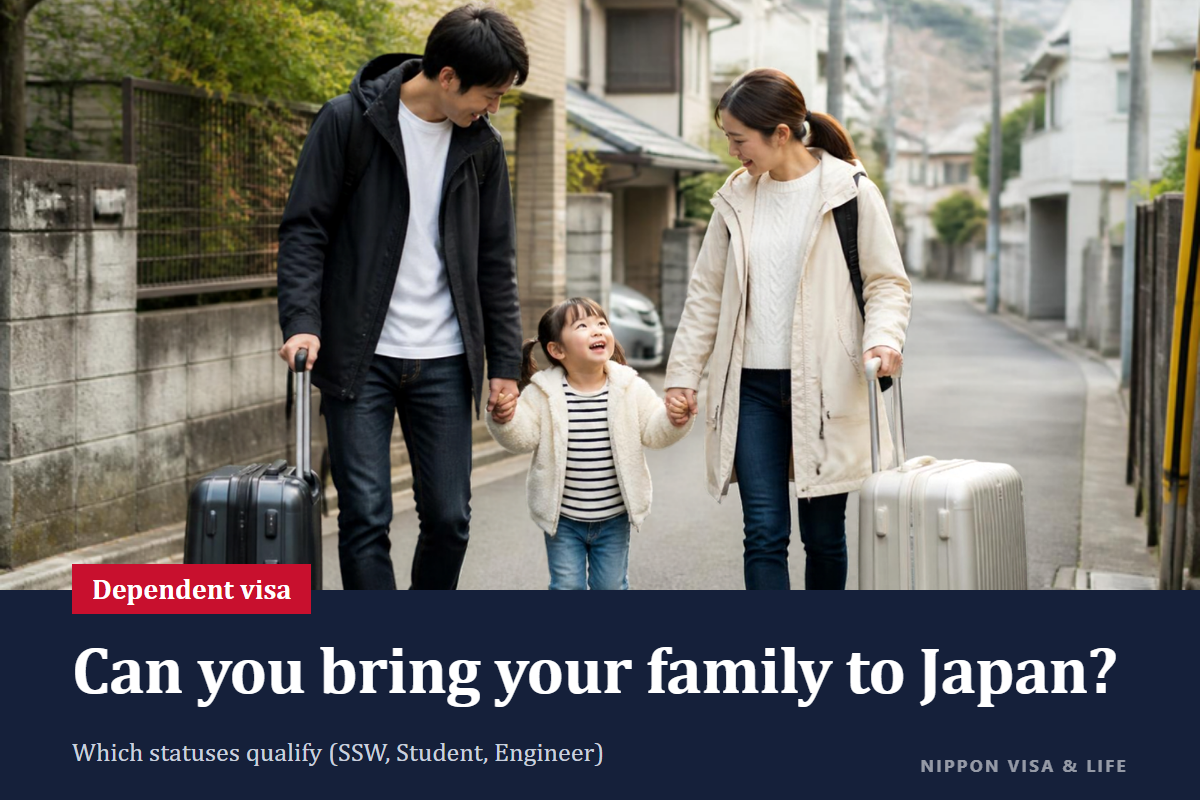

With a Dependent visa (the “Dependent” (家族滞在) status of residence), you can bring only your spouse and children to Japan. If the person bringing them (the supporter) is staying in Japan with a work status such as Engineer/Specialist in Humanities/International Services, or with Specified Skilled Worker (ii), Cultural Activities, or Student at a university or similar school, the family is eligible. People with Specified Skilled Worker (i) (特定技能1号), Technical Intern Training, or Employment for Skill Development in principle cannot bring their family.
As for income, no official threshold amount has been published. The processing time when bringing family from abroad was 70.0 days on average (results for cases permitted in July 2026).
For an overview of all statuses of residence, see the existing explanation (Japanese) An overview of all 29 types of visas for foreign nationals staying in Japan, including work visas and residence visas.
What is a Dependent visa? (Only spouses and children are covered)
“Dependent” is a status of residence that allows the “spouse” or “child” supported by a foreign national living in Japan to carry out ordinary daily life in Japan. It is not a status of residence for working.
The Immigration Control Act defines the activities of “Dependent” as follows: daily activities carried out as the spouse or child supported by a person staying in Japan with an eligible status of residence. Daily activities means the ordinary life of a family member, such as doing housework or going to school.
- Spouse: A person married to the supporter. If you divorce the supporter or the supporter dies, you are no longer a spouse.
- Child: A child of the supporter who is supported by the supporter.
- Parents and siblings: Not covered by “Dependent” (the exception for parents of Highly Skilled Professionals is explained later).
Treatment varies depending on individual circumstances for a common-law partner (a relationship without a registered marriage), a same-sex partner, an adopted child, an adult child, and so on. If you are unsure whether your family member qualifies, please consult a specialist before applying.
The period of stay is set individually for each person by the Minister of Justice, within a range not exceeding 5 years.
(Sources: e-Gov Laws and Regulations Search, “Immigration Control and Refugee Recognition Act,” Appended Table I (4), Immigration Services Agency (ISA), “Status of residence: Dependent”)
Which statuses of residence can bring family (quick-reference table)
Whether you can bring family with “Dependent” status depends on the supporter’s status of residence. The statuses excluded by law are Diplomat, Official, Specified Skilled Worker (i), Technical Intern Training, and Temporary Visitor. Trainee and Designated Activities are also not included. For Student, it is limited to regular students at universities and similar schools. Under the revised Immigration Control Act taking effect on April 1, 2027, Employment for Skill Development is excluded in place of Technical Intern Training, and the newly created Intra-company Transferee (ii) is also excluded.
| Supporter’s status of residence | Can bring family with “Dependent” | Notes |
|---|---|---|
| Professor, Artist, Religious Activities, Journalist | Yes | |
| Highly Skilled Professional | Yes | Preferential treatment for parents and domestic workers (explained later) |
| Business Manager, Legal/Accounting Services, Medical Services, Researcher, Instructor | Yes | |
| Engineer/Specialist in Humanities/International Services, Intra-company Transferee | Yes | Intra-company Transferee (ii) from April 2027 is not covered |
| Nursing Care, Entertainer, Skilled Labor | Yes | |
| Specified Skilled Worker (ii) | Yes | |
| Cultural Activities | Yes | |
| Student (university, graduate school, junior college, college of technology, vocational school, etc.) | Yes | Japanese language school students and students attending exclusively at night or by correspondence are not covered |
| Specified Skilled Worker (i) | No in principle | There is an exception (next chapter) |
| Technical Intern Training | No | Excluded by law |
| Employment for Skill Development (from April 2027) | No | Excluded under the revised Immigration Control Act |
| Temporary Visitor, Trainee | No | Excluded by law |
| Designated Activities | Cannot bring family with “Dependent” | Excluded by law |
| Diplomat, Official | Not “Dependent” | Family members also have Diplomat or Official status |
| Dependent | No | A person with “Dependent” status cannot be a supporter |
(Sources: e-Gov Laws and Regulations Search, “Immigration Control and Refugee Recognition Act,” Appended Table I (4), e-Gov Laws and Regulations Search, “Immigration Control and Refugee Recognition Act,” revised provisions taking effect on April 1, 2027, Appended Table I (4), Immigration Services Agency, “Status of residence: Dependent”)
The requirements and procedures for Engineer/Specialist in Humanities/International Services (技術・人文知識・国際業務) are explained in Internal link: a-0009 Engineer/Specialist in Humanities/International Services.
Students must be “regular students at universities and similar schools”
Students can bring family if they study at a university (including graduate schools and junior colleges), an equivalent institution, a college of technology, a vocational school (the specialized course of a specialized training college), or an advanced course. Graduate students in programs that hold classes at night are also included.
On the other hand, Japanese language school students and students at universities and similar schools who study only Japanese (such as in a Japanese language preparatory course) are not covered. The same applies to students attending exclusively at night and students studying by correspondence.
Students are assumed to have no income from work. For this reason, they need to show the family’s living expenses with savings or scholarships (explained later under “Required documents”).
People with Employment for Skill Development cannot be supporters for “Dependent”
Employment for Skill Development (育成就労) is a new status of residence starting on April 1, 2027. The revised Immigration Control Act defines the activities of “Dependent” as those of “a spouse or child supported by a person staying with a status of residence other than Diplomat, Official, Intra-company Transferee (ii), Specified Skilled Worker (i), Employment for Skill Development, or Temporary Visitor, among others.” In other words, like Technical Intern Training today, people with Employment for Skill Development cannot be supporters for “Dependent.”
The Immigration Services Agency also explains that under the Employment for Skill Development system, accompanying family members (bringing your family with you) are in principle not allowed.
The overall picture of the Employment for Skill Development system is explained in Internal link: a-0006 The Employment for Skill Development system.
(Sources: e-Gov Laws and Regulations Search, “Immigration Control and Refugee Recognition Act,” revised provisions taking effect on April 1, 2027, Appended Table I (4), Immigration Services Agency, “Q&A on the Employment for Skill Development System,” Q59)
Family of Japanese nationals, permanent residents, and long-term residents have different statuses of residence
Family members of Japanese nationals, permanent residents, special permanent residents, and long-term residents stay with a different status of residence, not “Dependent.” The main ones are as follows.
- Spouse or Child of Japanese National (日本人の配偶者等): The spouse of a Japanese national, a specially adopted child, or a person born as the child of a Japanese national
- Spouse or Child of Permanent Resident (永住者の配偶者等): The spouse of a permanent resident or special permanent resident, or a person born in Japan as the child of a permanent resident or special permanent resident who has continued to live in Japan since then
- Long-Term Resident (定住者): The spouse of a long-term resident granted a period of stay of 1 year or more; an unmarried minor biological child supported by a Japanese national, permanent resident, special permanent resident, or long-term resident with a period of stay of 1 year or more; an adopted child under 6 years old; and others (persons set out in the Public Notice on Long-Term Residents)
(Sources: e-Gov Laws and Regulations Search, “Immigration Control and Refugee Recognition Act,” Appended Table II, Immigration Services Agency, “Public Notice on Long-Term Residents”)
How people with statuses that cannot bring family can live with their family
Even people with a status of residence that cannot bring family may become eligible for “Dependent” if their status of residence changes. However, both the change and bringing family are examined, and permission is not guaranteed.
Specified Skilled Worker (i): not allowed in principle, with “Designated Activities” as an exception
With Specified Skilled Worker (i), accompanying family members are not allowed. However, on April 1, 2026, an exception was added to the Immigration Services Agency’s operational guidelines. For example, cases like the following:
- A child born in Japan to parents who are both Specified Skilled Worker (i)
- A spouse or child already in Japan with “Dependent” status when the person changes from Student to Specified Skilled Worker (i)
Such family members may be allowed to change to the “Designated Activities” (特定活動) status of residence as cases that particularly require humanitarian consideration.
However, if the child was born during a temporary return to the home country to give birth there, and there is someone in the home country who can raise the child, this is not regarded as requiring humanitarian consideration.
Moving to Specified Skilled Worker (ii) makes you eligible for “Dependent”
Specified Skilled Worker (ii) (特定技能2号) is a status of residence that can be a supporter for “Dependent.” If a person with Specified Skilled Worker (i) passes the exam for (ii) or similar and changes to (ii), the way opens to bring their spouse and children with “Dependent” status. How the period of stay for Specified Skilled Worker (i) works is explained in Internal link: a-0002 Period of stay for Specified Skilled Worker (i).
People with Technical Intern Training or Employment for Skill Development
While staying with Technical Intern Training or Employment for Skill Development, you in principle cannot bring your family. You would consider “Dependent” after moving to Specified Skilled Worker and then becoming Specified Skilled Worker (ii).
Japanese language school students
While studying at a Japanese language school, you cannot bring your family. If you go on to a regular course at a university or vocational school, you may become eligible. Even then, whether you can cover your family’s living expenses will be examined.
Preferential treatment for the family of Highly Skilled Professionals (spouse’s work, parents, domestic workers)
People with Highly Skilled Professional (高度専門職) status (highly skilled foreign professionals) can bring their spouse and children with “Dependent” status, and in addition receive the following preferential treatment for their family.
- Spouse’s work: Normally, a spouse needs to meet requirements such as education and work history to do work falling under “Instructor” or “Engineer/Specialist in Humanities/International Services.” The spouse of a highly skilled foreign professional can do such work even without meeting these requirements.
- Bringing parents: Parents are allowed to enter and stay in Japan to raise a child under 7 years old (including adopted children) of the highly skilled foreign professional or their spouse, or to help the professional or a spouse who is pregnant. The main requirements are that the household income, combining the annual income of the professional and the spouse, is 8,000,000 yen or more; that the parent lives with them; and that it is limited to the parents of only one side.
- Bringing domestic workers: With requirements such as a household income of 10,000,000 yen or more and plans to pay the domestic worker 200,000 yen or more per month, you can in principle bring up to 1 domestic worker (financial professionals such as those in investment management can bring up to 2 if the household income is 30,000,000 yen or more).
Parents and domestic workers stay with “Designated Activities,” not “Dependent.”
Conditions for “Dependent” permission (support and income)
In granting “Dependent” permission, the main points examined are “being supported” and “the supporter having the ability to support the family.” Regarding income, the Immigration Services Agency has not published a threshold amount.
Being supported
The family member must be living in reliance on the supporter. A person who can live on their own income may not count as a spouse or child who is “supported.”
The Immigration Services Agency does not present the “dependent” amounts used for tax or social insurance as a standard for “Dependent” status.
The supporter having the ability to support the family
The documents the Immigration Services Agency requires are documents showing the supporter’s occupation and income. A supporter who works submits a certificate of employment and a resident tax certificate of taxation (or non-taxation) and a tax payment certificate.
There is no published standard saying “you will be permitted if your annual income is at least a certain amount.” It is thought that whether the family can live in Japan is judged from the supporter’s income, the number of family members supported, savings, and so on. Amounts given as guidelines on the internet are not official standards.
If you are worried about your income, consider adding documents such as a bank balance, and consult a specialist.
Being able to prove the family relationship with documents
You need to show the marriage or parent-child relationship with official documents. The type of certificate differs by country, so start preparing early.
(Sources: Immigration Services Agency, “Status of residence: Dependent”)
Required documents (certificate, change, extension, acquisition)
There are 4 types of applications for “Dependent.” For all of them, documents showing the family relationship and the supporter’s income are central.
| Type of application | When it is used |
|---|---|
| Application for Certificate of Eligibility (在留資格認定証明書交付申請) (certificate) | When bringing family members who are abroad to Japan |
| Application for Permission to change status of residence (在留資格変更許可申請) (change) | When a family member already in Japan changes from another status of residence to “Dependent” |
| Application for Permission to extend period of stay (在留期間更新許可申請) (extension) | When extending the period of “Dependent” status |
| Application for permission to acquire status of residence (在留資格取得許可申請) (acquisition) | Such as when a child is born in Japan |
Documents for every application
- Application form
- 1 photo (meeting the specified standards)
- A document proving the family relationship (one of the following): a certified copy of the family register (koseki tohon), a certificate of acceptance of marriage notification, a copy of the marriage certificate, a copy of the birth certificate, or an equivalent document
- A copy of the supporter’s residence card or passport
The photo rules changed from June 14, 2026. For change, extension, and acquisition applications, a photo is required for persons aged 1 or older on the day the residence card is issued (previously, it was not required for those under 16). The residence card is explained in Internal link: a-0007 Residence card.
Documents showing the supporter’s occupation and income
| Supporter’s situation | Documents to submit |
|---|---|
| Working or running a business | A certificate of employment or a copy of a business license, etc., and a resident tax certificate of taxation (or non-taxation) and a tax payment certificate (showing total income for 1 year and tax payment status) |
| Not working (students, etc.) | A bank balance certificate in the supporter’s name, or a certificate showing the amount and period of a scholarship, etc., showing that the family’s living expenses can be paid |
Resident tax certificates are issued by the city, ward, town, or village where you lived on January 1. If one certificate shows both total income and tax payment status, one certificate is enough.
Additional items needed for each application
- Certificate: A return envelope (with stamps for simplified registered mail attached)
- Change and extension: Show your passport and residence card
- Acquisition: Show your passport, a document proving the birth, and a questionnaire. If you submit a certificate of residence (juminhyo), you will not need to notify your place of residence at the municipal office after permission (recommended)
Notes on documents
- Certificates issued in Japan must be submitted within 3 months of the date of issue.
- Attach a Japanese translation to documents in foreign languages.
- During the examination, you may be asked for other materials.
The Immigration Services Agency publishes a checklist of documents for each application. Please check the checklists for certificate, change, extension, and acquisition.
(Sources: Immigration Services Agency, “Status of residence: Dependent”)
Application process and processing time
When bringing family from abroad, first apply in Japan for a Certificate of Eligibility. The processing time, based on results for cases permitted in July 2026, averaged 70.0 days for certificates, 38.7 days for extensions, and 43.5 days for changes.
Bringing family from abroad
- The supporter or another eligible person in Japan applies for a Certificate of Eligibility (those who can apply include the person who will support the family in Japan and relatives of the family living in Japan)
- Once the certificate is issued, send it to the family abroad
- The family applies for a visa at the Japanese embassy or consulate general in the country where they live
- They receive landing permission at an airport or other port in Japan
For how the Certificate of Eligibility works, see the existing explanation (Japanese) Explanation of the Certificate of Eligibility (COE).
When a family member in Japan changes to “Dependent”
For example, a spouse who was a student graduates from school and changes to “Dependent” as the spouse of a supporter working with Engineer/Specialist in Humanities/International Services status. Apply for Permission to change status of residence before the period of stay expires.
When a child is born in Japan
A child born in Japan can stay in Japan without a status of residence for up to 60 days from the date of birth. If the child will stay in Japan for more than 60 days, an application for permission to acquire status of residence must be made within 30 days from the date of birth.
Extension
When the supporter extends their period of stay, also check the expiration date of the family’s period of stay. In extensions as well, the family relationship and the supporter’s income are checked.
Typical processing time
| Type of application | Average number of days (cases permitted in July 2026) |
|---|---|
| Certificate | 70.0 days |
| Extension | 38.7 days |
| Change | 43.5 days |
These numbers are averages from acceptance of the application to permission. If additional materials are requested, the days until they are submitted are also included. Certificates take time, so plan to bring your family with plenty of time to spare.
(Sources: Immigration Services Agency, “Processing period for residence examinations (cases permitted in July, Reiwa 8)”, e-Gov Laws and Regulations Search, “Immigration Control and Refugee Recognition Act,” Article 22-2, e-Gov Laws and Regulations Search, “Regulation for Enforcement of the Immigration Control and Refugee Recognition Act,” Appended Table IV)
From October 1, 2026, the fees for change and extension became amounts based on the permitted period of stay. Please check the amounts in Internal link: a-0001 Fees for residence procedures.
To work with “Dependent” status, you need permission to engage in activity other than that permitted (comprehensive permission is up to 28 hours a week)
People with “Dependent” status in principle cannot work. With “comprehensive permission” to engage in activity other than that permitted under the status of residence, you can do part-time work and similar within 28 hours per week. You can apply for comprehensive permission with only the application form.
What you can and cannot do with comprehensive permission
- You can carry out activities that earn remuneration or run a business within 28 hours per week.
- Work at businesses such as adult entertainment businesses is not possible with comprehensive permission. However, from October 1, 2026, only people with “Dependent” status can work at amusement businesses such as pachinko parlors if they receive individual permission (see the next section, “Working at amusement businesses (pachinko parlors, etc.)”).
- Work as a sole proprietor, receiving requests such as deliveries and earning remuneration based on results, is also possible with comprehensive permission if the hours worked can be objectively confirmed.
Working at amusement businesses (pachinko parlors, etc.) (from October 1, 2026)
From October 1, 2026, the Immigration Services Agency allows only people with the “Dependent” status of residence to work at amusement businesses (pachinko parlors, etc.) if they receive individual permission.
- Who is covered: Only people with “Dependent” status. People with Student status and people staying with “Designated Activities” as a supported spouse, child, or similar are not covered.
- Individual permission is needed even if you have comprehensive permission: Even people who already have comprehensive permission must separately obtain individual permission to engage in activity other than that permitted to work at an amusement business. You cannot work there until you receive permission.
- Working hours: The total of all activities other than those permitted, including both comprehensive and individual permission, must be within 28 hours per week. If you also have a part-time job at another place, the total must still be within 28 hours.
The main requirements are as follows.
- The business where you work has an adult entertainment business license under the Act on Control and Improvement of Amusement Business, etc. (the Amusement Business Act) (limited to the businesses in Article 2, Paragraph 1, Items 4 and 5 of that Act)
- The business where you work submits a written pledge promising the following: to comply with the legal obligations of employers who hire foreign nationals, such as notification of the employment status of foreign nationals; to encourage the foreign nationals it hires to obtain a specified residence card; and, if a foreign employee also does other activities other than those permitted, to regularly check that the total is within 28 hours per week
- The general requirements for permission to engage in activity other than that permitted are met, such as the work not violating laws and regulations and not interfering with the activities of “Dependent”
In the application, you submit the application form, a document explaining the content, hours, remuneration, etc. of the activity, a written pledge made by the employer, a written pledge made by yourself, a copy of the business’s business license or similar, and a document explaining the status of your other activities other than those permitted (showing that the total is within 28 hours per week). The Immigration Services Agency provides reference forms for the written pledges.
Work at adult entertainment businesses other than amusement businesses is not covered by this treatment.
When individual permission is required
- When you work as a sole proprietor and it is difficult to objectively confirm the hours worked
- When the working hours are not clear, such as under an outsourcing or service contract
- When you carry out activities beyond the scope of comprehensive permission (on the condition that the period of the activity does not exceed half of the period of stay)
If you start a new company, hire employees, or set up an office to run a business, you need to change to the “Business Manager” (経営・管理) status of residence.
Working without permission is illegal work
Working without permission, or working beyond the scope of permission (within 28 hours per week for comprehensive permission), is illegal work. It can result in deportation or penalties. Employers should check on the residence card whether the person has permission to engage in activity other than that permitted.
If you want to work longer hours, consider changing to a work status such as Engineer/Specialist in Humanities/International Services. You need to meet requirements such as education and the content of the work.
(Sources: Immigration Services Agency, “Permission to engage in activity other than that permitted under the status of residence for ‘Dependent'”, Immigration Services Agency, “Permission to engage in activity other than that permitted under the status of residence”, Immigration Services Agency, “Permission to engage in activity other than that permitted at amusement business premises”, Immigration Services Agency, “Part-time work at amusement business premises (pachinko parlors, etc.)”, e-Gov Laws and Regulations Search, “Immigration Control and Refugee Recognition Act,” Articles 19, 24, and 73)
Options for children with “Dependent” status (employment after high school, etc.)
When a child with “Dependent” status graduates from a Japanese high school and gets a job, they do not meet the education requirements for statuses such as Engineer/Specialist in Humanities/International Services. However, if certain requirements are met, they may be eligible to change to “Long-Term Resident” or “Designated Activities.”
The “Designated Activities” here has no public notice item number. Among Designated Activities, the types set in advance are listed as items in the “Public Notice on Designated Activities” (Ministry of Justice Public Notice No. 131 of Heisei 2), but this treatment for employment after high school is not included in the public notice. The Minister of Justice designates the activities individually for each person, and in practice this is called “Designated Activities outside the public notice.” The designated activities are activities of being employed by a company or other organization in Japan and receiving remuneration (excluding work at businesses such as adult entertainment businesses).
| Requirement | Long-Term Resident | Designated Activities |
|---|---|---|
| Compulsory education in Japan | Graduated from elementary school and junior high school | Not required |
| High school in Japan | Graduated or expected to graduate | Graduated or expected to graduate (people who transferred into high school also need about JLPT N2 level) |
| Supporter | Not required | The supporter is in Japan as a guarantor |
| At the time of entry | Under 18 | Under 18 |
| Residence history | Continuously “Dependent” since entry | Continuously “Dependent” since entry |
| Employment | A job has been secured (including an informal job offer) | A job has been secured (including an informal job offer) |
| Other | Has fulfilled public obligations such as notification of place of residence | Has fulfilled public obligations such as notification of place of residence |
Employment here means working beyond the scope of permission to engage in activity other than that permitted (28 hours per week). People who are not “Dependent” but are in an equivalent position (such as Student) are also covered.
People who have become “Designated Activities” also have a path to change to “Long-Term Resident” later. The main requirements include having stayed for 5 years or more with Designated Activities for the purpose of employment or with a work status (excluding Technical Intern Training), having a job secured, and being able to support yourself.
Children who came to Japan at age 18 or older, and children who did not graduate from a Japanese high school, are not covered by this treatment. Options such as Student or a work status need to be considered individually, so please consult a specialist.
(Sources: Immigration Services Agency, “For those staying with ‘Dependent’ status who wish to work in Japan after graduating from high school”, Immigration Services Agency, “For people with foreign nationality who are thinking about working in Japan after graduating from high school”, Immigration Services Agency, “Public Notice on Designated Activities” (reflecting revisions up to April 8, Reiwa 8), Immigration Services Agency, “Status of residence: Designated Activities”, Immigration Services Agency, Residence Management Division Director’s notice, “Treatment of persons working in Japan after graduating from high school, etc. (request)” (October 11, Reiwa 5, posted on the Ministry of Education, Culture, Sports, Science and Technology website))
If the supporter’s situation changes (divorce, death, permanent residence, change of job)
“Dependent” is a status of residence based on the relationship with the supporter. If the supporter’s situation changes, check the procedures early.
In case of divorce or death
If a person staying with “Dependent” status as a spouse divorces the supporter or the supporter dies, they must submit a “notification regarding the spouse” to the Immigration Services Agency within 14 days. It can also be submitted online. This notification is an obligation of the spouse, not of children.
In addition, if you have not carried out the activities of “Dependent” for 3 months or more continuously, your status of residence may be subject to revocation (unless there is a justifiable reason). If you want to keep living in Japan after a divorce or death, consider changing to another status of residence early.
A child may be able to continue staying with “Dependent” status even if the parents divorce, as long as the child continues to be supported by the supporter.
When the supporter becomes a permanent resident
When the supporter receives Permission for permanent residence (永住許可), they no longer count as a supporter for “Dependent.” The family considers changing to another status of residence or applying for Permission for permanent residence together as a family.
- Spouse: Change to “Spouse or Child of Permanent Resident”
- Child: A child who becomes “Spouse or Child of Permanent Resident” is one born in Japan as the child of a permanent resident who has continued to live in Japan since then. Other children consider options such as changing to “Long-Term Resident” (as an unmarried minor biological child supported by a permanent resident).
Which status of residence applies depends on when and where the child was born. If you are unsure, please consult a specialist. The guidelines for Permission for permanent residence are explained in Internal link: a-0005 Guidelines for Permission for permanent residence.
When the supporter has returned home or lost their status of residence
If the supporter is no longer there, the family also loses the basis for staying with “Dependent” status. If you want to stay in Japan, check whether you qualify for another status of residence.
When the supporter changes jobs or becomes unemployed
At the time of extension, the supporter’s income is checked. The supporter should also not forget their own notifications (such as the notification when their workplace changes).
(Sources: Immigration Services Agency, “Notification regarding the spouse”, Immigration Services Agency, “Revocation of status of residence (Article 22-4 of the Immigration Control Act)”, e-Gov Laws and Regulations Search, “Immigration Control and Refugee Recognition Act,” Articles 19-16 and 22-4 and Appended Table II, Immigration Services Agency, “Public Notice on Long-Term Residents”)
Frequently asked questions
Q1. I work with Engineer/Specialist in Humanities/International Services status. Can I bring my family?
Yes. Engineer/Specialist in Humanities/International Services is a status of residence that can be a supporter for “Dependent.” The examination looks at points such as whether your family will be supported by you and whether you have enough income to support your family.
Q2. I am a Specified Skilled Worker (i). My child was born in Japan.
A child born in Japan to parents who are both Specified Skilled Worker (i) may be allowed to change to “Designated Activities” out of humanitarian consideration. If the child will stay in Japan for more than 60 days from the date of birth, you must apply to acquire a status of residence within 30 days from the date of birth, so please consult someone right away.
Q3. I am a Japanese language school student. Can I bring my spouse?
No. Students who can bring family are limited to students in regular courses at universities, vocational schools, and similar schools.
Q4. Can I bring my parents?
Not with “Dependent” status. People with Highly Skilled Professional status may be able to bring their parents under certain requirements, for reasons such as raising a child under 7 years old.
Q5. How much annual income do I need to get permission?
No threshold amount has been published. It is thought that the decision is made comprehensively based on the supporter’s income, the number of family members, savings, and so on.
Q6. Can a spouse with “Dependent” status work full-time?
You cannot keep working full-time while remaining in “Dependent” status. With comprehensive permission, you can work within 28 hours per week. Activities beyond that require individual permission, with conditions such as not exceeding half of the period of stay. To keep working full-time, you need to change to a work status.
Q7. Can I bring an adult child?
The law does not set an upper age limit for children. However, the child must be supported. If the child is of an age or in a situation to support themselves, whether they are actually supported may be examined carefully.
Summary
- With “Dependent” status, you can bring only your spouse and children. Parents and siblings are not covered.
- People with work statuses such as Engineer/Specialist in Humanities/International Services, Specified Skilled Worker (ii), Cultural Activities, or Student at a university or similar school can bring their family.
- People with Specified Skilled Worker (i), Technical Intern Training, or Employment for Skill Development, and Japanese language school students, in principle cannot. For Specified Skilled Worker (i), there is a “Designated Activities” exception.
- There is no published income threshold. Documents showing the supporter’s income and tax payments are central.
- The processing time for cases permitted in July 2026 was 70.0 days for certificates, 38.7 days for extensions, and 43.5 days for changes.
- To work with “Dependent” status, you need permission to engage in activity other than that permitted. With comprehensive permission, you can work within 28 hours per week; activities beyond that require individual permission with conditions.
- If you divorce or the supporter dies, a notification is required within 14 days. If the supporter’s situation changes, check early.
Whether you can bring your family and which status of residence applies depend on your family’s situation. If you are unsure, please consult a specialist.
Primary Sources Referenced in Article Creation
- Immigration Services Agency, “Status of residence: Dependent”
- e-Gov Laws and Regulations Search, “Immigration Control and Refugee Recognition Act”
- e-Gov Laws and Regulations Search, “Ministerial Ordinance to Provide for the Criteria Pursuant to Article 7, Paragraph 1, Item 2 of the Immigration Control and Refugee Recognition Act”
- e-Gov Laws and Regulations Search, “Regulation for Enforcement of the Immigration Control and Refugee Recognition Act”
- Immigration Services Agency, “Partial revision of the ‘Operational Guidelines for Accepting Specified Skilled Foreign Workers'” (April 1, Reiwa 8)
- Immigration Services Agency, “Q&A on the Employment for Skill Development System”
- Immigration Services Agency, “Public Notice on Long-Term Residents”
- Immigration Services Agency, “Preferential immigration treatment under the points-based system for highly skilled professionals”
- Immigration Services Agency, “Processing period for residence examinations”
- Immigration Services Agency, “Permission to engage in activity other than that permitted under the status of residence”
- Immigration Services Agency, “Permission to engage in activity other than that permitted under the status of residence for ‘Dependent'”
- Immigration Services Agency, “Permission to engage in activity other than that permitted at amusement business premises”
- Immigration Services Agency, “Public Notice on Designated Activities”
- Immigration Services Agency, “For those staying with ‘Dependent’ status who wish to work in Japan after graduating from high school”
- Immigration Services Agency, “Notification regarding the spouse”
- Immigration Services Agency, “Revocation of status of residence (Article 22-4 of the Immigration Control Act)”
This article is a translation of the original Japanese version.