Specified Skilled Worker– tag –
-

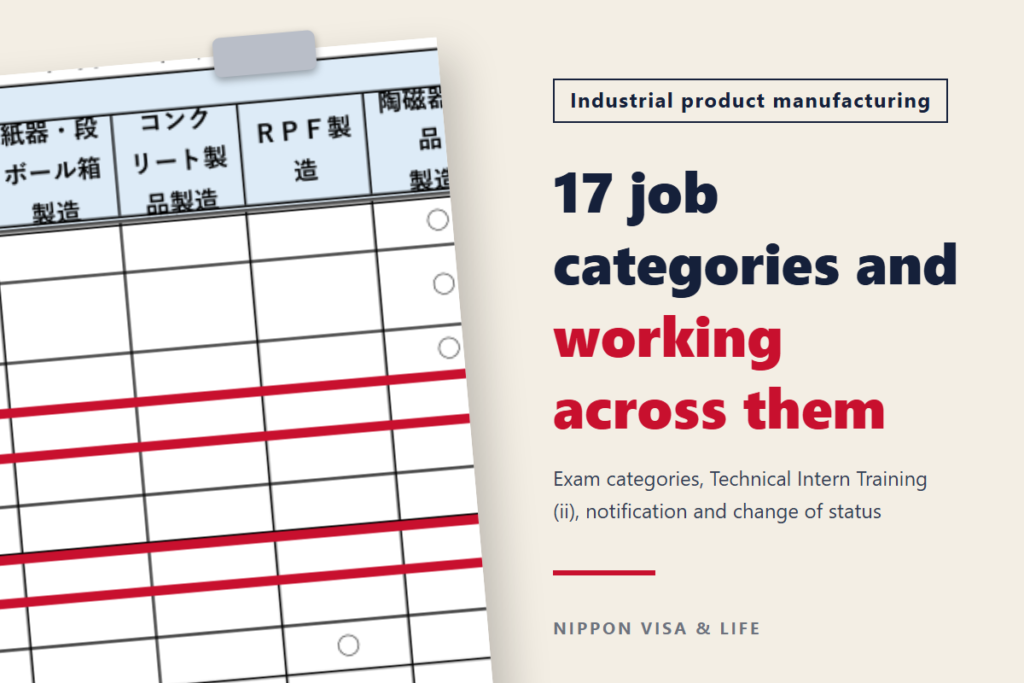
The 17 Job Categories of Specified Skilled Worker in Japan’s Industrial Product Manufacturing Field|Permitted Work, Exam Categories, and Working Across Categories
A table-based guide to the 17 job categories for (i) and 3 for (ii) of Specified Skilled Worker in the industrial product manufacturing field in Japan: the scope of work in each category, the exam categories, and the Technical Intern Training (ii) occupations exempt from the exams. Based on the operational guidelines and JAIM's FAQ, we explain why those who entered through the exams and those who moved from technical intern training can work in different categories, and which exams and notifications are needed to have a worker do another skill in the same category, a different category, or work in a different field. -
[Breaking News] Japan Building Maintenance Association Announces Schedule for the Building Cleaning Specified Skilled Worker (ii) Test on December 18 (October 20, 2026)
On October 20, 2026, the Japan Building Maintenance Association announced the schedule for the building cleaning Specified Skilled Worker (ii) evaluation test to be held in Japan on December 18, 2026. Online applications run from October 27 to November 10, and application documents must arrive by November 24. This article reports only the facts of the announcement. -
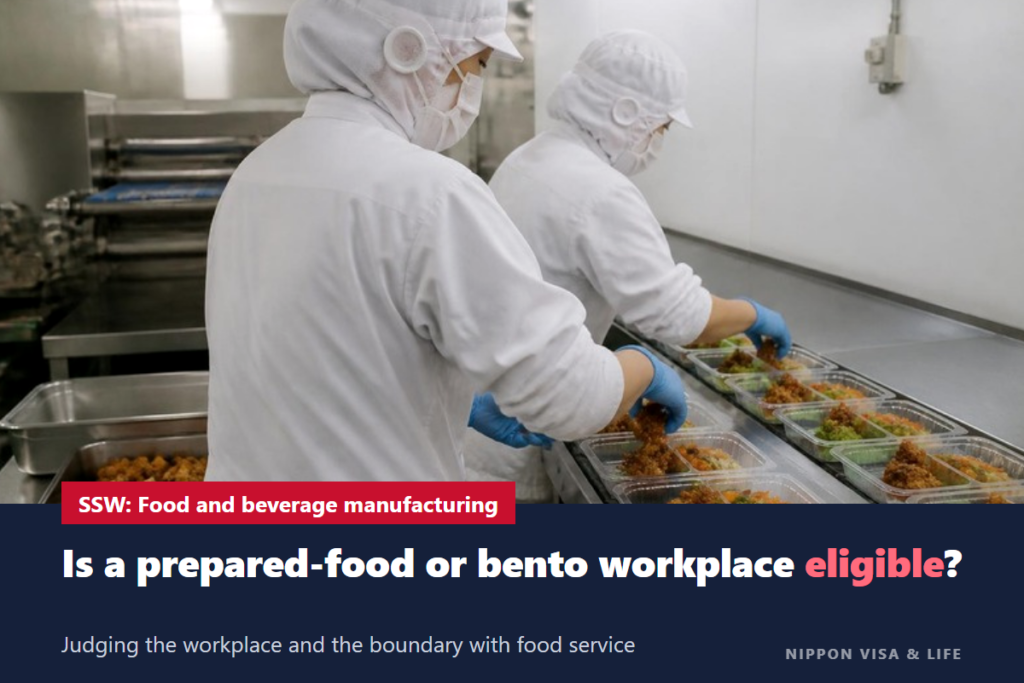
Specified Skilled Worker in Food and Beverage Manufacturing in Japan|How to Judge Eligible Workplaces and the Boundary with Food Service (Supermarkets and Bento)
Whether you can hire a foreign national in Japan in the Specified Skilled Worker "food and beverage manufacturing" field is decided not by the company but by the workplace where they work. Based on the operational guidelines and the FAQ of the Ministry of Agriculture, Forestry and Fisheries, this article covers how workplaces are counted, judging by the activity with the largest sales, the 10 industries in the public notice, judgments by business type (supermarkets, meat, fresh fish, cut vegetables, contract manufacturing, and more), the boundary with the food service field for central kitchens, bento, and institutional meals, and the documents requested in the council's review. -
Changing to a Different Field on Specified Skilled Worker Status in Japan|Passing the Tests, Job Categories, and the Change of Status Process
To move to work in a different field on Specified Skilled Worker status in Japan, you need Permission to change status of residence, and you cannot work at the new company until permission is granted. Based on the Immigration Services Agency's materials, this guide explains the skills test and Japanese level of the new field (N4, nursing care, and N3 categories), the scope of the Technical Intern Training (ii) exemption, omitting certificates you have already submitted, points to note for food service, construction, and other fields, and how the 5-year total is counted. -
How to Join JAC (Japan Association for Construction Human Resources) in Japan | Supporting Members vs. Full-Member Organizations, Fees, and Membership Certificates
In Japan, companies that accept foreign nationals as Specified Skilled Workers in the construction field must belong to JAC (Japan Association for Construction Human Resources), directly or indirectly. Based on JAC, MLIT, and the operational guidelines, this article covers the difference between joining through a full-member organization and becoming a supporting member, the supporting member annual fee of 240,000 yen and how to count the acceptance fee (12,500 yen per month for each (i) worker), the membership review deadline and how to receive the membership certificate, points where the Acceptance Plan application often stalls, and the order for changing organizations or withdrawing. -
What Are the Affiliated Organization Categories for Specified Skilled Workers in Japan? How Categories 1 to 4 Are Decided and Which Documents Can Be Omitted
In Japan, the "Categories 1 to 4" for affiliated organizations of Specified Skilled Workers are mainly about the upper limit of the period of stay. Whether a company can omit its own documents (Table 2) is decided by a separate standard: whether it has already accepted a Specified Skilled Worker in the same fiscal year, or whether it is an organization with a certain track record (Table 2-1). Based on Immigration Services Agency materials, this guide explains how to check the category, which documents can be omitted for each type of application, and points to note. -
Guide to Accepting Specified Skilled Workers in the Industrial Product Manufacturing Field in Japan|Eligible Industry Classifications, 17 Job Categories, Exams, and Joining JAIM
The overall picture of hiring foreign nationals on Specified Skilled Worker status at factories in Japan for metal processing, machinery, electrical and electronic equipment, plastics, plating, paper containers, printing, textiles, furniture, rubber, and more. Based on the operational guidelines (partially revised June 25, Reiwa 8) and guidance from the Ministry of Economy, Trade and Industry (METI) and JAIM, this guide covers eligible industry classifications (76 classifications for (i)), the 17 job categories, exams and Japanese language, joining JAIM (an average of 2 to 3 months until listed in the register; annual fee 60,000 yen to 83,000 yen), the field-specific documents for immigration, and the two routes to Specified Skilled Worker (ii). -
What Is Designated Activities (Preparation for Transition to Specified Skilled Worker (i)) in Japan? Eligibility, Requirements, Application Process, Use When Changing Jobs, and Points to Note
If your documents for Specified Skilled Worker (i) will not be ready before your period of stay expires in Japan, there is a Designated Activities status (6 months, work permitted) that lets you prepare while working at the company you plan to work for. Based on Immigration Services Agency materials, this article covers who can and cannot use it (passing the tests is a prerequisite, the 4 years and 6 months total limit, the food service industry), the 7 requirements, how to fill in the explanatory statement, the application process, how to use it when changing jobs, the one-time-only extension, and the fee (18,000 yen at the counter). -
Changing Jobs on Specified Skilled Worker Status in Japan: What the Worker, the New Company, and the Former Company Must Do, and in What Order
You can change jobs on Specified Skilled Worker status, but each time you change companies you need Permission to change status of residence, and you cannot work at the new company until permission is granted. This guide uses a table and a diagram to show what the worker, the new company (and its registered support organization), and the former company each do, and in what order. Based on Immigration Services Agency materials, it also explains how to check whether you can change jobs, when notifications are and are not required, and the Designated Activities options if you lose your job. -
Guide to Accepting Specified Skilled Workers in the Food and Beverage Manufacturing Field in Japan|Eligible Workplaces, Exams, the Council, and the Application Flow
The overall picture of hiring foreign nationals on Specified Skilled Worker status at food factories, supermarket production sections, and bakeries or confectioners that make and sell their own products. Based on the operational guidelines (partially revised August 28, 2026) and guidance from the Ministry of Agriculture, Forestry and Fisheries, this guide covers eligible workplaces (Japan Standard Industrial Classification), permitted work, the skills and Japanese language exams, joining the Food Industry Specified Skilled Worker Council (about 2 to 3 months), the field-specific documents for immigration, Specified Skilled Worker (ii), and the separation of the fishery processing industry from April 2027.