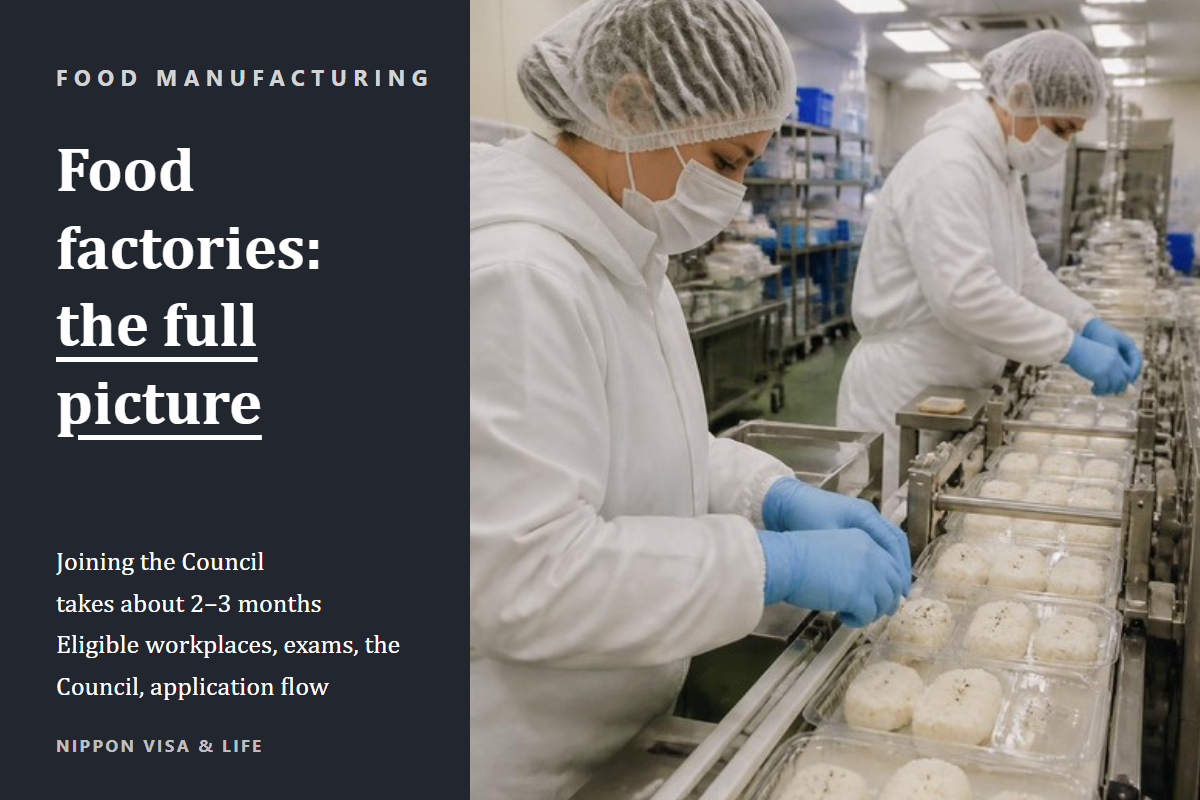


To hire a foreign national on Specified Skilled Worker (特定技能) status at a food factory or similar workplace, three things are required: the workplace must “mainly” carry out an industry eligible for acceptance; the foreign national must have passed the skills exam and the Japanese language exam (with exemptions for those who have satisfactorily completed Technical Intern Training (ii) (技能実習2号)); and the company must join the “Food Industry Specified Skilled Worker Council” (食品産業特定技能協議会) before applying to immigration. Joining the council takes about 2 to 3 months after you submit the documents. Only direct employment is allowed; dispatch (worker dispatch) is not. From April 1, 2027, the job category will be split into “food and beverage manufacturing” and “fishery processing.”
This article sets out the overall picture of what the accepting company and the registered support organization need to do. Detailed topics, such as how to judge whether a workplace is eligible and how to fill out the council documents, will be explained in separate articles.
The contents were checked on October 15, 2026 against the operational guidelines (food and beverage manufacturing field, partially revised August 28, 2026) and guidance from the Ministry of Agriculture, Forestry and Fisheries (MAFF) and the Fisheries Agency.
What is Specified Skilled Worker in the food and beverage manufacturing field? Competent ministry, acceptance cap, and changes in 2027
The food and beverage manufacturing field covers industries that manufacture and process food and beverages, excluding alcoholic beverages. In terms of the Japan Standard Industrial Classification, it centers on food manufacturing (Major Group 09: processed meat and fish products, bread, confectionery, noodles, prepared side dishes, and so on), and also includes soft drink manufacturing, tea and coffee manufacturing, ice manufacturing, supermarkets and meat retailers that manufacture food, and bakeries and confectioners that make and sell their own products (see the table under the next heading for details). Manufacturing alcoholic beverages, salt, or pharmaceuticals, and wholesaling food and beverages, are not included.
The competent ministry is MAFF, and the Fisheries Agency is also a point of contact for fishery processing. The standards specific to this field are set out in a MAFF public notice (MAFF Public Notice No. 526 of Heisei 31) and the operational guidelines.
Acceptance cap and the mechanism for suspending issuance
The projected number of Specified Skilled Worker (i) (特定技能1号) workers to be accepted is 133,500, which is applied as the cap for the 5 years up to the end of fiscal year Reiwa 10 (end of March 2029). The projected number for the field as a whole over the same 5 years is 194,900.
When the projected number is likely to be exceeded, the Minister of Agriculture, Forestry and Fisheries asks the Minister of Justice to temporarily stop issuing the Certificate of Eligibility (在留資格認定証明書). In the food service field, which is covered by the same council, a temporary suspension of issuance was put in place on April 13, 2026.
(Sources: Operational Guidelines (Food and Beverage Manufacturing Field), Field-Specific Operational Policy, Immigration Services Agency, “Food and Beverage Manufacturing Field”, MAFF, “About the Food Industry Specified Skilled Worker Council”)
Eligible workplaces: decided by the business the workplace “mainly” carries out under the Japan Standard Industrial Classification
The unit of judgment is not the company but the workplace (factory or store) where the foreign national works. That workplace must “mainly” carry out one of the industries in the table below.
For a workplace with several businesses, the industry is decided by the activity that accounts for the largest share of the most recent sales of products. When sales make it hard to decide, for example when the workplace does both contract processing and manufacturing of its own products, figures such as the value of output and the number of employees are also used.
Eligible industries
| Classification number | Industry | Conditions |
|---|---|---|
| Major Group 09 | Food manufacturing | Processed meat and fish products, canned foods, pickles, seasonings, bread, confectionery, noodles, frozen foods, prepared side dishes, and so on |
| Minor Group 101 | Soft drink manufacturing | — |
| Minor Group 103 | Tea and coffee manufacturing (excluding soft drinks) | — |
| Minor Group 104 | Ice manufacturing | — |
| Minor Group 583 | Meat retail | Only those that manufacture food. Added by the revision of the public notice on April 15, 2026 |
| Detailed Industry 5621 | General supermarkets | Only those that manufacture food |
| Detailed Industry 5811 | Food supermarkets | Only those that manufacture food |
| Detailed Industry 5861 | Confectionery retail (manufacturing and retail) | Businesses that make products themselves and sell them in their store |
| Detailed Industry 5863 | Bread retail (manufacturing and retail) | Businesses that make products themselves and sell them in their store |
| Detailed Industry 5896 | Retail of tofu, kamaboko (fish paste), and other processed foods | Only those that manufacture tofu, kamaboko, and similar products |
The following industries are not eligible: manufacturing of alcoholic beverages, salt, pharmaceuticals, or flavorings; wholesale of food and beverages; retail of various goods such as department stores (excluding general supermarkets); general food and beverage retail (excluding the retail businesses in the table); and manufacturing of animal feed such as pet food.
Quick reference for business types that are easy to confuse
We have summarized business types that are easy to confuse, based on MAFF’s FAQ and the operational guidelines. Most “conditional” cases also require that the sales of that manufacturing or processing be the largest within the workplace.
| Business type | Judgment | Conditions and reasons |
|---|---|---|
| Supermarket back rooms (processing prepared side dishes, bakery products, fresh fish, meat, and fresh produce) | Conditional | Only sections where the supermarket manufactures products itself. Cashier work, customer service, and shelf stocking are not allowed. Minor processing only is not eligible |
| Back rooms of convenience stores and department stores, and tenants in supermarkets | Not eligible | — |
| Process centers (manufacturing food supplied to retailers and wholesalers) | Eligible | Meat processing, seafood processing, manufacturing prepared side dishes, and so on |
| Central kitchens of food service businesses | Conditional | Eligible if it is an independent workplace. If it is on the same premises as a restaurant, it is treated as food service and is not eligible |
| Making boxed meals (bento) and prepared side dishes and supplying them to retailers and wholesalers | Eligible | Takeout bento, catering, and delivery belong to the food service field and are not eligible |
| School and institutional meals | Conditional | An independent facility that only cooks under the central-kitchen system is eligible. Kitchens that cook at the school itself, and kitchens attached to hospitals or welfare facilities, belong to the food service field |
| GP centers (eggs) | Conditional | Eligible if eggs are washed (and disinfected), then graded and packed, and supplied to retailers and wholesalers. Grading and packing only, without washing or disinfecting, is not eligible |
| Cutting vegetables | Conditional | Processing into a form ready to use in cooking is eligible. Minor processing such as cutting a cabbage in half is wholesale and not eligible |
| Meat processing, poultry processing, and cutting sashimi or fish fillets | Conditional | Processing to supply retailers and wholesalers. Fresh fish retail selling directly to consumers is not eligible |
| Contract manufacturing | Conditional | When the contractor undertakes the manufacturing process as an organization independent of the client, and the contractor gives the instructions. Incidental work only (such as boxing and cargo handling), dispatch, and disguised contracting are not eligible |
If you are unsure, check before applying to the council
The operational guidelines state that if the council judges a workplace to be ineligible, the company cannot hire foreign nationals. The operational guidelines advise that if you are unsure, you should contact MAFF before applying to join the council. You can also consult about workplace requirements at the free consultation service run as a MAFF subsidized project (listed at the end of this article).
(Sources: Operational Guidelines (Food and Beverage Manufacturing Field), Public Notice (partially revised April 15, 2026), MAFF FAQ, Membership Application Guidebook)
Work foreign nationals may do, and work they must not be given
Specified Skilled Worker (i) foreign nationals engage broadly in the manufacturing and processing of food and beverages (excluding alcoholic beverages) and in ensuring safety and hygiene.
- Manufacturing and processing: the series of production tasks, such as handling raw materials, heating, sterilizing, shaping, and drying
- Ensuring safety and hygiene: tasks that keep work safe and food hygienic, such as checking the safety of the machines used and managing the hygiene of workers
Work allowed only as incidental work
Related work that Japanese employees doing the same job normally do is allowed, but only as incidental work. The operational guidelines give procurement and receiving of raw materials, delivery of products, cleaning, and management of the workplace as examples.
However, the foreign national cannot be given related work only. The FAQ states that they cannot be engaged exclusively in packing, inspection, boxing, or transport. It says there is no problem if the amount is about the same as that of Japanese employees doing the same job.
What must not be done
- Work consisting only of simple sorting or wrapping (packing) (this does not count as manufacturing or processing)
- Sales work at supermarkets (not allowed even as related work)
- Dispatch (you can neither dispatch foreign nationals nor accept dispatched workers)
The operational guidelines state that if a company dispatches or accepts dispatched workers, it cannot accept Specified Skilled Workers for the following 5 years. Only direct employment is allowed.
Specified Skilled Worker (ii) (特定技能2号) foreign nationals, in addition, supervise multiple skilled workers while managing hygiene, quality, delivery deadlines, costs, employees, raw materials, and so on.
(Sources: Operational Guidelines (Food and Beverage Manufacturing Field), MAFF FAQ, Field-Specific Operational Policy)
Requirements for the foreign national: skills and Japanese language exams, and moving from Technical Intern Training (ii)
To become a Specified Skilled Worker (i), a person needs proof of both skills and Japanese language ability. People who have satisfactorily completed Technical Intern Training (ii) are exempted depending on their occupation.
| Foreign national’s route | Skills | Japanese |
|---|---|---|
| People who passed the exams | Pass the Food and Beverage Manufacturing Specified Skilled Worker (i) Evaluation Test | Level A2.2 or higher on the JFT-Basic (Japan Foundation Test for Basic Japanese), or N4 or higher on the Japanese-Language Proficiency Test |
| People who satisfactorily completed Technical Intern Training (ii) in a related occupation | Exempt | Exempt |
| People who satisfactorily completed Technical Intern Training (ii) in an unrelated occupation | Must pass the exam | Exempt |
Outline of the exam
The exam checks whether the person can immediately handle hygiene management in line with HACCP (a method of analyzing hazards at each process step and monitoring and recording the critical steps).
The exam is administered by the Organization for Technical Skill Assessment of Foreign Workers in the Food Industry (OTAFF, 一般社団法人外国人食品産業技能評価機構), which was selected through a public call by MAFF. It is held in Japanese, either as a CBT (answered on a computer) or as a paper test. It has a written part and a practical part, and the passing standard is 65% or more of the total score (adjusted if there is a large difference in difficulty).
Anyone who forges a test result notice will be banned from taking all OTAFF exams for 5 years.
→ [Breaking News OTAFF Warns Against Forging Test Result Notices: Forgery Leads to a 5-Year Ban from All Its Tests (October 13, 2026)](https://kisaragi-office.com/immigration_journal/en/archives/5928)
In immigration’s list of required documents, the exam is called the “skills measurement test” (技能測定試験). The operational guidelines state that people who take and pass the evaluation test by March 31, 2027 are deemed to have passed the skills measurement test.
People moving from Technical Intern Training (ii)
The Technical Intern Training occupations for which both the skills and Japanese exams are exempted are the following 10 occupations (from the appended table of the operational guidelines and the FAQ).
- Can seaming, poultry processing, beef and pork processing, ham, sausage, and bacon manufacturing, bread making, prepared side dish manufacturing, and agricultural pickle manufacturing
- Heated seafood processed food manufacturing, non-heated seafood processed food manufacturing, and fish paste product manufacturing
The FAQ states that people who completed these occupations can work in this field regardless of their occupation during Technical Intern Training (except for manufacturing alcoholic beverages).
(Sources: Operational Guidelines (Food and Beverage Manufacturing Field), Implementation Guidelines for the Food and Beverage Manufacturing Specified Skilled Worker Evaluation Test, MAFF field page, MAFF FAQ)
What is required of accepting organizations: 7 additional conditions for this field
In addition to the standards common to all accepting organizations of Specified Skilled Workers (the employment contract, the support system, and so on), this field has the following conditions.
| Condition | Content | When |
|---|---|---|
| 1. Become a member of the council | Join the Food Industry Specified Skilled Worker Council | Before applying to immigration |
| 2. Cooperate with the council | Cooperate with the council’s surveys, information sharing, and so on | At all times after joining |
| 3. Cooperate with MAFF | Cooperate with surveys, guidance, and so on (including by contractors) | At all times after joining |
| 4. Make the registered support organization a member too | If all support is outsourced, the registered support organization it is outsourced to must also be a member of the council | Before applying to immigration |
| 5. Explain the career-up plan | Give the worker a written plan (electronic data also accepted) showing how their work, position, and wages will rise, and explain it | Before signing the employment contract |
| 6. Issue a certificate of work experience | If the worker asks, give them a document certifying their work experience at the company | When asked |
| 7. The workplace is in an eligible industry | It mainly carries out one of the industries in the table under the previous heading | Checked in the council’s membership review |
Contents of the career-up plan
There is no fixed form. The operational guidelines give examples of content: the expected career routes, the work and approximate number of years for each level, the experience and qualifications needed to move up a level, and how treatment such as position and wages will improve.
MAFF’s Q&A on Specified Skilled Worker (ii) states that a career-up plan must also be shown to Specified Skilled Worker (ii) foreign nationals. MAFF has also posted the “Training and Career Development Program for the Food and Beverage Manufacturing Field” (October 9, 2026).
The operational guidelines state that a company that does not cooperate with the council, or does not issue a requested certificate of work experience, fails to meet the standards and can no longer accept workers.
(Sources: Operational Guidelines (Food and Beverage Manufacturing Field), Immigration Services Agency, “Food and Beverage Manufacturing Field”, Q&A on Specified Skilled Worker (ii), MAFF field page)
Joining the Food Industry Specified Skilled Worker Council: before the immigration application, allow 2 to 3 months
The Food Industry Specified Skilled Worker Council is an organization set up jointly by the food and beverage manufacturing field and the food service field, and it is run by MAFF. The accepting company joins before applying to immigration and attaches the membership certificate to the status of residence application. You do not need to join again when accepting a second or later worker.
We have made a diagram of the procedure. As step 4 of the diagram shows, it takes about 2 to 3 months from submitting the documents until the membership certificate arrives.
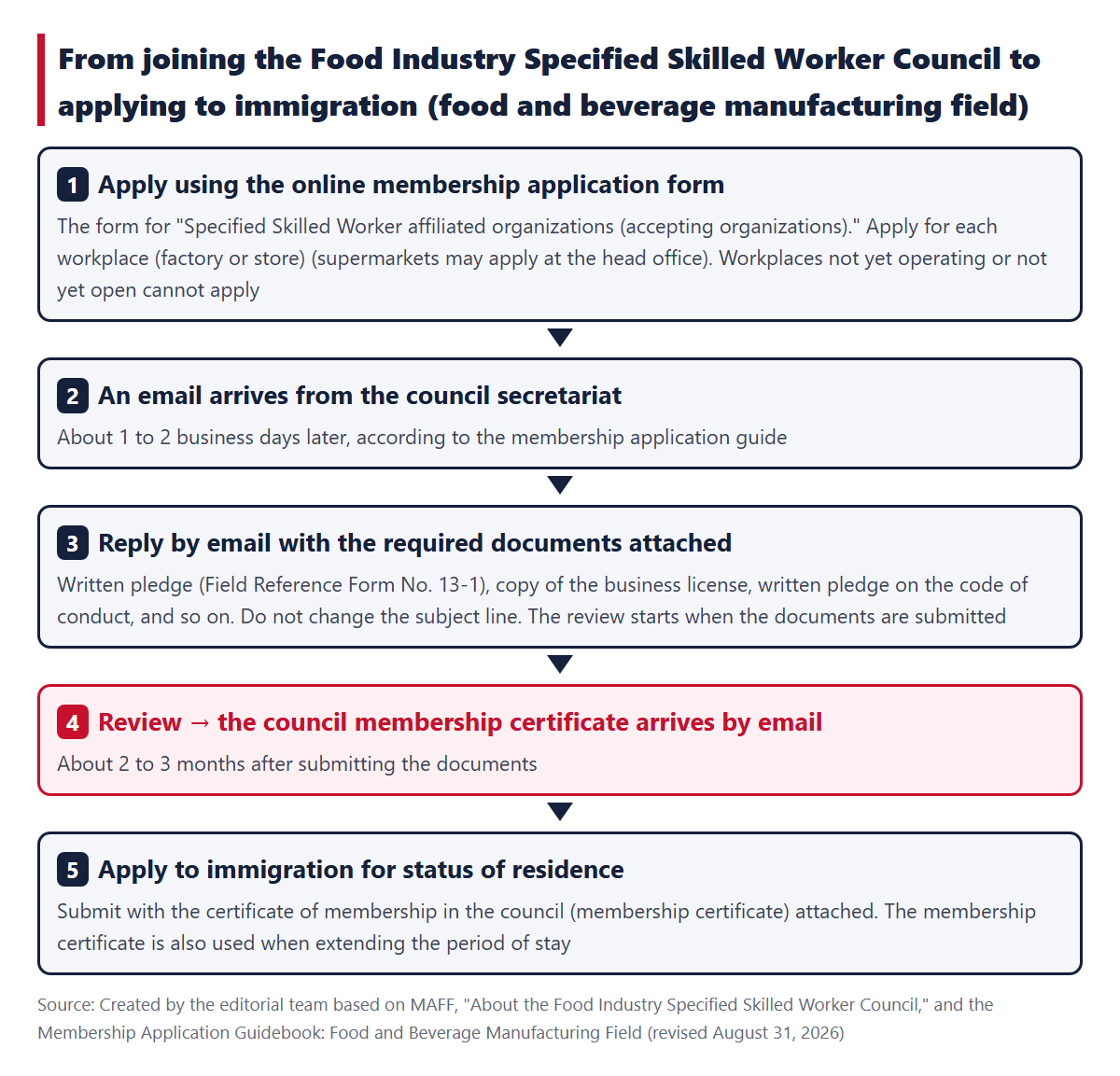
Sources: Created by the editorial team (based on MAFF, “About the Food Industry Specified Skilled Worker Council,” and the Membership Application Guidebook)
Documents to submit
| Document | Workplaces that submit it | Points to note |
|---|---|---|
| Written pledge (Field Reference Form No. 13-1) | All | A new form applies from September 1, 2026. No seal is needed. If the foreign national has not been decided yet, the foreign national’s section can be left blank |
| Copy of the business license | Other than supermarkets | The license for the workplace entered on the form as the place of work. Check that it is still valid and that the type of business falls within the field |
| Written pledge on the code of conduct (attached form to the council’s rules) | All | Required when documents are submitted on or after September 1, 2026. Submit one for each workplace |
| Written pledge on supermarket work | General supermarkets and food supermarkets | A pledge not to assign the foreign national to sales work. A business license is not needed |
| Work contract agreement, order specifications, and organization chart of the contracted process | Contract manufacturers | Show the flow of instructions from the contractor’s manager to the foreign national |
In the body of the email, describe the foreign national’s work, and attach 2 images of products and about 1 image each of the manufacturing and processing equipment and the exterior of the workplace.
Common sticking points
- In principle, an application is made for each workplace (factory or store). Supermarkets with back rooms can join at their head office.
- Workplaces that are not yet operating or not yet open cannot join, because the actual business cannot be confirmed.
- Check that the address and name on the business license match what you entered on the form. If there has been a change or succession, also attach materials showing the notification to the public health center.
- When replying, do not change the email subject line.
- Reviews are carried out in the order documents arrive. You are asked to refrain from inquiring about progress within 2 months of submission.
Fees, membership certificate, and later procedures
- Fees: For the time being, there is no admission fee or annual fee (the FAQ says fees may be requested in the future).
- Membership certificate: Needed when newly accepting a worker and when extending the period of stay. Pass it on when the person in charge changes.
- Changes to registered information: If the company name, address, representative, or person in charge changes, notify the council by email.
- If you also accept workers in the food service field, you need to complete a new membership procedure for the food service field.
If all support is outsourced to a registered support organization, that registered support organization must also be a member of the council before the application to immigration. Companies accepting Specified Skilled Worker (ii) foreign nationals must also join the council.
(Sources: MAFF, “About the Food Industry Specified Skilled Worker Council”, Membership Application Guidebook, MAFF FAQ, Operational Guidelines (Food and Beverage Manufacturing Field), Q&A on Specified Skilled Worker (ii))
Field-specific documents for immigration: Table 3-15 (Specified Skilled Worker (i)) and Table 3-10 (Specified Skilled Worker (ii))
In an immigration application, you submit the documents for the food and beverage manufacturing field in addition to the documents common to all fields. For Specified Skilled Worker (i), the application for a Certificate of Eligibility and the application for Permission to change status of residence (在留資格の変更許可) use the same list (Table 3-15).
| Document | When to submit and points to note |
|---|---|
| Proof of skills | For those who passed the exam, a copy of the pass certificate. For those who completed Technical Intern Training (ii) in a related occupation, a copy of the pass certificate for the Technical Intern Training evaluation test (specialist level) or the practical test of Skills Test Grade 3 (if not available, an evaluation report) |
| Proof of Japanese | A copy of the pass certificate for N4 or higher on the Japanese-Language Proficiency Test, or of the JFT-Basic result notice. Those who satisfactorily completed Technical Intern Training (ii) can omit it regardless of occupation |
| Written pledge (Field Reference Form No. 13-1) | Everyone |
| Certificate of membership in the council | Everyone |
| Registered support organization’s written pledge (No. 13-2) and certificate of membership | When all support is outsourced |
On the list, “people who satisfactorily completed Technical Intern Training (ii)” means those with 2 years and 10 months or more. Even when omitting proof of Japanese, documents proving satisfactory completion are required. If documents for the same person were submitted in a past application, and their contents have not changed and are still valid, some documents can be omitted.
Specified Skilled Worker (ii) and extension applications
In a Specified Skilled Worker (ii) application (Table 3-10), submit a copy of the pass certificate for the Specified Skilled Worker (ii) exam, the written pledge (No. 13-1), and the certificate of membership in the council.
For Permission to extend period of stay (在留期間の更新許可) as a Specified Skilled Worker (i) (Table 3-1), the certificate of membership in the council is required. If all support is outsourced, also submit the registered support organization’s written pledge and certificate.
Common documents, and who files the application
Documents common to all fields, such as the employment contract, the employment conditions document, and the support plan, are explained in the following articles.
Who can submit applications to immigration on someone’s behalf is explained in the following article.
(Sources: Table 3-15 (for Certificate of Eligibility), Table 3-15 (for change of status), Table 3-10 (for Certificate of Eligibility), Table 3-10 (for change of status), Table 3-1 (for extension), Immigration Services Agency, “Status of Residence ‘Specified Skilled Worker'”)
The flow up to acceptance, and a schedule worked backward
The council’s review takes time, and you cannot apply to immigration without its membership certificate. For this reason, start the council membership application first. We have made a diagram showing the order worked backward from the start date.
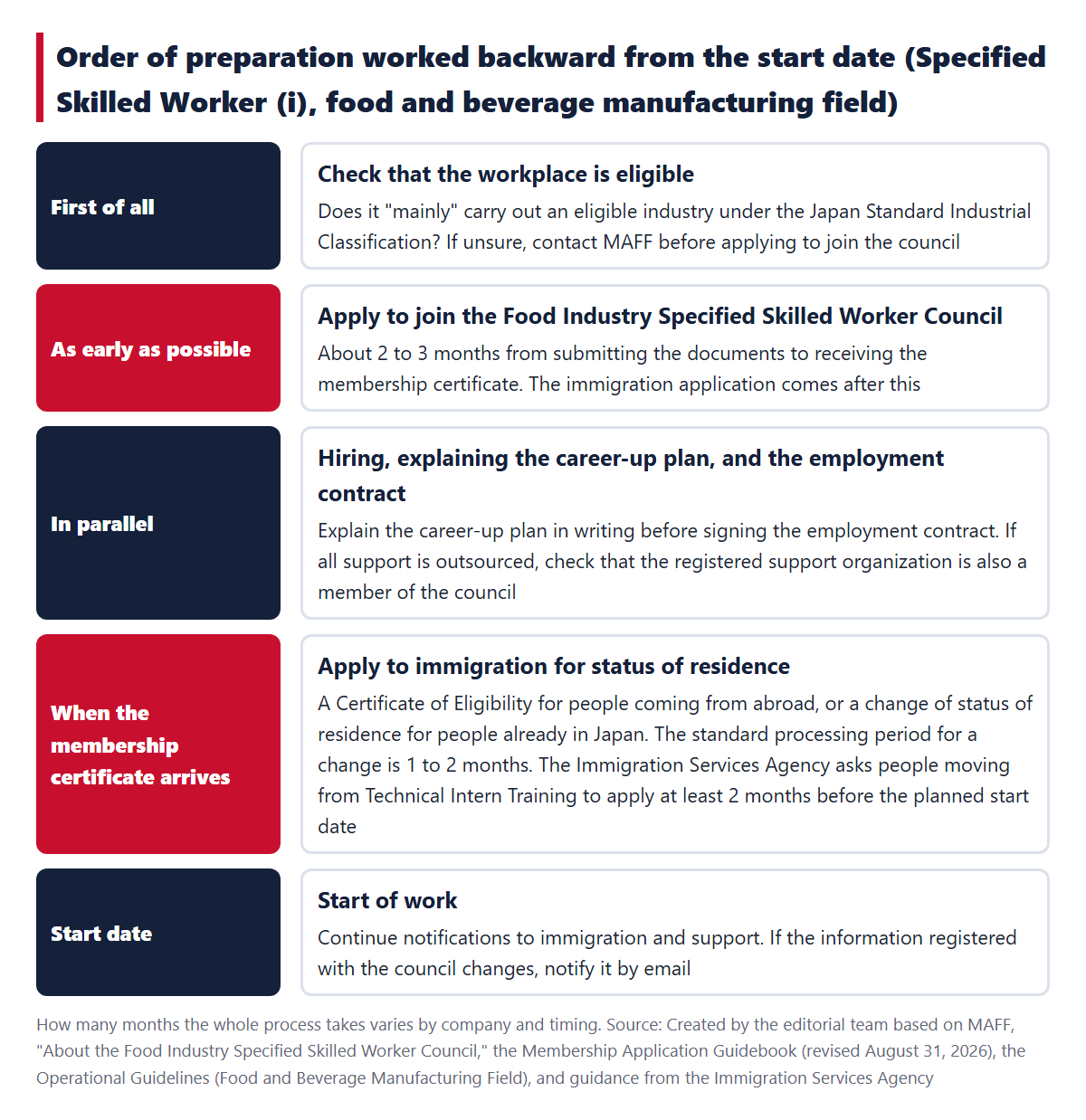
Sources: Created by the editorial team (based on MAFF, “About the Food Industry Specified Skilled Worker Council,” the Membership Application Guidebook, and guidance from the Immigration Services Agency)
Hiring and the employment contract can proceed in parallel with the council’s review. The career-up plan is explained in writing before the employment contract is signed.
Immigration processing time, and people moving from Technical Intern Training
The Immigration Services Agency sets the standard processing period for a change of status of residence at 1 to 2 months. For people moving from Technical Intern Training to Specified Skilled Worker, it asks that the application be made at least 2 months before the planned start of work.
People moving from Technical Intern Training must apply before their period of stay expires. “Designated Activities (preparation for transition to Specified Skilled Worker (i))” (特定活動(特定技能1号移行準備)), which can be used when preparations are not ready in time, will be explained in a separate article.
After acceptance
The timing of notifications to immigration is summarized in the following article.
(Sources: Membership Application Guidebook, Operational Guidelines (Food and Beverage Manufacturing Field), Immigration Services Agency, “Application for Permission to Change Status of Residence”, Immigration Services Agency, request for cooperation on the transition of technical intern trainees)
Specified Skilled Worker (ii): the exam and 2 years of practical experience “managing processes”
To become a Specified Skilled Worker (ii), a person must pass the Specified Skilled Worker (ii) evaluation test and have 2 years or more of practical management experience.
How practical experience is counted
- It is experience in a position of managing processes while working and supervising multiple employees (2 or more). The people being supervised may include Japanese employees, and nationality does not matter.
- A “person who manages processes” is someone who assists with management work, such as a factory manager. The operational guidelines give positions such as section manager, line manager, and team leader as examples.
- The position is assigned through a letter of appointment, a job order, or similar. If none was issued, the Q&A on Specified Skilled Worker (ii) asks you to prepare documents showing since when the person has been supervising.
- Management experience outside Japan counts, but experience in other fields does not (Q&A on Specified Skilled Worker (ii)).
Practical experience is checked when the person takes the Specified Skilled Worker (ii) exam. People taking it in Japan need 2 years or more of experience by the day before the exam. The certificate of practical management experience is submitted to the organization that administers the exam.
Japanese language requirement
The Immigration Services Agency’s field page and the operational guidelines state that from April 1, 2027, level B1 or higher on the “Japanese Language Education Reference Framework” (日本語教育の参照枠) will be required for Specified Skilled Worker (ii), and that the handling will be announced separately. The operational guidelines give N3 or higher on the Japanese-Language Proficiency Test (when judged equivalent to CEFR B1) as proof. The current list of documents for Specified Skilled Worker (ii) (Table 3-10) contains no Japanese language document. Please check for future announcements.
If the person fails the Specified Skilled Worker (ii) exam
If the person meets requirements such as scoring at least 8 tenths (80%) of the passing score on the Specified Skilled Worker (ii) exam, and it is recognized that there is a reasonable ground, they can stay for up to 1 year beyond the total period of stay for Specified Skilled Worker (i) (5 years). This applies to test result notices issued on or after June 30, 2025.
(Sources: Operational Guidelines (Food and Beverage Manufacturing Field), Immigration Services Agency, “Food and Beverage Manufacturing Field”, Q&A on Specified Skilled Worker (ii), Implementation Guidelines for the Food and Beverage Manufacturing Specified Skilled Worker Evaluation Test, Measures when failing the Specified Skilled Worker (ii) exam)
Changes from April 2027: separation of “fishery processing” and Employment for Skill Development
From April 1, 2027, the job category “food and beverage manufacturing in general” will be split into “food and beverage manufacturing” and “fishery processing.”
| Item | Until March 31, 2027 | From April 1, 2027 |
|---|---|---|
| Job category | Food and beverage manufacturing in general | Food and beverage manufacturing / fishery processing |
| Skills exam (Specified Skilled Worker (i) and (ii)) | Food and beverage manufacturing exam | Food and beverage manufacturing evaluation test / fishery processing evaluation test |
The operational guidelines state that people who passed the existing skills measurement test are deemed to have passed both of the 2 new evaluation tests. This applies equally to Specified Skilled Worker (i) and (ii).
Range of job changes
The Fisheries Agency explains that job changes are limited to within the same job category, and that people hired under the fishery processing category cannot change jobs to a workplace in the food and beverage manufacturing category.
According to the operational guidelines, the council has decided that when hiring under the fishery processing category, the company must carefully explain the career path and treatment, including the range of possible job changes, at the time of the employment contract, and obtain the worker’s consent. The overall procedure for changing jobs is explained in the following article.
People who satisfactorily completed Technical Intern Training (ii) and were exempted from the exams can, even after the change, work in both categories and change jobs between them.
Fishery processing exams and contact point
The Fisheries Agency says it is preparing new exams, such as the Fishery Processing Specified Skilled Worker (i) and (ii) Evaluation Tests, and will post details as soon as they are decided (as of October 15, 2026). The contact point for the fishery processing category is the Processing Promotion Team, Processing and Distribution Division, Fisheries Policy Planning Department, Fisheries Agency (03-6744-2349).
Start of Employment for Skill Development
Employment for Skill Development (育成就労) starts in April 2027, and this field is also covered. The projected number of workers to be accepted is 61,400 over the 2 years from fiscal year Reiwa 9. The council is a separate “Food Industry Employment for Skill Development Council” (食品産業育成就労協議会), and companies join one or both depending on the status of residence of the people they hire.
(Sources: Operational Guidelines (Food and Beverage Manufacturing Field), Fisheries Agency, “About the System for Accepting Foreign Nationals in Seafood Processing”, Field-Specific Operational Policy, MAFF field page)
Frequently asked questions
Q Can a worker work in a supermarket’s prepared side dish section? A Yes, for manufacturing and processing prepared side dishes that the supermarket makes itself. Cashier work, customer service, and shelf stocking are not allowed (FAQ Q3 and Q14).
Q Can we hire someone who completed Technical Intern Training in bread making at a seafood processing factory? A Yes. FAQ Q21 gives the example of someone who completed bread making working in seafood product manufacturing (except for manufacturing alcoholic beverages).
(Sources: MAFF FAQ, Operational Guidelines (Food and Beverage Manufacturing Field), MAFF, “About the Food Industry Specified Skilled Worker Council”, Membership Application Guidebook)
Summary and where to get advice
- First, check whether the workplace “mainly” carries out an eligible industry.
- Joining the council comes before the immigration application and takes about 2 to 3 months.
- From April 2027, the “fishery processing” category will be separated, and job changes will also be limited to within each category.
Public contact points when you need help are as follows.
- Whether a business falls within the field, workplace requirements, and the system in general: Specified Skilled Worker Foreign Human Resources System Consultation Service (a MAFF subsidized project, free) 03-6630-8179 (10:00 to 17:30, excluding Saturdays, Sundays, national holidays, and the year-end and New Year holidays)
- Council review: Food Industry Specified Skilled Worker Council Navi Dial 0570-031574 (weekdays 10:00 to 12:00 and 13:00 to 17:00)
- Fishery processing category: Processing Promotion Team, Processing and Distribution Division, Fisheries Policy Planning Department, Fisheries Agency 03-6744-2349
- Status of residence applications: Regional Immigration Services Bureau
Whether a workplace is eligible and which documents are needed may vary depending on the situation of the company or workplace. If you are unsure, please consult a specialist.
Primary Sources Referenced in Article Creation
- Operational Guidelines on the Acceptance of Specified Skilled Workers in Specific Fields: Standards for the Food and Beverage Manufacturing Field (Ministry of Justice and MAFF, partially revised August 28, 2026)
- Standards set in light of circumstances specific to the food and beverage manufacturing field (MAFF Public Notice No. 526 of Heisei 31, last revised April 15, 2026)
- Policy on the operation of the Specified Skilled Worker system and policy on the operation of the Employment for Skill Development system in the food and beverage manufacturing field (Cabinet decision of January 23, 2026)
- Immigration Services Agency, “Food and Beverage Manufacturing Field”
- Immigration Services Agency, “Status of Residence ‘Specified Skilled Worker'” (lists of required documents)
- List of documents to be submitted for “Specified Skilled Worker (i),” Table 3-15, Food and Beverage Manufacturing (for Application for Certificate of Eligibility)
- List of documents to be submitted for “Specified Skilled Worker (i),” Table 3-15, Food and Beverage Manufacturing (for Application for Permission to change status of residence)
- List of documents to be submitted for “Specified Skilled Worker (ii),” Table 3-10, Food and Beverage Manufacturing (for Application for Certificate of Eligibility)
- List of documents to be submitted for “Specified Skilled Worker (ii),” Table 3-10, Food and Beverage Manufacturing (for Application for Permission to change status of residence)
- List of documents to be submitted for “Specified Skilled Worker (i),” Table 3-1 (for Application for Permission to extend period of stay)
- Immigration Services Agency, “Application for Permission to Change Status of Residence”
- Immigration Services Agency, “To Those Involved in the Technical Intern Training and Specified Skilled Worker Systems [Request for Cooperation”](https://www.moj.go.jp/isa/content/001442736.pdf)
- MAFF, “Expanding the Acceptance of Foreign Human Resources in the Food and Beverage Manufacturing Field”
- MAFF, “About the Food Industry Specified Skilled Worker Council (Food and Beverage Manufacturing Field and Food Service Field)”
- MAFF, “Membership Application Guidebook: Food and Beverage Manufacturing Field” (revised August 31, 2026)
- MAFF, “FAQ on the Food and Beverage Manufacturing Field of Specified Skilled Worker” (updated March 2026)
- MAFF, “Q&A on Specified Skilled Worker (ii) in the Food Industry Fields (Food and Beverage Manufacturing Field and Food Service Field)” (August 2026 edition)
- MAFF, “Implementation Guidelines for the Food and Beverage Manufacturing Specified Skilled Worker Evaluation Test” (revised May 2026)
- MAFF, “Measures for Specified Skilled Worker (i) Foreign Nationals Who Failed the Specified Skilled Worker (ii) Evaluation Test”
- Fisheries Agency, “About the System for Accepting Foreign Nationals in Seafood Processing”
- Organization for Technical Skill Assessment of Foreign Workers in the Food Industry (OTAFF)
This article is a translation of the original Japanese version.