

To hire a foreign national on Specified Skilled Worker (特定技能) status at a factory in Japan, the factory must fall under an eligible industry classification, and the foreign national’s work must fall under one of the 17 job categories. The foreign national must have passed the skills exam and met the Japanese language requirement (those who have satisfactorily completed Technical Intern Training (ii) (技能実習2号) are exempt from the exams). Before applying to immigration, the company joins JAIM (Japan Association for Industrial Manufacturing Human Resources, 工業製品製造技能人材機構) for each workplace. It takes an average of 2 to 3 months to be listed in the register, and the annual fee (supporting member) is 60,000 yen to 83,000 yen.
This article sets out the overall picture of what the accepting company and the registered support organization (登録支援機関) need to do. Detailed topics, such as how to judge a workplace and the JAIM membership documents, will be explained in separate articles.
The contents were checked on October 15, 2026 against the operational guidelines (industrial product manufacturing field, partially revised June 25, Reiwa 8) and guidance from METI and JAIM.
What is Specified Skilled Worker in the industrial product manufacturing field? Competent ministry, acceptance cap, and the two axes of judgment
This field accepts foreign nationals who work as ready-to-work personnel on factory manufacturing floors. The competent ministry is METI. The acceptance standards specific to this field are set out in a METI public notice (METI Public Notice No. 127 of Reiwa 4) and the operational guidelines.
Acceptance cap and the current number of residents
The projected number of acceptances for Specified Skilled Worker (i) (特定技能1号) is 199,500 people, which is operated as the cap for the 5 years up to the end of fiscal Reiwa 10 (end of March 2029). There is a mechanism to suspend the issuance of the Certificate of Eligibility (在留資格認定証明書) when the projected number is likely to be exceeded.
As of the end of June, Reiwa 8, 64,419 foreign nationals were residing in Japan with Specified Skilled Worker status in this field (total of (i) and (ii), preliminary figure).
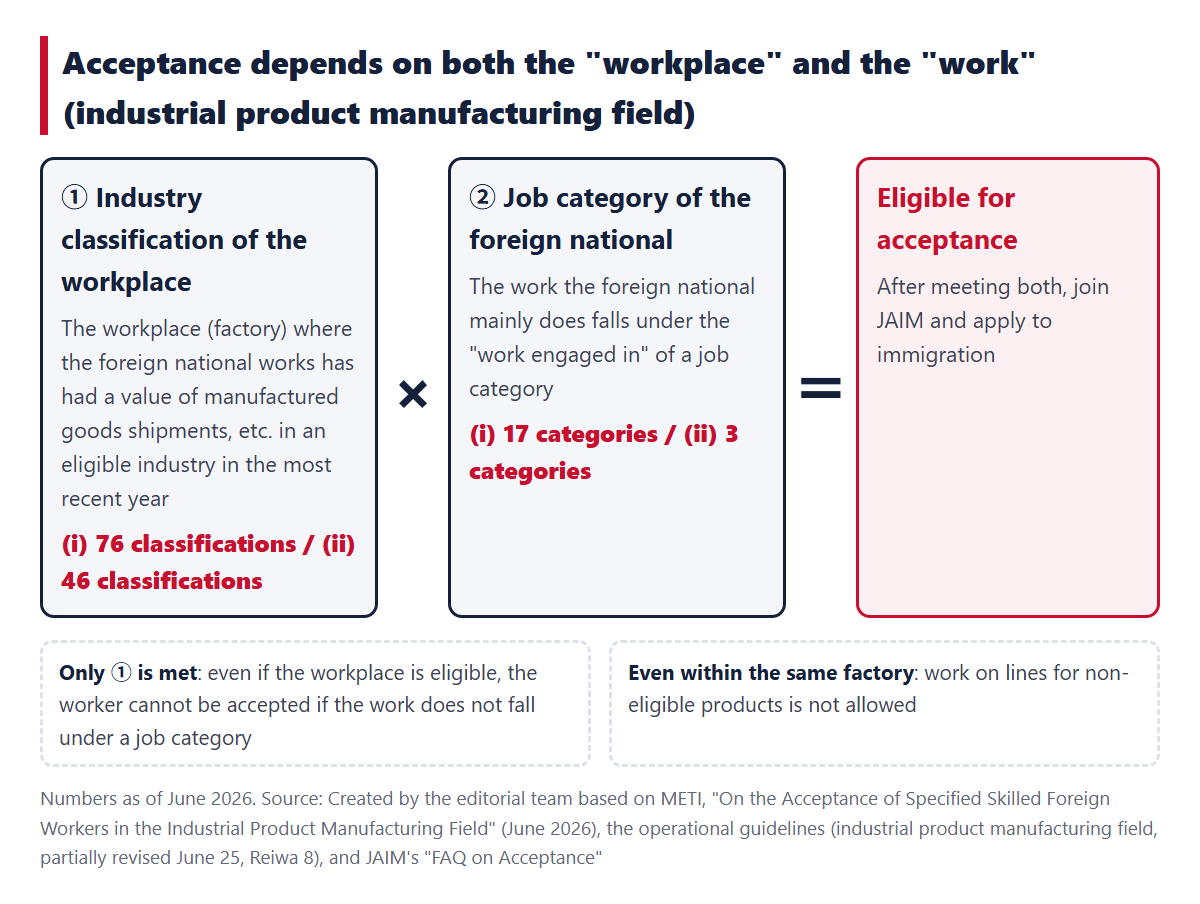
Two axes of judgment: “workplace” and “work”
Whether a company can accept a worker is judged on both of the following:
- ① Whether the workplace where the foreign national works falls under an eligible industry classification (76 classifications for (i), 46 classifications for (ii))
- ② Whether the foreign national’s work falls under an eligible job category (17 categories for (i), 3 categories for (ii))
Even if the workplace is eligible, the worker cannot be accepted if the work does not fall under a job category. Both ① and ② in the figure are required.
Sources: Created by the editorial team (based on METI’s overview material)
(Sources: Operational Guidelines, Field-Specific Operational Policy, Immigration Services Agency, “Industrial Product Manufacturing Field”, Status of the Specified Skilled Worker System (end of June, Reiwa 8), METI material)
Eligible workplaces: judged by the “value of manufactured goods shipments, etc.” in the most recent year
The unit of judgment is not the company but the workplace (factory) where the foreign national works. That workplace must have had a “value of manufactured goods shipments, etc.” (製造品出荷額等) in an eligible industry in the most recent year.
The value of manufactured goods shipments, etc. is the total of the value of shipments of manufactured goods and income from processing fees (including consumption tax and similar). Goods delivered to another workplace of the same company, goods used at the workplace itself, and goods placed on consignment sale are also counted as shipments.
It does not have to be the main business, but the work is limited to eligible products
The eligible industry does not have to be the workplace’s main business. If there is a shipment value for eligible products, the workplace can be judged to fall under the field.
However, the foreign national may only work in the processes that make eligible products. Even within the same factory or the same line, they cannot do work on non-eligible products.
Eligible industries (general list)
The industries set out in the public notice are grouped below. There are 76 classifications for (i), and 46 of them for (ii).
| Group | Main industries | (i) | (ii) |
|---|---|---|---|
| Textiles | Textile industry (Major Group 11) | ○ | - |
| Wood products and furniture | Millwork and prefabricated wooden building materials, furniture (Group 131), fixtures for offices and stores, etc. | ○ | - |
| Paper | Pulp, paper and paperboard, corrugated board, paper products and paper containers, etc. | ○ | - |
| Printing | Printing and allied industries (Major Group 15) | ○ | - |
| Plastics | Plastic products manufacturing (Major Group 18) | ○ | ○ |
| Rubber and bags | Rubber products (Major Group 19), bags (Group 206) | ○ | - |
| Cement, ceramics, and refractories | Ready-mixed concrete, concrete products, sanitary ware, tableware ceramics, tiles, etc., refractory bricks and unshaped refractories | ○ | - |
| Iron and steel, non-ferrous metals, and molds | Iron making, steel making and rolling, iron castings and forgings, aluminum rolling, non-ferrous metal castings and forgings, molds (including cores), etc. | ○ | ○ |
| Electric wire | Electric wire and cable (excluding optical fiber cable) | ○ | - |
| Fabricated metal products | Steel frames, sashes, boiler and sheet metal work, metal castings and forgings products, painting, plating, and heat treatment, bolts and nuts, etc. | ○ | ○ (excluding steel-frame prefabricated houses) |
| Machinery | General-purpose, production, and business-oriented machinery (with some exceptions) | ○ | ○ |
| Electronics, electrical, and information and communication | Electronic parts and devices, electrical machinery (with some exceptions), information and communication equipment | ○ | ○ |
| Transportation equipment | Motor vehicles, parts and accessories (Group 311), aircraft and parts (Group 314) | ○ | ○ |
| Others | Sporting goods, pallets, industrial models, RPF and personal protective equipment | ○ | ○ (excluding RPF) |
| Packing | Packing services (Group 484) | ○ | ○ |
Whether a product is eligible is checked product by product using the Japan Standard Industrial Classification. All 76 classifications are listed in the operational guidelines, and a list searchable by product name is on JAIM’s website.
If you are unsure
METI has published the expected combinations of job categories to be accepted for each industry classification. If you are unsure, you can ask JAIM’s consultation desk for businesses. Whether a workplace falls under an industry classification is checked in JAIM’s membership review, and whether status of residence (在留資格) is finally granted is decided in the immigration review.
Note that food factories belong to a different field (food and beverage manufacturing). In that field, the judgment is whether the workplace “mainly” carries out an eligible industry.
(Sources: Operational Guidelines, METI, “Expected combinations of industry classifications and job categories”, JAIM FAQ)
Work foreign nationals can do: the 17 job categories
There are 17 job categories for (i) and 3 job categories for (ii). The foreign national mainly engages in the work of the job category confirmed by the exam or other means.
| Job category | Main work (examples of work engaged in) | (ii) |
|---|---|---|
| Machinery and metal processing | Casting and forging, machining, metal pressing, sheet metal work, finishing, inspection, and maintenance, plastic molding, painting, welding, heat treatment, etc. | ○ |
| Electrical and electronic equipment assembly | Assembly of electronic and electrical equipment, printed wiring boards, machining, plastic molding, etc. | ○ |
| Metal surface treatment | Electroplating, hot-dip galvanizing, anodizing, buffing | ○ |
| Paper container and corrugated box manufacturing | Die-cutting and box making of printed boxes, set-up boxes, corrugated boxes | - |
| Concrete product manufacturing | Manufacturing of concrete products | - |
| RPF manufacturing | Crushing, molding, etc. | - |
| Ceramic product manufacturing | Wheel forming, slip casting, forming of tiles and sanitary ware, etc. | - |
| Printing and bookbinding | Offset printing, gravure printing, bookbinding | - |
| Textile product manufacturing | Spinning, weaving, knitting, dyeing, carpets, net making, etc. | - |
| Sewing | Sewing of ready-made clothing, bedding, car seats, towels, curtains, etc. | - |
| Electric wire and cable manufacturing | Manufacturing of electric wire and cable | - |
| Prefabricated housing product manufacturing | Carpentry work, welding, painting, metal processing, etc. | - |
| Furniture manufacturing | Hand processing and assembly of furniture, painting, mattresses, etc. | - |
| Shaped and unshaped refractory manufacturing | Manufacturing of shaped and unshaped refractories | - |
| Ready-mixed concrete manufacturing | Manufacturing of ready-mixed concrete | - |
| Rubber product manufacturing | Molding, extrusion, kneading and calendering, composite laminating | - |
| Bag manufacturing | Manufacturing of bags | - |
The 7 categories from electric wire and cable manufacturing to bag manufacturing were newly added under the Field-Specific Operational Policy (Cabinet decision of January 23, Reiwa 8). For 6 of the original 10 categories, the scope of work was also expanded (the table shows the content after the expansion).
Applications for the added or expanded parts can be made only once the METI public notice took effect on June 1, 2026 and the evaluation exam has been held. Those who have satisfactorily completed Technical Intern Training (ii) corresponding to an expanded skill can apply on or after June 1. Please check JAIM’s exam page for the status of the exams.
Incidental work, and work across categories
The foreign national may incidentally engage in related work that Japanese employees doing the same work usually do. Examples include procuring and transporting raw materials and parts, preceding and following processes, operating cranes and forklifts, and cleaning and maintenance. They cannot be made to do only related work.
Within the same job category, they can work on multiple skills. When they are given work involving a new skill, the company provides training (including safety and health education) as needed. To have them do work in a different job category, they need to pass the exam for that category (for those who moved from technical intern training, the corresponding category) and go through the status of residence procedure.
Direct employment only
Only direct employment is allowed. A company can neither dispatch foreign nationals nor accept dispatched workers. If a company uses dispatch, it cannot accept Specified Skilled Worker foreign nationals for the following 5 years.
Secondment while remaining on the payroll and transfers to affiliated companies are also not allowed. On-site contracting (構内請負) is acceptable if the conditions are met (direct employment, the contractor company is also a JAIM member, it is not disguised contracting, etc.).
Within the scope of the job category, foreign nationals can change companies. At the same time, METI and JAIM ask companies to refrain from actively poaching foreign nationals working at other companies.
(Sources: Immigration Services Agency, “Industrial Product Manufacturing Field”, Operational Guidelines, METI material, JAIM FAQ)
Requirements for the foreign national: exams and Japanese language, and moving from Technical Intern Training (ii)
A foreign national applying for (i) must prove both skills and Japanese language ability. Those who have satisfactorily completed Technical Intern Training (ii) do not need some or all of this proof.
| Foreign national’s route | Proof of skills | Proof of Japanese language |
|---|---|---|
| Those who passed the exams | Manufacturing Field Specified Skilled Worker (i) Evaluation Test (by job category) | JFT-Basic (A2.2 level or higher) or JLPT N4 or higher |
| Those who satisfactorily completed Technical Intern Training (ii) in a related occupation and operation | Not required | Not required |
| Those who satisfactorily completed Technical Intern Training (ii) in an unrelated occupation | Must pass the (i) Evaluation Test | Not required |
Manufacturing Field Specified Skilled Worker (i) Evaluation Test
The test has 17 categories, one for each job category, and is conducted by JAIM. It is taken on a computer (CBT format), and the language is Japanese. There is a written part and a practical part, and the passing criteria are 65% or more on the written part and 60% or more on the practical part.
The exam fee is 8,000 yen. Besides Japan, it can be taken in 5 countries overseas (India, Indonesia, the Philippines, Myanmar, and Vietnam). From fiscal 2026 onward, the “result notice” (結果通知書) is used as proof of passing (a certificate of passing is, in principle, not issued).
The operational guidelines also list Skills Test Grade 3 and the Employment for Skill Development Evaluation Test (Specialist Level) (育成就労評価試験(専門級)) as proof of skills for (i).
Schedules, applications, and the scope of questions will be explained in a separate article.
Those moving from Technical Intern Training (ii)
“Satisfactorily completed” means having completed at least 2 years and 10 months of technical intern training and either having passed the practical test of Skills Test Grade 3 or similar, or having been recognized as satisfactory in an evaluation report (評価調書). The occupations and operations eligible for exemption are listed in an appended table of the operational guidelines.
For a related occupation and operation, proof of skills and Japanese language will not be required for the time being even on and after April 1, Reiwa 9. Those who completed an unrelated occupation also do not need to prove Japanese language, but they must pass the skills exam. A person in the middle of Technical Intern Training (iii) (技能実習3号) cannot move to Specified Skilled Worker.
(Sources: Operational Guidelines, METI material, JAIM, “Manufacturing Field Specified Skilled Worker Evaluation Test”, JAIM FAQ)
What is required of the accepting organization: additional conditions for this field
In addition to the standards common to all Specified Skilled Worker accepting organizations (such as the employment contract (雇用契約) and the support system), there are conditions specific to this field.
| Condition | Details |
|---|---|
| Become a member of JAIM | Join JAIM before applying to immigration, and comply with the code of conduct |
| Efforts to improve productivity and secure domestic workers | Have JAIM confirm that the company is making these efforts |
| Measures decided by the council | Only for workplaces in the textile industry, printing, and packing services (table below) |
| Cooperation with METI | Cooperate with guidance, requests for reports, on-site investigations, etc. by METI or its contractors |
| Training | Provide training as needed when having the worker do work different from the work done in Employment for Skill Development (育成就労), or to ensure safety |
| Certificate of work experience | Give the foreign national a document certifying their work experience when requested (including those who have left the company) |
| Industry classification of the workplace | The workplace where the foreign national works carries out an eligible industry |
The operational guidelines state that if these are not carried out, the company does not meet the standards and cannot accept workers.
Additional requirements for the textile industry, printing, and packing services
| Industry | Measures decided by the council |
|---|---|
| Textile industry | Conduct business in line with international human rights standards, computerize attendance management, make a Declaration of Partnership Building, pay foreign nationals a monthly salary |
| Printing and allied industries | Belong to one of the following: the Japan Federation of Printing Industries (全日本印刷工業組合連合会), the National Federation of Gravure Cooperatives (全国グラビア協同組合連合会), the All Japan Bookbinding Industry Federation (全日本製本工業組合連合会), or the All Japan Metal Printing Industry Cooperative Federation (全日本金属印刷工業協同組合連合会) |
| Packing services | Belong to the Japan Packing Industry Association Federation (日本梱包工業組合連合会) |
These are checked with additional documents when joining JAIM.
In addition, JAIM supporting members must report on their productivity improvement efforts (record of wage increases). Workplaces that do not employ Specified Skilled Worker foreign nationals do not need to report.
(Sources: Operational Guidelines, Council Decision No. 1, JAIM membership page, JAIM membership manual)
Joining JAIM: before applying to immigration, allow 2 to 3 months
The relationship between the council and JAIM
Some older guidance says to “join the council,” but what companies join now is JAIM. JAIM is a corporation that was registered by the Minister of Economy, Trade and Industry on June 25, 2025.
Since July 2025, the council (Manufacturing Industry Specified Skilled Foreign Workers Acceptance Council, 製造業特定技能外国人材受入れ協議・連絡会) mainly makes the rules, while JAIM manages and supports accepting workplaces and runs the evaluation exams. Companies join JAIM, and JAIM represents them as a member of the council.
Membership process and timeline
As a rule, membership is for each workplace (factory). If you accept Specified Skilled Worker foreign nationals, you join as a “supporting member” (賛助会員) (if you use only Employment for Skill Development, you can also choose “Employment for Skill Development member” (育成就労会員)).
- Prepare the forms and supporting documents
- Apply on JAIM’s portal site
- After the review, pay the annual fee (bank transfer for the first year, automatic account debit from the following year)
- You are listed in the register
It takes an average of 2 to 3 months from application to being listed in the register. It can take longer if there are deficiencies in the documents or depending on the timing of the annual fee payment.
Documents to submit
- Written pledge on the code of conduct (Form 2)
- Written pledge on the declaration and assurance of not being an anti-social force (Form 3)
- Written pledge on efforts to improve productivity and secure domestic workers (Form 4, supporting members only)
- Supporting document describing information on manufactured products (template)
- For the textile industry, printing, packing services, etc., documents for the additional requirements
- To receive an annual fee discount, documents showing proof of eligibility
Annual fee
| Company size | Belongs to a regular member organization | Does not belong to a regular member organization |
|---|---|---|
| Small and medium-sized enterprise | 60,000 yen | 63,000 yen |
| Large enterprise | 80,000 yen | 83,000 yen |
These are the annual fees for supporting members. If you join in the middle of the fiscal year, the fee is prorated monthly depending on the month you join. You will not be listed in the Specified Skilled Worker register until payment of the annual fee is confirmed.
What you submit to immigration is a printout of the register
There is no membership card. To immigration, you submit a printout of the register on JAIM’s website. It must show the company name and the name of the place where the foreign national works.
Common sticking points
- When having the worker work on a line for a new product, an application to JAIM is required
- When sending the worker on a business trip to another factory in Japan, the destination factory must also be a JAIM member (a notification to immigration is also required)
- There is no system for suspending membership. If you accept workers again after withdrawing, you must go through the membership review again
How to fill out the membership documents will be explained in a separate article.
(Sources: Operational Guidelines, METI material, JAIM membership page, JAIM membership manual, JAIM FAQ)
Field-specific documents for immigration: Table 3-4 ((i)) and Table 3-2 ((ii))
In addition to the common documents, you submit the field-specific documents. These are listed in “Table 3-4” (第3表の4) for (i) and “Table 3-2” (第3表の2) for (ii), and the documents are the same for the Certificate of Eligibility and for a change of status of residence (在留資格の変更).
(i) (Table 3-4)
| Document | Those who passed the exams | Those who satisfactorily completed Technical Intern Training (ii) |
|---|---|---|
| Proof of skills | Copy of the certificate of passing or result notice of the (i) Evaluation Test | Copy of the certificate of passing the practical test of the Technical Intern Training Evaluation Test (Specialist Level) or Skills Test Grade 3, or the evaluation report |
| Proof of Japanese language | Certificate of passing JLPT N4 or higher, or a copy of the JFT-Basic score report | Can be omitted (proof of satisfactory completion is required) |
| Written pledge (Field Reference Form No. 3-1) | Required | Required |
| Printout of the JAIM register | Required | Required |
Documents showing satisfactory completion of Technical Intern Training (ii) (certificate of passing or evaluation report) can be omitted when the accepting company accepted that person as a technical intern trainee and has not received an improvement order (改善命令) (including improvement guidance under the former system) within the past year. The certificate of passing or result notice of the (i) Evaluation Test is not covered by this omission.
Those who completed Technical Intern Training (ii) in an unrelated occupation need proof of passing the (i) Evaluation Test. Documents submitted in a previous application whose contents have not changed can be omitted.
(ii) (Table 3-2)
- A copy of the certificate of passing or result notice of the (ii) Evaluation Test, and a copy of the certificate of passing Business Career Test Grade 3 (Production Management Planning or Production Management Operations)
- Or, a copy of the certificate of passing Skills Test Grade 1, and a certificate of work experience (Field Reference Form No. 3-2)
- Written pledge (Field Reference Form No. 3-1)
- Printout of the JAIM register
Extension of period of stay
For an extension of the period of stay (在留期間) for (i) as well, a printout of the JAIM register is required as a field-specific document (Table 3-1).
Common documents, and who files the application
The employment contract, the employment conditions document, and the support plan are common documents regardless of the field. Who can file the application with immigration on your behalf is explained in the article below.
(Sources: Immigration Services Agency, “Status of Residence ‘Specified Skilled Worker'” (lists of documents to submit), Table 3-4 (Certificate of Eligibility), Table 3-2 (Certificate of Eligibility), Table 3-1 (extension), Operational Guidelines)
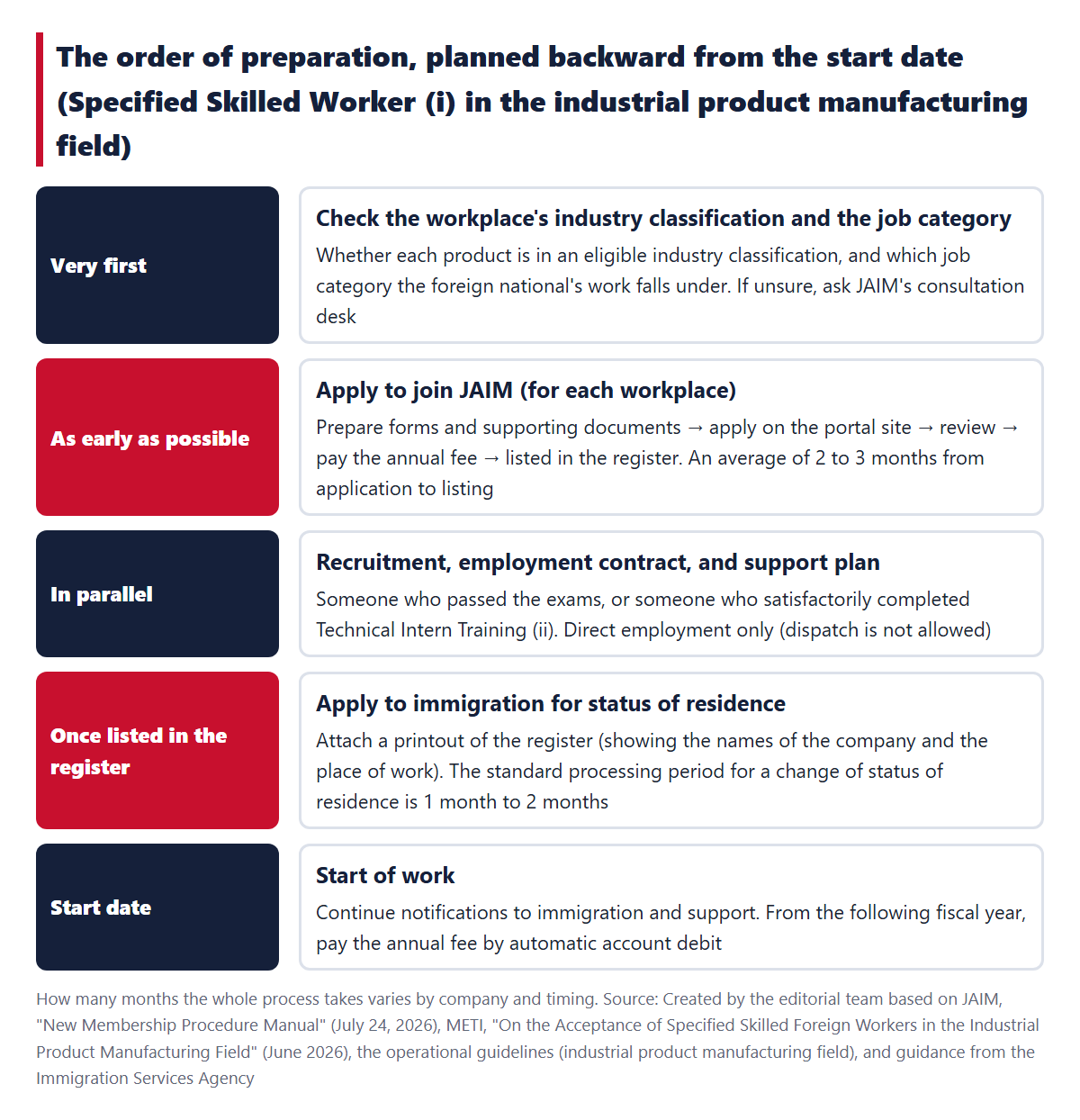
Flow up to acceptance and a backward-planned schedule
According to METI’s material, the process goes in the following order.
- Consider acceptance (check the workplace’s industry classification and the job category)
- Join JAIM
- Look for foreign national candidates
- Prepare the support plan
- Sign the employment contract
- Apply to immigration (Certificate of Eligibility for those coming from overseas, change of status of residence for those already in Japan)
- Those coming from overseas apply for a visa at a Japanese embassy or consulate
- Start work
The reason to start the JAIM membership first is that it takes a long time, and the application to immigration cannot be accompanied by the register printout until you are listed. Because the operational guidelines require membership “before the status of residence application,” preparations for recruitment and the employment contract can proceed in parallel. The red rows in the figure are the steps whose order cannot be changed.
Sources: Created by the editorial team (based on JAIM’s “New Membership Procedure Manual” and other materials)
Immigration review period, and those moving from technical intern training
The Immigration Services Agency (出入国在留管理庁) sets the standard processing period for a change of status of residence at 1 month to 2 months. For those moving from technical intern training to Specified Skilled Worker, it asks that the application be made at least 2 months before the planned start date.
If the documents cannot be ready by the expiry of the period of stay, there is a special measure (Designated Activities) for preparing to move to Specified Skilled Worker (i). Please check the conditions in the Immigration Services Agency’s guidance.
After acceptance
Continue making notifications to immigration and providing support. When the foreign national requests it, give them a certificate of work experience.
(Sources: METI material, JAIM membership manual, Immigration Services Agency, “Application for Permission to Change Status of Residence”, Immigration Services Agency, request for cooperation on the transition of technical intern trainees, Immigration Services Agency, “Designated Activities related to Specified Skilled Worker (for those wishing to move to ‘Specified Skilled Worker (i)’)”)
Specified Skilled Worker (ii): two routes and “3 years on a manufacturing floor”
Specified Skilled Worker (ii) (特定技能2号) covers only 3 categories: machinery and metal processing, electrical and electronic equipment assembly, and metal surface treatment. Workplaces are also limited to 46 classifications.
| Exam route | Skills test route | |
|---|---|---|
| Skills | Manufacturing Field Specified Skilled Worker (ii) Evaluation Test and Business Career Test Grade 3 (Production Management Planning or Production Management Operations) | Skills Test Grade 1 corresponding to the job category (both written and practical) |
| Work experience | 3 years or more on the manufacturing floor of a company with a base in Japan | Same |
| How work experience is checked | Checked when applying for the exam (eligibility confirmation number) | Certificate of work experience (Field Reference Form No. 3-2) |
The (ii) Evaluation Test is practical only, takes 80 minutes, and is passed with a correct answer rate of 60% or more. The exam fee is 15,000 yen. Because there is no Skills Test Grade 1 for welding, welding uses the (ii) Evaluation Test route.
How work experience is counted
A “manufacturing floor” means a workplace in the manufacturing industry, excluding food manufacturing and beverage, tobacco, and feed manufacturing. The period of technical intern training and experience at multiple companies can be added together. Periods when the person was not working are excluded.
Japanese language
The operational guidelines list JLPT N3 or higher (only when judged to be CEFR B1 level or higher) as the Japanese language requirement for (ii). On and after April 1, Reiwa 9, B1 level or higher will be required, and the handling will be announced separately.
On the other hand, the current list of documents to submit (Table 3-2) has no column for Japanese language documents. Before applying, please check with the regional immigration services bureau or a professional.
If the (ii) exam is not passed
If certain conditions are met, such as scoring at least 80% of the passing score on the (ii) exam, there is a measure that allows the person to stay for up to 1 year beyond the total period of stay for (i).
The detailed requirements for (ii) will be explained in a separate article.
(Sources: Operational Guidelines, Table 3-2 (Certificate of Eligibility), METI material, JAIM, “Manufacturing Field Specified Skilled Worker Evaluation Test”, JAIM FAQ)
Relationship with Employment for Skill Development (from April 2027)
Industrial product manufacturing is also an eligible field under Employment for Skill Development, which starts in April 2027. The projected number of acceptances for Employment for Skill Development is 119,700 people for the 2 years from fiscal Reiwa 9.
On June 30, 2026, JAIM was also registered by the Minister of Economy, Trade and Industry as an implementing organization for Employment for Skill Development. Workplaces that use both Specified Skilled Worker and Employment for Skill Development join as supporting members.
When moving from Employment for Skill Development to Specified Skilled Worker (i), the Employment for Skill Development Evaluation Test (Specialist Level) also serves as proof of skills.
(Sources: Field-Specific Operational Policy, METI, “Foreign Human Resources System in the Industrial Product Manufacturing Field”, JAIM membership manual)
Frequently asked questions
Q. Our main products are not eligible, but some of our products are. Can we accept workers? A. If there is a shipment value, etc. for eligible products, the workplace falls under the field. However, the worker can only work in the processes for eligible products (JAIM FAQ).
Q. Can a person who completed technical intern training in welding also do machining? A. Yes. A person who has satisfactorily completed Technical Intern Training (ii) in welding can move to the machinery and metal processing category under Specified Skilled Worker (i). Since machining is also a skill within the same machinery and metal processing category, they can do machining work in the same way as Japanese employees at the same workplace.
However, when having them do work involving a new skill different from welding, the company must provide training (including safety and health education) equivalent to what it gives Japanese employees, to prevent industrial accidents. There is no set format for the training content; each workplace provides what is necessary. Certificates or records of implementation are not required. If the necessary training is not provided, the company does not meet the field’s standards and cannot accept workers (JAIM FAQ, Operational Guidelines).
Summary and where to get help
- First, check whether the factory falls under an eligible industry classification and which job category the foreign national’s work falls under.
- Joining JAIM comes before the immigration application, and it takes an average of 2 to 3 months to be listed in the register.
- To immigration, you submit the written pledge and a printout of the JAIM register in addition to the common documents.
- (ii) covers only 3 categories, and 3 years or more of work experience on a manufacturing floor is required.
The public contact points when you need help are as follows.
- JAIM membership and evaluation exams: JAIM consultation desk for businesses 0120-777-544 (10:00 to 17:30, excluding Saturdays, Sundays, public holidays, and the year-end and New Year holidays)
- Consultation for foreign workers themselves: JAIM consultation desk for foreign nationals 050-2018-6773 (Japanese, English, Vietnamese, Indonesian, and Myanmar)
- The system in general: METI Manufacturing Industries Bureau, Manufacturing Industries Strategy Planning Office 03-3501-1511 (extension 3648)
- Status of residence applications: regional immigration services bureau
Whether a workplace is eligible and which documents are needed may vary depending on the situation of the company or factory. If you are unsure, please consult a professional.
Primary Sources Referenced in Article Creation
- Operational Guidelines for the Acceptance of Specified Skilled Foreign Workers in Specified Fields: Standards for the Industrial Product Manufacturing Field (Ministry of Justice and METI, partially revised June 25, Reiwa 8)
- Standards Set in Light of Circumstances Specific to the Industrial Product Manufacturing Field (METI Public Notice No. 127 of Reiwa 4)
- Policy on the Operation of the Specified Skilled Worker Status of Residence System and Policy on the Operation of the Employment for Skill Development System in the Industrial Product Manufacturing Field (Cabinet decision of January 23, Reiwa 8)
- Immigration Services Agency, “Industrial Product Manufacturing Field”
- Immigration Services Agency, “Status of the Specified Skilled Worker System (end of June, Reiwa 8)”
- Immigration Services Agency, “Status of Residence ‘Specified Skilled Worker'” (lists of documents to submit)
- List of documents to submit for “Specified Skilled Worker (i)”, Table 3-4, Industrial Product Manufacturing (for application for a Certificate of Eligibility)
- List of documents to submit for “Specified Skilled Worker (i)”, Table 3-4, Industrial Product Manufacturing (for application for permission to change status of residence)
- List of documents to submit for “Specified Skilled Worker (ii)”, Table 3-2, Industrial Product Manufacturing (for application for a Certificate of Eligibility)
- List of documents to submit for “Specified Skilled Worker (ii)”, Table 3-2, Industrial Product Manufacturing (for application for permission to change status of residence)
- List of documents to submit for “Specified Skilled Worker (i)”, Table 3-1 (for application for permission to extend period of stay)
- Immigration Services Agency, “Application for Permission to Change Status of Residence”
- Immigration Services Agency, “To Those Involved in the Technical Intern Training and Specified Skilled Worker Systems [Request for Cooperation”](https://www.moj.go.jp/isa/content/001442736.pdf)
- Immigration Services Agency, “Designated Activities related to Specified Skilled Worker (for those wishing to move to ‘Specified Skilled Worker (i)’)”
- METI, “Foreign Human Resources System in the Industrial Product Manufacturing Field (Specified Skilled Worker and Employment for Skill Development)”
- METI, “On the Acceptance of Specified Skilled Foreign Workers in the Industrial Product Manufacturing Field” (June 2026)
- METI, “Expected Combinations of the Industry Classification of the Workplace Where Specified Skilled Foreign Workers Work and the Job Categories They Engage In”
- Manufacturing Industry Specified Skilled Foreign Workers Acceptance Council, Decision No. 1 (partially revised May 8, Reiwa 8)
- METI, “Contact Points for the Foreign Human Resources System in the Industrial Product Manufacturing Field”
- Japan Association for Industrial Manufacturing Human Resources (JAIM), “Supporting Member / Employment for Skill Development Member Membership”
- JAIM, “New Membership Procedure Manual for Supporting Members and Employment for Skill Development Members” (July 24, 2026)
- JAIM, “FAQ on the Acceptance of Specified Skilled Foreign Workers in the Industrial Product Manufacturing Industry” (as of September 18, Reiwa 8)
- JAIM, “Manufacturing Field Specified Skilled Worker Evaluation Test”
This article is a translation of the original Japanese version.