This article was written by the NIPPON VISA & LIFE editorial team based on information from public organizations such as the national government and local governments. Rules and fees may differ depending on the city, ward, town or village where you live.
When you start living in Japan, opening a bank account first makes it easier to receive your salary and pay for electricity, gas and water. For a smartphone contract, you may also need the cash card for your account or a credit card. This article summarizes, situation by situation, the things people often have trouble with when it comes to money and shopping.
The Overall Flow First
- Once you have decided where to live, submit a moving-in notification (転入届) at your city, ward, town or village office within 14 days
- Open an account at a bank or other financial institution
- Sign a contract for a smartphone (mobile phone)
- Decide how to pay for electricity, gas, water and so on (such as automatic withdrawal from your account)
- When shopping every day, pay attention to the consumption tax added to prices
- When you send money to your family or others in your home country, use a bank or a funds transfer service provider (a company that offers money-sending services) that has a license or registration from the Japanese government
- When your address or the expiration date of your period of stay changes, contact the financial institution where you opened your account
The detailed flow of the moving-in notification is in Moving-in Notification and Resident Record: Go to Your City Office Within 14 Days After Your Address in Japan Is Decided (What to Bring, Steps, and When You Move). Other procedures you do at the city office are summarized in Procedures at the City Office After You Arrive in Japan: The Basics of the Moving-in Notification, My Number, National Health Insurance, National Pension and Resident Tax.
(Sources: Immigration Services Agency “Guidebook on Living and Working” Chapters 2, 8 and 12, Financial Services Agency “How to Use Bank Accounts and Money Transfers for Living in Japan”)
A Map by Situation
| Situation | What to do | Detailed article / where to go |
|---|---|---|
| You want to receive your salary | Open a bank account | The bank account article (section 1 below) |
| You pay for electricity, gas and water | Choose from automatic withdrawal, convenience stores, credit card, etc. | Section 3 below |
| You look at prices in a shop | Consumption tax (10% or 8%) is added | Section 4 below |
| You want to use a smartphone | Sign a contract, bringing an identity document and something to pay with | Section 5 below |
| You want to send money to your home country | Use a bank or funds transfer service provider with a license or registration from the Japanese government | Section 6 below |
| You have trouble with shopping or a contract | Call the Consumer Hotline “188” | Section 8 below |
| You return to your home country | Close your account, cancel your smartphone contract, etc. | “Common Questions” below |
1. Opening a Bank Account
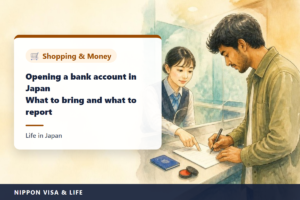
- Besides banks, you can open an account at a shinkin bank (credit association), a credit cooperative, JA Bank, JF Marine Bank or a labour bank. At a post office, you can open a Japan Post Bank (Yucho Bank) account.
- Examples of what to bring are an identity document such as your residence card, a hanko (a small seal with your name carved on it; some financial institutions accept a signature instead), and your employee ID card or student ID card. If you do not have an employee ID or student ID card, ask someone from your company or school to come with you.
- What you need may differ depending on the financial institution. Check before you go.
- When you open an account and after you have opened it, financial institutions check your address, name, period of stay, status of residence, your work situation and so on. If they cannot confirm these, you may not be able to open an account, or you may become unable to use it.
What you need, the reasons you may not be able to open an account, and what to report after opening one are explained in detail in How to Open a Bank Account in Japan: What You Need, Why You May Not Be Able to Open One, and Telling Your Bank When Your Address or Period of Stay Changes.
(Sources: Financial Services Agency “How to Use Bank Accounts and Money Transfers for Living in Japan”, Immigration Services Agency “Guidebook on Living and Working” Chapter 12)
If Your Address or the Expiration Date of Your Period of Stay Changes, Report It Right Away
In the following cases, contact the financial institution where you opened your account.
- When your address, the expiration date of your period of stay, your status of residence or your workplace changes
- When you apply for an extension of your period of stay or a change of your status of residence
- When you quit your job or leave your school
- When you lose your bankbook or cash card
- When you return to your home country (close your account)
If you do not report these, or do not do what the financial institution asks, you may become unable to use your account.
(Sources: Immigration Services Agency “Guidebook on Living and Working” Chapter 12, Financial Services Agency “How to Use Bank Accounts and Money Transfers for Living in Japan”)
2. What You Can Do at the Post Office
The mark for Japanese post offices and mailboxes is “〒”, and they are easy to spot by their red color. At the post office, you can do the following.
- Send letters, postcards and parcels within Japan or abroad
- Savings, money transfers, and payments of utility bills and other charges
- Take out life insurance
When you open a Japan Post Bank account, you can get guidance from Japan Post’s “Multilingual Call Center.” It supports English, Chinese, Korean, Vietnamese, Indonesian, Nepali and Burmese. Check the phone number on Japan Post’s website.
(Sources: Immigration Services Agency “Guidebook on Living and Working” Chapter 12, Japan Post “Multilingual Call Center for Foreign Customers”)
3. Ways to Pay
In Japan, besides cash, there are many ways to pay.
| Way to pay | Examples of when you can use it |
|---|---|
| Automatic withdrawal from a bank account (account transfer) | Electricity, gas, water and phone bills |
| Payment at a convenience store or bank | Electricity, gas and water bills, National Pension premiums (paid with a payment slip) |
| Credit card | Electricity and gas bills, National Pension premiums |
| Debit card | Payments in shops and online (apply at a financial institution that offers it) |
- For electricity and gas bills, you can choose from automatic withdrawal from a bank account, payment at a convenience store or bank, credit card payment and so on.
- How to pay water bills differs depending on the water utility. Basically, you can choose from account transfer, payment at a bank or convenience store, and so on.
- National Pension premiums can also be paid with a payment slip (paid at a bank counter, a convenience store, etc.), by account transfer, or by credit card.
How to apply for and stop electricity, gas and water is covered in Checklist for Moving Within Japan: Moving-out and Moving-in Notifications, Residence Card, Electricity, Gas and Water, and Mail Forwarding.
(Sources: Immigration Services Agency “Guidebook on Living and Working” Chapters 7 and 12, Financial Services Agency “How to Use Bank Accounts and Money Transfers for Living in Japan”)
4. Shopping and Consumption Tax
- When you buy goods or receive services, a consumption tax (a tax on shopping and services) of 10% is charged.
- When you buy food and drinks, excluding alcohol and eating out, the tax rate is 8% (the reduced tax rate).
- For example, food and drinks bought at a supermarket (excluding alcohol) are 8%, while alcohol and meals eaten at a restaurant (eating out) are 10%.
- Foreign nationals also pay consumption tax when they stay at a hotel or have a meal.
(Sources: Immigration Services Agency “Guidebook on Living and Working” Chapter 8)
5. Smartphone (Mobile Phone) Contracts
- When you sign a contract, your identity is checked.
- Examples of identity documents you can use are a residence card, a driver’s license and a My Number Card. Some companies also require a passport.
- For the procedure to pay the charges, you need one of the following.
- A credit card
- A cash card for a bank account in Japan
- A bankbook for a bank account in Japan
- Minors need both an identity document and a letter of consent from a person with parental authority (such as a parent).
- Some mobile phone companies offer support in foreign languages on their websites or in their shops. You can check in advance which documents you need for the contract and ask questions.
Points to Note About Smartphone Contracts
- There are bad intermediaries (brokers) who approach you saying, “I will sign a mobile phone contract for you,” then use your identity documents without permission to sign contracts and use the phones for crimes.
- When you ask someone to sign a contract for you, check the details yourself as well.
- Giving a smartphone you signed a contract for to someone else without the mobile phone company’s consent is a violation of the law and is punished.
- When you will no longer use it, for example because you are returning to your home country, contact the mobile phone company and complete the procedure to cancel the contract.
(Sources: Immigration Services Agency “Guidebook on Living and Working” Chapter 12)
6. Sending Money Abroad (Overseas Remittance)
- You can send money abroad through a bank or a funds transfer service provider.
- When you send money, you may need documents that show the purpose and details of the transfer.
- It may take time for the money to arrive.
- Whether you can send money abroad, and to which countries and regions, differs depending on the bank or funds transfer service provider. For details, ask the bank or funds transfer service provider you use.
- Banks and funds transfer service providers that do not have a license, permission, registration or similar from the Financial Services Agency are illegal, so do not use them. You can check the list of banks and funds transfer service providers on the Financial Services Agency’s website.
- If you are not sure whether a bank is illegal, ask your company or others for advice.
My Number (a 12-digit number) is listed as one of the things you may need when sending money abroad or receiving money from abroad. For My Number, see My Number and the My Number Card in Japan: What Foreign Residents Should Know (When It Is Used, Applying, Extending the Expiration Date, and If You Lose It).
(Sources: Financial Services Agency “How to Use Bank Accounts and Money Transfers for Living in Japan”, Immigration Services Agency “Guidebook on Living and Working” Chapters 2 and 12)
7. Things You Must Not Do
| Things you must not do | Reason |
|---|---|
| Selling, giving away or receiving a bank account (cash card, bankbook, login ID, password, etc.) | It is a crime and is punished |
| Accepting a request such as “I will pay you, so please send this money from your account” | Money laundering (hiding where money obtained through crime came from) is illegal |
| Asking a business without a license or registration from the Japanese government to send money | It is an illegal business and must not be used |
| Giving a smartphone you signed a contract for to someone else without the mobile phone company’s consent | It is a violation of the law and is punished |
The Financial Services Agency warns that if you do something illegal, such as giving your account to someone else, you may become unable to stay in Japan or unable to come to Japan. Even if someone asks, “I want to use your account,” when you return to your home country, do not give your account to anyone; close it at the financial institution.
(Sources: Financial Services Agency “How to Use Bank Accounts and Money Transfers for Living in Japan”, Immigration Services Agency “Guidebook on Living and Working” Chapter 12)
8. When You Have Trouble with Shopping or Contracts
- When you have trouble with something you bought or a contract for a service, call the Consumer Hotline “188”. It will guide you to a consultation counter of your city, ward, town or village or prefecture, such as a nearby Consumer Affairs Center. Consultations are free (call charges apply).
- For contracts made through door-to-door sales or telephone solicitation, there is a system called cooling-off, which lets you withdraw your application or cancel the contract unconditionally within a certain period.
- There is no cooling-off system for mail-order sales (such as online shopping). Whether you can return an item depends on the conditions set by the shop (special terms).
How to call, what you can ask about, and the cooling-off period and procedure are explained in detail in Where to Get Help With Shopping and Contract Problems in Japan: Consumer Hotline 188, Consumer Affairs Centers and Cooling-off.
(Sources: Consumer Affairs Agency “Consumer Hotline”, National Consumer Affairs Center of Japan “Cooling-off”)
Common Questions
Can I Not Sign a Smartphone Contract Without a Bank Account?
For the procedure to pay the charges, you need one of the following: a credit card, a cash card for a bank account in Japan, or a bankbook for a bank account in Japan. Opening a bank account first makes it easier to sign a smartphone contract. What you need may differ depending on the company, so check in advance.
(Sources: Immigration Services Agency “Guidebook on Living and Working” Chapter 12)
What Should I Do When I Return to My Home Country?
- Close your bank account (you can do this at a branch of the financial institution)
- Contact your mobile phone company, for example to cancel your smartphone contract
- Complete the procedures to stop using electricity and gas, allowing enough days in advance
For the procedures at the city office (moving-out notification, resident tax, pensions), see Procedures at the City Office After You Arrive in Japan: The Basics of the Moving-in Notification, My Number, National Health Insurance, National Pension and Resident Tax.
(Sources: Immigration Services Agency “Guidebook on Living and Working” Chapter 12)
Where Can I Learn About Accounts and Money Transfers in a Foreign Language?
The Financial Services Agency publishes a pamphlet summarizing how to use accounts and money transfers, “How to Use Bank Accounts and Money Transfers for Living in Japan,” in many languages, including English and Chinese. You can view it on the Financial Services Agency’s website.
(Sources: Financial Services Agency “Financial Measures for the Acceptance of and Coexistence with Foreign Nationals”, Immigration Services Agency “Guidebook on Living and Working” Chapter 12)
Where to Get Advice When You Have Trouble
- People at your company or school: The Financial Services Agency advises you to talk to people at your company or school if you have trouble with accounts, overseas remittances and so on.
- Financial Services Agency “Counseling Office for Financial Services Users”: It accepts general questions and consultations about financial services such as deposits. Check how to contact it on the Financial Services Agency’s website.
- Consumer Hotline “188”: It guides you to consultation counters for trouble with shopping and contracts.
(Sources: Financial Services Agency “How to Use Bank Accounts and Money Transfers for Living in Japan”, Financial Services Agency “Counseling Office for Financial Services Users”, Consumer Affairs Agency “Consumer Hotline”)
Primary Sources Used for This Article
- Immigration Services Agency “Guidebook on Living and Working” (Chapter 2 Procedures at Municipal Offices, Chapter 7 Pensions and Welfare, Chapter 8 Taxes, Chapter 12 Rules and Customs in Daily Life)
- Financial Services Agency “How to Use Bank Accounts and Money Transfers for Living in Japan” (Japanese-language pamphlet, revised September 2024)
- Financial Services Agency “Financial Measures for the Acceptance of and Coexistence with Foreign Nationals”
- Financial Services Agency “Counseling Office for Financial Services Users”
- Japan Post “Multilingual Call Center for Foreign Customers”
- Consumer Affairs Agency “Consumer Hotline”
- National Consumer Affairs Center of Japan “Cooling-off”
This article is a translation of the original Japanese version.