This article was written by the NIPPON VISA & LIFE editorial team based on information from public organizations such as the national government and local governments. Rules and fees may differ depending on the city, ward, town or village where you live.
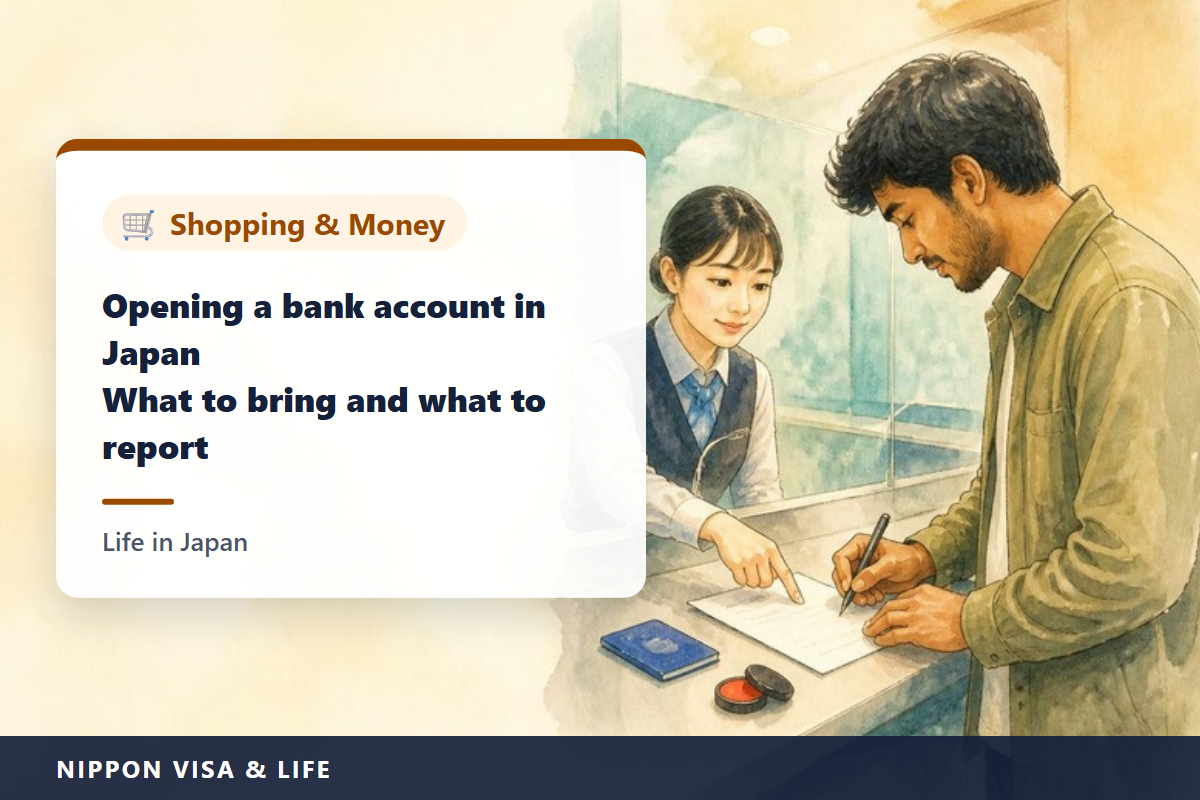
To receive your salary or pay for electricity, gas and water in Japan, it is convenient to have a bank account (your own account where you keep money). To open an account, go to the bank with an identity document such as your residence card, a personal seal (hanko), and your employee ID or student ID. After opening the account, contact the bank right away if your address or the expiration date of your period of stay changes. If you do not, you may become unable to use your account.
The Overall Flow
- Choose a financial institution (such as a bank) where you will open the account
- Check what you need on that financial institution’s website or at its counter
- Apply at a branch (some financial institutions also accept applications by mail, by smartphone app, or on a computer)
- Your cash card (the card you use to put money in and take money out at an ATM) is usually mailed to your home at a later date
- When your address, the expiration date of your period of stay, your workplace or other details change, contact the financial institution where you opened the account
- When you no longer use the account, for example because you are returning to your home country, close it
(Sources: Immigration Services Agency “Guidebook on Living and Working”, Financial Services Agency “How to Use Bank Accounts and Money Transfers for Living in Japan”)
Where You Can Open an Account
Besides banks, you can open an account at financial institutions such as the following.
- Banks
- Shinkin banks (shinyo kinko)
- Credit cooperatives (shinyo kumiai)
- JA Bank (JAバンク)
- JF Marine Bank (JFマリンバンク)
- Labour banks (rodo kinko)
At post offices, you can open an account with Japan Post Bank (ゆうちょ銀行). At post offices, you can also save money, send money, and pay utility bills.
(Sources: Financial Services Agency “How to Use Bank Accounts and Money Transfers for Living in Japan”, Immigration Services Agency “Guidebook on Living and Working”)
What You Need to Open an Account
The Financial Services Agency and the Immigration Services Agency give the following as examples. What you need may differ depending on the financial institution. Check before you go.
| What you need | Explanation |
|---|---|
| Identity document | Residence card, passport, etc. |
| Personal seal (hanko / inkan) | A small stamp carved with your name. Some financial institutions accept a signature instead of a seal |
| Employee ID or student ID | If you do not have one, ask someone from your company or school to come to the financial institution with you |
(Sources: Financial Services Agency “How to Use Bank Accounts and Money Transfers for Living in Japan”, Immigration Services Agency “Guidebook on Living and Working”)
The Immigration Services Agency’s “Guidebook on Living and Working” lists opening an account at a bank as one of the situations where you need your My Number (Individual Number) (a 12-digit number given to each person living in Japan). Your My Number is notified to you by your city, ward, town or village after you submit your address notification (moving-in notification) (Moving-in Notification and Resident Record: Go to Your City Office Within 14 Days After Your Address in Japan Is Decided (What to Bring, Steps, and When You Move)).
(Sources: Immigration Services Agency “Guidebook on Living and Working”)
How to Apply
- You can apply at a branch (counter) of the financial institution.
- Depending on the financial institution, you can also apply by mail, by smartphone app, or on a computer.
- Your cash card is usually mailed to your home at a later date.
(Sources: Immigration Services Agency “Guidebook on Living and Working”)
If You Are Worried About Japanese
- The Immigration Services Agency advises that if you are worried about communicating in Japanese, you should ask someone who can keep supporting you, such as a person from your workplace or school, to interpret for you.
- When opening a Japan Post Bank account, you can get guidance on how to open an account from Japan Post’s “Multilingual Call Center.” It supports English, Chinese, Korean, Vietnamese, Indonesian, Nepali and Burmese. Check the phone number on Japan Post’s website.
- Japan Post says that if you go directly to a post office counter without contacting the call center, your application may not be accepted that day; for example, you may be asked to make a reservation and come back another day.
- The “Yucho Procedures App” (ゆうちょ手続きアプリ), which lets you open an account on your smartphone, supports Japanese, English, Chinese (Simplified) and Vietnamese.
- Japan Post Bank and post offices explain important matters in Japanese. If you do not understand the explanation in Japanese, you may be asked to come with someone who understands Japanese well.
(Sources: Immigration Services Agency “Guidebook on Living and Working”, Japan Post “Multilingual Call Center for Foreign Customers”)
Why You May Not Be Able to Open or Use an Account
Financial institutions must make sure that their accounts and services are not used for money laundering (hiding where money gained through crime came from) or for funding terrorism. For this reason, when you open an account and after you open it, they check your address, name, period of stay, status of residence, work situation and other details as needed.
If this check cannot be done, you may not be able to open an account, or you may become unable to use your account. If the financial institution asks you questions or asks you to submit documents, respond as soon as possible.
(Sources: Financial Services Agency “How to Use Bank Accounts and Money Transfers for Living in Japan”, Immigration Services Agency “Guidebook on Living and Working”)
What to Tell Your Financial Institution After Opening an Account
In the following cases, contact the financial institution where you opened the account right away.
| When | What to tell them |
|---|---|
| Your address has changed | Your new address |
| The expiration date of your period of stay or your status of residence has changed | Your new expiration date and status of residence |
| You have applied to extend your period of stay or change your status of residence | That your application is being processed |
| You have changed jobs, or quit your job or school | Your new workplace, etc. |
| You have lost your bankbook or cash card | That you lost it |
| You are returning to your home country | Close the account |
The financial institution may also contact you to check whether your information has changed. If you do not contact them, or do not do what the financial institution asks, you may become unable to use your account.
(Sources: Immigration Services Agency “Guidebook on Living and Working”, Financial Services Agency “How to Use Bank Accounts and Money Transfers for Living in Japan”)
Tell Them by the Expiration Date of Your Period of Stay
The leaflet “To Prevent Misuse of Savings Accounts” by the Financial Services Agency, the National Police Agency and the Immigration Services Agency gives the following guidance.
- There are many cases where the accounts of people who can no longer be contacted, for example because their period of stay has ended, are misused.
- Tell your financial institution, by the expiration date of your period of stay, that you have extended your period of stay or that your application for extension or similar is being processed.
- If you do not tell them by the expiration date, transactions on your account may be restricted from the day after the expiration date.
For renewing your residence card and changing your address, see What Is a Residence Card? How to Read the New-Style Card and the Specified Residence Card, and Procedures for Renewal, Address Changes, and Loss. All the procedures you need when you move are summarized in Checklist for Moving Within Japan: Moving-out and Moving-in Notifications, Residence Card, Electricity, Gas and Water, and Mail Forwarding.
What You Can Do With an Account
- Receiving your salary: Your salary from your company is paid into your account.
- Automatic payment of utility bills: You can pay electricity, gas, water and phone bills automatically from your account.
- Paying at shops and online: If you apply for a debit card (a card that takes the payment from your account right away) at a financial institution that offers one, you can use it to pay at shops and online.
- Mobile phone contracts: As a way to pay mobile phone charges, you may be asked for a cash card or bankbook of a Japanese bank account, in addition to a credit card.
(Sources: Financial Services Agency “How to Use Bank Accounts and Money Transfers for Living in Japan”, Immigration Services Agency “Guidebook on Living and Working”)
What You Must Not Do
Giving or Selling Your Account to Someone
Selling a bank account (cash card, bankbook, login ID, password, etc.), giving it to someone, or receiving one from someone is a crime and will be punished. Even if someone asks, “I want to use your account,” when you are returning home, you must not give your account to anyone. When you no longer use an account, for example because you are returning home, close it at a branch of the financial institution.
The Financial Services Agency warns that if you do something illegal, such as giving your account to someone, you may no longer be able to stay in Japan or come to Japan.
(Sources: Immigration Services Agency “Guidebook on Living and Working”, Financial Services Agency “How to Use Bank Accounts and Money Transfers for Living in Japan”)
Sending a Stranger’s Money From Your Account
Even if someone says, “I will pay you a reward, so please send this money from your account,” do not agree. The Financial Services Agency warns that money laundering is illegal.
(Sources: Financial Services Agency “How to Use Bank Accounts and Money Transfers for Living in Japan”)
Asking a Business Without a National License or Registration to Send Money
To do banking business, a license from the national government is required. Banks and funds transfer service providers (money transfer companies) that do not have a license, permission, registration or similar from the Financial Services Agency are illegal, so do not use them. You can check the lists of banks and funds transfer service providers on the Financial Services Agency’s website. If you are not sure whether a business is illegal, do not use it, and talk to someone at your company or school.
(Sources: Immigration Services Agency “Guidebook on Living and Working”, Financial Services Agency “How to Use Bank Accounts and Money Transfers for Living in Japan”)
Common Questions
Can I Open an Account Without a Personal Seal?
Some financial institutions accept a signature instead of a seal. Check with the financial institution where you want to open an account before you go.
What If I Do Not Have an Employee ID or Student ID?
The Financial Services Agency and the Immigration Services Agency advise that if you do not have an employee ID or student ID, you should ask someone from your company or school to come to the financial institution with you.
Can I Open an Account Right After Arriving in Japan?
What you need and how your identity is checked may differ depending on the financial institution. Your cash card is usually mailed to your home at a later date. Once your address in Japan is decided, submit a moving-in notification to your city, ward, town or village within 14 days. When you submit the moving-in notification, the notification of your place of residence (address) for your residence card is also completed at the same time. For details, such as from when you can open an account, ask the financial institution where you want to open one.
(Sources: Immigration Services Agency “Guidebook on Living and Working”, Financial Services Agency “How to Use Bank Accounts and Money Transfers for Living in Japan”)
Where to Get Help
- People at your company or school: The Financial Services Agency advises you to talk to someone at your company or school if you have problems using your account, sending money overseas, and so on.
- Financial Services Agency “Counseling Office for Financial Services Users”: It accepts general questions and consultations about financial services such as deposits. It does not mediate or act as an intermediary, but it gives advice such as introducing other places to consult and sorting out the issues. Check how to contact it on the Financial Services Agency’s website.
- The Financial Services Agency publishes its pamphlet “How to Use Bank Accounts and Money Transfers for Living in Japan,” which explains how to use accounts and money transfers, in many languages, including easy Japanese, English, Chinese, Vietnamese and Nepali.
(Sources: Financial Services Agency “Financial Measures for Accepting and Living Together with Foreign Nationals”, Financial Services Agency “Counseling Office for Financial Services Users”, Financial Services Agency “How to Use Bank Accounts and Money Transfers for Living in Japan”)
Primary Sources Used for This Article
- Immigration Services Agency “Guidebook on Living and Working”
- Financial Services Agency “Financial Measures for Accepting and Living Together with Foreign Nationals”
- Financial Services Agency “How to Use Bank Accounts and Money Transfers for Living in Japan” (Japanese pamphlet, revised September 2024)
- Financial Services Agency, National Police Agency and Immigration Services Agency “To Prevent Misuse of Savings Accounts”
- Japan Post “Multilingual Call Center for Foreign Customers”
- Financial Services Agency “Counseling Office for Financial Services Users”
This article is a translation of the original Japanese version.