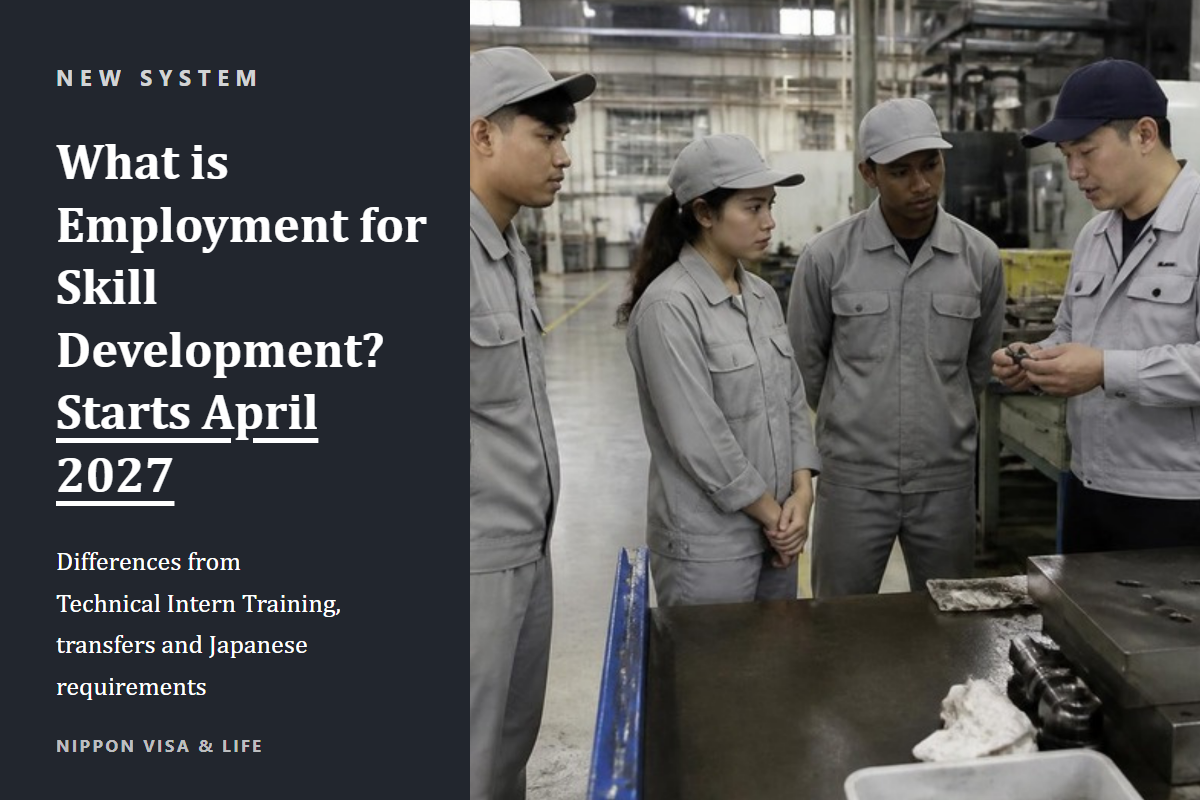


The Employment for Skill Development (育成就労) system replaces the Technical Intern Training (技能実習) system and starts on April 1, 2027 (April 1, Reiwa 9). Its purpose is to develop workers in 17 fields with labor shortages up to the level of Specified Skilled Worker (i) (特定技能1号) while they work, in principle for 3 years. The fees that workers pay to the sending organization in their home country are limited to no more than 2 months of their monthly wage.
Applications before the start date have already begun. Applications for the license of a supervising and support organization have been accepted since April 15, 2026, and applications for certification of an Employment for Skill Development plan have been accepted since September 1, 2026.
On the other hand, some matters have not been published yet, such as the standards for excellent supervising and support organizations and the amount set by public notice for the initial costs that the new employer pays when a worker transfers. This article is based on what we checked on the Immigration Services Agency’s website on October 7, 2026. Please prepare while checking what has been published.
What is the Employment for Skill Development system: its purpose and start date
The Employment for Skill Development system is a system for developing and securing workers at the level of Specified Skilled Worker (i) through 3 years of work in Japan. The Technical Intern Training system will be “dissolved and developed” into this new system, which replaces it.
The purpose of Technical Intern Training was “international contribution”: transferring skills learned in Japan to the home country. The purpose of Employment for Skill Development is to develop and secure workers in fields with labor shortages in Japan. Because the purpose changed, the protection of foreign nationals as workers has been strengthened, and transfers at the worker’s own wish (changing the employer) are also allowed under certain conditions.
The steps leading up to the system are as follows.
| Date | Event |
|---|---|
| June 21, 2024 (Reiwa 6) | The amended law (Act No. 60 of Reiwa 6) is promulgated |
| March 11, 2025 (Reiwa 7) | The Cabinet approves the Basic Policy |
| September 30, 2025 (Reiwa 7) | The ministerial ordinance is promulgated |
| January 23, 2026 (Reiwa 8) | The Cabinet approves the field-specific operational policies (accepted fields, expected numbers of workers, etc.) |
| April 15, 2026 (Reiwa 8) | Pre-start applications for the license of supervising and support organizations begin |
| September 1, 2026 (Reiwa 8) | Pre-start applications for certification of Employment for Skill Development plans begin |
| April 1, 2027 (Reiwa 9) | The system takes effect. Acceptance of Employment for Skill Development foreign workers begins |
Pre-start applications are handled by the Organization for Technical Intern Training (OTIT).
(Sources: Immigration Services Agency, “Overview of the Employment for Skill Development System (revised July, Reiwa 8)”, Immigration Services Agency, “Q&A on the Employment for Skill Development System”, Immigration Services Agency, “Basic Policy and Field-Specific Operational Policies”, Immigration Services Agency, “Employment for Skill Development System: Outline and Related Laws”)
Differences from Technical Intern Training and Specified Skilled Worker (comparison tables)
The biggest difference is that the purpose changed from “international contribution” to “developing and securing workers.” As a result, the systems for transfers and supervision, and the way to move to Specified Skilled Worker, have changed.
First, the differences from Technical Intern Training.
| Item | Technical Intern Training | Employment for Skill Development |
|---|---|---|
| Purpose | International contribution through transfer of skills | Developing and securing workers in fields with labor shortages |
| Plan stages | A plan is certified for each stage: (i), (ii), and (iii) | No stages; a 3-year plan is made from the start and certified |
| Transfer at the worker’s own wish | Not allowed | Allowed under certain conditions (only within the same job category) |
| Supervising organization | Supervising organization (監理団体) | Supervising and support organization (監理支援機関) (stricter license standards) |
| Previous-job requirement and requirement to work in the same field after returning home | Yes | No |
| Expected number of workers (cap) | Not set | Set for each field and used as a cap |
| Moving to Specified Skilled Worker (i) | After good completion of (ii), the skills and Japanese tests are exempted | Must pass the skills and Japanese tests |
Next, the differences from Specified Skilled Worker (i).
| Item | Employment for Skill Development | Specified Skilled Worker (i) |
|---|---|---|
| Expected workers | No expertise or skills required at the time of entry | “Ready-to-work” workers with a certain level of expertise and skills |
| Length of stay | 3 years in principle | Up to 5 years in principle (no limit for Specified Skilled Worker (ii)) |
| Accepted fields | 17 fields | 19 fields |
| Protection of foreign workers | Plan certification, license of supervising and support organizations, cap on sending fees, etc. | The employer (affiliated organization of Specified Skilled Workers) has a duty to provide support |
(Sources: Immigration Services Agency, “Q&A on the Employment for Skill Development System”, Immigration Services Agency and Ministry of Health, Labour and Welfare, “Main Points of the Field-Specific Operational Policies”)
The 17 fields and expected numbers of workers
Employment for Skill Development covers 17 of the 19 Specified Skilled Worker fields. Automobile transportation and aviation are Specified Skilled Worker-only fields and are not covered by Employment for Skill Development.
The “transfer restriction period” for each field (the period a worker must work at the current employer before transferring at their own wish) and the expected number of Employment for Skill Development workers are as follows.
| Field | Ministry in charge | Job category | Transfer restriction period | Expected number of workers (Employment for Skill Development) |
|---|---|---|---|---|
| Nursing care | Ministry of Health, Labour and Welfare | Nursing care | 2 years | 33,800 people |
| Building cleaning | Ministry of Health, Labour and Welfare | Building cleaning | 1 year | 7,300 people |
| Linen supply | Ministry of Health, Labour and Welfare | Linen supply | 1 year | 3,400 people |
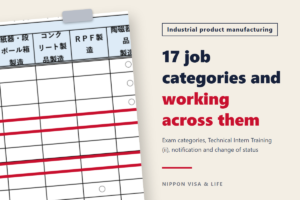
| Industrial product manufacturing | Ministry of Economy, Trade and Industry | 17 categories, including machining and metal processing, and electrical and electronic equipment assembly | 2 years | 119,700 people |
| Construction | Ministry of Land, Infrastructure, Transport and Tourism | Civil engineering, building, lifelines and facilities | 2 years | 123,500 people |
| Shipbuilding and ship machinery | Ministry of Land, Infrastructure, Transport and Tourism | Shipbuilding, marine machinery, marine electrical and electronic equipment | 2 years | 13,500 people |
| Automobile maintenance | Ministry of Land, Infrastructure, Transport and Tourism | Automobile maintenance, auto body maintenance | 2 years | 9,900 people |
| Accommodation | Ministry of Land, Infrastructure, Transport and Tourism | Accommodation | 1 year | 5,200 people |
| Railway | Ministry of Land, Infrastructure, Transport and Tourism | Track maintenance, electrical equipment maintenance, rolling stock maintenance, rolling stock manufacturing, transport staff, station and train cleaning | 1 year | 1,100 people |
| Logistics warehousing | Ministry of Land, Infrastructure, Transport and Tourism | Logistics warehousing | 1 year | 6,900 people |
| Agriculture | Ministry of Agriculture, Forestry and Fisheries | Crop farming, livestock farming | 1 year | 26,300 people |
| Fishery | Ministry of Agriculture, Forestry and Fisheries | Fishing, aquaculture | 1 year | 2,600 people |
| Food and beverage manufacturing | Ministry of Agriculture, Forestry and Fisheries | Food and beverage manufacturing, seafood processing | 2 years | 61,400 people |
| Food service | Ministry of Agriculture, Forestry and Fisheries | Food service | 2 years | 5,300 people |
| Forestry | Ministry of Agriculture, Forestry and Fisheries | Forestry | 1 year | 500 people |
| Wood industry | Ministry of Agriculture, Forestry and Fisheries | Wood industry | 1 year | 2,200 people |
| Resource recycling | Ministry of the Environment | Waste disposal business (intermediate treatment) | 2 years | 3,600 people |
The expected numbers are for the period up to the end of March 2029 (end of March, Reiwa 11). The total is 426,200 for Employment for Skill Development and 805,700 for Specified Skilled Worker (i), or 1,231,900 combined. This is not a number to be added to the current number of residents; it is the total of the caps on acceptance.
If a field is about to exceed its cap, certification of Employment for Skill Development plans in that field is temporarily stopped. Even if an employment contract has already been signed, new entry under Employment for Skill Development is in principle no longer possible. However, applications for Permission to extend period of stay (在留期間の更新許可) are in principle examined as usual.
Other points to note:
- Among the Technical Intern Training (ii) occupations, cleaning (household laundry work), airport ground handling, and boiler maintenance are not covered by Employment for Skill Development.
- Cosmetics manufacturing is an occupation that can move to Technical Intern Training (ii) according to the Ministry of Health, Labour and Welfare’s list (as of July 29, 2026), but it does not appear in the list of Employment for Skill Development job categories or in the Immigration Services Agency’s table matching Technical Intern Training occupations to job categories. Please check future announcements to see whether it can be accepted under Employment for Skill Development.
- Tofu manufacturing is also an occupation that can move to Technical Intern Training (ii), but it is not listed as an individual “main skill” in the food and beverage manufacturing field. It is thought to be treated as the main skill “food and beverage manufacturing in general” within the job category “food and beverage manufacturing” (manufacturing and processing of food and beverages), but please check the field’s public notice and operational guidelines for the scope of eligible workplaces.
- You cannot work across fields, such as “agriculture in summer and fishery in winter.”
- Only agriculture and fishery allow acceptance through dispatch (worker dispatch).
- At least one-third of working hours must be spent on “required work” needed for the skill to be learned (the main skill).
- Linen supply, logistics warehousing, and resource recycling are newly added fields. Acceptance is scheduled to begin once the field standards (public notices) take effect and preparations are complete.
(Sources: Immigration Services Agency and Ministry of Health, Labour and Welfare, “Main Points of the Field-Specific Operational Policies”, Immigration Services Agency, “Q&A on the Employment for Skill Development System”, Immigration Services Agency, “Overview of the Employment for Skill Development System (revised July, Reiwa 8)”, Ministry of Health, Labour and Welfare, “Technical Intern Training: List of Occupations and Work Eligible for Transition”, Immigration Services Agency, “Relationship between Technical Intern Training (ii) Occupations and Employment for Skill Development Fields (Job Categories)”, Immigration Services Agency, “Field-Specific Operational Policy, Attachment 15: Food and Beverage Manufacturing”)
Japanese and skill targets: from before entry to Specified Skilled Worker (i)
Japanese is raised step by step over 3 years. No specific Japanese qualification is required at the time of entry, but there are certain conditions before starting work. The required level differs by field.
The general levels are as follows. Japanese levels are expressed using a national standard called the “Reference Framework for Japanese Language Education.”
| Point in time | Skills | Japanese |
|---|---|---|
| Before starting work | None | Pass a test equivalent to A1 or higher, or take at least 100 hours of A1-level training |
| After 1 year | Employment for Skill Development evaluation test (basic level), etc. | Equivalent to A1 or higher |
| When transferring at your own wish | Employment for Skill Development evaluation test (basic level), etc. | Equivalent to A2.1 or higher |
| End of Employment for Skill Development (Specified Skilled Worker (i)) | Specified Skilled Worker (i) evaluation test, Skills Test Grade 3, etc. | Equivalent to A2.2 or higher |
“A2.2” is the level corresponding to A2 in the Reference Framework. “A2.1” is a level that has reached A1 and is progressing toward A2.2. For reference, the Immigration Services Agency’s materials give the Japanese-Language Proficiency Test (JLPT) N5 as an example of an A1 test and N4 as an example of an A2.2 test.
Some fields set higher levels. For example, in nursing care, A2.2 or higher is required after 1 year (together with a Japanese study plan, which is not needed at B1 or higher), and A2.2 or higher is also required when transferring. Transport staff in the railway field also need A2.2 or higher after 1 year and when transferring. Please check the materials for your field to see its level.
The main rules for Japanese language training are as follows.
- The A1-level training before starting work is in principle taken in the “employment” course of a certified Japanese language education institution. Part of it can also be taken in the home country. For the time being, training that meets certain requirements and is given by a registered Japanese language teacher is also accepted.
- Even without passing an A1-level test, you can enter Japan if you take the training.
- Within the 3 years, the employer must provide opportunities to take at least 100 hours of A2-level training.
- The employer or the supervising and support organization handles the cost of the training, including bearing it.
- There is no obligation to treat the training hours as working hours.
(Sources: Immigration Services Agency, “Overview of the Employment for Skill Development System (revised July, Reiwa 8)”, Immigration Services Agency and Ministry of Health, Labour and Welfare, “Main Points of the Field-Specific Operational Policies”, Immigration Services Agency, “Q&A on the Employment for Skill Development System”)
Rules for transfers (changing the employer)
Under Employment for Skill Development, in addition to transfers when there are “unavoidable circumstances” such as violence or harassment, transfers at the worker’s own wish are also allowed. In both cases, a transfer is possible only within the same job category.
The main conditions for transferring at your own wish are as follows.
- You have worked at your current employer for longer than the transfer restriction period for the field (1 year or 2 years)
- You have reached the skill and Japanese levels set for each field (passed the tests)
- You have not received a referral from a private employment placement business or similar
- The new employer is an “excellent Employment for Skill Development implementer,” has you do work in the same job category, and does not exceed its acceptance quota
- At the new employer, the share of people who transferred at their own wish is within a certain limit
- The new employer pays a certain amount to the previous employer
Even in fields where the transfer restriction period is 2 years, the employer can decide to make it 1 year. If it stays at 2 years, improvements in treatment (better working conditions) set for each field are required. Also, after transferring once, the transfer restriction period must have passed again before transferring a second time.
The share in condition 5 is calculated including the person who wants to transfer, and must be within one-third of all Employment for Skill Development foreign workers at the new employer. If the new employer is in a major metropolitan area and accepts a worker from a regional area, the limit is one-sixth. However, small employers with fewer than 6 such workers, including the transferring worker, can accept up to 1 person as long as they stay within one-third.
The “regional area” here means the “designated areas” set by public notice. These are the prefectures other than Tokyo, Kanagawa, Chiba, Saitama, Aichi, Osaka, Kyoto, and Hyogo, plus some areas within these 8 prefectures. Whether an employer is in a designated area is decided by the location of its head office.
The amount in condition 6 is for the new employer to bear the initial costs of acceptance. It is calculated by multiplying the amount set by public notice by a ratio based on how long the worker worked at the previous employer. For example, for the first transfer, the ratio is five-sixths for 1 year or more but less than 1 year and 6 months, and one-quarter for 2 years and 6 months or more. However, as of October 7, 2026, the base amount set by public notice has not yet been published.
The procedure and documents are shown in the Employment for Skill Development System Operational Guidelines (Chapter 4, Section 3), revised in August 2026. Roughly, the steps are as follows.
- The worker submits a “Request to Change the Employment for Skill Development Implementer” to the employer, the supervising and support organization, or the Organization for Employment for Skill Development of Foreign Nationals
- The party that receives the request accepts it, notifies the Organization, and informs the people concerned (if the request was made directly to the Organization, the Organization informs the people concerned)
- The new employer makes a new Employment for Skill Development plan, gathers documents such as copies of the certificates of passing the skills and Japanese tests, and applies to the Organization for certification
- Within 6 months after certification, the new employer submits documents to the Organization proving that it has paid the initial costs
The standards for an “excellent Employment for Skill Development implementer,” which the new employer must meet, are also shown in the same operational guidelines (Chapter 4, Section 2, Item 12). It is a points system: the employer needs at least 70% of the total points, which depend on its acceptance record, and at least 60% in each item, with some exceptions. To be recognized as excellent, the employer submits a declaration of meeting the excellence requirements when applying for plan certification, and the Organization checks it.
Hello Work (public employment security offices) supports transfers in cooperation with supervising and support organizations and the Organization.
(Sources: Immigration Services Agency, “Q&A on the Employment for Skill Development System”, Immigration Services Agency, “Employment for Skill Development System Operational Guidelines, Chapter 4”, Immigration Services Agency and Ministry of Health, Labour and Welfare, “Main Points of the Field-Specific Operational Policies”, Immigration Services Agency, “Overview of the Employment for Skill Development System (revised July, Reiwa 8)”)
Organizations involved: supervising and support organizations, the Organization for Employment for Skill Development of Foreign Nationals, and sending organizations
Besides the employer and the foreign worker, the main organizations involved and their roles are as follows.
| Organization | Main role |
|---|---|
| Organization for Employment for Skill Development of Foreign Nationals | Certifying Employment for Skill Development plans, on-site inspections of whether plans are being carried out, guidance and advice |
| Supervising and support organization | Arranging the employment relationship between foreign workers and employers, auditing employers, supporting and protecting foreign workers, coordinating transfers |
| Sending organization (home country) | Recruiting and providing pre-departure training to foreign nationals who want to do Employment for Skill Development, and passing on their job applications |
| Hello Work | Supporting transfers in cooperation with supervising and support organizations and the Organization |
There are 2 types of acceptance: the “individual type,” which accepts employees of overseas branches or subsidiaries, and the “supervised type,” which involves a supervising and support organization. Unlike Technical Intern Training, employees of overseas business partners are accepted under the “supervised type.”
Supervising and support organizations need a license
Supervising and support organizations require a license, and current supervising organizations must also newly obtain a license as a supervising and support organization. The license standards are stricter than those for supervising organizations. The main new standards are:
- Having an external auditor
- Not having liabilities exceeding assets
- In principle, supervising and supporting 2 or more employers
- Having 2 or more full-time officers and staff doing the actual work, more than both the number of employers divided by 8 and the number of foreign workers divided by 40
The external auditor must take training, must be a person with knowledge of Employment for Skill Development such as a lawyer, labor and social security attorney, or gyoseishoshi lawyer (administrative scrivener), and must not have a close relationship with the employers. The specific standards for excellent supervising and support organizations have not yet been published.
Sending is in principle from countries with a Memorandum of Cooperation (MOC)
In principle, foreign workers can be accepted only from countries that have made a bilateral arrangement with Japan (a Memorandum of Cooperation, MOC). The maximum fees a foreign worker pays to a sending organization are 2 months of the monthly wage paid by the employer (the regular monthly amount). Any fees above this are borne by the employer or the supervising and support organization.
In addition, for acceptance from some countries, a “letter of recommendation” issued by a public body in the home country is required for each person at the time of application (except for the individual type and for accepting employees of business partners under the supervised type). As of October 7, 2026, the countries that are to issue letters of recommendation are Indonesia, Cambodia, Kyrgyzstan, Vietnam, and Laos.
(Sources: Immigration Services Agency, “Q&A on the Employment for Skill Development System”, Immigration Services Agency, “Overview of the Employment for Skill Development System (revised July, Reiwa 8)”, Immigration Services Agency, “Pre-start Applications for the Employment for Skill Development System”)
Main requirements for employers (Employment for Skill Development implementers)
The requirements for employers carry over those of Technical Intern Training, with new requirements added. The main ones are:
- In the past year, no foreign worker has gone missing due to the responsibility of the employer or related parties
- In the past year, the employer has not made workers who did the same kind of work leave their jobs, except in cases such as leaving voluntarily
- Complying with labor, social insurance, and tax laws
- Not receiving money, goods, or entertainment beyond common sense from sending organizations or others
- Explaining working conditions and other matters in person or online when signing the employment contract
- Being a member of the field-specific council (for industrial product manufacturing, joining the Japan Association for Industrial Manufacturing Human Resources (JAIM), a general incorporated association)
The number of workers an employer can accept has a cap based on the number of full-time staff (the acceptance quota). Technical intern trainees in (i) and (ii) who remain under the transitional measures are also counted in this quota. Excellent employers get a larger quota (the standards are the points system explained in the section on transfers).
In addition to the Employment for Skill Development manager, the Employment for Skill Development instructor and the life counselor are now also required to have taken training courses within the past 3 years. For the time being, the training courses of the Technical Intern Training system are planned to be accepted instead.
Furthermore, each field has additional standards (public notices), and the documents needed are explained in the field-specific operational guidelines. The publication status as checked on October 17, 2026 (covering items published up to October 16) was as follows.
- Field-specific operational guidelines published: building cleaning, linen supply, industrial product manufacturing, automobile maintenance, accommodation, railway, logistics warehousing, food and beverage manufacturing, food service, forestry, wood industry, resource recycling
- Examination standards published: building cleaning, linen supply, automobile maintenance, accommodation, railway, food and beverage manufacturing, logistics warehousing, forestry, wood industry, resource recycling
- Membership procedures for councils and similar bodies started: nursing care, building cleaning, linen supply, industrial product manufacturing, shipbuilding and ship machinery, automobile maintenance, railway, food and beverage manufacturing, forestry, wood industry
The other fields are “in preparation.” If you apply without all the documents, you will need to submit more, and the examination will be on hold in the meantime.
(Sources: Immigration Services Agency, “Q&A on the Employment for Skill Development System”, Immigration Services Agency, “Employment for Skill Development System Operational Guidelines, Chapter 4”, Immigration Services Agency, “Pre-start Applications for the Employment for Skill Development System”)
What foreign workers in Employment for Skill Development should know
Here are the important points for workers.
- Family: In principle, you cannot bring your family to Japan to live with you.
- Fees paid to the sending organization: Up to 2 months of your monthly wage. Any amount above this is borne by the employer or the supervising and support organization.
- Taxes: Unlike Technical Intern Training, wages from Employment for Skill Development are in principle not exempt under tax treaties. Income tax and residence tax apply.
- Pregnancy and childbirth: Even if it becomes difficult to continue, you can suspend Employment for Skill Development and resume it later.
- Temporary return home: In agriculture and fishery, a plan can be made to return home and rest for up to 6 months at the same time each year. The time at home is not counted in the 3 years, so that the total period of work in Japan is 3 years.
- From another status of residence: People currently in Japan with another status of residence (在留資格) may be able to change to “Employment for Skill Development.” However, people with no room to move to Specified Skilled Worker, such as those who have already stayed for the maximum period as Specified Skilled Worker (i), cannot.
(Sources: Immigration Services Agency, “Q&A on the Employment for Skill Development System”, National Tax Agency, “Tax Treatment of Wages Paid to Employment for Skill Development Foreign Workers by Employment for Skill Development Implementers”)
Relationship with Specified Skilled Worker (i) and permanent residence
After finishing Employment for Skill Development, workers are expected to move to Specified Skilled Worker (i). To move, you must pass a skills test (Skills Test Grade 3 or similar, or the Specified Skilled Worker (i) evaluation test) and a Japanese test equivalent to A2.2 or higher (A2.2 level on the JFT-Basic, JLPT N4, or similar). There is no test exemption like the one for good completion of Technical Intern Training (ii).
If you cannot pass the tests after 3 years, the policy is to allow continued stay to a certain extent, for up to 1 year. The policy is to allow a move to Specified Skilled Worker (i) partway through Employment for Skill Development only if you pass the tests and have worked at your current employer for longer than a certain period. We could not confirm the length of that period as of this article.
How the period of stay for Specified Skilled Worker (i) is decided is explained in the following article.
For Permission for permanent residence (永住許可), the guidelines revised on October 1, 2026 exclude Employment for Skill Development from “work statuses.” Permission for permanent residence in principle requires continuous residence of 10 years or more, including continuous residence of 5 years or more with a work status or residential status. The period of Employment for Skill Development does not count toward these “5 years with a work status.”
(Sources: Immigration Services Agency, “Q&A on the Employment for Skill Development System”, Immigration Services Agency, “Guidelines for Permission for Permanent Residence (revised October 1, Reiwa 8)”)
What happens to companies with technical intern trainees and to people now in Technical Intern Training? (transitional measures)
Technical Intern Training does not end all at once on April 1, 2027. Certain people can continue Technical Intern Training after the start date. However, it is not possible to switch from Technical Intern Training to Employment for Skill Development.
| Case | Treatment after the start date |
|---|---|
| Doing Technical Intern Training in Japan as of April 1, 2027 | In principle, can continue Technical Intern Training based on the certified plan |
| Applied for certification of a Technical Intern Training plan by March 31, 2027, and in principle starts Technical Intern Training by June 30, 2027 | May be able to enter Japan as a technical intern trainee and do Technical Intern Training (plan certification may come on or after the start date) |
| Finished Technical Intern Training and left Japan before the start date | Cannot enter Japan again as a technical intern trainee (depending on the period and occupation, may be able to enter under Employment for Skill Development) |
The treatment after the start date is as follows.
- People in (i) as of April 1, 2027 can still move up to (ii) after the start date.
- Only people who have been in (ii) for 1 year or more as of April 1, 2027 can move up to (iii).
- For the time being, people who have completed Technical Intern Training (ii) in good standing can move from Technical Intern Training to Specified Skilled Worker (i) if the work is related.
- Past periods of Technical Intern Training are counted as periods of Employment for Skill Development. People who did Technical Intern Training for 2 years or more basically cannot come back to Japan for Employment for Skill Development in a different field.
- Supervising organizations that accept technical intern trainees after the start date need to renew the validity period of their license. However, renewal is not needed if they have a license as a supervising and support organization.
The Organization for Technical Intern Training advises that applications for certification of (i) Technical Intern Training plans be made by February 2027.
The outcome of the transitional measures depends on each person’s date of entry and stage. If you are unsure which case applies to your company’s technical intern trainees, please consult an expert.
(Sources: Immigration Services Agency, “Overview of the Employment for Skill Development System (revised July, Reiwa 8)”, Immigration Services Agency, “Q&A on the Employment for Skill Development System”, Organization for Technical Intern Training, “About the Employment for Skill Development System”)
What companies and supervising organizations should prepare before the start
Preparations by role:
Supervising organizations
- Apply for a license as a supervising and support organization (accepted from April 15, 2026). Check whether you meet the new standards, such as an external auditor and the number of full-time officers and staff
- If you handle nursing care, industrial product manufacturing, automobile maintenance, logistics warehousing, or fishery, check the additional standards (public notices) and operational guidelines for each field
- Check whether the country of your contracted sending organization has made an MOC or is still in discussions
Employers
- Check whether your field and job category are among the 17 Employment for Skill Development fields
- Join the field-specific council (JAIM for industrial product manufacturing)
- Check the publication status of the field’s operational guidelines and examination standards, and prepare the documents for the pre-start application for an Employment for Skill Development plan (accepted from September 1, 2026)
- If accepting workers from a country that requires a letter of recommendation, obtain the letter of recommendation
- Find a Japanese language education institution that offers A1 and A2 Japanese training
- Have the Employment for Skill Development manager, instructor, and life counselor take the training courses
Note that in supervised-type Employment for Skill Development, supervision and support are provided by the supervising and support organization. A registered support organization (登録支援機関) is an organization that provides support under the Specified Skilled Worker system; it becomes involved when a worker moves from Employment for Skill Development to Specified Skilled Worker (i) and the employer entrusts support to it.
How to make plans and what the license standards require depend on the situation of each company or organization. If you are unsure how to prepare your application, please consult an expert.
(Sources: Immigration Services Agency, “Pre-start Applications for the Employment for Skill Development System”, Immigration Services Agency, “Q&A on the Employment for Skill Development System”)
Frequently asked questions
Q1. When does Employment for Skill Development start?
It starts on April 1, 2027 (April 1, Reiwa 9). Pre-start applications are already being accepted.
Q2. Will the Technical Intern Training system end right away?
No, it will not end right away. People doing Technical Intern Training on April 1, 2027, and some others, can continue Technical Intern Training under the transitional measures. After the start date, new entry as a technical intern trainee is limited to people whose plan certification was applied for by March 31, 2027 and who in principle start by June 30.
Q3. Can I change jobs (transfer) freely?
No, not freely. Transfers at the worker’s own wish are limited to cases within the same job category where conditions are met, such as having passed the transfer restriction period and passed the skills and Japanese tests. The procedure is shown in the operational guidelines, but the amount set by public notice that is the basis for the initial costs the new employer bears has not yet been published.
Q4. Can I bring my family to Japan?
In principle, you cannot bring your family to live with you.
Q5. Can workers be accepted from any country?
In principle, only from countries that have made a Memorandum of Cooperation (MOC) with Japan. The countries that have made one are published on the website of the Organization for Technical Intern Training.
Q6. Is there a cap on the number of workers accepted?
Yes. The expected number of Employment for Skill Development workers is 426,200 in total up to the end of March 2029, used as a cap for each field. If a field is about to exceed its cap, certification of Employment for Skill Development plans in that field is temporarily stopped.
(Sources: Immigration Services Agency, “Q&A on the Employment for Skill Development System”, Immigration Services Agency and Ministry of Health, Labour and Welfare, “Main Points of the Field-Specific Operational Policies”)
Summary
- The Employment for Skill Development system replaces Technical Intern Training and starts on April 1, 2027. Its purpose is to develop and secure workers in fields with labor shortages.
- It covers 17 fields and aims for the level of Specified Skilled Worker (i) through work, in principle for 3 years.
- Transfers at the worker’s own wish are allowed with conditions, within the same job category. The transfer restriction period is 1 year or 2 years depending on the field.
- Japanese is required step by step, from A1 level before starting work to A2.2 level at the end. The level differs by field.
- Current technical intern trainees can continue Technical Intern Training under the transitional measures, but cannot switch from Technical Intern Training to Employment for Skill Development.
- The standards for excellent employers were shown in the revision of the operational guidelines in August 2026. The procedure for transfers at the worker’s own wish is also shown in the operational guidelines. The standards for excellent supervising and support organizations and the amount set by public notice for initial costs had not been published as of October 7, 2026. Please check the publication status on the websites of the Immigration Services Agency and the Organization for Technical Intern Training.
- If you are unsure how to prepare in your company’s or your own case, please consult an expert.
Primary Sources Referenced in Article Creation
- Immigration Services Agency, “Employment for Skill Development System”
- Immigration Services Agency, “Employment for Skill Development System: Outline and Related Laws”
- Immigration Services Agency, “Q&A on the Employment for Skill Development System”
- Immigration Services Agency and Ministry of Health, Labour and Welfare, “Overview of the Employment for Skill Development System (revised July, Reiwa 8)”
- Immigration Services Agency and Ministry of Health, Labour and Welfare, “Main Points of the Field-Specific Operational Policies (List of Specified Industrial Fields, Employment for Skill Development Industrial Fields, and Job Categories)”
- Immigration Services Agency, “Basic Policy and Field-Specific Operational Policies for the Specified Skilled Worker System and the Employment for Skill Development System”
- Immigration Services Agency, “Field-Specific Operational Policy, Attachment 15: Food and Beverage Manufacturing”
- Immigration Services Agency, “Relationship between Technical Intern Training (ii) Occupations and Employment for Skill Development Fields (Job Categories)”
- Ministry of Health, Labour and Welfare, “Technical Intern Training: List of Occupations and Work Eligible for Transition (as of July 29, Reiwa 8)”
- Immigration Services Agency, “Pre-start Applications for the Employment for Skill Development System”
- Immigration Services Agency, “Employment for Skill Development System Operational Guidelines”
- Immigration Services Agency, “Employment for Skill Development System Operational Guidelines, Chapter 4: Certification of Employment for Skill Development Plans, etc. (revised August 5, Reiwa 8)”
- Organization for Technical Intern Training, “About the Employment for Skill Development System”
- National Tax Agency, “Tax Treatment of Wages Paid to Employment for Skill Development Foreign Workers by Employment for Skill Development Implementers”
- Immigration Services Agency, “Guidelines for Permission for Permanent Residence (revised October 1, Reiwa 8)”
This article is a translation of the original Japanese version.