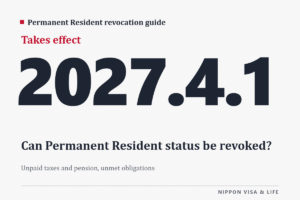

The guidelines for Permission for permanent residence (永住許可) were revised on October 1, 2026 (Reiwa 8). Most of the changes apply to applications filed on or after April 1, 2027. However, the approach to “income” and “public burden” alone also applies to cases filed on or after April 1, 2026 that were still under examination as of October 1.
This article summarizes the differences between the guidelines before and after the revision, and what you can prepare from now.
Permission for permanent residence is decided by looking at each person’s circumstances as a whole. The guidelines show the “basic approach” to the factors considered in the examination. Even if you meet the items in the guidelines, permission is not guaranteed.
Also note that this revision changes the approach to examining applications for permanent residence. It does not change the status of residence of people who have already received Permission for permanent residence.
Overview of the revision: when and what changed
The revision date is October 1, 2026. The revised guidelines now describe in detail what is looked at in the examination for each of the three requirements for permanent residence.
- Good conduct requirement: You obey the law and live a life that is not socially condemned
- Independent livelihood requirement: You do not become a public burden and have income or assets that allow a stable life in the future
- National interest requirement: Your permanent residence is recognized as being in Japan’s interest
There are four main changes.
- Under the independent livelihood requirement, a “numerical approach” based on household income and expected pension amount was introduced
- Japanese language ability, understanding of Japan’s systems and rules, and children’s school attendance were added to the national interest requirement
- The number of years required under the special provisions for spouses, biological children, and others became longer
- The guidelines on “contributions to Japan” were abolished, and examples of contributions were moved into the new guidelines
In addition, the words “compliance with the obligations prescribed in this Act, payment of public taxes and charges, etc.” will be added to Article 22, Paragraph 2 of the Immigration Control Act (the provision on Permission for permanent residence). This comes from the amendment act of Reiwa 6, which takes effect on April 1, 2027. The guidelines explain that this amendment makes clear in the law what had been written in the guidelines until now, and that these points were also considered in examinations before that.
(Sources: Immigration Services Agency, “Guidelines for Permission for Permanent Residence (revised October 1, Reiwa 8)”, Immigration Services Agency, “Q&A on making the permanent residence system more appropriate”)
Comparison table (before and after the revision)
Comparing the wording of the guidelines before the revision (version revised on February 24, 2026) and after the revision (version revised on October 1, 2026) gives the following.
| Item | Before the revision | After the revision |
|---|---|---|
| Income | You do not become a public burden and a stable life can be expected in the future | Whether your household income continuously reaches a level above the average income of Japanese households of the same household size |
| Pension | Not mentioned | Whether your expected future pension amount reaches a certain level (any shortfall can be covered by financial assets) |
| Taxes and insurance premiums | You properly pay taxes, pension and medical insurance premiums, etc. Even if paid by the time of application, not paying by the original due date is in principle evaluated negatively | Cases where you did not pay properly in the past, such as having been subject to a delinquency disposition, are also in principle evaluated negatively. It is newly stated that this is in principle looked at per household |
| Criminal penalties, etc. | You have not received a fine, imprisonment, etc. | In addition to imprisonment and fines, protective measures under the Juvenile Act are also in principle evaluated negatively |
| Statuses of residence excluded from “work statuses” | Technical Intern Training, Specified Skilled Worker (i) | Technical Intern Training, Employment for Skill Development, Specified Skilled Worker (i), Intra-company Transferee, some Designated Activities |
| Periods spent outside Japan | Not mentioned | If, within the past 10 years, you were out of Japan without reason for half a year or more at one time, or for a total of 2 years and 6 months or more, this is in principle evaluated negatively |
| Japanese language ability | Not mentioned | Whether you are at B1 equivalent or above in the “Reference Framework for Japanese Language Education” |
| Understanding of systems and rules | Not mentioned | Whether you understand, mainly, the contents of the “Guidebook on Living and Working” |
| Children’s school attendance | Not mentioned | Whether children of compulsory education age attend elementary or junior high school |
| Public health / grounds for denial of landing | There is no risk of being harmful from a public health standpoint | You do not fall under the reasons for which landing is denied under the Immigration Control Act (grounds for denial of landing; these include not only infectious diseases but also having received certain criminal penalties, etc.) |
| Special provision for spouses | Married for 3 years or more, and continuously residing for 1 year or more | Married for 5 years or more, and continuously residing for 3 years or more |
| Special provision for biological children, etc. | Continuously residing for 1 year or more | Continuously residing for 3 years or more |
The basic residence period (in principle, 10 or more consecutive years, of which 5 or more consecutive years with a work status or a residence-based status) is the same before and after the revision.
The revised guidelines also describe specific obligations under the Immigration Control Act. For example, not complying with obligations such as the following is evaluated negatively. Not only violations at the time of application, but also past violations that come to light are in principle evaluated negatively.
- Various notifications required of mid- to long-term residents, such as notification of your place of residence
- Procedures such as reissuance of your residence card
- Always carrying your residence card and showing it when asked
- Not engaging in activities other than those permitted by your status of residence
For “Designated Activities,” the approach and examples for which activities count toward the “10 years” and which count as a “work status” were also shown. For example, staying for continued job hunting or as a person with a job offer does not count toward the “10 years.” Working holiday and internship do not count as a “work status.”
In addition, the revised guidelines added to the list a special provision under which 3 or more years of residence is sufficient for people engaged in specific projects in a Special Zone for Structural Reform who are recognized as contributing.
(Sources: Immigration Services Agency, “Guidelines for Permission for Permanent Residence (revised October 1, Reiwa 8)”, Immigration Services Agency, “Guidelines for Permission for Permanent Residence (revised February 24, Reiwa 8)”)
Income: household income and the “income level”
After the revision, the examination looks at whether your household income continuously reaches the “income level” at the time of application. The income level means a level above the average income of Japanese households of the same household size.
“Household” here means a group of people who share a home and household finances. Household income is calculated as follows.
- If you live alone, your own annual income is your household income
- If you live with family, your annual income and your family members’ annual incomes are added together
- For people no longer supported by their parents, such as adult children, their own income is looked at without adding the parents’ income
- Income of family members who do not have a work status, such as “Dependent” (part-time job income earned under permission to engage in activities other than those permitted), is not added to household income
- Relatives you support are included in the household size, even if they live abroad
- If the household has 5 or more people, an amount for the increase in living costs, etc. is added to the income level
This requirement is in principle examined per household sharing the same finances.
No specific amount for the income level has been published. As of October 7, 2026, we checked the Immigration Services Agency’s guidelines, its page on applying for Permission for permanent residence, and its Q&A, but they did not give amounts for each household size. Specific amounts are sometimes presented on the internet, but these are not standards published by the Immigration Services Agency. If you use an amount as a guide, please check where it comes from.
(Sources: Immigration Services Agency, “Guidelines for Permission for Permanent Residence (revised October 1, Reiwa 8)”, Immigration Services Agency, “Application for Permission for Permanent Residence”)
Pension: expected pension amount and supplementary assets
After the revision, the examination also looks at the amount of pension you are expected to receive in the future (expected pension amount). It is compared with the expected pension amount for a person who worked for 30 years at the income level and was enrolled in Employees’ Pension Insurance the whole time (pension level).
- The expected pension amount is estimated from your age at the time of application, your pension enrollment history so far (how you worked, enrollment period, average annual income, etc.), and your annual income at the time of application
- Even if your expected pension amount is short, if you have financial assets that can cover the shortfall (supplementary assets), you are evaluated as having reached the level
- The standard for supplementary assets changes with your age at the time of application, and is lower the younger you are
- If you have a spouse, the expected amounts of you and your spouse are considered together. In exchange, the expected amount for a case where the spouse was a Category 3 insured person of the National Pension (a spouse supported by a company employee, etc.) for the same period is added to the level used for comparison, and the standard for supplementary assets rises accordingly
This requirement is also in principle judged per household. The method for calculating the expected pension amount and the specific amounts of supplementary assets have not been published.
Japanese language ability, understanding of systems, and children’s school attendance
After the revision, Japanese language ability, understanding of Japan’s systems and rules, and children’s school attendance are now considered under the national interest requirement.
Japanese language ability: The examination looks at whether you are at B1 equivalent or above in the “Reference Framework for Japanese Language Education” (a report by the Japanese Language Subdivision of the Council for Cultural Affairs). However, it may not be required of people such as the following.
- Highly skilled professionals (70 points or more, etc.) and their families
- People who received a total of 6 years or more of education at Japanese elementary, junior high, or high schools, etc.
- Children of permanent residents who were born in Japan, where the parent raising them has Japanese ability at B1 equivalent or above
As of October 7, 2026, the guidelines do not state which tests or methods will be used to confirm B1 equivalence. You will need to check future announcements from the Immigration Services Agency.
Understanding of systems and rules: Using a method set by the Commissioner of the Immigration Services Agency, it is confirmed whether you understand Japan’s systems and rules, mainly the contents of the “Guidebook on Living and Working.” If your understanding is poor or you show no willingness to understand, this is evaluated negatively.
Children’s school attendance: If you are raising children of compulsory education age, the examination looks at whether they attend elementary or junior high school. If the applicant is of compulsory education age, it looks at whether the applicant attends.
How the special provisions for spouses, Long-Term Residents, and others change
Permission for permanent residence in principle requires 10 or more years of residence, but there are special provisions under which fewer years are sufficient for spouses and others. After the revision, the number of years for spouses and for biological children, etc. became longer.
- Spouses of Japanese nationals, permanent residents, or special permanent residents: A genuine marriage has continued for 5 years or more, and you have continuously resided in Japan for 3 years or more (before the revision: 3 years or more and 1 year or more)
- Their biological children, etc.: Continuously residing in Japan for 3 years or more (before the revision: 1 year or more)
- Long-Term Residents: Residing for 5 years or more as a “Long-Term Resident” (no change)
- Refugees and persons eligible for complementary protection: Residing for 5 years or more after recognition (no change)
By law, spouses and children of Japanese nationals, permanent residents, and special permanent residents do not need to meet the good conduct requirement and the independent livelihood requirement. However, after the revision, if the household is currently a public burden or there is a realistic risk of it becoming one, and no special circumstances are recognized for how this came about, this may be evaluated negatively. In this judgment, stability of residence as a family unit and humanitarian considerations are also to be given heavy weight, and a comprehensive decision is made.
(Sources: Immigration Services Agency, “Guidelines for Permission for Permanent Residence (revised October 1, Reiwa 8)”, Immigration Services Agency, “Guidelines for Permission for Permanent Residence (revised February 24, Reiwa 8)”)
Which applies to your application? By application date
Which approach your application is examined under depends on the date you applied.
| Date of application | Income and public burden | Other revised items (Japanese, special provision for spouses, etc.) |
|---|---|---|
| Up to March 31, 2026 | Approach before the revision | Approach before the revision |
| April 1, 2026 to March 31, 2027 | Cases under examination on October 1, 2026: approach after the revision. Others: approach before the revision | Approach before the revision |
| April 1, 2027 or later | Approach after the revision | Approach after the revision |
For income and public burden, the guidelines state that they “apply to applications filed on or after the date 6 months before the revision date, including cases pending on the revision date.” Since the revision date is October 1, 2026, the date 6 months before is April 1, 2026. In other words, this covers people who applied on or after April 1, 2026 and had not yet received a result as of October 1. If you apply after October 1 and by March 31, 2027, according to the wording of the guidelines, the approach before the revision applies, including for income and public burden.
The special provision for spouses (5 years of marriage and 3 years of residence), Japanese language ability, and other items apply to applications filed on or after April 1, 2027.
Treatment of a “3-year” period of stay: For Permission for permanent residence, it is also checked whether you have been granted the longest period of stay for your current status of residence (in most cases 5 years).
- Applications up to March 31, 2027: a “3-year” period of stay is also treated as the longest
- Applications on or after April 1, 2027: treated as the longest only if you hold a “3-year” period of stay as of March 31, 2027, it is your first application for Permission for permanent residence on or after April 1, 2027, and the result comes out by the expiration of that “3-year” period
This treatment was also written with the same intent in the guidelines before the revision, and is not something newly decided in this revision.
Please decide whether to rush your application before the revision based on whether you meet the requirements. If you apply when the conditions are not in place, your application may be denied. If you are unsure which approach applies in your case, please consult a specialist.
(Sources: Immigration Services Agency, “Guidelines for Permission for Permanent Residence (revised October 1, Reiwa 8)”, Immigration Services Agency, “Guidelines for Permission for Permanent Residence (revised February 24, Reiwa 8)”)
Fee for applying for Permission for permanent residence
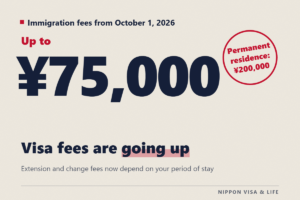
The fee for Permission for permanent residence is 200,000 yen when permission is granted (from October 1, 2026). It is paid with a revenue stamp (収入印紙).
- For applications accepted by September 30, 2026, the fee is the pre-revision 10,000 yen even if permission is granted on or after October 1
- People who are in financial hardship to a degree comparable to persons requiring protection under the Public Assistance Act, and who are recognized as needing humanitarian consideration, may have the fee reduced to 20,000 yen. However, for Permission for permanent residence, the fee reduction applies only to spouses or children, etc. of Japanese nationals, permanent residents, or special permanent residents. To receive the reduction, apply at the counter (online application does not support the reduction)
- People who receive a specified residence card at the time of permission may have to pay an additional fee for its issuance
Fees for other residence procedures are explained in Fees for residence procedures.
(Sources: Immigration Services Agency, “Application for Permission for Permanent Residence”, Immigration Services Agency, “Fee reduction or exemption measures for residence permission fees on or after October 1, Reiwa 8”)
What you can prepare now (you and your employer)
To prepare for the approach after the revision, here is what you can do from now.
What you can do yourself
- Make a timeline of your stay: Write down the date you entered Japan, the dates you changed your status of residence, and the periods you were out of Japan. Keep periods under Technical Intern Training, Specified Skilled Worker (i), Intra-company Transferee, etc. separate, as they do not count toward “5 years with a work status”
- Check your payment of taxes and insurance premiums: Check whether you pay resident tax, National Health Insurance, National Pension, etc. by the due date. Past delinquency dispositions are also looked at
- Organize your household income: Check whose income can be added to your household income (part-time job income of family members with “Dependent” status is not added)
- Keep studying Japanese: B1 equivalent or above is the guide
- Read the Guidebook on Living and Working: It will be central when your understanding of systems and rules is checked
- Check your children’s school attendance: Check whether children of compulsory education age attend elementary or junior high school
Making your timeline in a format like the following makes it easier to check the “10 years” and the “5 years with a work status” (the numbers are an example of how to fill it in).
| Period | Status of residence | Counts toward 5 years with a work status? | Notes |
|---|---|---|---|
| Years 1 to 4 | Student | No | Graduated from a Japanese university |
| Years 5 to 6 | Specified Skilled Worker (i) | No | Excluded from work statuses |
| Years 7 to 11 | Engineer/Specialist in Humanities/International Services | Yes | One trip home of 3 months |
If a single absence from Japan was long, or your total time outside Japan is long, writing down the reasons as well makes things easier to organize. Which periods count toward the “10 years” depends on individual circumstances, so if you are unsure, please check with a specialist.
What your employer can do
- Explain how to pay taxes and insurance premiums that are not deducted from salary (resident tax under ordinary collection, National Pension, etc.)
- Explain notification obligations under the Immigration Control Act, such as notification of your place of residence
- Create opportunities to study Japanese
(Sources: Immigration Services Agency, “Guidelines for Permission for Permanent Residence (revised October 1, Reiwa 8)”, Immigration Services Agency, “Guidebook on Living and Working”)
Frequently asked questions
Q1. Do people who are already permanent residents also have to meet the new standards?
What was revised this time is the approach to examining applications for Permission for permanent residence. The status of residence of people who have already received Permission for permanent residence will not be reviewed because of this revision. However, permanent residents are also subject to the system for revocation of status of residence. Revocation for intentionally not paying taxes, etc. is explained as a separate system in the Immigration Services Agency’s Q&A.
Q2. How much annual income do I need to get permanent residence?
No specific amount has been published. The guidelines only state “a level above the average income of Japanese households of the same household size.” Also, the decision is not based on income alone; it is made comprehensively together with other circumstances.
Q3. Can I not get permanent residence without N2 on the Japanese-Language Proficiency Test?
What the guidelines state is B1 equivalent or above in the “Reference Framework for Japanese Language Education,” and no specific test is named. As of October 7, 2026, which tests or methods will be used for confirmation has not been published.
Q4. My application is currently pending. Will it be affected?
If you applied on or after April 1, 2026 and your application was under examination as of October 1, 2026, income and public burden will be looked at under the approach after the revision. Other items follow the approach before the revision. If you have concerns, please consult a specialist.
Q5. Do periods under Specified Skilled Worker (i) or Intra-company Transferee count?
In the revised guidelines, Specified Skilled Worker (i) and Intra-company Transferee are excluded from “work statuses.” Therefore, they do not count toward “5 years with a work status.” On the other hand, they are not given as examples of periods excluded from the “10 years.” The path for people in Specified Skilled Worker “Nursing Care” is explained in From Specified Skilled Worker “Nursing Care” to Permission for permanent residence.
An overview of the Employment for Skill Development system will be explained in Overview of the Employment for Skill Development system.
(Sources: Immigration Services Agency, “Guidelines for Permission for Permanent Residence (revised October 1, Reiwa 8)”, Immigration Services Agency, “Q&A on making the permanent residence system more appropriate”)
Summary
- The guidelines for Permission for permanent residence were revised on October 1, 2026. Most items apply to applications filed on or after April 1, 2027.
- Only income and public burden also apply to applications filed on or after April 1, 2026 that were under examination on October 1.
- An approach based on the income level and the expected pension amount was shown, but no specific amounts have been published.
- Japanese language ability (B1 equivalent), understanding of systems and rules, and children’s school attendance are now newly considered.
- The special provision for spouses is now 5 years of marriage and 3 years of residence, and for biological children, etc. 3 years (for applications filed on or after April 1, 2027).
- The fee for Permission for permanent residence is 200,000 yen (from October 1, 2026).
- Permission for permanent residence is decided by looking at individual circumstances as a whole. If you are unsure which approach applies to you or how to prepare, please consult a specialist.
Primary Sources Referenced in Article Creation
- Immigration Services Agency, “Guidelines for Permission for Permanent Residence (revised October 1, Reiwa 8)”
- Immigration Services Agency, “Guidelines for Permission for Permanent Residence (revised February 24, Reiwa 8)”
- Immigration Services Agency, “Application for Permission for Permanent Residence”
- Immigration Services Agency, “Fee reduction or exemption measures for residence permission fees on or after October 1, Reiwa 8”
- Immigration Services Agency, “Q&A on making the permanent residence system more appropriate”
- Immigration Services Agency, “Guidebook on Living and Working”
This article is a translation of the original Japanese version.