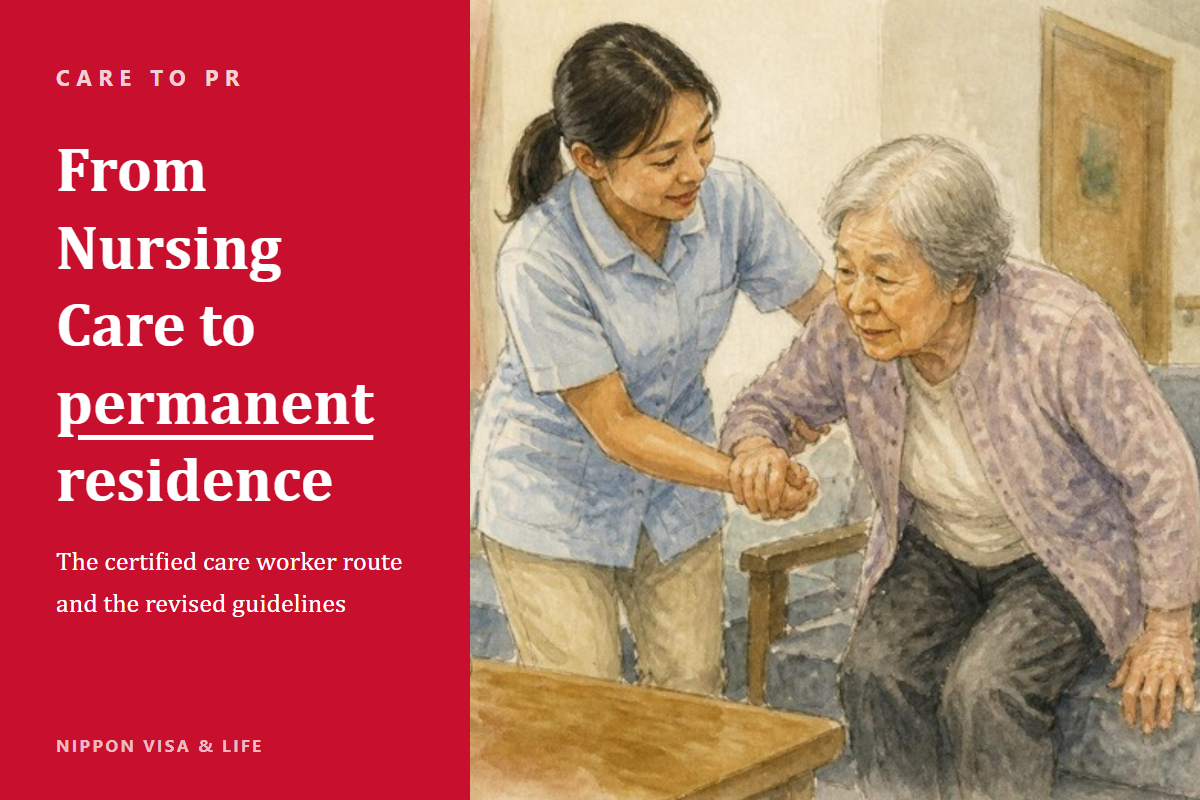

Time spent as a Specified Skilled Worker (i) (特定技能1号) does not count toward the “5 years with a work status” required for Permission for permanent residence (永住許可). For this reason, if you are working as a Specified Skilled Worker in “Nursing Care” and want permanent residence, the basic path is to pass the certified care worker (介護福祉士) exam, change to the “Nursing Care” (介護) status of residence, and then stay for 5 years or more with that status.
In addition, the guidelines for Permission for permanent residence were revised on October 1, 2026 (October 1, Reiwa 8), adding considerations such as the household income level and Japanese language ability (B1 level). They mainly apply to applications filed on or after April 1, 2027. The fee for Permission for permanent residence also became 200,000 yen from October 1, 2026.
This article is for staff at care facilities and registered support organizations that employ foreign nationals in Specified Skilled Worker “Nursing Care,” and for the workers themselves who are thinking about permanent residence. It summarizes the path and the preparations you can start now. Permission for permanent residence is decided by looking at each person’s circumstances as a whole, so meeting the number of years and other conditions does not guarantee permission.
Existing explanation (Japanese): What is Specified Skilled Worker “Nursing Care”? An overview of the system, the scope of work, and the permission criteria
The 3 requirements for Permission for permanent residence, and where people in Specified Skilled Worker “Nursing Care” get stuck
Permission for permanent residence has 3 requirements set by law. The point where people in Specified Skilled Worker “Nursing Care” most often get stuck is how years of residence are counted, which is part of the third requirement, the “national interest requirement.”
- Good conduct requirement: You obey the law and live in a way that is not socially criticized.
- Independent livelihood requirement: You do not become a burden on the public, and you have income or assets that allow a stable life in the future.
- National interest requirement: Your permanent residence is recognized as being in Japan’s interest.
Under the national interest requirement, the examiners also check whether you have properly paid taxes and social insurance premiums, and whether you have followed the notification obligations under the Immigration Control Act. Regarding years of residence, the following 3 points are considered.
- In principle, you have stayed in Japan continuously for 10 years or more.
- Within those 10 years, you have stayed continuously for 5 years or more with a work status or a residence-based status.
- With your current status of residence, you have been granted the longest period of stay (5 years for the “Nursing Care” status of residence).
The second point needs attention. The guidelines state that the following statuses of residence are not included in “work status.”
- Technical Intern Training
- Employment for Skill Development (育成就労)
- Specified Skilled Worker (i)
- Intra-company Transferee
- Some types of Designated Activities
On the other hand, time spent as an EPA certified care worker is included in work status. However, time spent as an EPA certified care worker “candidate” is not included.
In other words, even if you work for 5 years in Specified Skilled Worker “Nursing Care,” those 5 years do not count as “5 years with a work status.” To aim for permanent residence, a guideline is to move to a work status such as the “Nursing Care” status of residence and then stay for 5 years or more.
(Sources: Immigration Services Agency (ISA), “Guidelines for Permission for Permanent Residence (revised October 1, Reiwa 8)”, Immigration Services Agency, “Status of residence: Nursing Care”)
What changes with the revision on October 1, Reiwa 8 (the parts related to Specified Skilled Worker “Nursing Care”)
The guidelines for Permission for permanent residence were revised on October 1, 2026. In principle, the revised approach applies to applications filed on or after April 1, 2027. However, the approach to income (the household income continuously reaching a level above the average income of Japanese households of the same size) and to public burden (not becoming a burden on the public) also applies to cases filed on or after the date 6 months before the revision date and still under examination on the revision date.
The points relevant to people aiming for permanent residence from Specified Skilled Worker “Nursing Care,” compared with before the revision, are as follows.
| Item | Guidelines before the revision | Guidelines after the revision |
|---|---|---|
| Income | As part of the independent livelihood requirement, a stable life can be expected | Whether the household income continuously reaches a level above the average income of Japanese households of the same size |
| Japanese language ability | Not listed as a factor to consider | Whether you have B1 level or higher of the “Japanese Language Education Reference Framework” |
| Understanding of systems and rules | Not listed as a factor to consider | Whether you understand them, centered on the “Guidebook on Living and Working” |
| School-age children | Not listed as a factor to consider | Whether your children attend elementary school and junior high school |
| Special rule for spouses | Married 3 years or more, staying 1 year or more | Married 5 years or more, staying 3 years or more |
The revised guidelines are used for applications filed on or after April 1, 2027. However, the approach to income and public burden is also used for the pending cases explained above.
(Sources: Immigration Services Agency, “Guidelines for Permission for Permanent Residence (revised October 1, Reiwa 8)”, Immigration Services Agency, “Guidelines for Permission for Permanent Residence (revised February 24, Reiwa 8)”)
Income: the household income level is considered
After the revision, the examiners consider whether the income of the applicant’s household continuously reaches “a level above the average income of Japanese households” of the same number of members. The guidelines do not give a specific amount.
For people working in care, the following 2 points are important.
- The income of family members with “Dependent” status is not added: Even if your spouse has “Dependent” (家族滞在) status and works part-time with permission to engage in activity other than that permitted under the status of residence, that income is not included in the household income.
- Dependents living abroad are counted in the number of household members: If you support your parents or others in your home country, you add them to the number of household members even if you do not live together. The income level is looked at according to this number of household members.
This approach to income also applies to cases filed on or after the date 6 months before the revision date and still under examination on the revision date.
Japanese language ability: B1 level or higher
After the revision, the examiners consider whether, at the time of application, you have Japanese ability at B1 level or higher of the “Japanese Language Education Reference Framework.” The guidelines do not say which test is used to check this.
However, people who have received a total of 6 years or more of education at elementary school, junior high school, and so on in Japan, among others, are not subject to this factor.
Understanding of systems and rules, and children’s schooling
Whether you understand Japan’s systems and rules is also checked. This is confirmed by a method designated by the Commissioner of the Immigration Services Agency, centered on the contents of the “Guidebook on Living and Working.” As of October 5, 2026, no specific method of confirmation can be found in materials published by the Immigration Services Agency.
Also, for people raising children of elementary or junior high school age, whether the children attend school is considered.
Longest period of stay: how a 3-year period of stay is treated changes from April 1, 2027
The period of stay for the “Nursing Care” status of residence is one of 5 years, 3 years, 1 year, or 3 months. For Permission for permanent residence, it is considered whether you have been granted the longest period of stay (5 years for “Nursing Care”).
There is a transitional measure for how a “3-year” period of stay is treated. This was not newly created by this revision; the same content was also written in the guidelines before the revision.
- Applications filed by March 31, 2027: Even a “3-year” period of stay is treated as having the longest period of stay.
- Applications filed on or after April 1, 2027: “3 years” is treated as the longest only when all of the following conditions are met.
- You hold a “3-year” period of stay as of March 31, 2027.
- It is your first application for Permission for permanent residence filed on or after April 1, 2027.
- The result of the application (the decision) is issued by the expiration date of that “3-year” period of stay.
If you do not meet these conditions, consider applying after you receive a “5-year” period of stay. The longest period of stay is one of the factors considered in the examination.
(Sources: Immigration Services Agency, “Guidelines for Permission for Permanent Residence (revised October 1, Reiwa 8)”, Immigration Services Agency, “Guidelines for Permission for Permanent Residence (revised February 24, Reiwa 8)”, Immigration Services Agency, “Status of residence: Nursing Care”)
The overall picture of the revision is explained in detail in the following article.
Checking how years of residence (10 years and 5 years) are counted with a timeline
“10 years” and “5 years with a work status” are checked separately.
The example the guidelines give of a period not counted toward “10 years” is some types of Designated Activities (such as while job hunting). Technical Intern Training and Specified Skilled Worker (i) are clearly stated to be excluded from “5 years with a work status,” but they are not listed as examples excluded from “10 years.”
The examples below are rough estimates counted with this approach. In practice, the conclusion can change depending on whether your status of residence has been interrupted, periods spent outside Japan, and so on. Please check with a specialist how your own case is counted.
| Example | Path of residence | Total | Period with a work status | How to see it |
|---|---|---|---|---|
| Example 1 | Technical Intern Training 3 years → Specified Skilled Worker “Nursing Care” 5 years → “Nursing Care” status of residence 5 years | 13 years | 5 years | Meets the guidelines for both 10 years and 5 years |
| Example 2 | Specified Skilled Worker “Nursing Care” 4 years → “Nursing Care” status of residence 5 years | 9 years | 5 years | Has 5 years with a work status, but does not reach 10 years |
| Example 3 | Student 2 years → Specified Skilled Worker “Nursing Care” 4 years → “Nursing Care” status of residence 4 years | 10 years | 4 years | Has 10 years, but work status does not reach 5 years |
As in Examples 2 and 3, meeting only one of the two is not enough. In Example 3, the basic approach is to wait until your stay with the “Nursing Care” status of residence reaches 5 years or more.
Also pay attention to periods outside Japan
You are basically required to be living in Japan. If, within the past 10 years from the time of application, you had departures like the following without a reasonable reason, this is in principle evaluated negatively.
- You were away from Japan for half a year or more on a single departure.
- Your departures add up to 2 years and 6 months or more in total.
If a temporary return home is likely to be long, keep documents that can explain the reason.
Path 1: Pass the certified care worker exam and change to the “Nursing Care” status of residence
When aiming for permanent residence from Specified Skilled Worker “Nursing Care,” the most basic path is to pass the certified care worker exam and change to the “Nursing Care” status of residence.
Specified Skilled Worker (i) is limited to 5 years in total
The period you can stay in Japan as a Specified Skilled Worker (i) is, in principle, up to 5 years in total. The care field is not covered by Specified Skilled Worker (ii) (特定技能2号). Therefore, to continue working in care beyond 5 years, you will need to consider changing to the “Nursing Care” status of residence or a similar option.
The total period is counted from the date you received permission for Specified Skilled Worker (i). It also includes time spent on a temporary return home with a re-entry permit.
(Sources: Immigration Services Agency, “Q&A on the Specified Skilled Worker System”)
Eligibility for the certified care worker exam (practical experience route)
People working as Specified Skilled Worker (i) or Technical Intern Trainees take the exam through the “practical experience route.” The following 2 things are required.
- Practical experience: By March 31 of the fiscal year in which the exam is held, an employment period of 3 years or more (1,095 days or more) and 540 or more days actually engaged in the work
- Completion of practitioner training (実務者研修): The training period is in principle 6 months or more (it may be shorter for people who have completed initial training (初任者研修) or similar)
The employment period is the period you were employed, and the days engaged are the number of days you actually did care work. Both must be met. If you expect to meet them by March 31, you can apply for the exam as “expected practical experience.”
There is no limit on the number of times you can take the exam. Foreign nationals who request it when applying receive question sheets with furigana on all kanji, and the exam time is 1.5 times the usual length.
Also, even if you fail, the parts you passed are exempted in later exams (partial pass). This is valid until the following year and the year after that.
(Sources: Social Welfare Promotion and National Examination Center, “Eligibility: practical experience + practitioner training”, Social Welfare Promotion and National Examination Center, “Frequently asked questions”)
After passing, change to the “Nursing Care” status of residence
The “Nursing Care” status of residence is a status of residence for people holding the certified care worker qualification to provide care or give instruction in care, based on a contract with an organization in Japan. Since April 1, 2020, it has been granted regardless of the route by which the certified care worker qualification was obtained.
The “Nursing Care” status of residence is one of the statuses of residence that allow you to bring your spouse and children with “Dependent” status. With Specified Skilled Worker (i), you cannot bring your family in principle, so there is also a big difference in daily life.
Time with the “Nursing Care” status of residence counts toward the “5 years with a work status” required for permanent residence.
(Sources: Immigration Services Agency, “Status of residence: Nursing Care”, Immigration Services Agency, “Status of residence: Dependent”, Immigration Services Agency, “Guidelines for Permission for Permanent Residence (revised October 1, Reiwa 8)”)
Path 2: Change to another work status (such as Engineer/Specialist in Humanities/International Services)
There is also a path of changing to a work status such as “Engineer/Specialist in Humanities/International Services” (技術・人文知識・国際業務), making use of what you studied at university or elsewhere and your work history. However, the work must be related to your education and work history, and the bar for permission is not low.
This status of residence is for work that uses specialized knowledge. On-site work such as physical care is considered different from the activities of this status of residence.
Even if you apply after being reassigned to work such as facility administration or interpreting, the decision is based on what work you will actually do. Changing your assignment only on paper for the sake of permanent residence is not recommended. Each case needs an individual judgment, so please consult a specialist.
(Sources: Immigration Services Agency, “Status of residence: Engineer/Specialist in Humanities/International Services”. The standards for education and work history are in “Applicable activities and landing permission criteria” on the same page)
Path 3: If you become the spouse of a Japanese national or permanent resident
If you marry a Japanese national, permanent resident, or similar and get “Spouse or Child of Japanese National” (日本人の配偶者等) or “Spouse or Child of Permanent Resident” (永住者の配偶者等) status, there is a special rule to the 10-year principle. However, the number of years changed with the revision.
- Applications filed by March 31, 2027: A genuine married life has continued for 3 years or more, and you have stayed in Japan continuously for 1 year or more.
- Applications filed on or after April 1, 2027: A genuine married life has continued for 5 years or more, and you have stayed in Japan continuously for 3 years or more.
Spouses and children of Japanese nationals, permanent residents, and so on are not required to meet the good conduct requirement or the independent livelihood requirement. However, if the household is actually a burden on the public, for example, it may be evaluated negatively unless there are special circumstances.
Marriage is not a means of obtaining permanent residence. A genuine married life is a precondition.
(Sources: Immigration Services Agency, “Guidelines for Permission for Permanent Residence (revised October 1, Reiwa 8)”, Immigration Services Agency, “Guidelines for Permission for Permanent Residence (revised February 24, Reiwa 8)”)
Cost of applying for Permission for permanent residence
The fee for Permission for permanent residence is 200,000 yen, paid when permission is granted (from October 1, 2026). It is paid with a revenue stamp (収入印紙).
- For applications received by September 30, 2026, the fee is the pre-revision 10,000 yen, even if permission is granted on or after October 1.
- People who meet certain requirements, such as having difficulty making a living, may have the fee reduced to 20,000 yen. However, for Permission for permanent residence, fee reduction applies only to spouses and children of Japanese nationals, permanent residents, and special permanent residents, and similar persons.
- People who receive a specified residence card when permission is granted may have to pay that fee in addition.
The fees for other residence procedures are summarized in the following article.
→ Visa extension and change fees rise to up to 75,000 yen
(Sources: Immigration Services Agency, “Application for Permission for Permanent Residence”, Immigration Services Agency, “About fee reduction”)
Preparations host facilities and registered support organizations can start now
In the examination for Permission for permanent residence, your residence history going back many years is looked at. So that the worker does not have to rush when starting to think about permanent residence, here is a summary of support that facilities and registered support organizations can provide early on.
- Make a residence timeline: List the date of entry, dates of changes of status of residence, periods of stay, and periods of temporary return home.
- Pay taxes, social insurance premiums, and pension by the deadline: Late payments in the past are also, in principle, evaluated negatively. Take special care if there is resident tax, National Health Insurance, or other payments that are not deducted from salary.
- Follow the notifications under the Immigration Control Act: Check that required notifications, such as notification of your place of residence, are made by the deadline.
- Keep studying Japanese: After the revision, Japanese ability at B1 level is considered. Support learning together with preparation for the certified care worker exam.
- Introduce the “Guidebook on Living and Working”: The check of understanding of systems and rules is centered on the contents of this guidebook.
- Make a plan for the certified care worker exam: Start early on when to take practitioner training and on managing the employment period and days engaged.
- Think about income when bringing family: The income of a spouse with “Dependent” status is not included in the household income. Family members you support are counted in the number of household members even if they live abroad.
(Sources: Immigration Services Agency, “Guidelines for Permission for Permanent Residence (revised October 1, Reiwa 8)”, Immigration Services Agency, “Guidebook on Living and Working”)
Frequently asked questions
Q1. Can I apply for Permission for permanent residence while still in Specified Skilled Worker “Nursing Care”?
You can apply, but permission is considered difficult. This is because time as a Specified Skilled Worker (i) does not count toward “5 years with a work status,” and Specified Skilled Worker (i) is in principle limited to 5 years in total. The Immigration Services Agency’s Q&A also explains that changing from Specified Skilled Worker (i) to permanent resident is difficult.
Q2. Is there Specified Skilled Worker (ii) for care?
No. The care field is excluded from the fields covered by Specified Skilled Worker (ii). To continue working in care beyond 5 years, the basic approach is to pass the certified care worker exam and change to the “Nursing Care” status of residence.
Q3. Does time in Technical Intern Training count toward the 10 years?
The guidelines clearly state that Technical Intern Training is not included in “5 years with a work status.” On the other hand, it is not listed as an example excluded from the “10 years” period. The timeline examples are counted with this approach. Please check with a specialist how your individual case is counted.
Q4. What happens when Employment for Skill Development starts?
In the revised guidelines, Employment for Skill Development is also listed as a status of residence not included in “work status.” The overall picture of the Employment for Skill Development system is planned to be explained in a separate article.
Q5. Can I not get permanent residence without JLPT N2?
What the guidelines state is B1 level or higher of the “Japanese Language Education Reference Framework”; no specific test is named. As of October 5, 2026, materials published by the Immigration Services Agency do not show which test or method will be used to check this.
(Sources: Immigration Services Agency, “Q&A on the Specified Skilled Worker System”, Immigration Services Agency, “Guidelines for Permission for Permanent Residence (revised October 1, Reiwa 8)”)
Summary
- Time as a Specified Skilled Worker (i) does not count toward “5 years with a work status.” The basic guideline is to pass the certified care worker exam, change to the “Nursing Care” status of residence, and stay 5 years or more from then.
- With the revision on October 1, 2026, the household income level, Japanese at B1 level, understanding of systems and rules, and children’s schooling are now considered. They mainly apply to applications filed on or after April 1, 2027.
- Treating a “3-year” period of stay as the longest becomes conditional from April 1, 2027 (a transitional measure decided before the revision).
- The fee for Permission for permanent residence is 200,000 yen (from October 1, 2026).
- Permission for permanent residence is decided by looking at each person’s circumstances as a whole. If you are unsure when you can apply in your own case, please consult a specialist.
Primary Sources Referenced in Article Creation
- Immigration Services Agency, “Guidelines for Permission for Permanent Residence (revised October 1, Reiwa 8)”
- Immigration Services Agency, “Guidelines for Permission for Permanent Residence (revised February 24, Reiwa 8)”
- Immigration Services Agency, “Application for Permission for Permanent Residence”
- Immigration Services Agency, “About fee reduction”
- Immigration Services Agency, “Status of residence: Nursing Care”
- Immigration Services Agency, “Status of residence: Dependent”
- Immigration Services Agency, “Status of residence: Engineer/Specialist in Humanities/International Services”
- Immigration Services Agency, “Q&A on the Specified Skilled Worker System”
- Immigration Services Agency, “Guidebook on Living and Working”
- Social Welfare Promotion and National Examination Center, “Eligibility: practical experience + practitioner training”
- Social Welfare Promotion and National Examination Center, “Frequently asked questions”
This article is a translation of the original Japanese version.