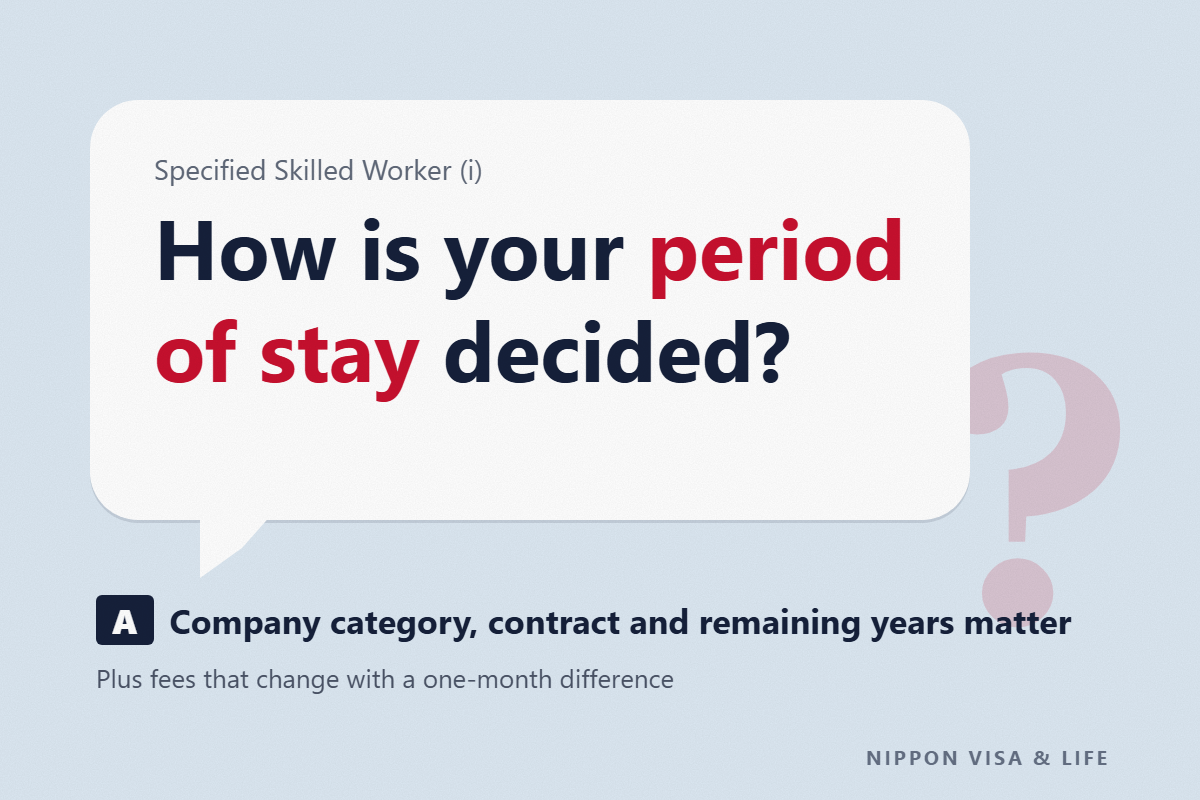


The period of stay granted for Specified Skilled Worker (i) (特定技能1号) is decided by three things: the category of the company you work for, the length of your employment contract, and how much of the 5-year total remains. It is not only 1 year or 3 years; it can also be decided in one-month units, such as “11 months” or “2 years 8 months.” Since October 2026 the fee has been set by period of stay, so how the period is decided also affects the cost.
Conclusion: the period depends on “company category,” “employment contract,” and “remaining total period”
By law, the period of stay for Specified Skilled Worker (i) is “a period designated by the Minister of Justice for each individual foreign national, not exceeding 3 years.” You do not choose from fixed options; a period is designated for each person.
The Immigration and Residence Examination Guidelines (入国・在留審査要領, “the Guidelines” below), the immigration authority’s internal examination standards, describe how this period is decided. This article explains the parts that help workers and companies prepare. The Guidelines are not law and may be revised. A different decision may also be made depending on individual circumstances.
(Sources: Ordinance for Enforcement of the Immigration Control and Refugee Recognition Act, Appended Table II (e-Gov); Immigration and Residence Examination Guidelines, Part 12 (Reiwa 8 edition, disclosed through an information disclosure request))
What is the company (affiliated organization) category?
The Guidelines divide companies that employ Specified Skilled Workers (specified skilled worker affiliated organizations) into categories 1 to 4. Roughly:
- Category 1: Among companies that have not received written guidance and recommendation or an improvement order in the past 3 years and have pledged to use electronic applications and notifications: listed companies, organizations or individuals whose withholding tax for the previous year was 10,000,000 yen or more, corporations that have continuously accepted Specified Skilled Workers for 3 years with no excess of liabilities, and so on.
- Category 2: Companies that do not fall under category 1, have not received written guidance and recommendation or an improvement order in the past 3 years, and have no excess of liabilities, and so on.
- Category 3: Corporations that fall under none of categories 1, 2, or 4.
- Category 4: Sole proprietors that do not fall under categories 1 or 2, corporations that received written guidance and recommendation or an improvement order in the past 3 years, and so on.
Ask your company or your registered support organization which category your company falls under.
(Source: Immigration and Residence Examination Guidelines, Part 12 (Reiwa 8 edition, disclosed through an information disclosure request))
List of the longest periods that can be granted
The upper limit of the permitted period of stay differs by category and type of procedure.
| Category | Certificate / change (corporation) | Certificate / change (sole proprietor) | Extension (corporation) | Extension (sole proprietor) |
|---|---|---|---|---|
| Category 1 | 2 years | 1 year | 3 years | 2 years |
| Category 2 | 2 years | 1 year | 3 years | 1 year |
| Category 3 | 2 years | Not applicable | 3 years | Not applicable |
| Category 4 | 1 year | 1 year | 1 year | 1 year |
“Certificate / change” means bringing someone from abroad (Certificate of Eligibility) or changing from another status of residence to Specified Skilled Worker (i). “Extension” means extending the period of stay as a Specified Skilled Worker (i). In other words, a 3-year period of stay is possible only on extension for people working at a category 1 to 3 corporation.
The Guidelines also set out the idea that, for people employed by a sole proprietor, the upper limit of the period of stay is 2 years, because the worker’s obligation to pay National Health Insurance and National Pension premiums expires after 2 years under the statute of limitations.
(Source: Immigration and Residence Examination Guidelines, Part 12 (Reiwa 8 edition, disclosed through an information disclosure request))
Conditions for receiving the standard period
The upper limit in the table above (for example, 3 years for an extension) is granted as a rule when both of the following apply:
- The employment contract is expected to continue for at least that many years
- At least that many years remain of the 5-year total
The Guidelines say that whether “the employment contract is expected to continue for at least that many years” is judged by the following two points:
- The intended period of stay or the desired period of stay written on the application form is at least that many years
- The employment contract period is at least that many years (including when the contract says “automatic renewal” or “may be renewed”)
In other words, how you fill in the “desired period of stay” on the application form is also one of the factors. Decide what to write for the desired period of stay together with your company or a specialist, in line with your employment contract.
(Source: Immigration and Residence Examination Guidelines, Part 12 (Reiwa 8 edition, disclosed through an information disclosure request))
When the period becomes something like 11 months or 2 years 8 months
If the standard period does not apply, a period shorter than the upper limit is decided in one-month units, based on the employment contract period and the remaining total period. The ranges are:
- If the upper limit is 3 years: 4 months to 2 years 11 months
- If the upper limit is 2 years: 4 months to 1 year 11 months
- If the upper limit is 1 year: 4 months to 11 months
There is also an idea of adjusting the period so that, after permission, the remainder of the 5-year total does not become shorter than 6 months. The Guidelines give examples such as the following:
| Total period of stay at the time of permission | Remaining total period | Period of stay decided |
|---|---|---|
| 2 years | 3 years | 3 years |
| 1 year 10 months | 3 years 2 months | 2 years 8 months |
| 4 years 7 months | 5 months | 5 months |
| 4 years 10 months | 2 months | 4 months |
The first row is an example of someone working at a category 1 to 3 corporation whose employment is expected to continue for 3 years or more. The second row is an example where 3 years would leave only 2 months, so the period becomes “2 years 8 months,” leaving 6 months.
(Source: Immigration and Residence Examination Guidelines, Part 12 (Reiwa 8 edition, disclosed through an information disclosure request))
Cases that result in “4 months”
In cases like the following, “4 months” may be granted regardless of the rules above:
- When 4 months is considered appropriate based on the company’s suitability or the person’s residence situation
- When the residence situation needs to be checked once every 4 months, based on the person’s position at work, activity record, the company’s acceptance situation, and so on
- When required notifications under the Immigration Control Act have not been made, such as notification of place of residence or of a change of affiliated organization
You can prevent the notification problem yourself. When you move or change jobs, make the notification within the required deadline.
(Source: Immigration and Residence Examination Guidelines, Part 12 (Reiwa 8 edition, disclosed through an information disclosure request))
How much does the fee change?
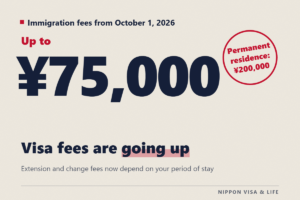
For changes and extensions received on or after October 1, 2026, the fee is set by the permitted period of stay. Applied to the periods in this article:
| Permitted period of stay | Application at the counter | Online application |
|---|---|---|
| 4 months | 18,000 yen | 15,000 yen |
| 11 months | 25,000 yen | 21,000 yen |
| 1 year | 33,000 yen | 27,000 yen |
| 2 years 8 months | 48,000 yen | 42,000 yen |
| 3 years | 64,000 yen | 56,000 yen |
For example, with an online application, “2 years 8 months” costs 42,000 yen and “3 years” costs 56,000 yen. A longer period means a higher fee each time, but a smaller cost per year. The full fee table is explained in the article on the fee revision.
→ Visa extension and change fees rise to up to 75,000 yen
(Source: Immigration Services Agency leaflet (Japanese))
What workers and companies can prepare
- Check your company’s category: You will know the upper limit of the period, and it becomes easier to budget for the fee.
- Check the period and renewal clause in the employment contract: If the contract period is short and there is no mention of renewal, you may not receive the standard period.
- Decide the “desired period of stay” on the application form after consulting: Check with your company or a specialist so that what you write does not conflict with your employment contract.
- Do not forget notifications: If you have not notified a change of place of residence or affiliated organization, you may receive “4 months.”
- Know your remaining total period: The period granted changes depending on how much of the 5-year total remains.
Frequently asked questions
Who can receive 3 years on an extension?
The Guidelines set out the idea that, as a rule, 3 years is granted on extension for people working at a category 1 to 3 corporation, when the employment contract is expected to continue for 3 years or more and at least 3 years remain of the 5-year total. However, a different decision may be made depending on individual circumstances.
How can I find out my company’s category?
Ask your company or your registered support organization. Categories are divided by whether the company is listed, the amount of withholding tax, whether it has received written guidance and recommendation or an improvement order in the past, and so on.
Why was I granted “4 months”?
The Guidelines list reasons such as the residence situation of the company or the person, whether the residence situation needs to be checked at short intervals, and whether notifications have been made. If you do not know the reason, consult a specialist.
Summary
- The period of stay for Specified Skilled Worker (i) is designated for each person, within a range not exceeding 3 years.
- The Guidelines set out the idea of deciding the period based on the company category, the employment contract period, and the remaining total period.
- The “desired period of stay” on the application form is also one of the factors.
- From October 2026, the fee changes with the permitted period, so preparation has become more important.
If you are unsure how long a period you can expect, or how to fill in the application form, consult a specialist.
Primary Sources Referenced in Article Creation
- Ordinance for Enforcement of the Immigration Control and Refugee Recognition Act, Appended Table II (e-Gov)
- Immigration and Residence Examination Guidelines, Part 12: Status of Residence (Reiwa 8 edition, disclosed through an information disclosure request)
- Immigration Services Agency, residence permission fee leaflet (Japanese)
This article is a translation of the original Japanese version.