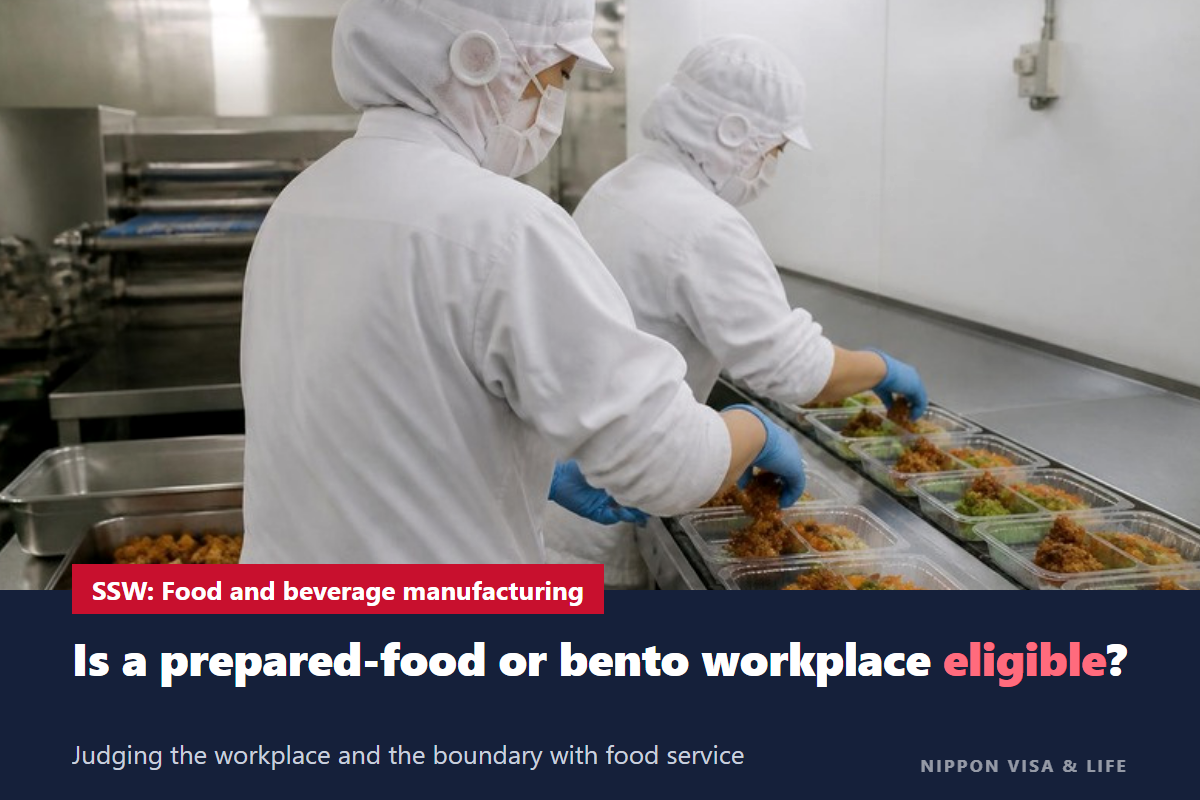


Whether you can hire a foreign national in Japan in the Specified Skilled Worker (特定技能) “food and beverage manufacturing” field (飲食料品製造業分野) is decided not by the company but by each workplace (factory or store) where the foreign national works. The condition is that the activity with the largest sales at that workplace falls under one of the 10 industries listed in the public notice. For boxed meals (bento), institutional meals, and central kitchens, the boundary with the food service field (外食業分野) depends on whether the workplace is independent of stores and facilities, and whether it serves what it makes to “customers who eat it” (including not only people who eat on the spot but also people who receive food made to their order by takeout or delivery and eat it) or supplies it wholesale to “parties who sell it.”
In the end, this is checked in the membership review of the Food Industry Specified Skilled Worker Council (食品産業特定技能協議会), and if the workplace is judged ineligible, you cannot hire. This article sets out the steps the accepting company and the registered support organization (登録支援機関) should take to check the workplace before applying. The field as a whole is explained in the following article.
The contents were checked on October 17, 2026 against the operational guidelines (food and beverage manufacturing field, partially revised August 28, 2026; food service field, partially revised May 30, Reiwa 7) and against the FAQ and council guidance of the Ministry of Agriculture, Forestry and Fisheries (MAFF, 農林水産省).
Steps for judging: 3 stages, from workplace to main activity to the industries in the public notice
The public notice requires that the workplace where the foreign national works “mainly” carries out one of the specified industries in the Japan Standard Industrial Classification (日本標準産業分類). Even within the same company, the result can differ for each factory or store. We have made a diagram of the order in which to check.
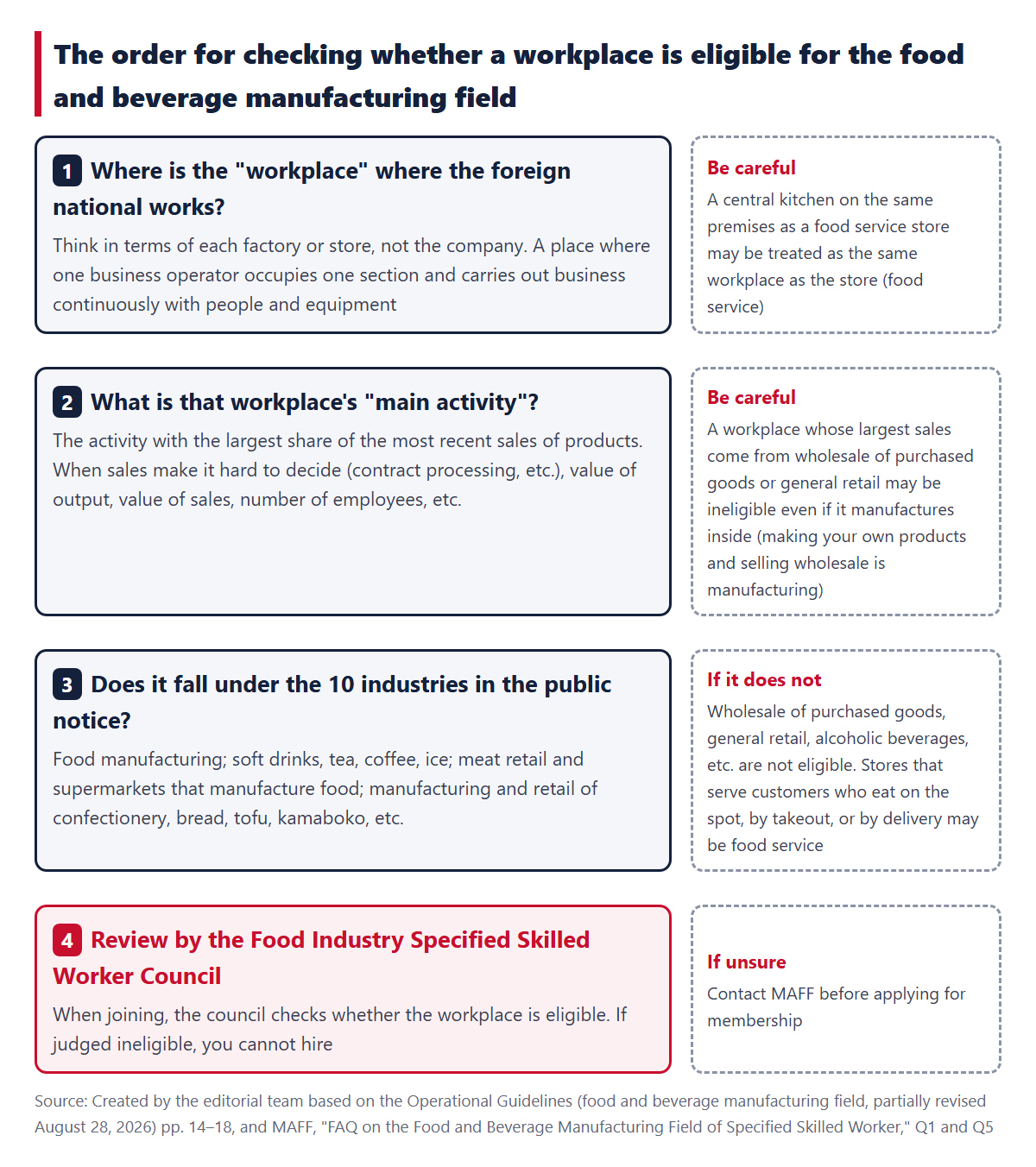
Sources: Created by the editorial team (based on the Operational Guidelines for the Food and Beverage Manufacturing Field, pp. 14–18, and MAFF FAQ Q1 and Q5)
1. How workplaces are counted
Following the definitions of the Japan Standard Industrial Classification, the operational guidelines treat a place that meets both of the following 2 conditions as one workplace.
- One business operator (a company or a sole proprietor) occupies one section and runs a business there
- That section has people and equipment, and the business is carried out continuously
Even on the same premises, different companies mean different sections. As a rule, 2 nearby locations separated by a road or similar are each treated as separate sections. When sections are hard to tell apart, the range that can be distinguished in books such as sales ledgers and wage ledgers may be regarded as one section.
2. How the main activity is decided
When a workplace carries out several activities, the industry is decided by its main activity. The main activity is the one that accounts for the largest share of the most recent sales of the products it makes.
When deciding by sales alone is not appropriate, for example when the workplace does both contract processing (processing materials entrusted by others) and manufacturing of its own products, figures such as the value of output, the value of sales, or the number of employees in that activity are used instead.
3. Does it count as “manufacturing”?
MAFF’s FAQ describes manufacturing as “a workplace that manufactures or processes products and sells them wholesale.” Wholesale here includes the following.
- Selling to wholesalers, retailers, or industrial businesses
- Selling goods that are used for business purposes
- Handing over to another workplace of the same company
A workplace that only does light processing such as packaging, washing, or sorting does not count as manufacturing. Selling to individuals by mail order without a store counts as manufacturing, but “manufacturing and retail” (製造小売), where products are sold on the spot in a store, is classified as retail. Among retail businesses, only those in the table under the next heading are eligible.
Supplying products you made yourself wholesale is manufacturing and can be eligible. “Food and beverage wholesale” (飲食料品卸売業), which is not eligible, means workplaces that sell food and beverages they have purchased. MAFF’s FAQ gives, as an example of an ineligible wholesale business, a workplace that buys vegetables and sells them after minor processing such as cutting a cabbage in half. Even a wholesale company’s factory is eligible if it is an independent, dedicated factory (a process center) that manufactures and processes. On the other hand, a workplace whose largest sales come from wholesale of purchased goods or from general retail may be ineligible even if it does manufacturing inside.
(Sources: Operational Guidelines (Food and Beverage Manufacturing Field), MAFF FAQ, MAFF system explanation material)
Eligible industries and ineligible industries
The 10 industries in the public notice are as follows. 6 of them are retail businesses, but all of them assume that “you manufacture the products yourself.”
| Classification number | Industry | Why it is eligible even as retail, and conditions |
|---|---|---|
| Major Group 09 | Food manufacturing | Workplaces that manufacture and sell wholesale |
| Minor Group 101 | Soft drink manufacturing | Same as above |
| Minor Group 103 | Tea and coffee manufacturing (excluding soft drinks) | Same as above |
| Minor Group 104 | Ice manufacturing | Same as above |
| Minor Group 583 | Meat retail | Only those that manufacture food. Added by the revision of the public notice on April 15, 2026 |
| Detailed Industry 5621 | General supermarkets | Only those that manufacture food. Only the back rooms of the manufacturing sections are eligible |
| Detailed Industry 5811 | Food supermarkets | Same as above |
| Detailed Industry 5861 | Confectionery retail (manufacturing and retail) | Manufacturing and retail as one: products made by the business are sold in its own store |
| Detailed Industry 5863 | Bread retail (manufacturing and retail) | Same as above |
| Detailed Industry 5896 | Retail of tofu, kamaboko (fish paste), and other processed foods | Only those that manufacture tofu, kamaboko, and similar products |
The operational guidelines explain that meat retail and the manufacturing and retail of confectionery, bread, and tofu, kamaboko, and similar products are eligible because they are a form in which manufacturing and retail are one: products the business made itself are sold to consumers in its own store. On the other hand, when a store in any other retail business manufactures or processes in one section of the store, it is not eligible, because its main activity is not manufacturing.
The following are not eligible: manufacturing of alcoholic beverages, salt, pharmaceuticals, or flavorings; wholesale of food and beverages; retail of various goods such as department stores (excluding general supermarkets); general food and beverage retail; and manufacturing of animal feed such as pet food.
Note that the list in MAFF’s FAQ (updated March 2026) does not yet include meat retail. This article follows the revised operational guidelines and the system explanation material (updated May 2026).
(Sources: Operational Guidelines (Food and Beverage Manufacturing Field), Public Notice (partially revised April 15, 2026), MAFF system explanation material)
Judgments by business type: supermarkets, meat and fresh fish, vegetables, eggs, contracting, and more
Based on the FAQ and the operational guidelines, we have summarized judgments for business types that are easy to confuse. Most “conditional” cases also require that the sales of that manufacturing or processing be the largest among the workplace’s sales.
| Business type | Judgment | Reasons and conditions |
|---|---|---|
| Supermarket back rooms | Conditional | Only sections where the supermarket manufactures products itself (fresh produce processing, fresh fish processing, meat processing, bakery, prepared side dishes). Cashier work, customer service, and displaying or stocking items other than those the company made itself are not allowed. Minor processing only is not eligible |
| Tenants in supermarkets, and back rooms of convenience stores, department stores, and drugstores | Not eligible | Making and selling in one section under a tenant or concession contract is prepared food retail (5895) |
| Process centers | Eligible | Meat processing, seafood processing, manufacturing prepared side dishes, and so on, supplied to retailers and wholesalers |
| Meat processing, poultry processing, and offal | Conditional | Processing to supply retailers and wholesalers. Slaughterhouses are not eligible (work at an attached slaughterhouse to make meat edible is allowed if it is incidental, as procurement of raw materials) |
| Sashimi and fish fillets | Conditional | Eligible if supplied to retailers and wholesalers. Fresh fish retail selling directly to consumers (5841) is not eligible |
| Bleeding fish, ikejime (killing fish to keep them fresh), and removing innards | Conditional | Not eligible if done only to keep freshness by a workplace that sells fresh products. Eligible if the purpose is manufacturing or processing (work consisting only of simple processing is not allowed) |
| Shucking oysters | Conditional | May be eligible if it is processing for further processing |
| Egg GP centers | Conditional | Eligible if eggs are washed (and disinfected), then graded and packed, and supplied to retailers and wholesalers. Packing centers that only grade and pack are not eligible |
| Cut vegetables | Conditional | Cutting into a form ready to use in cooking and peeling onions, for example, are eligible. Minor processing such as cutting a cabbage in half is vegetable wholesale (5213) and not eligible. Only minor processing at the same workplace where the vegetables are grown is agriculture (not eligible) |
| Health foods | Conditional | Eligible if treated as food. Pharmaceuticals, quasi-drugs, and food additives are not eligible |
| Contract manufacturing | Conditional | The workplace that ordered the work must mainly carry out manufacturing, there must be a work contract agreement, and the contractor’s manager must give the instructions and orders. Incidental work only (such as boxing and cargo handling), dispatch, and disguised contracting are not eligible |
| Direct sales shops attached to food factories | Sales not allowed | Foreign nationals working at the factory cannot be assigned to sales at the direct sales shop |
Sales work at supermarkets and direct sales shops
The operational guidelines state that at supermarkets, sales work is not allowed even as related work. Sales at a direct sales shop attached to a food factory are not allowed either. The council’s frequently asked questions explain that only in the manufacturing and retail of confectionery, bread, and tofu, kamaboko, and similar products, where manufacturing and sales are combined in one workplace, may sales be done incidentally as related work.
For meat retail (added in 2026), at the time of writing we could not find a specific explanation in MAFF’s FAQ of how sales work in the store is handled. If you are accepting a worker at a butcher shop, check with MAFF before applying for membership.
In contract manufacturing, “disguised contracting” (偽装請負), in which the client gives instructions directly to the foreign national, counts as dispatch and is not allowed. Even if the contract is called a work contract, it is not eligible if the reality is different.
(Sources: MAFF FAQ, Operational Guidelines (Food and Beverage Manufacturing Field), Council’s frequently asked questions, Membership Application Guidebook)
The boundary with food service: which field do central kitchens, bento, and institutional meals belong to?
The boundary depends on 2 things: who you serve what you make to, and whether the workplace is independent of stores and facilities. The operational guidelines for the food service field define a food service “customer” as a specific person who eats the food and beverages themselves (including cases such as institutional meals, where someone else orders and receives on their behalf). Supplying parties who buy in order to sell to unspecified consumers is B to B wholesale and does not count as food service.
However, institutional meals and central kitchens are eligible for the food and beverage manufacturing field, even when the food reaches the people who eat it, if they are cooking or manufacturing workplaces independent of stores and facilities (see the table below).
Another difference is how sales are treated. In the food and beverage manufacturing field, the condition is that the activity with the largest sales at the workplace falls under one of the 10 industries in the public notice. In the food service field, the sales of the food service section do not need to be the main part of the whole workplace, and people can work in the food and beverage section of a hotel or the meal service section of a hospital or welfare facility.
| Item | Food and beverage manufacturing field | Food service field |
|---|---|---|
| Who you serve | Supply wholesale to wholesale, retail, or business-use parties (including central kitchens and meal service centers independent of stores and facilities) | Serve specific customers who eat it (on the spot, takeout, delivery, and meal services attached to facilities) |
| Sales | The activity with the largest sales at the workplace falls under one of the 10 industries in the public notice | Food service sales do not need to be the main part |
| Central kitchens | Eligible if it is a workplace independent of stores | Treated as food service if it is on the same premises as a store |
| Kitchens inside stores | Not eligible (not regarded as central kitchens) | Food service |
| Bento and prepared side dishes | Workplaces that make them and supply retailers and wholesalers | Takeout bento made on the spot after receiving an order, catering (仕出し), and delivery |
| Institutional meals | Independent facilities that only cook under the central-kitchen system | Cooking rooms at schools that cook on site, and kitchens attached to hospitals or welfare facilities |
| Unit for joining the council | Each workplace (supermarkets can join at the head office) | Can join at the head office (main office) |
Central kitchens
An independent workplace that makes dishes or ingredients in place of cooking in food service stores is eligible for the food and beverage manufacturing field. However, if it is on the same premises as a store, it is regarded as the same workplace as the store, treated as food service, and is not eligible. Conversely, the FAQ explains that Specified Skilled Worker foreign nationals in the food service field cannot work in a food service business’s central kitchen.
Bento and institutional meals
Workplaces that make bento and prepared side dishes and supply them to retailers and wholesalers are eligible. Takeout bento made on the spot after receiving an order, catering and delivery, and meal service facilities that serve meals to a fixed large number of people count as food service. If you only buy bento and sell them, that is retail and belongs to neither field.
When the same company hires foreign nationals in both fields
An application to join the council is needed for each field. The foreign nationals are also in different fields: people who passed the food service exam and people who passed the food and beverage manufacturing exam. To hire someone working in food service at a factory, a procedure to change fields is required.
Suspension of acceptance of (i) workers in the food service field
In the food service field, because the number was expected to exceed the acceptance cap (50,000 people), a measure to temporarily stop issuing the Certificate of Eligibility (在留資格認定証明書) was taken on April 13, 2026. According to MAFF’s guidance, applications for a Certificate of Eligibility for food service (i) received on or after April 13 will not be issued, and changes of status of residence to (i) will in principle not be permitted. Job changes and similar applications by people already staying on food service (i) status are reviewed as usual. The food service (i) evaluation test will not be held for the time being, and when it will resume is undecided (as of October 17, 2026).
Which field a workplace belongs to is decided by the actual situation of that workplace, and the council reviews it. Kitchens in food service stores, and central kitchens on the same premises as a store, are not eligible for the food and beverage manufacturing field.
(Sources: Operational Guidelines (Food Service Field), Operational Guidelines (Food and Beverage Manufacturing Field), MAFF FAQ, Council’s frequently asked questions, On the operation of the acceptance cap in the food service field, Q&A on the same)
What the council’s review looks at: if judged ineligible, you cannot hire
The accepting company joins the Food Industry Specified Skilled Worker Council before applying to immigration. The operational guidelines state that if the council judges a workplace to be ineligible, the company cannot hire foreign nationals, and advise you to contact MAFF before applying for membership if you are unsure. It takes about 2 to 3 months from submitting the documents until the membership certificate arrives.
Documents submitted to confirm the workplace
| Document | When it is submitted |
|---|---|
| Certificate of registered matters, a copy of the articles of incorporation, financial statements showing sales, a copy of the business license from the head of the public health center, and so on | When the council requests them (operational guidelines) |
| Copy of the business license | Other than supermarkets. The license for the workplace where the foreign national works |
| Written pledge not to assign the foreign national to sales work | General supermarkets and food supermarkets |
| Work contract agreement, order specifications, and organization chart of the contracted process | Contract manufacturers |
In addition, everyone submits documents such as the written pledge (Field Reference Form No. 13-1) (see the parent article for details). Workplaces that have not yet opened or started operating cannot join, because the actual business cannot be confirmed.
Unit for joining
| Situation | Council procedure |
|---|---|
| Accepting a worker for the first time at one factory | Apply for membership with that factory’s name, representative, and address |
| Also accepting workers at another factory of the same company | Make a new membership application for that factory (per workplace) |
| Accepting workers at several supermarket stores | Can join at the head office (main office) (on the assumption that the head office handles employment management and support) |
| Already a member through a process center, and also accepting workers in a supermarket store’s back room | Email the supermarket written pledge and the membership certificate with the subject line “スーパーマーケット追加” (Supermarket addition) |
| Also accepting workers in food service | Make a new membership application for the food service field |
From the second worker onward, you do not need to join again.
(Sources: Operational Guidelines (Food and Beverage Manufacturing Field), Council’s frequently asked questions, Membership Application Guidebook, MAFF, “About the Food Industry Specified Skilled Worker Council”)
How to check when unsure: where to ask before applying, and a checklist
Before applying, check the following points.
- Is the place where the foreign national works an independent workplace (not on the same premises as a food service store)?
- What has the largest sales at that workplace? Can you explain it with financial statements or similar documents?
- Who do you serve what you make to (wholesale, retail, or business-use parties, or customers who eat it)?
- Do the name and address on the business license match the workplace you are applying for?
- Is the foreign national’s work centered on manufacturing and processing (not only sales, shelf stocking, or packaging)?
- If it is contracting, is it your own company’s manager who gives instructions to the foreign national?
Public contact points
- Whether a workplace is eligible (before applying to join the council): New Business and International Group, New Business and Food Industry Department, MAFF 03-6744-2397
- Whether the work falls within the food and beverage manufacturing field: Food Manufacturing Division, MAFF 03-6744-1869
- Fishery processing: Processing Promotion Team, Processing and Distribution Division, Fisheries Agency 03-6744-2349
- Whether it falls within the food service field: Food Service Industry and Food Culture Division, MAFF 03-6744-2053
- Free consultation on the system in general: Specified Skilled Worker Foreign Human Resources System Consultation Service (a MAFF subsidized project) 03-6630-8179 (10:00 to 17:30, excluding Saturdays, Sundays, national holidays, and the year-end and New Year holidays)
The actual judgment depends on the actual situation of the workplace. If you are unsure, please consult a specialist.
(Sources: Operational Guidelines (Food and Beverage Manufacturing Field), Operational Guidelines (Food Service Field), MAFF field page)
Frequently asked questions
Q Our main business is wholesale, but we have a factory where we manufacture. A The judgment is made for each factory. If the activity with the largest sales at that factory is manufacturing, it can be eligible (operational guidelines).
Q Can we hire at a prepared side dish shop that is a tenant in a supermarket? A No, it is not eligible. Making and selling under a tenant or concession contract is prepared food retail (FAQ Q3 and Q14).
Q A restaurant chain’s central kitchen is on the same premises as a store. A It is regarded as the same workplace as the store and treated as food service, so it is not eligible for the food and beverage manufacturing field (FAQ Q5).
Q Can we hire at a butcher shop? A Meat retail that manufactures food was added as eligible by the revision of the public notice on April 15, 2026 (operational guidelines). Check with MAFF before applying about how sales work is handled.
Q Can a worker staff the factory’s direct sales shop? A No (council’s frequently asked questions 19).
Summary
- The judgment is made not for the company but for each workplace where the foreign national works.
- Check whether the activity with the largest sales at that workplace falls under one of the 10 industries in the public notice.
- Places that serve customers who eat the food (kitchens inside stores, takeout, catering, and kitchens attached to facilities) are food service. Workplaces that supply wholesale to parties who sell, and central kitchens and meal service centers independent of stores and facilities, can be eligible for the food and beverage manufacturing field. Central kitchens on the same premises as a store are food service.
- In the end, this is checked in the council’s review. If you are unsure, contact MAFF before applying for membership.
Primary Sources Referenced in Article Creation
- Operational Guidelines on the Acceptance of Specified Skilled Workers in Specific Fields: Standards for the Food and Beverage Manufacturing Field (Ministry of Justice and MAFF, partially revised August 28, 2026)
- Operational Guidelines on the Acceptance of Specified Skilled Workers in Specific Fields: Standards for the Food Service Field (Ministry of Justice and MAFF, partially revised May 30, Reiwa 7)
- Standards set in light of circumstances specific to the food and beverage manufacturing field (MAFF Public Notice No. 526 of Heisei 31, last revised April 15, 2026)
- Immigration Services Agency, “Food and Beverage Manufacturing Field”
- MAFF, “Expanding the Acceptance of Foreign Human Resources in the Food and Beverage Manufacturing Field”
- MAFF, “FAQ on the Food and Beverage Manufacturing Field of Specified Skilled Worker” (updated March 2026)
- MAFF, “Accepting Foreign Nationals in Food and Beverage Manufacturing” (system explanation material, updated May 2026)
- MAFF, “About the Food Industry Specified Skilled Worker Council (Food and Beverage Manufacturing Field and Food Service Field)”
- MAFF, “Frequently Asked Questions about the Food Industry Specified Skilled Worker Council” (updated October 7, Reiwa 6)
- MAFF, “Membership Application Guidebook: Food and Beverage Manufacturing Field” (revised August 31, 2026)
- MAFF, “Accepting Foreign Human Resources in the Food Service Field”
- MAFF, “On the Operation of the Acceptance Cap in the Specified Skilled Worker ‘Food Service Field'” (March 27, 2026)
- MAFF, “Q&A on the Operation of the Acceptance Cap in the Specified Skilled Worker ‘Food Service Field'”
This article is a translation of the original Japanese version.