

On Specified Skilled Worker (i) (特定技能1号) status in Japan, you can move to work in a field different from your current one. However, a job change that involves a change of field requires Permission to change status of residence (在留資格の変更許可), and you cannot work at the new company until permission is granted.
In principle, you must pass the skills test of the field you are moving to and prove the level of Japanese that field requires. People who have completed Technical Intern Training (ii) (技能実習2号) in good standing may be exempt from the tests. There are also exceptions for each field: for example, in principle, changes to the food service field are not permitted, even from other fields.
The contents of this article were checked on October 17, 2026 against the materials of the Immigration Services Agency (出入国在留管理庁, ISA). The overall process of changing jobs within the same field is summarized in Changing Jobs on Specified Skilled Worker Status in Japan: What the Worker, the New Company, and the Former Company Must Do, and in What Order.
First check: does only the job category change, or does the field change?
If the field changes, you need Permission to change status of residence even if the company stays the same. If you stay at the same company and only the job category (業務区分) within the same field changes, a notification is enough.
The reason is the “designation document” (指定書). The designation document, given together with the residence card, states the company you can work for (the affiliated organization, 所属機関) and the field (the specified industrial field, 特定産業分野). The Operational Guidelines state that Permission to change status of residence must be obtained both when changing companies and when changing fields. The same applies to Specified Skilled Worker (ii) (特定技能2号).
A “job category” is a division of a field by the type of work. For example, the industrial product manufacturing field has several job categories. The government’s Basic Policy states that job changes are possible “within the same job category” or “between job categories whose skill levels have been confirmed as common through tests and other means.”
| What changes | Procedure | Tests |
|---|---|---|
| Same company and same field, only the job category | Notification concerning the specified skills employment contract (Reference Form 3-1) | Attach the certificate of passing the skills test for the new job category |
| Only the company (same field and same job category) | Permission to change status of residence | In principle, no additional test is needed |
| The field (even with the same company) | Permission to change status of residence | Skills test and Japanese of the new field (exemptions may apply) |
| Both the company and the field | Permission to change status of residence | Skills test and Japanese of the new field (exemptions may apply) |
The procedure, processing time, and working during the application when changing companies within the same field are explained in Changing jobs in Japan on Specified Skilled Worker status: the change of status process, processing time, and can you work while your application is pending?.
(Sources: Immigration Services Agency, “Operational Guidelines for Accepting Specified Skilled Foreign Workers,” pp.12, 13, and 47, Immigration Services Agency, “Q&A on the Specified Skilled Worker System,” Q13)
Tests and Japanese needed to move to a different field
In principle, you must pass the skills test of the field and job category you are moving to, and prove by a test the level of Japanese set by that field. The required level of Japanese differs by field.
Skills test The names of the tests and the job categories they cover are written in the Operational Guidelines for each field and in the list of documents to submit (Table 3). Tests held in Japan can be taken by anyone in Japan with a status of residence (people of some nationalities cannot take the tests in Japan). Passing a test does not guarantee that permission will be granted.
Japanese For most fields, you need to pass the Japanese-Language Proficiency Test (JLPT) at N4 or above, or the Japan Foundation Test for Basic Japanese (JFT-Basic). The following fields and job categories require a different level.
| Moving to | Japanese required | Exempt by completing Technical Intern Training (ii) in good standing? |
|---|---|---|
| Most fields | N4 or above, or JFT-Basic | Exempt regardless of occupation or work |
| Nursing care | In addition to the tests above, a nursing care Japanese test | The nursing care Japanese test is exempt only for those who completed the nursing care occupation and work |
| Automobile transportation (taxi and bus drivers) | In principle, N3 or above | Not exempt where N3 is required |
| Railway (transport staff) | N3 or above | Not exempt |
From the tests held in April 2026, the nursing care Japanese test is called the “Nursing Care Specified Skills Evaluation Test (Japanese)” (介護特定技能評価試験(日本語)) (before that, it was the Nursing Care Japanese Language Evaluation Test). For how to take the tests if you are moving to nursing care, see What Is the Nursing Care Specified Skills Evaluation Test (Skills and Japanese)?.
For taxi and bus drivers, N4 or similar is accepted if conditions are met, such as not driving chartered buses, making a Japanese study plan, and having a person who helps with Japanese ride along. In this case, people who have completed Technical Intern Training (ii) in good standing do not need to prove their Japanese. The Operational Guidelines also note that from April 1, 2027, a level equivalent to N3 (B1 or above) will be required, and that how this will be handled will be announced separately. For truck drivers, N4 or above or JFT-Basic is required.
People who completed Technical Intern Training (ii) in good standing ”Completed in good standing” means having completed 2 years and 10 months or more of Technical Intern Training, and either having passed a practical test such as Grade 3 of the National Trade Skills Test, or having been evaluated as good by the training organization.
- The occupation and work you completed are related to the work in the new field: both the skills test and the Japanese test are exempt
- They are not related: the skills test is required. Japanese (N4 level) is exempt (except for the exceptions in the table above)
People who completed Technical Intern Training or similar before the Technical Intern Training Act took effect will need to pass both the skills and Japanese tests from April 1, 2027.
(Sources: Immigration Services Agency, “Operational Guidelines for Accepting Specified Skilled Foreign Workers,” pp.18, 19, and 21, same, “Automobile Transportation Field,” pp.7 to 8, same, “Railway Field,” p.8, Immigration Services Agency, “Q&A on the Specified Skilled Worker System,” Q50, Ministry of Health, Labour and Welfare, “Accepting Specified Skilled Foreign Workers in the Nursing Care Field”)
Can you use certificates you have already submitted?
You may not need to submit again a Japanese test certificate that you already submitted in a Specified Skilled Worker application. However, a certificate of passing the skills test of the new field is newly required.
The Immigration Services Agency’s list of documents to submit (Table 3) states that test certificates and similar documents can be omitted if they have “already been submitted in a past residence application for the applicant,” their contents have not changed, and they are still valid. This means that if you submitted an N4 certificate in your previous field, you can omit it when moving to a field that requires N4. If you are moving to a job category that requires the nursing care Japanese test or N3, that certificate is newly required.
Documents on resident tax, health insurance, and pension (Table 1) can also be omitted if they were submitted in an application within the past year and their contents have not changed.
In the list of documents to submit, in the “submission check” column of the rows for documents that can be omitted, there is a space to the right of where you circle whether you are submitting the document, for writing the “previously submitted application information” (date of application and receipt number). When omitting a document, you need to write in this space the date of application and the receipt number of the application in which you submitted it in the past. Check the application date and receipt number with the copy of your previous application or similar.
(Sources: Immigration Services Agency, “Status of Residence ‘Specified Skilled Worker'” (list of documents to submit), Table 1 (change, revised October 9, Reiwa 8), Table 3-1 (nursing care), Table 3-4 (industrial product manufacturing))
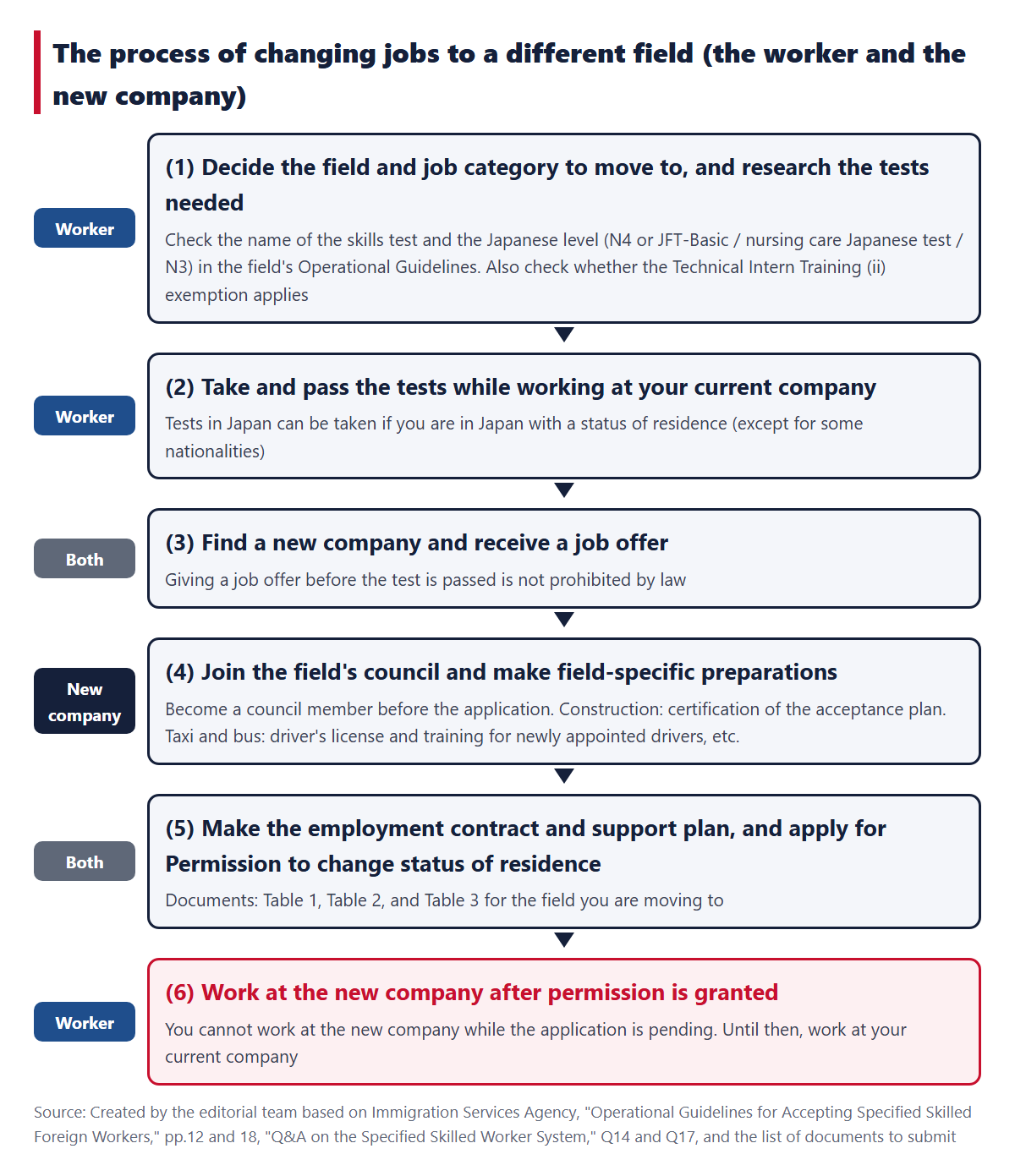
The process of changing jobs across fields (the worker and the new company)
The basic approach is to “pass the tests while working at your current company, and apply for permission to change once the new company has finished its preparations.” You cannot work at the new company until permission is granted.
Sources: Created by the editorial team (based on Immigration Services Agency, “Operational Guidelines for Accepting Specified Skilled Foreign Workers” (https://www.moj.go.jp/isa/content/001468647.pdf))
- Decide where to move and research the tests needed Check the job categories, skills test, and Japanese level in the field’s Operational Guidelines.
- Take the tests It is safest to take them while working at your current company. Discuss how to take time off with your company.
- Find a new company The Immigration Services Agency’s Q&A states that giving a job offer before the person passes the test is not prohibited by law.
- The new company’s preparations The accepting company must become a member of the field’s council (協議会) before the application. Preparations for each field are explained under the next heading.
- Contract and application Make the employment contract and the support plan, and apply for Permission to change status of residence. Use Table 1 (the worker), Table 2 (the company), and Table 3 for the field you are moving to.
- Join the company after permission Start working at the new company after permission is granted.
(Sources: Immigration Services Agency, “Operational Guidelines for Accepting Specified Skilled Foreign Workers,” p.12, Immigration Services Agency, “Q&A on the Specified Skilled Worker System,” Q14 and Q17)
Points to note by field: food service, construction, automobile transportation, nursing care, and food and beverage manufacturing
When moving across fields, pay attention to rules that apply only to the field you are moving to. The main ones are as follows.
Moving to food service The Immigration Services Agency treats applications for a change to the food service field received on or after April 13, 2026 as not permitted in principle. The exceptions that are examined as usual are limited to cases such as job changes by people working in the food service field as Specified Skilled Worker (i). People on Specified Skilled Worker (i) in other fields are not listed among these exceptions. Because the situation may change, check the Immigration Services Agency’s “examination status” page (posted September 10, 2026) before applying.
Moving to construction Even when hiring a Specified Skilled Worker already working in Japan as a job changer, certification of a “Construction Specified Skilled Worker Acceptance Plan” by the Minister of Land, Infrastructure, Transport and Tourism is required. For details, see What Is the Construction Specified Skilled Worker Acceptance Plan in Japan?.
Moving to automobile transportation Truck drivers need a Japanese Class 1 driver’s license, and taxi and bus drivers need a Class 2 driver’s license. Taxi and bus drivers must also complete the training for newly appointed drivers.
Moving to nursing care In addition to the nursing care skills test and Japanese test, the new company submits a certificate that it is a member of the nursing care field’s council. Conditions for home-visit services and other details are in Accepting Specified Skilled Workers in Japan’s “Nursing Care” Field: Requirements and Process.
Moving to food and beverage manufacturing From April 1, 2027, the seafood processing job category will be separated from the general food and beverage manufacturing job category. Companies hiring in the seafood processing job category are to explain the scope of possible job changes (in principle, within the same job category) and obtain the worker’s consent. For details, see Guide to Accepting Specified Skilled Workers in the Food and Beverage Manufacturing Field in Japan.
Moving to a field with many job categories In fields with many job categories, such as industrial product manufacturing, which category’s test you passed is important. Check in Guide to Accepting Specified Skilled Workers in the Industrial Product Manufacturing Field in Japan.
(Sources: Immigration Services Agency, “Operation of the Acceptance Cap in the Specified Skilled Worker ‘Food Service Field'”, Immigration Services Agency, “Examination Status of Residence Applications for Specified Skilled Worker (i) (Food Service Field)”, Immigration Services Agency, “Operational Guidelines for Accepting Specified Skilled Foreign Workers in Specific Fields (Construction Field),” p.23, same, “Automobile Transportation Field,” pp.6 to 8, same, “Food and Beverage Manufacturing Field,” p.18, Table 3-1 (nursing care))
The 5-year total, and working in more than one field
The 5-year total for Specified Skilled Worker (i) is counted regardless of field. Changing fields does not reset the count to 0.
The Operational Guidelines state that the “total” means the period spent in Japan on Specified Skilled Worker (i) regardless of field, including past periods. Periods without work, the special period while an application for change or extension is pending, and periods of Designated Activities for transition preparation are also included. If you have little time left, start preparing early, considering the time the tests and the application will take.
There is also a way to “add” a field rather than “change” it. This applies when both the worker and the company (the affiliated organization) meet the conditions of each of the two fields. The worker must have passed the skills test and the Japanese level of each field (including exemptions). The company must meet the standards of each field; for example, in the accommodation field, it must have a license to operate a ryokan or hotel.
In this case, there is a way to receive permission for both the field you mainly work in (the main field) and the other field (the secondary field), and do both kinds of work at one company. The application form has 3 spaces for “content of the work to be engaged in”; write the main field at the top and the other fields from the second space onward. However, even if both sets of conditions are met, whether permission is granted depends on the examination.
People on Specified Skilled Worker (ii) also need Permission to change status of residence when changing fields. Specified Skilled Worker (ii) covers 11 fields; nursing care, linen supply, automobile transportation, railway, logistics warehousing, forestry, the wood industry, and resource circulation are not covered. Because the skill level for Specified Skilled Worker (ii) is judged by passing tests and similar means, check whether you meet the Specified Skilled Worker (ii) level in the field you are moving to.
(Sources: Immigration Services Agency, “Operational Guidelines for Accepting Specified Skilled Foreign Workers,” pp.12, 13, 14, and 25, Immigration Services Agency, “Operational Guidelines for Accepting Specified Skilled Foreign Workers in Specific Fields (Accommodation Field),” p.14, Immigration Services Agency, “Total Period of Stay”)
If you lose your job before the tests, or preparations are not ready after the tests
If you can no longer work for reasons such as your company’s circumstances and you have not yet passed the test for the field you want to move to, you may be able to use Designated Activities (Employment Continuation Support) (特定活動(就労継続支援)).
This covers people who can no longer work due to unavoidable circumstances such as the company’s bankruptcy, dismissal, or harassment, and who have not found their next job after 3 months, among others. Until you take the tests, you can work at the company you plan to move to. The period of stay is 1 year, and it can be extended up to 2 times in certain cases (the second extension requires passing either the skills test or the Japanese test). The accepting company must have a record of accepting Specified Skilled Workers for a total of 1 year or more.
If you have passed the tests but the new company’s preparations are not ready in time, there is Designated Activities (Preparation for Transition to Specified Skilled Worker (i)) (特定活動(特定技能1号移行準備)). This requires passing the tests (including exemptions), so it cannot be used before the tests. For details, see What Is Designated Activities (Preparation for Transition to Specified Skilled Worker (i)) in Japan?.
If you quit first on your own decision, these may not apply to you. The basic approach is to proceed with the tests and the application while still employed. If you are unsure what to do in your own case, consult a specialist.
(Sources: Immigration Services Agency, “When It Is Difficult to Continue Activities Due to Unavoidable Circumstances (‘Designated Activities’ (Employment Continuation Support))”, Immigration Services Agency, “Designated Activities Related to Specified Skilled Worker (When Wishing to Move to ‘Specified Skilled Worker (i)’)”)
Frequently asked questions
Q. Can I take the tests while working at my current company? A. Yes. Tests held in Japan can be taken if you are in Japan with a status of residence (except for some nationalities). Discuss how to take time off with your company. (Operational Guidelines, p.18)
Q. Can I move to a field unrelated to the occupation I completed in Technical Intern Training (ii)? A. If you pass the skills test of the new field, you can apply (whether permission is granted depends on the examination; changes to food service are currently not permitted in principle). Japanese (N4 level) is exempt, but the nursing care Japanese test and cases where N3 is required (taxi and bus drivers, railway transport staff) are not exempt. (Q&A Q50, Operational Guidelines, p.21)
Q. Can I move from food service to another field? A. The Immigration Services Agency’s notices on food service concern changes “to” food service, and they contain nothing restricting applications to move “from” food service. As with other fields, the tests of the new field and other requirements apply. (03_00001, 10_00259)
Q. If I change fields, does the 5-year total start over? A. No. The 5-year total is counted regardless of field. (Operational Guidelines, p.25)
Q. Do I need to apply if I stay at the same company and only change fields? A. Yes. When the field changes, you obtain Permission to change status of residence. If only the job category changes within the same field, a notification is made. (Operational Guidelines, pp.12 and 47)
(Sources: Immigration Services Agency, “Operational Guidelines for Accepting Specified Skilled Foreign Workers”, Immigration Services Agency, “Q&A on the Specified Skilled Worker System”, Immigration Services Agency, “Operation of the Acceptance Cap in the Specified Skilled Worker ‘Food Service Field'”)
Summary
- A job change that involves a change of field requires Permission to change status of residence, even with the same company. You cannot work at the new company until permission is granted.
- In principle, you need the skills test of the new field and proof of that field’s Japanese level. The Technical Intern Training (ii) exemption does not apply to the nursing care Japanese test or to cases where N3 is required.
- Changes to food service, even from other fields, are treated as not permitted in principle. Construction, automobile transportation, nursing care, and other fields also have their own rules.
- The 5-year total keeps counting even if you change fields. If you lose your job before the tests, you may be able to use Designated Activities (Employment Continuation Support).
The overall process of changing jobs on Specified Skilled Worker status is summarized in Changing Jobs on Specified Skilled Worker Status in Japan: What the Worker, the New Company, and the Former Company Must Do, and in What Order.
Primary Sources Referenced in Article Creation
- Immigration Services Agency, “Operational Guidelines for Accepting Specified Skilled Foreign Workers (August, Reiwa 8)”
- Immigration Services Agency, “Specified Skilled Worker Operational Guidelines” (list of Operational Guidelines by field)
- Immigration Services Agency, “Operational Guidelines for Accepting Specified Skilled Foreign Workers in Specific Fields (Construction Field)”
- Immigration Services Agency, “Operational Guidelines for Accepting Specified Skilled Foreign Workers in Specific Fields (Accommodation Field)”
- Immigration Services Agency, “Operational Guidelines for Accepting Specified Skilled Foreign Workers in Specific Fields (Automobile Transportation Field)”
- Immigration Services Agency, “Operational Guidelines for Accepting Specified Skilled Foreign Workers in Specific Fields (Railway Field)”
- Immigration Services Agency, “Operational Guidelines for Accepting Specified Skilled Foreign Workers in Specific Fields (Food and Beverage Manufacturing Field)”
- Immigration Services Agency, “Q&A on the Specified Skilled Worker System”
- Immigration Services Agency, “Status of Residence ‘Specified Skilled Worker'” (list of documents to submit)
- Immigration Services Agency, “Total Period of Stay”
- Immigration Services Agency, “Operation of the Acceptance Cap in the Specified Skilled Worker ‘Food Service Field'”
- Immigration Services Agency, “Examination Status of Residence Applications for Specified Skilled Worker (i) (Food Service Field) (posted September 10, 2026)”
- Immigration Services Agency, “When It Is Difficult to Continue Activities Due to Unavoidable Circumstances (‘Designated Activities’ (Employment Continuation Support))”
- Immigration Services Agency, “Designated Activities Related to Specified Skilled Worker (When Wishing to Move to ‘Specified Skilled Worker (i)’)”
- Ministry of Health, Labour and Welfare, “Accepting Specified Skilled Foreign Workers in the Nursing Care Field”
This article is a translation of the original Japanese version.