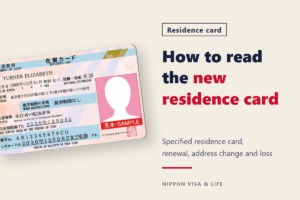


In Japan, if you file an online application (オンライン申請) and receive your residence card (在留カード) by mail, permission such as a change of status of residence takes effect when the new card arrives. Because the applicant cannot choose the day it arrives, problems can occur, such as the card arriving before your last day at your former company.
In this article, we publish, with some parts hidden, the text of the “Request Regarding the Residence Card Issue Date” (在留カード交付日についてのお願い) that Kisaragi Gyoseishoshi Office (きさらぎ行政書士事務所) actually sent to immigration, and explain the intent behind the wording.
“How to ask for a specific issue date” in the title means a way of asking in writing for consideration regarding when the card is issued. There is no official procedure that lets you decide the date. “Issue date (permission date)” also means the time when the permission takes effect (with mail, when the card arrives). It does not mean that the “date of permission” (許可年月日) recorded on the card can be set to the date you requested.
The official information was checked on the Immigration Services Agency (出入国在留管理庁, ISA) website on October 18, 2026.
If you receive the card by mail, it takes effect when the card arrives
If you choose to receive it by mail, you will get an “examination completion” email when the examination is finished. Following the instructions, you send a return Letter Pack, your current residence card, and other items to the Odaiba Branch Office, Online Examination Division 2, Tokyo Regional Immigration Services Bureau (東京出入国在留管理局オンライン審査第二部門おだいば分室). Immigration officers make new cards in the order the items arrive and return them together with your old card, which has had a hole punched in it.
In this case, the permission takes effect “from the time the residence card is delivered.” The Immigration Control Act (入管法) also provides that permission to change status of residence takes effect when the residence card is issued.
If the card arrives too early, problems arise in situations like the following.
- Changing jobs on Specified Skilled Worker status: A person on Specified Skilled Worker (特定技能) status receives a “designation document” (指定書) at the time of permission, which states the company they work for (the Specified Skilled Worker affiliated organization, 特定技能所属機関). When the new card and designation document arrive, the designated company changes to the new company, so if they arrive before your last day at your former company, you can no longer work at the former company for the remaining days until that last day.
- Changing from Technical Intern Training to Specified Skilled Worker: As a rule, a person who has not yet completed Technical Intern Training (技能実習) is not allowed to change to Specified Skilled Worker. If the card arrives before the scheduled completion date, you may move to the new status of residence before completing the training.
The whole job-change process is summarized in Changing Jobs on Specified Skilled Worker Status in Japan|The procedures and order for the worker, the new company, and the former company, at a glance.
(Sources: Immigration Services Agency, “FAQ on Online Procedures for Residence Applications,” Q5-7, Q6-1, Q6-5, Q6-6, Q6-8, e-Gov Law Search, “Immigration Control and Refugee Recognition Act,” Article 20, Immigration Services Agency, “Operational Guidelines on the Acceptance of Specified Skilled Workers,” pp. 17–18, p. 50)
The text of the “Request Regarding the Residence Card Issue Date” we actually sent
This is a letter we used when a Specified Skilled Worker was changing jobs: the examination for Permission to change status of residence (在留資格変更許可) had finished, but the last day at the former company was still some time away.
We publish the letter that was actually sent in a real residence card exchange by mail, with some parts hidden so that no individual can be identified. “(Name)” and “(Application number)” are the hidden parts. “○/○, Reiwa ○” is the date of leaving the company, and “△/△, Reiwa ○” is the day after. All other wording is as in the original (translated here from Japanese).
Request Regarding the Residence Card Issue Date
| Name: | (Name) |
| Type of application: | Application for Permission to change status of residence |
| Application number: | (Application number) |
We sincerely thank you for notifying us that the examination of the above application has been completed.
The foreign national concerned will leave their current affiliated organization as of ○/○, Reiwa ○, and is scheduled to start work at a new affiliated organization from the following day onward.
Accordingly, regarding the issue date of the residence card for this Permission to change status of residence, in view of consistency with the employment relationship with the current affiliated organization, we would be grateful if you could kindly arrange for it to be on or after △/△, Reiwa ○.
We humbly ask for your kind consideration.
End
We sent this letter together with the residence card and designation document sent to the Odaiba Branch Office (おだいば分室) after receiving the examination completion email.
The intent behind the wording: what we kept in mind in this case
- The first 3 lines: Because the branch office receives documents from all over the country, we put the name, type of application, and application number first, so that it is clear at once which application the request is about.
- The leaving date and the planned start of work: We wrote the reason for caring about the date using only these 2 facts. To make it easy to reuse, we did not include company names or similar details.
- “On or after △/△”: Rather than one specific day, we left some room with “on or after this date.” We thought this would be an easier form to accommodate within a process where cards are made in the order items arrive.
- Wording it as a request: Adjusting the issue date is not an official procedure, and whether to accommodate it is up to immigration. For that reason, we did not word it as a demand. The ISA’s FAQ also does not provide any set form.
Our office’s practical experience (not official guidance)
This is the experience of one office, and the result may not be the same for every application.
- When our office checked with the Odaiba Branch Office by phone, the answer was that if asked in this way, they would basically respond in the direction of accommodating it (this is not published guidance).
- New cards have been issued roughly 3 days to 2 weeks after the documents reach the branch office. This varies greatly depending on how busy they are.
- If you specify a date that is too close when they are busy, they may not be able to accommodate it. It is also unclear whether they will accept a request for “exactly this day.”
- We feel that writing the leaving date and then asking for “on or after ○/○” makes it more likely that they will accommodate the request.
The text above is one case in which a letter was sent with this wording. It does not guarantee any consideration.
Points to note when writing your own
- Fit it to your own situation: Do not copy it as is; write it with your own dates, such as your leaving date or scheduled completion date. If you are changing from Technical Intern Training, rewrite it with something like “the scheduled completion date” and “on or after the following day.”
- Avoid asking for it “to be issued early”: Avoid this unless there are special circumstances, such as being just before the end of the special period (特例期間: the period during which a person who applied by the expiration date of their period of stay can stay until the earlier of when a decision is made or 2 months after the expiration date). The ISA warns that if 2 months pass after your period of stay expires without your receiving the card, you will no longer be able to stay in Japan.
- Consider the counter if you are in a hurry: The ISA recommends receiving the card at the counter for those who want to receive it early. While the processing status is “Application completed” or “Under examination,” you can change the receiving method to the counter in the system.
- Let them know if your plans change: If your leaving date or other dates change, contact the Odaiba Branch Office as soon as possible.
If you are unsure what to do, consult a professional such as a gyoseishoshi lawyer who acts as an application agent (申請取次).
(Sources: Immigration Services Agency, “FAQ on Online Procedures for Residence Applications,” Q5-2, Q6-5, Q6-9, Q6-12, e-Gov Law Search, “Immigration Control and Refugee Recognition Act,” Article 20, paragraph 6)
Summary
- If you receive your residence card by mail, the permission takes effect when the card arrives, and you cannot choose the day it arrives.
- Our office sends a “Request Regarding the Residence Card Issue Date” together with the documents sent after the examination is completed, asking for consideration so that it will be “on or after ○/○.” This is not an official procedure, and whether it is accommodated is up to immigration.
- Unless there are special circumstances, avoid asking for the card to be issued early.
Primary Sources Referenced in Article Creation
- Immigration Services Agency, “FAQ on Online Procedures for Residence Applications”
- e-Gov Law Search, “Immigration Control and Refugee Recognition Act”
- Immigration Services Agency, “Operational Guidelines on the Acceptance of Specified Skilled Workers”
This article is a translation of the original Japanese version.