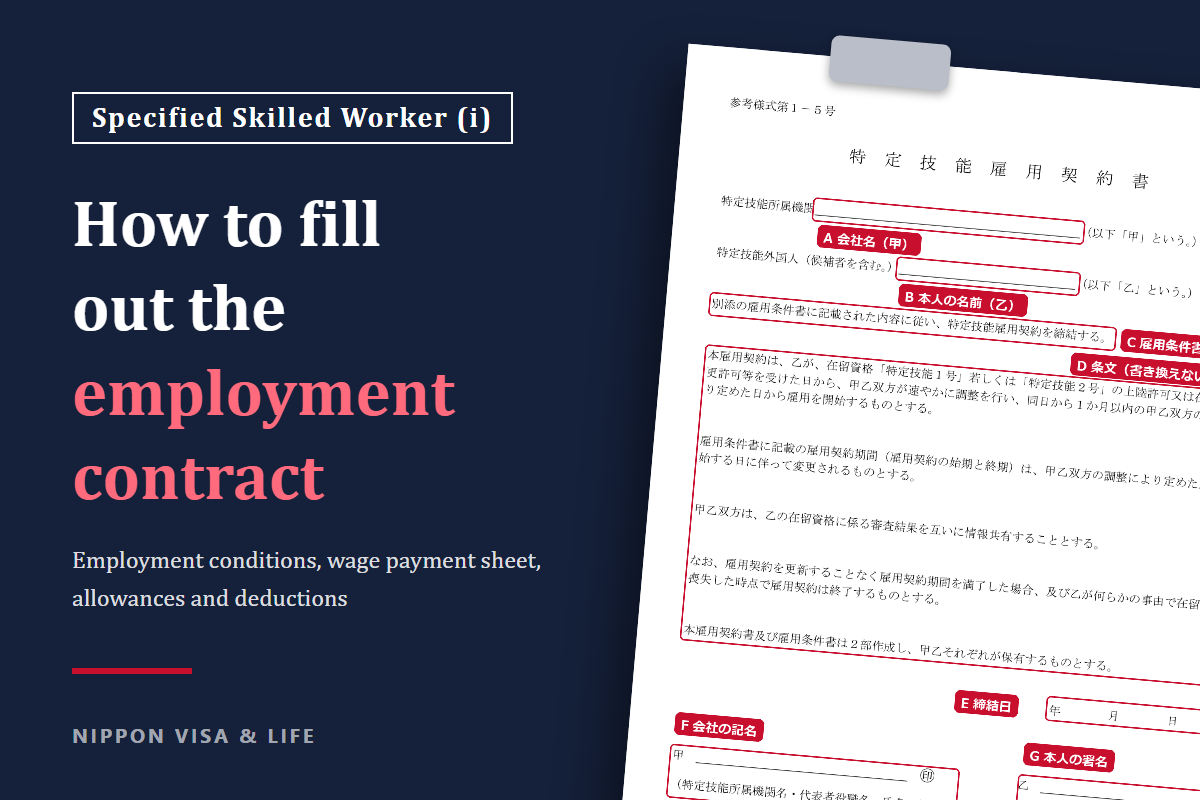


In a Specified Skilled Worker (i) (特定技能1号) application, you submit 3 documents — the Specified Skilled Worker employment contract (特定技能雇用契約書, Reference Form No. 1-5), the employment conditions (雇用条件書, No. 1-6), and the wage payment sheet (賃金の支払, Attachment 1 to No. 1-6) — whether the application is for a Certificate of Eligibility, a change of status, or an extension. The list of documents to submit revised on October 1, 2026 also marks all 3 as “required.” All of them must be written in a language the worker can fully understand, and any costs to be deducted must be clearly stated by item and amount.
Using the Immigration Services Agency’s (出入国在留管理庁) reference forms and filled-in examples, a company can prepare them on its own. The 3 points where applications tend to get stuck are:
- Write them in a language the worker can fully understand, and have the worker sign them
- Make sure the contents of the employment conditions and the wage payment sheet are consistent with each other (for housing costs, also match the support plan)
- Set deductions at an “appropriate amount,” and fill them out keeping in mind which fields require a notification if changed later
How to fill out the support plan submitted in the same application is explained in a separate article. This article does not cover how to fill out other documents such as the explanation of remuneration, or field-specific documents. The contents were checked on October 12, 2026 against materials from the Immigration Services Agency.
Overview: how the 3 documents relate and which applications need them
The 3 documents are a set. The contract promises to “contract according to the employment conditions,” the employment conditions are the main body of the terms, and the wage payment sheet details the wages. The contract has no fields for numbers such as the period or wages, so the numbers are checked mainly in the employment conditions and the wage payment sheet.
| Document | Role | Worker’s signature |
|---|---|---|
| Specified Skilled Worker employment contract (No. 1-5) | A single page promising to contract “in accordance with the contents stated in the attached employment conditions” | Sign in the field for Party B (乙) |
| Employment conditions (No. 1-6) | The main body: period, place, work, hours, days off, leave, wages, retirement, other (Ⅰ–Ⅸ) | Sign in the recipient field |
| Wage payment sheet (No. 1-6, Attachment 1) | The contents of “details as in the attachment” under Ⅶ Wages of the employment conditions. Allowances, deductions, take-home pay | No signature field |
There is also Attachment 2. It is used when a fixed-term contract with the same company exceeds a total of 5 years and the conditions after converting to an indefinite-term contract differ from the current ones.
All 3 documents are submitted in every application
Under Table 1 of the list of documents to submit (revised October 1, 2026), copies of the 3 documents are required for a Certificate of Eligibility, a change of status, and an extension alike. If you use a 1-year variable working hours system, also submit a copy of the annual calendar with a language the worker can understand written alongside. Under the Operational Guidelines, a copy of the agreement filed with the Labour Standards Inspection Office is also subject to checking.
When hiring a Specified Skilled Worker who works for another company, the application is for a change of status of residence (在留資格). The new company prepares the 3 documents.
Examples of field-specific documents are in the following article.
→ Required Documents for Specified Skilled Worker “Nursing Care” | Attachments and Where to Submit for Certificate of Eligibility, Change, and Extension [2026 Edition](https://kisaragi-office.com/immigration_journal/en/archives/5167)
Get the latest forms from the Immigration Services Agency’s page
The forms are on the Immigration Services Agency’s “List of application and notification forms related to Specified Skilled Worker” page. For the employment conditions, the form and the filled-in example are separate files. You are not required to use the reference forms. However, even when you use a different format, you must comply with labor laws and include the items required for the application. If items are missing, you may be asked to correct them.
(Sources: Immigration Services Agency, “List of application and notification forms related to Specified Skilled Worker”, Reference Form No. 1-6 Employment conditions (filled-in example), Table 1 (for Certificate of Eligibility, revised October 1, Reiwa 8), Table 1 (for change of status), Table 1 (for extension), Operational Guidelines on the Acceptance of Specified Skilled Foreign Workers)
Rules common to the 3 documents: a language the worker understands, and signatures
All 3 are written in a language the worker can fully understand. For the contract and the employment conditions, the worker must sign after fully understanding the contents.
| Document | Language | Signature |
|---|---|---|
| Employment contract | A language the worker can fully understand | Required |
| Employment conditions | A language the worker can fully understand | Required |
| Wage payment sheet | A language the worker can fully understand | Not among the requirements in the list (the form has no signature field either) |
Points to note when using the translated forms
The Immigration Services Agency provides translated forms in English and 9 other languages (Vietnamese, Tagalog, Indonesian, Thai, Burmese, Khmer, Mongolian, Nepali, and Chinese).
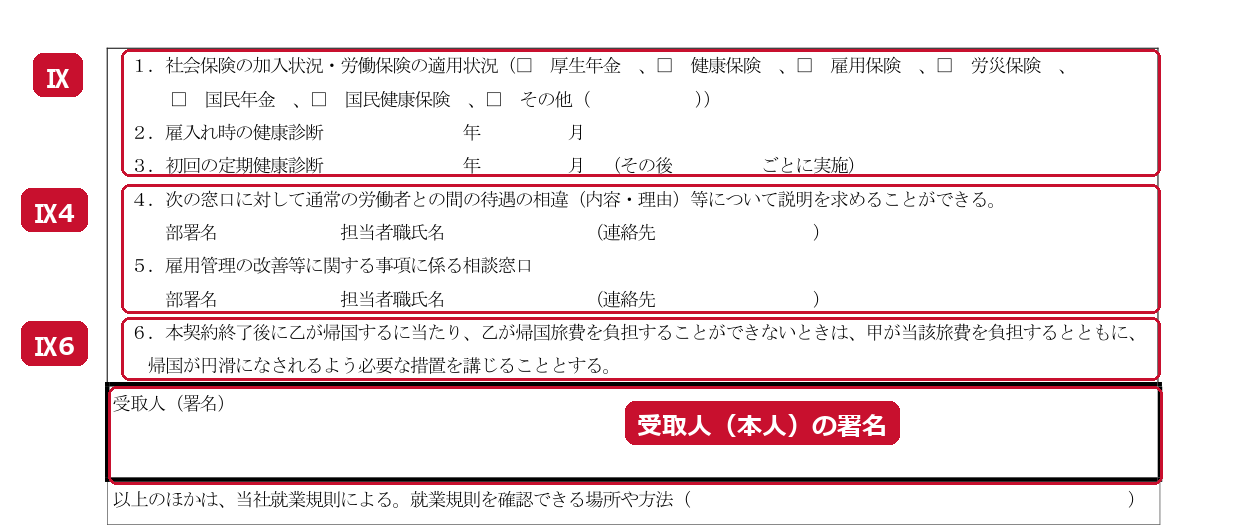
However, the translated employment conditions form checked on October 12, 2026 did not have the field in Ⅸ4 of the current Japanese form, “the contact point where the worker can ask for an explanation of differences in treatment compared with regular workers.” When using a translated form, compare its items with the current Japanese form and add any missing fields.
Explain before signing
After filling them out, explain the contents in the worker’s language, and then have the worker sign. Make the company name, representative’s name, date, and the worker’s name consistent across the 3 documents.
The forms show “seal” (捺印) or seal marks in the company’s fields. On the other hand, the list of forms page states that, in principle, seals are not required on submitted documents, including the application form. Whether to affix a seal under internal company rules is for the company to decide.
(Sources: Table 1 (for Certificate of Eligibility, revised October 1, Reiwa 8), Operational Guidelines on the Acceptance of Specified Skilled Foreign Workers, Immigration Services Agency, “List of application and notification forms related to Specified Skilled Worker”, English translated forms, Reference Form No. 1-6 Employment conditions (form))
How to fill out the Specified Skilled Worker employment contract (Reference Form No. 1-5)
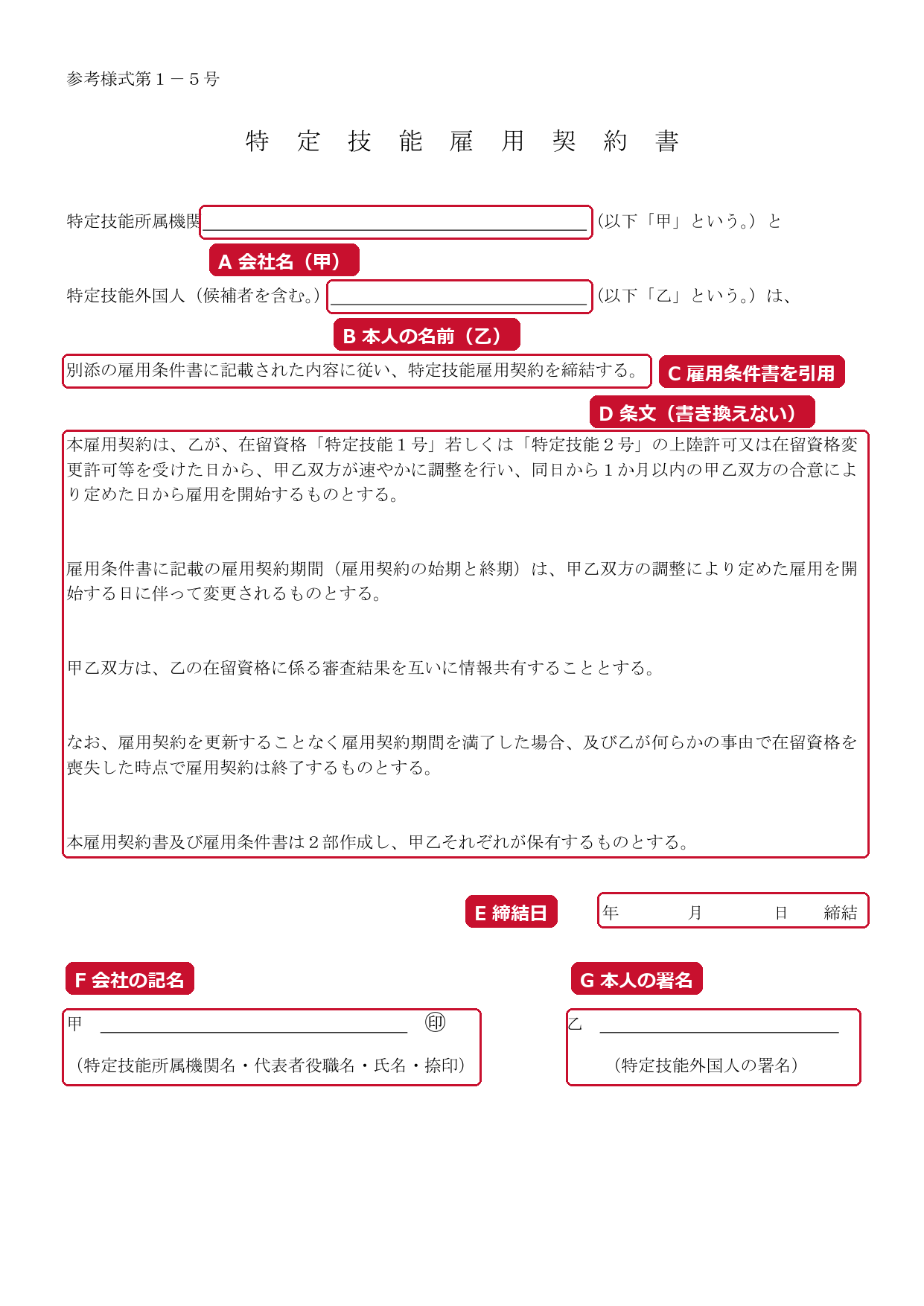
The contract is a single page with the clauses already written. The only things you fill in are, in the image, A the company name (Party A, 甲), B the worker’s name (Party B, 乙), E the date of conclusion, F the company’s name entry (company name, representative’s title and name), and G the worker’s signature.
Sources: Immigration Services Agency, “Reference Form No. 1-5 Specified Skilled Worker employment contract”
Because sentence C states that the contract is made “in accordance with the contents stated in the attached employment conditions,” conditions such as the period, hours, and wages are written in the employment conditions, not in the contract. The contract has no fields for numbers such as the period or wages. Do not rewrite the clauses in D. The clauses state the following:
- The worker starts work on a date agreed by both parties within 1 month from the date permission (such as landing permission or permission to change status of residence) is granted
- The employment contract period in the employment conditions changes to match the date the worker actually starts work
- The company and the worker share the results of the status of residence examination
- The contract ends when the period ends without the contract being renewed, or when the worker loses their status of residence
- The contract and the employment conditions are made in 2 copies, and the company and the worker each keep 1
The period in Ⅰ of the employment conditions is written based on the plan at the time of application. Under the Operational Guidelines, even if the start date changes because entry is postponed or for similar reasons, no notification is needed as long as the employment contract period does not change.
(Sources: Reference Form No. 1-5 Specified Skilled Worker employment contract, Operational Guidelines on the Acceptance of Specified Skilled Foreign Workers)
How to fill out each field of the employment conditions (Reference Form No. 1-6)
The fields of the employment conditions are divided into “fields where you replace the text with your company’s information” and “fields where the company decides the content.” If you change what you decided later, a notification to immigration may be required.
| Field | Fields to replace | Fields that need a decision | Examples that require a notification if changed later |
|---|---|---|---|
| Ⅰ Employment contract period | Period, planned date of entry | Whether the contract is renewed and the criteria, renewal limit | Shortening the period, changing the renewal criteria |
| Ⅱ Place of work | Name, address, and contact details of the workplace | Scope of changes | Changing the workplace (excluding a change of contact details only) |
| Ⅲ Work content | Field and work category | Scope of changes | Changing the work category within the same field |
| Ⅳ Working hours, etc. | Start and end times, breaks | Variable working hours system / shift system, prescribed hours and days | Adopting or abolishing a 1-year variable working hours system, changing the prescribed hours or days (except reducing the annual prescribed working days) |
| Ⅴ Days off | Days of the week, public holidays | Total annual days off | Reducing annual days off |
| Ⅵ Leave | Number of days of annual paid leave | Other leave | Reducing leave days, abolishing a type of leave |
| Ⅶ Wages | Closing date, payday | Basic wage, allowances, premium rates, deductions, pay raises, bonuses, retirement allowance | Reducing the basic wage or allowances, adding deductions, etc. |
| Ⅷ Retirement | Number of days of notice | - | Any change requires a notification |
| Ⅸ Other | Insurance, health checkups, contact point | Interval of periodic health checkups | Making the health checkup interval longer than 1 year |
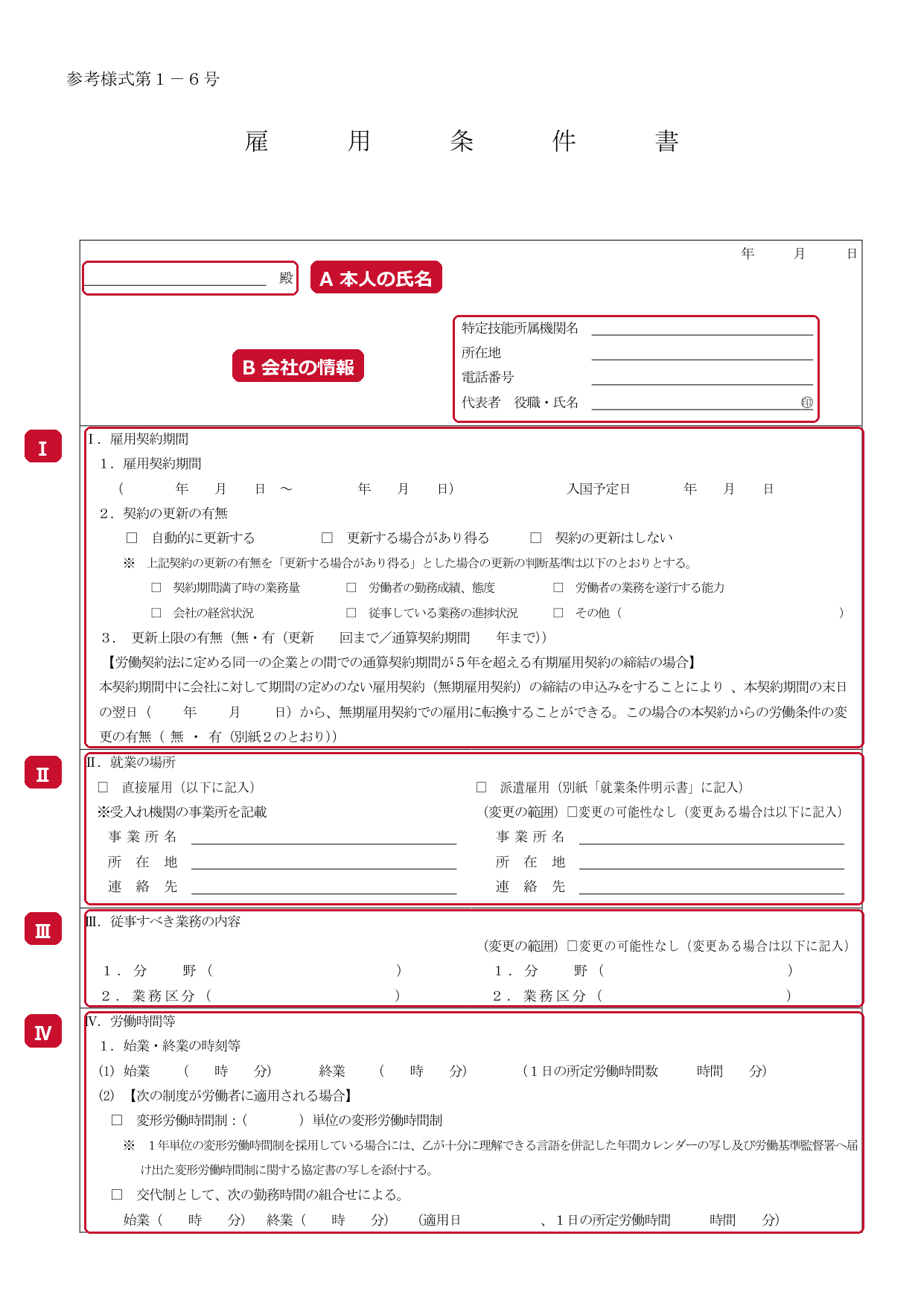
The first page of the form has, in the image, A the worker’s name (addressee), B the company’s information, and fields Ⅰ–Ⅳ. Ⅰ–Ⅳ in red frames are the same as the fields in the table above.
Sources: Immigration Services Agency, “Reference Form No. 1-6 Employment conditions (form)”
Ⅰ Employment contract period
People already in Japan do not need to write a planned date of entry. If you choose “may be renewed,” also mark the renewal criteria. Also state whether there is a renewal limit. If a fixed-term contract with the same company will exceed a total of 5 years, state whether the conditions will change after converting to an indefinite-term contract, and if they will, use Attachment 2.
Ⅱ Place of work, Ⅲ Work content
For the place of work, write the workplace of the accepting organization. If there are several places of work, clearly state the main one and then list all of them. Employment in the form of dispatch is allowed only in the agriculture and fishery fields.
For the work, write the field and work category using the exact names in the field-specific operational guidelines. If the field itself changes, an application for permission to change status of residence is required, not a notification.
The “scope of changes” in both fields is where you state whether the place of work or work content may change in the future. From April 2024, the Ministry of Health, Labour and Welfare introduced a rule requiring the scope of changes of the place of work and work content to be stated when concluding a labor contract. If there is no possibility of change, mark “no possibility of change.”
Ⅳ Working hours, etc., Ⅴ Days off, Ⅵ Leave
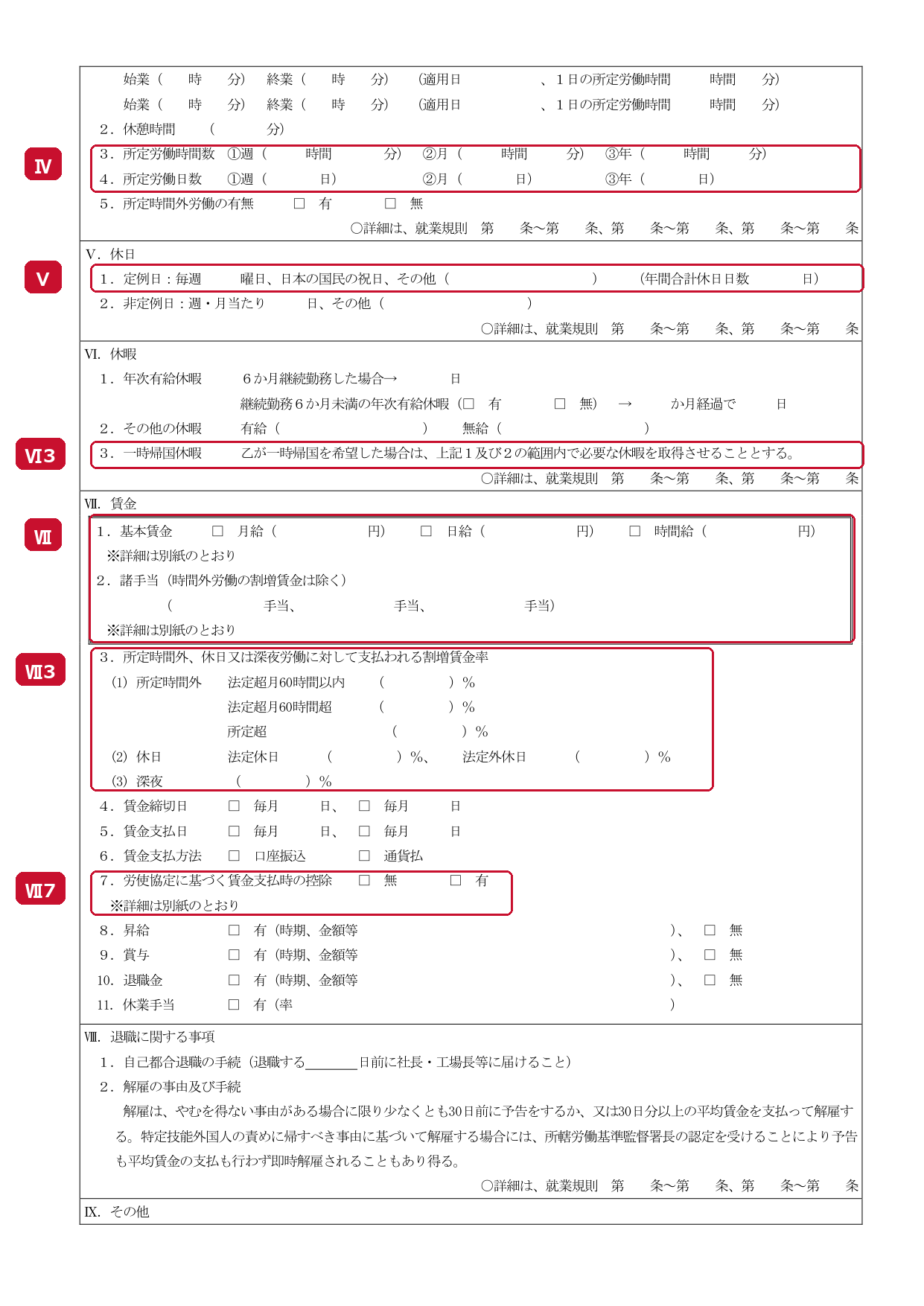
Page 2 runs from the continuation of Ⅳ to Ⅷ. The red frames in the image are: the prescribed working hours and days in Ⅳ3 and 4, the total annual days off in Ⅴ1, temporary home leave in Ⅵ3, the basic wage and allowances in Ⅶ1 and 2, the premium wage rates in Ⅶ3, and whether there are deductions in Ⅶ7. All of these are explained below. Of these, Ⅳ3 and 4 and the Ⅶ fields also relate to what is written in the wage payment sheet (Attachment 1).
Sources: Immigration Services Agency, “Reference Form No. 1-6 Employment conditions (form)”
The prescribed working hours must be the same as those of people working full-time at the company. Under the Operational Guidelines, full-time means, in principle, working at least 5 days a week and at least 217 days a year, with weekly working hours of at least 30 hours.
If you use a 1-year variable working hours system, attach copies of the annual calendar and the agreement. Check the total annual days off together with the annual prescribed working days in Ⅳ.
Do not delete the sentence on temporary home leave in Ⅵ3; keep it. Under the Operational Guidelines, the contract must provide that, when the worker requests a temporary return home, the company gives the necessary paid or unpaid leave. When the worker’s family comes to Japan on “Temporary Visitor” (短期滞在) status, consideration is needed so that the worker can take paid leave during their stay.
Ⅶ Wages, Ⅷ Retirement, Ⅸ Other
Use the same names for the basic wage and allowances in Ⅶ Wages as in the wage payment sheet (Attachment 1). Also write the premium wage rates, the closing date, the payday, and the payment method. If there are deductions, mark “yes” and write the details in Attachment 1. If you mark pay raises, bonuses, or retirement allowance as “yes,” make them something you can actually continue. This is because changing them to “no” later requires a notification.
In Ⅸ, write the social insurance and labor insurance, the timing of the health checkup at hiring and the first periodic health checkup, and the department, person in charge, and contact details of the contact point. Also keep the sentence stating that the company will pay the travel costs for returning home if the worker cannot pay them.
In the image of page 3, Ⅸ is insurance and health checkups, Ⅸ4 is the contact point where the worker can ask for an explanation of differences in treatment (a field missing from the translated forms), and Ⅸ6 is the sentence on travel costs for returning home. The worker signs in the recipient field below them.
Sources: Immigration Services Agency, “Reference Form No. 1-6 Employment conditions (form)”
Points to note when using the filled-in example as a draft
The filled-in example of the employment conditions is dated 2019, and some of its wording differs from the current form. For example, “(immediately after hiring)” in Ⅱ and Ⅲ of the filled-in example does not appear in the current form. Even when writing while looking at the filled-in example, fill out the current form.
(Sources: Reference Form No. 1-6 Employment conditions (form), Reference Form No. 1-6 Employment conditions (filled-in example), Operational Guidelines on the Acceptance of Specified Skilled Foreign Workers, Ministry of Health, Labour and Welfare, “The rules for stating working conditions changed from April 2024”)
How to fill out the wage payment sheet (Attachment 1): allowances, deductions, and take-home pay
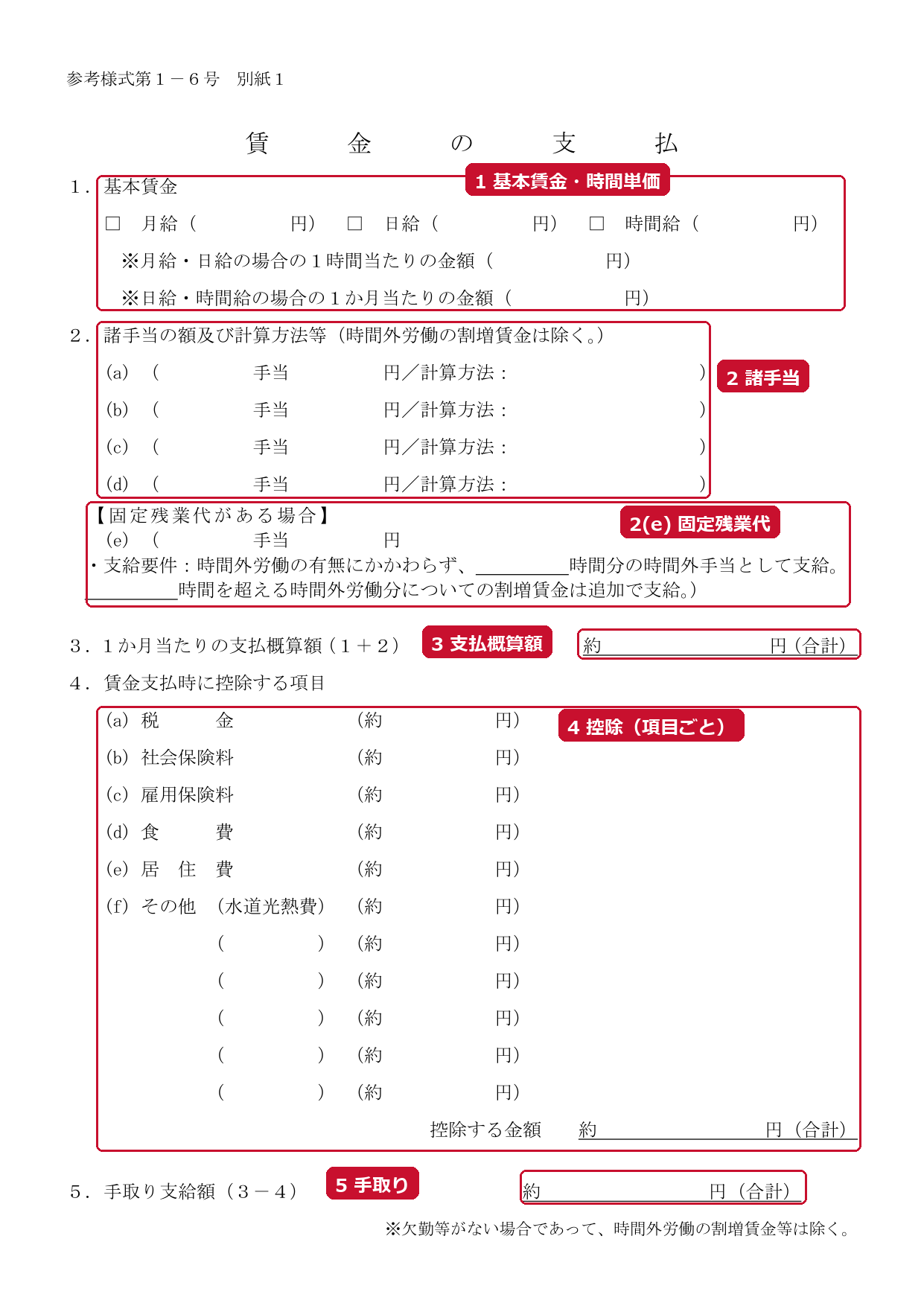
In the wage payment sheet, write, from top to bottom: 1 basic wage, 2 allowances, 3 approximate payment amount, 4 deductions, and 5 take-home pay. The numbers in the red frames in the image are the same as the numbers in the form. 2(e) is the field for when there is fixed overtime pay, and 4 is the field where you write deductions by item and also the total.
Sources: Immigration Services Agency, “Reference Form No. 1-6 Employment conditions (Attachment 1 Wage payment)”
1 Basic wage and 2 Allowances
For a monthly or daily wage, also write the amount per hour. For a daily or hourly wage, also write the amount per month.
For allowances, write the amount and the calculation method for each allowance. Use the same allowance names as in Ⅶ2 of the employment conditions.
If there is fixed overtime pay, state the following 3 things clearly, as in the notes of the filled-in example:
- The amount of wages excluding fixed overtime pay
- How many hours of overtime work it covers, and how the amount is calculated
- That premium wages will be paid additionally for overtime work beyond those hours
Some allowances are not included in the hourly rate used to calculate fixed overtime pay. Under the Labor Standards Act and its Enforcement Regulations, family allowance, commuting allowance, separate-living allowance, children’s education allowance, housing allowance, wages paid temporarily, and wages paid at intervals longer than 1 month are not included in the basis for premium wages.
3 Approximate payment amount, 4 Deductions, 5 Take-home pay
The approximate payment amount is the total of 1 and 2. For deductions, write taxes, social insurance premiums, employment insurance premiums, meals, housing, utilities, and so on, item by item. The filled-in example describes this as a field for explaining to the worker how much is deducted for which item. Take-home pay is the approximate payment amount minus the total deductions. As noted on the form, it is the amount when there are no absences, and it does not include premium wages for overtime work and the like. Fixed overtime pay is an allowance under 2, so it is included in the approximate payment amount and the take-home pay.
Under the Operational Guidelines, if costs are deducted regularly from wages, the name and amount of each cost to be deducted must be clearly stated in the employment conditions.
The “appropriate amount” of deductions
For meals, housing, and utilities, the Operational Guidelines set out how to think about an “appropriate amount.”
| Cost | Approach in the Operational Guidelines |
|---|---|
| Meals (food items, boxed meals, etc. provided in kind) | No more than the amount it cost to buy them |
| Meals (staff cafeteria) | No more than the amount charged to other employees |
| Meals (prepared and served by the company) | No more than the cost of ingredients, utilities, labor, etc. divided by the number of people receiving meals |
| Housing (property owned by the company) | A reasonable amount calculated from construction and renovation costs, useful life, number of residents, etc. |
| Housing (rented property) | No more than the cost of renting it (including management and common area fees) divided by the number of Specified Skilled foreign workers living there |
| Utilities | No more than the actual cost divided by the number of people living together (including company staff and family members) |
For rented property, the worker cannot be made to pay the security deposit, key money, guarantee deposit, brokerage fee, renewal fee, early cancellation fee, and similar costs. If housing costs are high, you may be asked for additional explanation of whether the amount is appropriate.
Make the amount of housing costs the same as in the housing field of the support plan. The Examination Guidelines state that it is checked whether the housing cost in the support plan and the housing cost deducted in the wage payment sheet are the same. How to write housing costs in the support plan is explained in the following article.
The Operational Guidelines state that deducting savings for travel costs for returning home from wages is not allowed. Do not include it as a deduction item.
(Sources: Reference Form No. 1-6 Employment conditions (form and Attachment 1), Reference Form No. 1-6 Employment conditions (filled-in example), Operational Guidelines on the Acceptance of Specified Skilled Foreign Workers, Labor Standards Act (e-Gov), Enforcement Regulations of the Labor Standards Act (e-Gov))
Review before submission: make the contents of the employment conditions and the wage payment sheet consistent
Before submitting, check that what is written in the employment conditions and the wage payment sheet is consistent. The employment conditions state items such as the prescribed working hours and days, the basic wage amount, the names of allowances, and whether there are deductions; the allowance amounts, the details of deductions, and take-home pay are written in the wage payment sheet. The employment contract has no fields for numbers such as the period or wages, so it is not part of this review. The following example uses hypothetical numbers for explanation. In practice, calculate taxes and social insurance premiums based on the worker’s own situation.
Calculation example (hypothetical numbers)
- 8 hours a day, 5 days a week, 252 prescribed working days a year, 113 days off a year
- Monthly wage of 210,000 yen, perfect attendance allowance of 8,400 yen, commuting allowance of 6,000 yen
- Fixed overtime pay for 20 hours
- A rented apartment where only 3 Specified Skilled foreign workers live (rent and common area fee 75,000 yen), utilities of 15,000 yen a month
| What to check | Calculation | Result |
|---|---|---|
| Days in a year | 252 days + 113 days | 365 days |
| Prescribed hours per week / year | 8 hours × 5 days / 8 hours × 252 days | 40 hours a week / 2,016 hours a year |
| Prescribed hours per month | 2,016 hours ÷ 12 | 168 hours |
| Amount per hour | 210,000 yen ÷ 168 hours | 1,250 yen |
| Basis of the hourly rate for premium wages | (210,000 yen + 8,400 yen) ÷ 168 hours | 1,300 yen (commuting allowance not included) |
| Fixed overtime pay | 1,300 yen × 1.25 × 20 hours | 32,500 yen |
| Approximate payment amount | 210,000 yen + 8,400 yen + 6,000 yen + 32,500 yen | 256,900 yen |
| Housing | 75,000 yen ÷ 3 Specified Skilled foreign workers living there | No more than 25,000 yen |
| Utilities | 15,000 yen ÷ 3 people living together | No more than 5,000 yen |
| Total deductions | Taxes 6,000 yen + social insurance premiums 37,000 yen + employment insurance premiums 1,400 yen + housing 25,000 yen + utilities 5,000 yen | 74,400 yen |
| Take-home pay | 256,900 yen − 74,400 yen | 182,500 yen |
This example is 5 days a week, 252 days a year, and 40 hours a week, so it meets the full-time standard. The premium rate of 1.25 is an example. Calculate using the rate you wrote in Ⅶ3 of the employment conditions.
What to check between the employment conditions and the wage payment sheet
- Hours and days: Do the daily hours × days match the prescribed hours per week, month, and year? Does the total of annual prescribed working days and annual days off match the number of days in the year?
- Hourly amount: Does the monthly wage ÷ prescribed hours per month match the amount per hour in Attachment 1?
- Allowances: Are the allowance names in Ⅶ2 of the employment conditions the same as in 2 of Attachment 1?
- Deductions: If Ⅶ7 of the employment conditions is “yes,” are there items in 4 of Attachment 1? Does the sum of the items match the total deductions?
- Take-home pay: Does the approximate payment amount minus the total deductions match the take-home pay field?
Cross-checking with other documents
Make the housing cost in the wage payment sheet the same amount as the housing cost in the support plan. The monthly wage and allowances in the explanation of remuneration, and the workplace and work in the application form, must also match the employment conditions and the wage payment sheet.
(Sources: Reference Form No. 1-6 Employment conditions (form and Attachment 1), Operational Guidelines on the Acceptance of Specified Skilled Foreign Workers, Enforcement Regulations of the Labor Standards Act (e-Gov))
When you change the conditions after preparing the documents
When the Specified Skilled Worker employment contract is changed (excluding minor changes), notify immigration within 14 days from the date of the change. An appended table in the Operational Guidelines gives examples, for each item of the employment conditions, of changes that require a notification. The appended table gives examples only, and notifications are not limited to what is in it.
| Examples that require a notification | Examples said not to require a notification |
|---|---|
| Reducing the basic wage, changing the payment method (e.g. from monthly to daily wages) | A shift in the start date where the employment contract period does not change |
| Abolishing or reducing allowances, lowering the premium wage rates | Reducing the annual prescribed working days from the original number (a notification is required if the work is no longer full-time) |
| Introducing or abolishing fixed overtime pay | Increasing leave days |
| Changing deductions between “yes” and “no,” adding deduction items | Deduction items or amounts simply decreasing (except where the worker’s burden increases) |
| Reducing annual days off, changing the place of work or work category | Changing only the timing of pay raises, bonuses, etc. |
The employment conditions attached to the notification only need to state the changed parts. In this case too, they must be written in a language the worker can fully understand, and the worker must sign after understanding them. If these conditions are met, the company’s own format may be used instead of the employment conditions form.
From the first time you fill them out, make allowances, pay raises, bonuses, and deductions something you can continue. The notification process is explained in the following article.
(Sources: Operational Guidelines on the Acceptance of Specified Skilled Foreign Workers)
Frequently asked questions
Q Is a seal required? A The list of forms page states that, in principle, seals are not required on submitted documents, including the application form.
Q Does the wage payment sheet also need the worker’s signature? A The requirement in the list is that it be written in a language the worker can fully understand. A signature is not a requirement, and the form has no signature field.
Q What if there is no translated form in the worker’s native language? A The requirement is to prepare them in a language the worker can fully understand. We could not confirm in official materials how languages without an Immigration Services Agency translated form are handled. Please check with the Regional Immigration Services Bureau where you submit, or with a professional.
Q Are the 3 documents also submitted for an extension? A The list for extensions also requires copies of the 3 documents. Whether they need to be newly prepared when the conditions have not changed cannot be determined from the list. If you are unsure, check with the Regional Immigration Services Bureau where you submit.
(Sources: Immigration Services Agency, “List of application and notification forms related to Specified Skilled Worker”, Reference Form No. 1-6 Employment conditions (filled-in example), Table 1 (for Certificate of Eligibility, revised October 1, Reiwa 8), Table 1 (for extension))
Summary
- The employment contract, employment conditions, and wage payment sheet are a set of documents submitted for a Certificate of Eligibility, a change of status, and an extension alike. Write them in a language the worker can fully understand, and get the worker’s signature on the contract and the employment conditions.
- Before submitting, check that the contents of the employment conditions and the wage payment sheet are consistent, and verify the calculations of allowances, deductions, and take-home pay in the wage payment sheet. Also match housing costs with the support plan.
- Set deductions at the “appropriate amount” in the Operational Guidelines. Fill out the fields that require a notification if changed later with content you can continue.
Registered support organizations (登録支援機関), application agents, and gyoseishoshi lawyers can help prepare and submit application documents. For who can do what, see the following article. If the way to fill them out changes due to individual circumstances, consult the Regional Immigration Services Bureau where you submit or a professional.
→ How to get and renew the Application Agent Certificate | Application form, required documents, and what registered support organizations can submit [Updated for the revised Gyoseishoshi Lawyer Act](https://kisaragi-office.com/immigration_journal/en/archives/4582)
Primary Sources Referenced in Article Creation
- Immigration Services Agency, “List of application and notification forms related to Specified Skilled Worker”
- Reference Form No. 1-5 Specified Skilled Worker employment contract
- Reference Form No. 1-6 Employment conditions (including the attachment “Wage payment”; form)
- Reference Form No. 1-6 Employment conditions (filled-in example)
- English translated forms (Reference Forms No. 1-5, No. 1-6, etc.)
- Immigration Services Agency, “Operational Guidelines for Specified Skilled Worker”
- Operational Guidelines on the Acceptance of Specified Skilled Foreign Workers (partially revised August 20, Reiwa 8)
- List of documents to submit for “Specified Skilled Worker (i)” (for Certificate of Eligibility applications) Table 1 (revised October 1, Reiwa 8)
- List of documents to submit for “Specified Skilled Worker (i)” (for change of status of residence applications) Table 1 (revised October 1, Reiwa 8)
- List of documents to submit for “Specified Skilled Worker (i)” (for extension of period of stay applications) Table 1 (revised October 1, Reiwa 8)
- Labor Standards Act (e-Gov Law Search)
- Enforcement Regulations of the Labor Standards Act (e-Gov Law Search)
- Ministry of Health, Labour and Welfare, “The rules for stating working conditions changed from April 2024” (leaflet)
This article is a translation of the original Japanese version.