This article was written by the NIPPON VISA & LIFE editorial team based on information from public organizations such as the national government and local governments. Rules and fees may differ depending on the city, ward, town or village where you live.
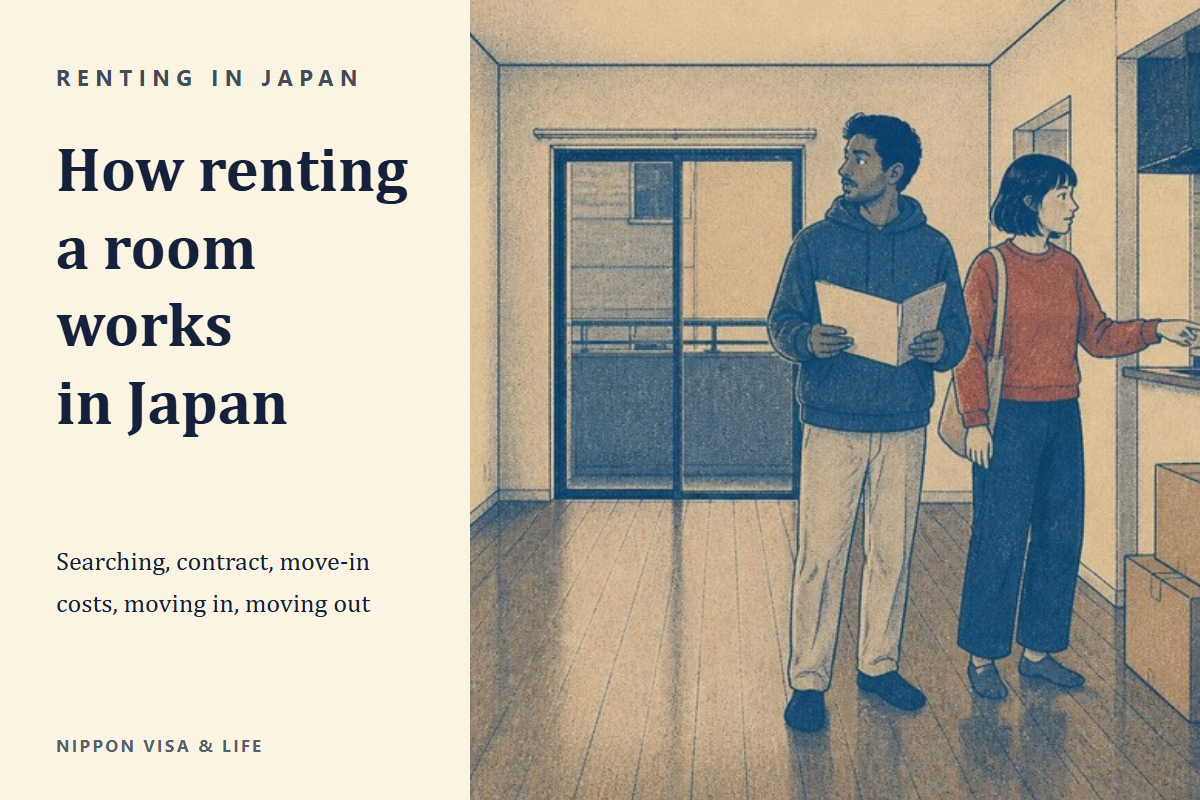
When you rent a home in Japan, you look for a room at a real estate agency (fudosan-ya: a shop that introduces rooms), go through a screening, and sign a contract. When you sign the contract, you often need about 4 to 7 months’ worth of rent, so prepare the money early. In this article, we explain the flow from looking for a room to moving out, scene by scene.
The Overall Flow
- Look for a room on the internet or at a real estate agency
- Do a viewing (shitami: going to actually see the room)
- Apply to move in and go through the screening
- Listen to the explanation of important matters (juyo jiko setsumei: an explanation of the important points of the contract), sign the contract, and pay the move-in costs
- Receive the key, apply for electricity, gas, water and so on, and move in
- Once your address is decided, submit a moving-in notification (tennyu todoke) at your city, ward, town or village office
- While you live there, follow the rules on garbage, noise and how to use the room
- When you leave, notify the landlord of cancellation by the deadline in the contract, hand back the room, and settle the security deposit
It usually takes 1 to 2 weeks from applying to moving in.
(Sources: Ministry of Land, Infrastructure, Transport and Tourism “Apartment Search Guidebook”)
Map by Situation
| When you want to… | What to know | Detailed article or information |
|---|---|---|
| Find a room | You can search on the internet, at real estate agencies, at your school and so on | Section 1 below |
| Sign a contract | There is a screening, and a guarantee company or a joint guarantor is often required | Section 2 below |
| Prepare the money | Move-in costs are roughly 4 to 7 months’ worth of rent | Section 3 below |
| Moving day | Apply for electricity, gas and water; notifications at the city office | Section 4 below |
| While you live there | Rules on garbage, noise and how to use the room | Section 5 below |
| Move out | Notice of cancellation, restoration to original condition, settling the security deposit | Section 6 below |
| Find cheaper housing | Public housing and UR rental housing | Section 7 below |
1. Finding a Room
- You can search on real estate websites on the internet. Rental homes that accept foreign tenants can also be found on the Ministry of Land, Infrastructure, Transport and Tourism’s “Safety Net Housing Information System” (in Japanese).
- You can also go to a local real estate agency, tell them what you are looking for, and have them introduce rooms to you. If you do not speak much Japanese, go with someone who speaks Japanese.
- International students should ask the student affairs section of their university or school whether it has information on rooms.
- At a real estate agency, you will be asked your name, job, the number of people who will live with you, income, Japanese ability, the reason you are looking for a room and so on. You may apply on the same day, so bring your residence card and passport.
How to Read a Floor Plan (Madori)
In Japan, the layout of a home is written like “2LDK”. “L” means a living room, “D” a dining room, and “K” a kitchen. The first number is the number of other rooms. “2LDK” means there are 2 rooms in addition to the living room, dining room and kitchen.
What to Check During a Viewing
Viewings are free. If you do not like the room after seeing it, you do not have to apply. Check the equipment such as the kitchen and air conditioner, and the spaces for a refrigerator and washing machine. It is also reassuring to check where the train station, bus stop, supermarket and hospital are. How to find out whether the area is at risk of disasters is explained in How to Find Evacuation Sites, Evacuation Shelters and Hazard Maps in Japan: What to Check for Your Address Before a Disaster.
(Sources: Ministry of Land, Infrastructure, Transport and Tourism “Apartment Search Guidebook”, Immigration Services Agency “Guidebook on Living and Working” Chapter 11)
2. Application, Screening and Contract
Application and Screening
If you like the room, fill out a tenancy application form and submit the documents needed for the screening. The real estate agency and the landlord (yanushi: the owner of the room) carry out the screening, and if you pass, you can sign the contract.
| Documents often required for the screening |
|---|
| Passport, residence card |
| Income certificate (a document showing your income), a certificate from your employer or a certificate of enrollment from your school, etc. |
| If you have a joint guarantor, that person’s income certificate and certificate of seal registration |
In rental contracts in Japan, in case you become unable to pay the rent, you are often asked to use a rent guarantee company (yachin saimu hosho gaisha) or to have a joint guarantor (rentai hoshonin: a person who promises to pay instead of you). A guarantee company is not insurance. Money that the guarantee company pays on your behalf will later be charged to you.
Before the Contract: Explanation of Important Matters
Before the contract, the real estate agency explains the important points about the contract and the home to you (explanation of important matters). If there is anything you do not understand, ask on the spot. Signing the contract means you promise that you understand its content and will follow it. Before signing, check the following points in particular.
- Whether the contract is an “ordinary lease contract” or a “fixed-term lease contract” (a fixed-term lease contract ends when the period ends, without being renewed)
- The amounts of the security deposit, key money and so on. If there is a shikibiki (an amount decided in advance not to be returned), its amount
- Whether there is a renewal fee when the contract is renewed, and its amount (the contract period is usually 2 years)
- Things you must not do (remodeling the room, living with people you have not reported, keeping pets, etc.)
- The conditions for restoration to original condition when you move out
When you pay an application fee (moshikomi-kin), check whether it will be returned if the contract is not signed.
(Sources: Ministry of Land, Infrastructure, Transport and Tourism “Apartment Search Guidebook”)
3. Move-in Costs (Money You Pay When Signing the Contract)
When you sign the contract, the amount differs by region, but a guide is about 4 to 7 months’ worth of rent. Payment is usually in cash or by bank transfer.
| Cost | What it is |
|---|---|
| Security deposit (shikikin) | Money deposited with the landlord. About 1 to 2 months’ worth of rent. It is settled when you move out, and the rest is returned |
| Key money (reikin) | Money paid to the landlord. About 1 to 2 months’ worth of rent. It is not returned. Some rooms have no key money |
| Brokerage fee (chukai tesuryo) | A fee paid to the real estate agency. It is set at no more than 1 month’s worth of rent |
| Property insurance premium (fire insurance) | Insurance for fire and water leaks. It is common to take it out |
| Rent and common service fee | Rent is paid in the previous month (paid in advance). The common service fee (management fee) is money for things such as electricity and cleaning of the stairs and hallways |
| Guarantee fee | When you use a guarantee company. Often 2 years’ worth is paid at once at the beginning, and the amount is often about 30 to 60% of 1 month’s rent |
If you move in partway through a month, the rent is usually calculated on a daily basis. For the bank account you use for receiving your salary and paying rent, see How to Open a Bank Account in Japan: What You Need, Why You May Not Be Able to Open One, and Telling Your Bank When Your Address or Period of Stay Changes.
(Sources: Ministry of Land, Infrastructure, Transport and Tourism “Apartment Search Guidebook”)
4. Moving-in Day: Keys, Electricity, Gas, Water and Notifications at the City Office
- Receive the key: Once you sign the contract and pay, you get the key. You will return it when you move out, so do not lose it.
- Check the condition of the room: If possible, check where there are scratches and dirt together with someone from the real estate agency. Taking dated photos helps prevent trouble when you move out. Actually try using the equipment.
- Apply for electricity, gas and water: Ask the real estate agency for the contact information. When you start using gas, someone from the gas company will come, and you need to be present.
- Phone and internet: Apply to the company you will use.
Once you start living in the room, submit a moving-in notification at your city, ward, town or village office within 14 days. If you bring your residence card, you can also do the notification of your place of residence (where you live) at the same time. For details, see Moving-in Notification and Resident Record: Go to Your City Office Within 14 Days After Your Address in Japan Is Decided (What to Bring, Steps, and When You Move).
(Sources: Ministry of Land, Infrastructure, Transport and Tourism “Apartment Search Guidebook”, Immigration Services Agency “Notification of Change of Place of Residence (Mid- to Long-Term Residents)”)
5. Rules While You Live There
- Garbage: The days, times, places and sorting rules for putting out garbage differ by city, ward, town or village. When you move in, check with the real estate agency or the city office. The basics are summarized in How to Sort and Put Out Garbage in Japan: Basic Rules for Burnable, Recyclable and Oversized Garbage.
- Noise: In apartments, sound travels easily to the rooms next door, above and below. Especially from night to early morning, be careful about loud voices, music, vacuum cleaners and washing machines, opening and closing doors, and taking baths late at night.
- Shoes: Take off your shoes at the entrance before going into the room.
- Humidity and mold: Japan is very humid, so air out your room. Wipe off water droplets that form on windows and other places (condensation).
- Walls: Hammering nails, painting and similar things are often prohibited by the contract. Check your contract.
- Kitchen, bath and toilet: Do not pour oil or food waste down the sink. Do not flush anything other than human waste and toilet paper down the toilet. If it gets clogged and causes damage to the room below, you may have to pay compensation.
- Hallways, stairs and balconies: These are shared spaces and evacuation routes, so do not leave things there.
- Bicycles: Park them in the designated bicycle parking area.
If someone will live with you, report this to the landlord when you sign the contract. If you let someone you have not reported live with you, you may be required to move out.
(Sources: Ministry of Land, Infrastructure, Transport and Tourism “Apartment Search Guidebook”, Immigration Services Agency “Guidebook on Living and Working” Chapter 12)
6. Moving House or Leaving the Room
- Give notice of cancellation: By the deadline written in the contract, tell the landlord or the real estate agency in writing (notice of cancellation). The deadline is usually 1 to 2 months before.
- Contact to stop electricity, gas and water: At least 1 week before you move, contact each company and the office in charge of water.
- Mail forwarding: If you complete the forwarding procedure at a post office, you can receive mail sent to your old address at your new address for a certain period.
- Notifications at the city office: When you move to a different city, ward, town or village, you need a moving-out notification and a moving-in notification.
- Return the key and settle the security deposit: Return the key when you hand back the room. In principle, the security deposit is returned, but costs such as restoration to original condition are taken out.
Restoration to original condition (genjo kaifuku) means repairing the places the tenant broke or made dirty before handing the room back. The view of the guidelines of the Ministry of Land, Infrastructure, Transport and Tourism is that the tenant does not need to pay for dirt that comes from normal living or for wear that comes from the home getting older. However, a “special term” (tokuyaku: a special arrangement) in the contract may decide how the costs are shared. Check this when you sign the contract.
- Order and deadlines of the procedures: Checklist for Moving Within Japan: Moving-out and Moving-in Notifications, Residence Card, Electricity, Gas and Water, and Mail Forwarding
- Who pays the costs: Restoration and Security Deposits When Moving Out of a Rental Home in Japan: Who Pays for Repairs? Examples from the National Government’s Guidelines
- When throwing away large furniture or appliances: How to Put Out Oversized Garbage in Japan: Basics of Applying, Disposal Tickets (Stickers), and the Day and Place to Put It Out, How to Throw Away a TV, Refrigerator, Washing Machine or Air Conditioner in Japan: Disposal Methods and Fees for the 4 Items Covered by the Home Appliance Recycling Act
(Sources: Ministry of Land, Infrastructure, Transport and Tourism “Apartment Search Guidebook”, Ministry of Land, Infrastructure, Transport and Tourism “Key Points on Restoration to Original Condition When Moving Out of a Rental Home”, Ministry of Internal Affairs and Communications “How to Submit a Notification of Change of Resident Record” (leaflet))
7. Public Housing and UR Rental Housing
| Housing | Features |
|---|---|
| Public housing | Housing that prefectures and cities, wards, towns and villages rent at low rent to people with low incomes who have trouble finding housing. The conditions for moving in (income, etc.) differ by local government. For foreign nationals, there may be conditions such as having a status of residence of 1 year or more or a record of residing in Japan. Apply to the prefecture or city, ward, town or village that manages the housing |
| UR rental housing | Housing managed by the Urban Renaissance Agency (UR). One condition is having an income higher than the standard monthly income set by UR. Foreign nationals who need to continue living in Japan, such as mid- to long-term residents (including permanent residents) and special permanent residents, can move in. Apply at a UR sales center or similar office |
(Sources: Immigration Services Agency “Guidebook on Living and Working” Chapter 11)
Frequently Asked Questions
Can I rent a room even if I have no one to be my guarantor?
If you use a guarantee company, there are rooms you can rent without a joint guarantor. Which one is required differs from room to room, so ask the real estate agency.
(Sources: Ministry of Land, Infrastructure, Transport and Tourism “Apartment Search Guidebook”)
Do I have to move out when the contract period ends?
With an ordinary lease contract, the landlord cannot refuse renewal unless there is a justifiable reason. Even if the discussion about renewal does not reach an agreement, the contract is renewed automatically. A fixed-term lease contract ends when the period ends (if you and the landlord agree, you can sign a contract again). Check which type of contract it is before signing.
(Sources: Ministry of Land, Infrastructure, Transport and Tourism “Apartment Search Guidebook”)
What if I have a problem with the contract or money?
For troubles such as rental contracts or the return of the security deposit, you can consult the Consumer Hotline (188) or a Consumer Affairs Center. For details, see Where to Get Help With Shopping and Contract Problems in Japan: Consumer Hotline 188, Consumer Affairs Centers and Cooling-off.
(Sources: Consumer Affairs Agency “Consumer Hotline”, National Consumer Affairs Center of Japan (NCAC) “Troubles over Restoration of Rental Homes”)
Information Available in Foreign Languages
- Ministry of Land, Infrastructure, Transport and Tourism “Apartment Search Guidebook”: You can read about the flow of finding a room, the documents and costs you need, the rules for living, the procedures for moving out, and explanations of real estate terms in English, Chinese, Korean, Vietnamese, Nepali, Thai, Indonesian, Burmese, Tagalog, Portuguese and other languages. The file for each language is on the page Ministry of Land, Infrastructure, Transport and Tourism “Smooth Move-in of Foreign Nationals to Private Rental Housing”.
- Ministry of Land, Infrastructure, Transport and Tourism “Guide to Renting Housing for Foreign Nationals”: It includes sheets for writing the conditions you want, which you can show at a real estate agency.
- You can also read information about renting a room in the “Multilingual Living Information” of the Council of Local Authorities for International Relations (CLAIR).
(Sources: Immigration Services Agency “Guidebook on Living and Working” Chapter 11, Ministry of Land, Infrastructure, Transport and Tourism “Smooth Move-in of Foreign Nationals to Private Rental Housing”, Ministry of Land, Infrastructure, Transport and Tourism “Apartment Search Guidebook”)
Primary Sources Used for This Article
- Immigration Services Agency “Guidebook on Living and Working” 8th edition (Chapter 11 Housing, Chapter 12 Rules and Customs in Daily Life)
- Ministry of Land, Infrastructure, Transport and Tourism “Apartment Search Guidebook” (Japanese version)
- Ministry of Land, Infrastructure, Transport and Tourism “Smooth Move-in of Foreign Nationals to Private Rental Housing”
- Ministry of Land, Infrastructure, Transport and Tourism “Safety Net Housing Information System”
- Ministry of Land, Infrastructure, Transport and Tourism “Key Points on Restoration to Original Condition When Moving Out of a Rental Home”
- Immigration Services Agency “Notification of Change of Place of Residence (Mid- to Long-Term Residents)”
- Consumer Affairs Agency “Consumer Hotline”
- National Consumer Affairs Center of Japan (NCAC) “Troubles over Restoration of Rental Homes”
- Ministry of Internal Affairs and Communications “How to Submit a Notification of Change of Resident Record” (leaflet)
This article is a translation of the original Japanese version.