This article was written by the NIPPON VISA & LIFE editorial team based on information from public organizations such as the national government and local governments. Rules and fees may differ depending on the city, ward, town or village where you live.
When you move out of an apartment in Japan, the tenant pays the cost of repairing places that the tenant broke or made dirty. This is called “restoration to original condition” (genjo kaifuku). However, the view of the guidelines of the Ministry of Land, Infrastructure, Transport and Tourism is that the tenant does not need to pay for dirt that comes from normal living or for wear that comes from the home getting older. The “security deposit” (shikikin) you paid when you moved in is returned to you after these costs and other amounts are taken out.
In this article, we use the following words.
- Landlord: the owner of the home (lessor) or the management company hired by the owner
- Tenant: you, the person who rents and lives in the home (lessee)
The Short Answer: The Steps Until You Move Out
- Read your contract again: Check how to notify the landlord that you are moving out and the rules on costs when you move out (the “special terms”).
- Contact the landlord early: Check your moving-out date and the procedures.
- Clean the home: Clear away garbage, and remove grease from the kitchen and limescale and mold from the bathroom and toilet.
- Move-out inspection: In many cases, you look at the home and its equipment together with the landlord or management company and check what needs to be repaired. Take photos and keep notes.
- Settlement: Repair costs and other amounts are taken out of the security deposit, and the rest is returned to you. If the costs are more than the security deposit, you pay the difference.
The procedures for moving as a whole (notifications to the city office, electricity, gas and water, mail forwarding, and so on) are summarized in Checklist for Moving Within Japan: moving-out notification, moving-in notification, residence card, electricity, gas and water, and mail forwarding.
What Is Restoration to Original Condition?
Under the Civil Code (Japan’s basic law), the tenant has a duty to restore damage that occurred after renting the home when the contract ends. However, the following are excluded.
- Normal wear and tear (tsujo sonmo): damage and dirt that come from normal use
- Aging (keinen henka): damage that comes from the home getting older over time
The Ministry of Land, Infrastructure, Transport and Tourism’s “Guidelines on Troubles Concerning Restoration to Original Condition” also explains that restoration to original condition “does not mean returning the home exactly to the condition it was in when you rented it.” What the tenant pays is the cost of repairing damage caused on purpose, by carelessness, or by not taking proper care of the home. The cost of repairing damage from normal use is considered to be included in the rent.
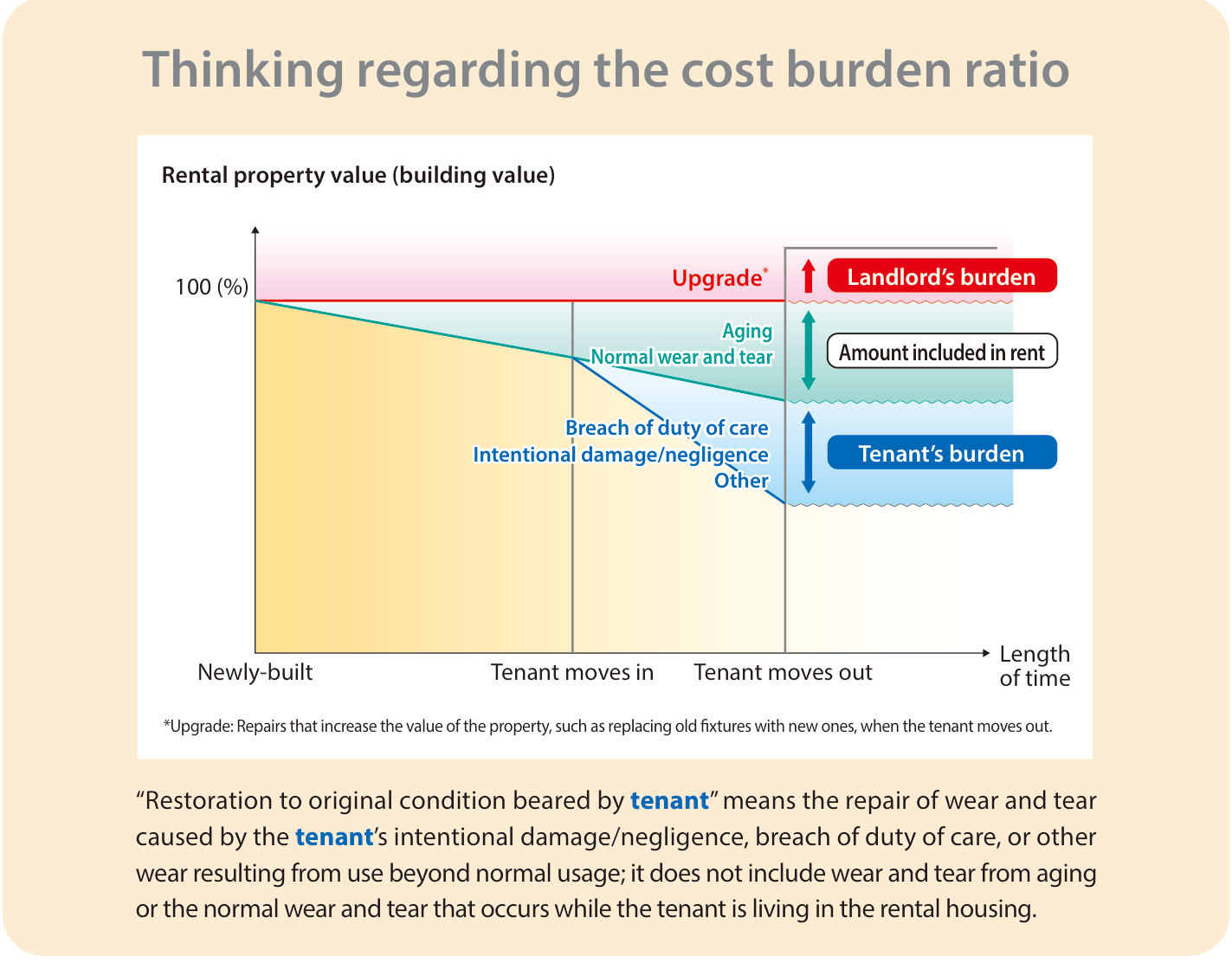
Sources: Ministry of Land, Infrastructure, Transport and Tourism “Key Points on Restoration to Original Condition When Moving Out of a Rental Home”
(Sources: e-Gov Laws and Regulations Search “Civil Code” Article 621, Ministry of Land, Infrastructure, Transport and Tourism “About the ‘Guidelines on Troubles Concerning Restoration to Original Condition'”)
How the Security Deposit Is Returned
The security deposit is money the tenant leaves with the landlord to make sure that rent and other payments are made. Under the Civil Code, when the home is returned and the contract ends, the landlord must return to the tenant what is left after taking out unpaid rent, restoration costs and other amounts from the security deposit.
- If you have not forgotten to pay rent and have used the home carefully, the security deposit is returned to you.
- If you damage or dirty the home or break equipment by using it badly, it is common to be asked to pay repair costs when you move out.
- If the repair costs are more than the security deposit, you need to pay the difference.
(Sources: e-Gov Laws and Regulations Search “Civil Code” Article 622-2, Ministry of Land, Infrastructure, Transport and Tourism “Key Points on Restoration to Original Condition When Moving Out of a Rental Home”)
Who Pays? Examples of Costs
The Ministry of Land, Infrastructure, Transport and Tourism’s guidelines give examples like the following (these are general examples and may change depending on what the contract says).
| Place | Examples paid by the landlord (normal wear and aging) | Examples paid by the tenant (carelessness, lack of care, etc.) |
|---|---|---|
| Walls (wallpaper) | Dark marks behind a refrigerator or TV (electrical burn marks), thumbtack and pin holes from hanging posters or calendars (small enough that the board underneath does not need to be replaced), color changes from sunlight, screw holes from an air conditioner you installed yourself | Tobacco tar stains and smells, nail and screw holes for hanging heavy things (where the board underneath needs to be replaced), graffiti, kitchen grease that was not cleaned, mold and stains that spread because condensation was left alone |
| Floors | Marks and dents from furniture, color changes in tatami mats or wooden flooring from sunlight | Scratches made while moving, stains and mold from drinks spilled on a carpet and not cleaned |
| Water areas and equipment | Breakdown of equipment because it reached the end of its life, replacing the bathtub or other items for the next tenant | Limescale and mold in the bathroom, toilet and washbasin caused by not cleaning, grease around the ventilation fan and stove |
| Pets | — | Damage and smells on pillars and walls caused by your pet |
| Keys | Changing the lock when you have not broken or lost the key | Replacement when you lost or broke the key |
| Whole home | Professional house cleaning (when the tenant cleaned normally) | Cleaning costs when you did not do everyday cleaning |
(Sources: Ministry of Land, Infrastructure, Transport and Tourism “Key Points on Restoration to Original Condition When Moving Out of a Rental Home”, Ministry of Land, Infrastructure, Transport and Tourism “Guidelines on Troubles Concerning Restoration to Original Condition (Second Revised Edition)” Chapter 1)
The Longer You Live There, the Less You Pay
Even for damage that the tenant has to pay for, it is common that the longer you have lived in the home, the smaller the tenant’s share becomes. This is because the aging part is considered to have already been paid as rent.
- For example, the guidelines show a way of calculating in which wallpaper and carpets “lose their value down to 1 yen in 6 years.”
- However, the guidelines say that the number of years you lived there is not considered for things such as changing the lock after losing the key or cleaning costs for not cleaning.
- Even for old equipment, you may have to pay the cost of returning it to a usable condition if you broke it on purpose or drew graffiti on it.
Be Careful About “Special Terms” in Your Contract
If your contract has “special terms” (tokuyaku: promises decided separately from the guidelines), your share of costs may be different from the guidelines. One example is a special term saying that the tenant pays for “house cleaning when moving out” or “air conditioner cleaning” no matter how the home was used.
- If you understood the special terms and agreed to them when you signed the contract, it is common for your share of costs to be decided according to those special terms.
- Before you sign a contract, ask the real estate agency right then about anything you do not understand regarding costs when moving out.
- If you have already signed a contract, first check what your current contract says.
(Sources: Ministry of Land, Infrastructure, Transport and Tourism “Key Points on Restoration to Original Condition When Moving Out of a Rental Home”, Ministry of Land, Infrastructure, Transport and Tourism “About the ‘Guidelines on Troubles Concerning Restoration to Original Condition'”, National Consumer Affairs Center of Japan (NCAC) “Be Careful About Troubles over Restoration of Rental Homes!”)
What to Do When Moving In, While Living There, and When Moving Out
When moving in
- Check whether there are scratches or dirt in the home and whether equipment such as the air conditioner works. If possible, together with the landlord, take photos that show the date and keep notes.
- The Ministry of Land, Infrastructure, Transport and Tourism publishes, in many languages, a “Checklist of Property Condition and Restoration at Move-in and Move-out (Example)” for writing down the condition of the home when you move in and when you move out.
- Tell the management company or landlord about scratches or problems that were already there.
While living there
- When equipment breaks, or when there is a roof leak or water leak, contact the landlord right away. As a rule, repairs needed for living in the home are made by the landlord.
- Do not find a repair company and ask for repairs yourself. If you do so without permission, you may have to pay part of the cost or it may lead to trouble.
- Before remodeling the home or installing an air conditioner, get permission from the landlord. An air conditioner you installed yourself must be removed when you move out.
- If mold or stains are left alone and spread, the tenant may have to pay for them. Clean and air out the home often.
When moving out
- In the same way as when you moved in, check the condition of the home while taking photos and keeping notes.
- When you receive the itemized settlement, compare it with the way of thinking in the guidelines, ask the landlord to explain any costs you do not understand, and talk it over.
(Sources: National Consumer Affairs Center of Japan (NCAC) “How to Deal with Troubles When Moving Out of a Rental Home: Steps You Can Take from the Time You Move In”, Ministry of Land, Infrastructure, Transport and Tourism “Key Points on Restoration to Original Condition When Moving Out of a Rental Home”, Ministry of Land, Infrastructure, Transport and Tourism “Smooth Move-in of Foreign Nationals to Private Rental Housing”)
When You Have a Problem / Frequently Asked Questions
I want to read the rules on restoration in my own language
The Ministry of Land, Infrastructure, Transport and Tourism publishes the leaflet “Key Points on Restoration to Original Condition When Moving Out of a Rental Home” and the checklist of the home’s condition in 14 languages (Japanese, English, Chinese, Korean, Spanish, Portuguese, Vietnamese, Nepali, Thai, Indonesian, Myanmar, Cambodian, Tagalog and Mongolian). You can read them from the page “Smooth Move-in of Foreign Nationals to Private Rental Housing.”
I cleaned the home well before leaving, but I was charged a cleaning fee
If a special term makes house cleaning the tenant’s cost and you understood and agreed to it when you signed the contract, it is common to pay even if you cleaned before leaving. If there is no special term, the example in the guidelines is that professional house cleaning is the landlord’s cost as long as the tenant cleaned normally. First check your contract.
I do not agree with the amount charged
First, ask the landlord to show you an itemized list of the costs, ask for an explanation, and talk it over. If that still does not solve the problem, or if it turns into a dispute, you can consult the Consumer Hotline (188) (a nationwide phone number that guides you to a nearby Consumer Affairs Center or similar office). Consultation desks at cities, wards, towns and villages may also give advice about housing. How to use 188 is explained in detail in Where to Get Help With Shopping and Contract Problems in Japan: Consumer Hotline 188, Consumer Affairs Centers and Cooling-off.
(Sources: National Consumer Affairs Center of Japan (NCAC) “Be Careful About Troubles over Restoration of Rental Homes!”, Ministry of Land, Infrastructure, Transport and Tourism “Guidelines on Troubles Concerning Restoration to Original Condition (Second Revised Edition)” Chapter 2)
Primary Sources Used for This Article
- e-Gov Laws and Regulations Search “Civil Code” (Article 621 and Article 622-2)
- Ministry of Land, Infrastructure, Transport and Tourism “About the ‘Guidelines on Troubles Concerning Restoration to Original Condition'”
- Ministry of Land, Infrastructure, Transport and Tourism “Guidelines on Troubles Concerning Restoration to Original Condition (Second Revised Edition)” Chapter 1
- Ministry of Land, Infrastructure, Transport and Tourism “Guidelines on Troubles Concerning Restoration to Original Condition (Second Revised Edition)” Chapter 2
- Ministry of Land, Infrastructure, Transport and Tourism and Japan Property Management Association “Key Points on Restoration to Original Condition When Moving Out of a Rental Home” (March, Reiwa 5)
- Ministry of Land, Infrastructure, Transport and Tourism “Smooth Move-in of Foreign Nationals to Private Rental Housing”
- National Consumer Affairs Center of Japan (NCAC) “How to Deal with Troubles When Moving Out of a Rental Home: Steps You Can Take from the Time You Move In” (February 21, 2025)
- National Consumer Affairs Center of Japan (NCAC) “Be Careful About Troubles over Restoration of Rental Homes!” (February 17, 2026)
This article is a translation of the original Japanese version.