This article was written by the NIPPON VISA & LIFE editorial team based on information from public organizations such as the national government and local governments. Rules and fees may differ depending on the city, ward, town or village where you live.
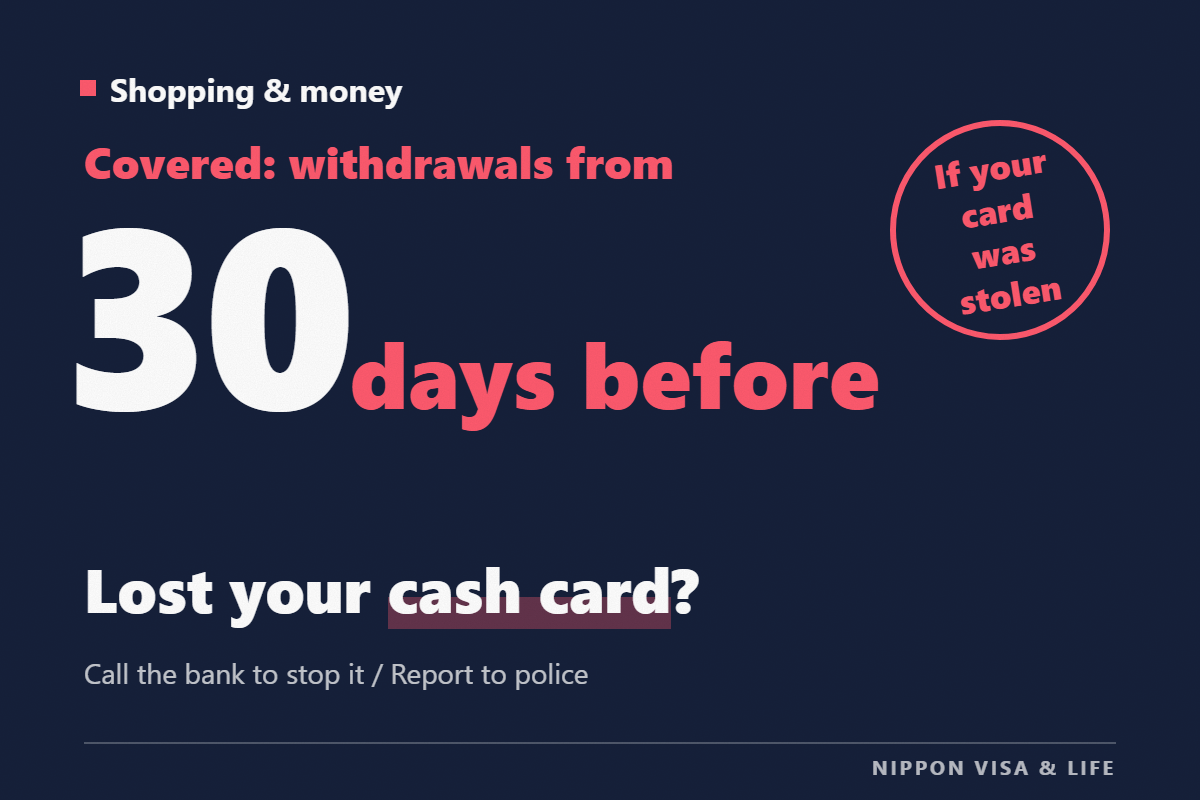
If your cash card (キャッシュカード: the card you use to put money in and take money out at a bank ATM) or bankbook is lost or stolen in Japan, contact your bank right away and have them stop the use of your card or account. Next, report it to the police. If money is withdrawn with a stolen card, you can ask the bank for compensation if certain conditions are met. For this reason too, the sooner you contact them, the better.
An overview of money and shopping in Japan is summarized in The Basics of Money and Shopping in Japan: Bank Accounts, Ways to Pay, Consumption Tax, Smartphone Contracts, Sending Money Abroad and Where to Get Help.
What to Do When Your Cash Card or Bankbook Is Lost or Stolen (4 Steps)
- Contact your bank and have them stop its use: Call the lost/stolen card contact number of the bank that issued the cash card or bankbook.
- Report it to the police: If you dropped (lost) it, submit a “lost property report” (遺失届, ishitsu todoke: a report that you have lost something). If it was stolen, report the theft to the police.
- Check whether any money has been withdrawn: Ask the bank whether any money was withdrawn before you contacted them. If money was withdrawn, tell the bank.
- Apply for a reissue at the bank: How to get a new card or bankbook, what you need and the fees differ by bank. Please ask your bank.
The Tokyo Metropolitan Police Department advises that if you lose a cash card, credit card or mobile phone, you should contact the card issuer, the mobile phone company and so on so that it is not misused. The Japanese Bankers Association also advises that if you become a victim, you should first stay calm and contact the police and the bank you deal with.
(Source: Tokyo Metropolitan Police Department “For People Who Have Lost Something”, Japanese Bankers Association “What If You Are a Victim of a Counterfeit or Stolen Cash Card Even Though You Protected Yourself?”)
1. Contact Your Bank and Have Them Stop the Use of Your Card or Account
How to Find Your Bank’s Contact Number for Lost or Stolen Cards
The contact number for lost or stolen cards differs from bank to bank. Find it in the following ways.
- Look at the Japanese Bankers Association’s list: The Japanese Bankers Association’s website has a list of each bank’s contact numbers for “lost or stolen bank cards” (Japanese Bankers Association “Lost or Stolen Bank Cards”).
- Search your bank’s website: Search for “(name of the bank) キャッシュカード 紛失” (cash card lost).
- For cards from Japan Post Bank, shinkin banks (信用金庫), labour banks (労働金庫), agricultural cooperatives (JA) and so on, contact the financial institution that issued the card.
When you call, things will go faster if you are ready to tell them your name, the branch where your account is, what you lost (card, bankbook, seal), and when and where it was lost or stolen. If it is difficult for you to call in Japanese, you can also ask a family member, friend or someone at your workplace who speaks Japanese to help you.
If You Have Also Lost Your Seal
If you have also lost the seal (印鑑, inkan: a personal stamp, also called hanko) that you registered with the bank, tell the bank about this too. Please also ask the bank about the procedure for changing your seal.
2. Report It to the Police
If You Dropped (Lost) It: Lost Property Report
- Where to submit it: At the nearest police station or police box (交番, koban). The Tokyo Metropolitan Police Department says you can submit the report at any police station or police box. However, it does not accept reports for items lost outside Japan.
- Submitting it online: Depending on the prefectural police, you can submit a lost property report online (choose your prefecture on the National Police Agency’s “Reporting and Searching for Lost Items” page). The National Police Agency advises that because online reports may take time to be accepted, you should go to a police station or police box if it is urgent.
- What to tell them: The date and time and place you lost it, what you lost (the name of the bank, the color and type of the card, etc.), and your name and contact information.
- If you lost it in a shop, station, etc.: The National Police Agency advises that if you think you lost it in a facility such as a station or a department store, you should also check with the manager of that facility whether it has been handed in.
When a cash card is handed in to the police, the card issuer (such as the bank) that received an inquiry from the police may contact you. If you are contacted, check which police station it was handed in to and the acceptance number of the lost item (according to the Tokyo Metropolitan Police Department).
(Source: National Police Agency “Reporting and Searching for Lost Items”, National Police Agency Lost Property Report Information Site “If You Lost Something in a Shop or Other Facility”)
Reporting to the Police When Your Cash Card or Bankbook Is Stolen
If it was stolen, for example your whole wallet was stolen or someone broke into your home, report it at the nearest police station or police box. When you ask the bank for compensation for money withdrawn with a stolen card, one of the conditions is to show facts that prove it was stolen, such as telling the bank that you reported it to the police (see “3” below).
3. Compensation If Money Is Withdrawn with a Stolen Card
What the Law Says About Compensation for Stolen Cards
Japan has a law to protect depositors when money is withdrawn from an ATM with a counterfeit card or a stolen cash card (the Act on the Protection of Depositors and Postal Savings Holders from Unauthorized Machine Withdrawals Using Counterfeit Cards and Stolen Cards (偽造カード等及び盗難カード等を用いて行われる不正な機械式預貯金払戻し等からの預貯金者の保護等に関する法律), also called the Counterfeit and Stolen Card Depositor Protection Act).
Under this law, if your cash card is stolen and you meet all 3 of the following conditions, you can ask the bank for compensation for the amount of money withdrawn (Article 5, Paragraph 1).
- After noticing the card was stolen, you promptly notified the bank that it was stolen
- When the bank asked, you fully explained the circumstances of the theft and so on
- You showed facts that prove it was stolen, such as telling the bank that you reported the theft to the police
Main Cases Where Compensation Is Reduced or Not Given
| Case | Amount of compensation (as set by law) |
|---|---|
| The depositor was not negligent (careless) | The full amount withdrawn |
| The bank proves that the depositor was negligent (careless) | 3/4 of the amount withdrawn |
| The bank proves that the depositor was grossly negligent, or that the money was withdrawn by the depositor’s spouse, a relative within the second degree of kinship, a relative living with the depositor, etc. | No compensation |
| The bank proves that the depositor lied about important matters when explaining to the bank | No compensation |
| The bank proves that the card was stolen by taking advantage of major disorder such as war or riots | No compensation |
(Rows 2, 3 and 4 apply when the bank also proves that it was not negligent itself. Also, there is no compensation if the bank proves that the withdrawal was not made with a stolen card, or that the depositor intentionally let the money be withdrawn. Article 5, Paragraphs 2 and 3)
The Japanese Bankers Association advises that if you carelessly hand your cash card to another person, or use a PIN (暗証番号, anshō bangō: the number you use at an ATM) that is easy for others to guess, the amount of compensation may be reduced or you may not receive compensation.
The 30-Day and 2-Year Time Limits for Asking for Compensation
- Compensation covers money withdrawn on or after the day 30 days before the day you notified the bank (Article 5, Paragraph 6). If you notice late, money withdrawn before that is not covered. If you prove there were unavoidable circumstances that prevented you from noticing, the period is extended by that amount of time.
- If you notify the bank more than 2 years after the day the card was stolen, you cannot receive compensation under this law (Article 7).
Is Money Withdrawn with a “Lost (Dropped)” Card Also Covered by the Law’s Compensation?
This law’s compensation rules (Article 5) apply when a card is “stolen.” If money is withdrawn after you dropped or lost your card, please check with your bank how it will be handled. In either case, it is important to contact your bank as soon as you notice.
Bankbooks and Internet Banking
The “cards, etc.” in this law include not only cash cards but also bankbooks (Article 2). If a stolen bankbook is used at an ATM, this is also covered by the law.
If money is withdrawn at a bank counter using a stolen bankbook, or if money is fraudulently transferred through internet banking, this law does not apply. However, on February 19, 2008, the Japanese Bankers Association agreed that banks will compensate for damage that occurred through no fault of the depositor, even if the bank was not negligent. When asking for compensation, you will be asked to contact the bank promptly, explain the circumstances, report to the police and so on. Please check the detailed conditions in the deposit rules of your bank.
(Source: e-Gov Law Search “Act on the Protection of Depositors and Postal Savings Holders from Unauthorized Machine Withdrawals Using Counterfeit Cards and Stolen Cards”, Japanese Bankers Association “Responding to Unauthorized Withdrawals of Deposits”)
Frequently Asked Questions and Things to Be Careful About
What If Someone Claiming to Be the “Police” or a “Bank” Says They Will Take Your Card?
The National Police Agency says that police officers and staff of bankers associations and the like will never ask for your PIN or have you put your cash card in an envelope. There is a scam in which someone claiming to be a police officer calls you saying “your card is being used fraudulently,” then comes to your home, swaps your card and steals it. Do not give your cash card or bankbook to anyone, and do not tell anyone your PIN. If something seems strange, hang up once, and call back a police station or bank number that you looked up yourself to check.
(Source: National Police Agency “Cash Card Theft Fraud”)
What If You Find Your Card Later After Stopping Its Use?
Even if you later find a card whose use you stopped, whether you can keep using it differs by bank. If you find it, contact your bank and ask what to do.
When You Return to Your Home Country or Stop Using Your Account
Giving or selling your account or cash card to someone else is a crime (Japanese Bankers Association “Responding to Financial Crime”). For how to handle your account when you return to your home country, see Closing Your Bank Account When You Leave Japan: What to Do with Your Remaining Money, and Why Giving Your Account to Someone Else Is a Crime. How to open a bank account is summarized in How to Open a Bank Account in Japan: What You Need, Why You May Not Be Able to Open One, and Telling Your Bank When Your Address or Period of Stay Changes.
Primary Sources Referred to in Writing This Article
- e-Gov Law Search “Act on the Protection of Depositors and Postal Savings Holders from Unauthorized Machine Withdrawals Using Counterfeit Cards and Stolen Cards”
- National Police Agency “Reporting and Searching for Lost Items”
- National Police Agency Lost Property Report Information Site “If You Lost Something in a Shop or Other Facility (Station, Hotel, Entertainment Facility, School, etc.)”
- Tokyo Metropolitan Police Department “For People Who Have Lost Something”
- National Police Agency “Cash Card Theft Fraud”
- Japanese Bankers Association “What If You Are a Victim of a Counterfeit or Stolen Cash Card Even Though You Protected Yourself?”
- Japanese Bankers Association “Responding to Unauthorized Withdrawals of Deposits”
- Japanese Bankers Association “Lost or Stolen Bank Cards”
- Japanese Bankers Association “Responding to Financial Crime”
This article is a translation of the original Japanese version.