This article was written by the NIPPON VISA & LIFE editorial team based on information from public organizations such as the national government and local governments. Rules and fees may differ depending on the city, ward, town or village where you live.
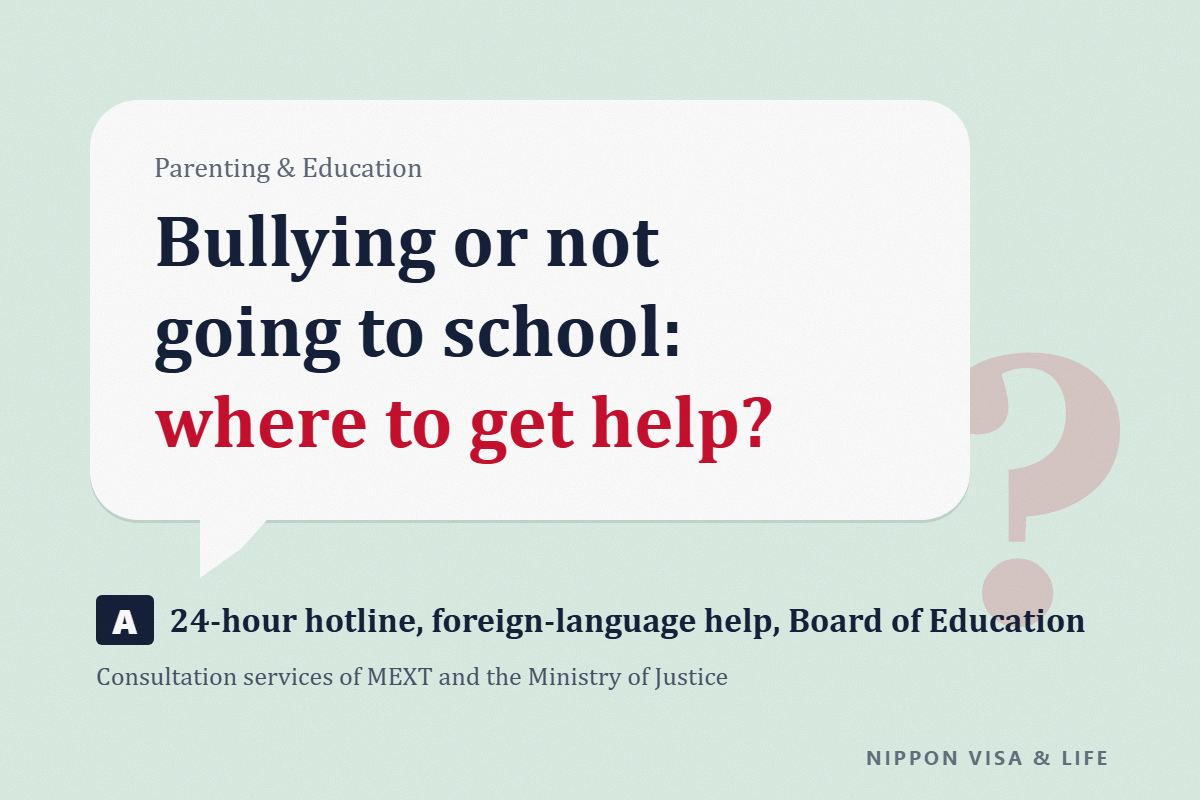
In Japan, if your child is being bullied at school or can no longer go to school, first talk to the school or to the Board of Education (教育委員会, kyoiku iinkai: the section of the city or other local government office in charge of public schools) in your area. If that is hard to do, you can call the 24-Hour Child SOS Dial (24時間子供SOSダイヤル) (0120-078310), which you can reach even at night and on holidays. If speaking Japanese is difficult for you, the Legal Affairs Bureau’s Foreign-Language Human Rights Counseling Dial (外国語人権相談ダイヤル) (0570-090-911) accepts consultations in 10 languages.
The Short Answer: How to Choose Where to Get Help
- First, talk to the school: besides the homeroom teacher, a school may have a “school counselor” (スクールカウンセラー), who is a specialist in mental health, and a “school social worker” (スクールソーシャルワーカー), who is a specialist in welfare
- When it is hard to tell the school, or at night and on holidays: the 24-Hour Child SOS Dial (0120-078310). Both children and parents can call
- For problems with children’s human rights, such as bullying or verbal abuse or violence by teachers: the Legal Affairs Bureau’s “Children’s Human Rights Hotline” (こどもの人権110番) (0120-007-110) or “LINE Human Rights Consultation” (LINEじんけん相談)
- When speaking Japanese is difficult: the Foreign-Language Human Rights Counseling Dial (0570-090-911) or Foreign-Language Online Human Rights Counseling (外国語インターネット人権相談)
- When your child continues to be unable to go to school (futoko, 不登校): the person in charge of school non-attendance consultations at the Board of Education. They can introduce you to places where your child can learn outside of school, such as an education support center
- In an urgent case involving a crime or an accident: call 110 or your nearest police station. Children who are troubled by bullying or by being the victim of a crime can also consult the juvenile consultation desk of the prefectural police
(Sources: MEXT “Consultation Desks for Children’s SOS”, Ministry of Justice “Human Rights Counseling for Foreign Nationals”, National Police Agency “Juvenile Consultation Desks of Prefectural Police”)
An overview of raising children and schools in Japan is in The Basics of Raising Children in Japan: Pregnancy and Childbirth Procedures, Child Allowance, Health Checkups and Vaccinations, Nursery Schools and Kindergartens, Elementary and Junior High Schools.
The Main National Consultation Desks in Japan
| Desk | Phone number, etc. | Hours | What you can consult about |
|---|---|---|---|
| 24-Hour Child SOS Dial (MEXT) | 0120-078310 | 24 hours a day, including nights and holidays | Any worry a child has, not only bullying |
| Children’s Human Rights Hotline (Ministry of Justice) | 0120-007-110 | Weekdays 8:30–17:15 | Problems with children’s human rights, such as bullying, corporal punishment and abuse at home |
| LINE Human Rights Consultation (Ministry of Justice) | On LINE, add “法務局LINEじんけん相談” (Legal Affairs Bureau LINE Human Rights Consultation) as a friend | Monday to Friday 8:30–17:15 | Same as above (consultation by chat) |
| Foreign-Language Human Rights Counseling Dial (Ministry of Justice) | 0570-090-911 | Weekdays 9:00–17:00 (except the New Year holidays) | Human rights consultations for people who cannot speak Japanese freely |
| Child Guidance Center Abuse Hotline “189” (Children and Families Agency) | 189 | 24 hours a day, 365 days a year | Reporting and consulting when you think a child may be being abused |
(Sources: MEXT “Telephone Consultation Desks”, MEXT “Social Media Consultation Desks”, Ministry of Justice “Children’s Human Rights Hotline”, Ministry of Justice “Human Rights Counseling for Foreign Nationals”)
Where to Get Help When Your Child Is Bullied
The 24-Hour Child SOS Dial
- The phone number is 0120-078310 (in Japanese, the digits can be read as “nayami iou”)
- You can call at any time, including at night and on holidays. As a rule, the call is connected to a consultation office of the Board of Education in the area you are calling from
- It accepts any SOS from children, not only about bullying but also about worries such as going to school or relationships with friends
- Not only children but also parents can consult
- You are told to call again as many times as needed, even if you cannot get through
(Sources: MEXT “About the 24-Hour Child SOS Dial”)
The Children’s Human Rights Hotline and LINE Human Rights Consultation (Legal Affairs Bureau)
- The Children’s Human Rights Hotline (0120-007-110) is a dedicated phone line for problems with children’s human rights, such as bullying at school, corporal punishment, inappropriate guidance such as verbal abuse by teachers, and abuse at home
- The call is connected to a nearby Legal Affairs Bureau (法務局, homukyoku: a regional office of the Ministry of Justice), where a bureau staff member or a human rights volunteer (人権擁護委員) listens to you
- Consultation is free, and your privacy is protected
- Not only children but also parents who are worried about their child can consult. You can also consult about “a child around me who is in trouble”
- Besides the phone, you can also consult by email, on LINE (Legal Affairs Bureau LINE Human Rights Consultation), or by letter (Children’s Human Rights SOS Mini-Letter, こどもの人権SOSミニレター)
(Sources: Ministry of Justice “Children’s Human Rights Hotline”, MEXT “Social Media Consultation Desks”)
When Speaking Japanese Is Difficult: Human Rights Counseling in Foreign Languages
- Foreign-Language Human Rights Counseling Dial: 0570-090-911. Weekdays 9:00–17:00 (except the New Year holidays)
- Languages available: English, Chinese, Korean, Filipino, Portuguese, Vietnamese, Nepali, Spanish, Indonesian and Thai
- The call is connected to a nearby Legal Affairs Bureau through a multilingual telephone interpretation company
- Foreign-Language Online Human Rights Counseling: you can send a consultation over the internet in the same 10 languages as above (go to the page Ministry of Justice “Human Rights Counseling for Foreign Nationals” and choose your language)
- The Ministry of Justice publishes a leaflet explaining the human rights counseling desks for foreign nationals in 10 languages
This number is a “Navi Dial” (ナビダイヤル: a phone number that starts with “0570” and can be called with the same number from anywhere in Japan). You are asked to be careful not to dial the wrong number.
(Sources: Ministry of Justice “Human Rights Counseling for Foreign Nationals”)
The Police Juvenile Consultation Desks
The police of each prefecture have a juvenile consultation desk (少年相談窓口) for families who are worried about their children and for children who are troubled by bullying or by being the victim of a crime. Phone numbers and email consultation differ by prefecture, so look for the desk of the prefecture where you live in the list on the National Police Agency’s page. For urgent incidents and accidents, call 110 or your nearest police station. How to call 110 is explained in How to Call the Police on 110 in Japan and When to Use 119 Instead: What to Say on the Phone, Reporting in Foreign Languages, and #9110 for Non-Emergency Consultations.
(Sources: National Police Agency “Juvenile Consultation Desks of Prefectural Police”)
Where to Get Help When Your Child Cannot Go to School (Futoko)
First, Talk to the School and the Board of Education
The model information sheet for parents presented by MEXT says that when school non-attendance continues, or when you are worried about your child’s learning or daily life, you should first consult the person in charge of school non-attendance consultations at the Board of Education. They listen to your worries about school life and can introduce you to places to learn inside and outside of school and to other places to consult.
You can find the consultation desks for school non-attendance in each prefecture on MEXT’s page “Local Consultation Desks for School Non-Attendance” by choosing your prefecture.
(Sources: MEXT “Local Consultation Desks for School Non-Attendance”, MEXT “Information Sheet for Parents” (PDF))
Places to Learn Inside and Outside of School
MEXT’s model information sheet introduces the following places and people. Whether they exist and how to use them differ by area, so ask the school or the Board of Education.
| Place or person | What it is |
|---|---|
| In-school education support center (校内教育支援センター) | A place inside the school, such as an empty classroom, that a child can use when, for example, they can go to school but cannot enter their own class |
| School counselor | A psychology specialist who cares for children’s mental health. Assigned or sent to schools and other places by the Board of Education |
| School social worker | A welfare specialist who, when welfare or medical support is needed, connects families to welfare desks and helps with procedures |
| Education support center (教育支援センター) | A place to learn run by the Board of Education. It offers learning and consultation tailored to each child. It is often located inside a public facility, and as a rule it is free to use |
| Free schools, etc. (フリースクール) | Places other than schools and education support centers where children who do not go to school study and do other activities during the day. If certain requirements are met, the time spent there can be treated as attendance and counted in grading at the school the child is enrolled in |
| Schools for diverse learning (学びの多様化学校) | Schools for children who find it hard to go to school, where children can learn flexibly, for example with fewer class hours than regular schools |
| Parents’ groups (保護者の会) | Places where parents of children who do not go to school exchange information and talk about their worries |
(Sources: MEXT “Information Sheet for Parents” (PDF))
When You Are in Trouble: Common Worries
Can I Consult the School Even If I Am Not Good at Japanese?
Ask the school or the Board of Education whether you can request an interpreter. For human rights problems (bullying, corporal punishment, etc.), you can consult in 10 languages at the Foreign-Language Human Rights Counseling Dial mentioned above. How to find a local Japanese class is explained in How to Find a Local Japanese Class in Japan: How to Look for Free or Low-Cost Classes, What to Check Before Signing Up, and Online Learning When You Cannot Attend.
Should I Tell My Child to Go to School?
MEXT’s model information sheet calls school non-attendance “something that can happen to anyone” and encourages parents not to worry alone but to consult someone. When you are unsure how to deal with your child, you can also consult the person in charge at the Board of Education or a school counselor.
(Sources: MEXT “Information Sheet for Parents” (PDF))
When Your Child Says “I Want to Die” or You Are Worried About Your Child’s Mental Health
MEXT’s page “Consultation Desks for Children’s SOS” lists desks where you can consult by phone or social media. Places where parents themselves can consult when they are struggling emotionally are listed in Where to Get Help in Japan When You Are Struggling Emotionally or Feel Mentally Unwell: Free Phone and Social Media Consultations, Desks Where You Can Talk in Foreign Languages, Public Health Centers and Mental Health and Welfare Centers.
(Sources: MEXT “Consultation Desks for Children’s SOS”)
When You Are Worried About Abuse at Home
When you think a child may be being abused, you can call the Child Guidance Center Abuse Hotline “189” (児童相談所虐待対応ダイヤル「189」). It is a nationwide number available 24 hours a day, 365 days a year, and you can report or consult with your nearest child guidance center.
(Sources: Children and Families Agency “Special Site for Promoting the Prevention of Child Abuse”, MEXT “Telephone Consultation Desks”)
I Want to Know How a Child of Foreign Nationality Can Enter School
The procedure for entering a public elementary or junior high school in Japan is explained in How to Enroll a Child of Foreign Nationality in an Elementary or Junior High School in Japan: Procedures, What to Bring and Costs for Entering a Public School.
Primary Sources Referenced in Writing This Article
- MEXT “Consultation Desks for Children’s SOS”
- MEXT “About the 24-Hour Child SOS Dial”
- MEXT “Telephone Consultation Desks”
- MEXT “Social Media Consultation Desks”
- MEXT “Local Consultation Desks for School Non-Attendance”
- MEXT “Information Sheet for Parents” (PDF)
- Ministry of Justice “Children’s Human Rights Hotline”
- Ministry of Justice “Human Rights Counseling for Foreign Nationals”
- National Police Agency “Juvenile Consultation Desks of Prefectural Police”
- Children and Families Agency “Special Site for Promoting the Prevention of Child Abuse”
This article is a translation of the original Japanese version.