This article was written by the NIPPON VISA & LIFE editorial team based on information from public organizations such as the national government and local governments. Rules and fees may differ depending on the city, ward, town or village where you live.
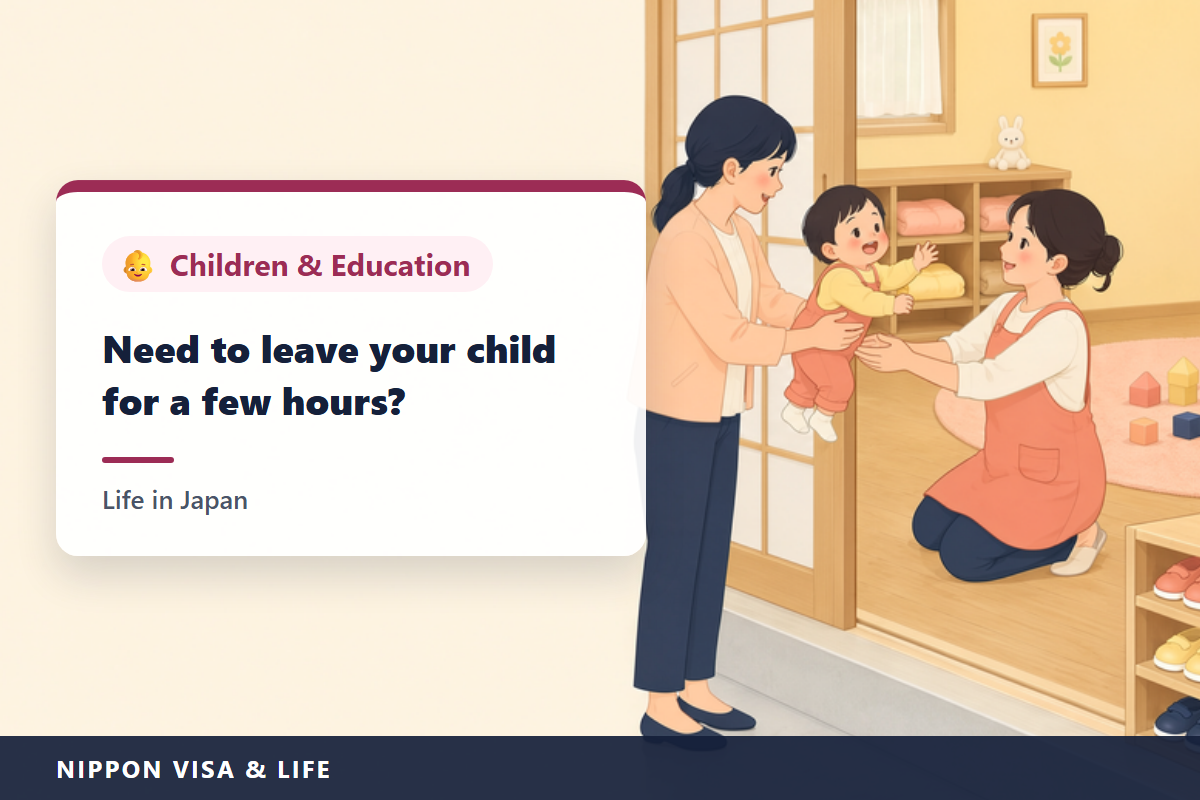
While raising children in Japan, on days when you go to the hospital or have a sudden errand, you may want someone to look after your child for just a short time. You can use temporary childcare (一時預かり, ichiji azukari), where nursery schools and other facilities look after children, and Family Support Centers (ファミリー・サポート・センター), where people in the local community look after children. For a Family Support Center, you need to register as a member in advance, and for temporary childcare, too, some facilities require you to register in advance. Check with your city, ward, town or village (市区町村) before you are in trouble.
For an overview of child-rearing procedures, see The Basics of Raising Children in Japan: Pregnancy and Birth Procedures, Child Allowance, Checkups and Vaccinations, Nursery Schools and Kindergartens, Elementary and Junior High School.
The Short Answer: Two Ways to Have Your Child Looked After for a Short Time
| Item | Temporary childcare | Family Support Center |
|---|---|---|
| Where children are looked after | Nursery schools, kindergartens, certified childcare centers (認定こども園, nintei kodomo-en), etc. | The home of the member who looks after the child, children’s centers (児童館, jidokan), etc. |
| Who looks after children | Staff of nursery schools and other facilities | Local members who have taken a training session |
| Main children | Children before entering elementary school (infants and young children) | From infants and young children to elementary school children |
| What they do | Look after children temporarily at the facility, mainly during the day | In addition to looking after children, take them to and from nursery schools, After-School Children’s Clubs, etc. |
| Where to apply | The nursery school or other facility you want to use (search the municipality’s list) | The municipality’s Family Support Center |
Both are run by municipalities. In some cases, an organization commissioned by the municipality operates them.
The flow until you start using them is roughly as follows.
- Check the municipality’s website: Search for “(name of your municipality) 一時預かり” or “(name of your municipality) ファミリー・サポート・センター.” If you cannot find the information, ask the municipality’s child-rearing office.
- Register: For temporary childcare, some facilities require an interview and registration in advance (example: in the case of Kumamoto City). For a Family Support Center, you need to register as a member, and you may also have to take a training session (example: in the case of Kumamoto City).
- Make a reservation: When you have decided the day you want to use the service, apply to the facility or the center.
- Leave your child: Follow the facility’s or the center’s instructions on what to bring.
(Source: Children and Families Agency, “Implementation of the Temporary Childcare Program (Notice)”, Children and Families Agency, “Family Support Center Program”)
What Temporary Childcare Is: A System Where Nursery Schools and Other Facilities Look After Children for a Short Time
Temporary childcare is a system in which nursery schools and other facilities look after infants and young children (乳幼児, nyuyoji: children before entering elementary school) when it is temporarily difficult to look after them at home. Under the national rules, its purposes include the following situations.
- When something sudden happens in daily life, such as an urgent errand
- When you take part in society, such as work or community activities
- When you want to reduce tiredness from child-rearing and lighten the mental and physical burden on parents
The general type (in the table below) is mainly for children who do not attend a nursery school, kindergarten, certified childcare center, etc. The kindergarten type is for children who attend a kindergarten or similar facility. According to materials from the Children and Families Agency, in FY2023 it was provided at 10,908 locations nationwide, and children used it a total of 3,855,873 times.
Types of Temporary Childcare
According to national materials, there are several types of temporary childcare.
| Type | Details |
|---|---|
| General type | Nursery schools and other facilities temporarily look after infants and young children who cannot be looked after at home |
| Spare-capacity type | When a nursery school or other facility has vacancies within its capacity, it uses those vacancies to look after children |
| Kindergarten type | Looks after children who attend a kindergarten or certified childcare center before and after education hours and on long holidays (sometimes called “預かり保育,” azukari hoiku) |
| Home-visit type | Looks after children at their home when, for example, group childcare is difficult because of a disability or illness |
In addition, there is a “disaster special type” that looks after children from families affected by a disaster in areas where the Disaster Relief Act has been applied. Under the national rules, parents are not asked to pay fees in this case.
(Source: Children and Families Agency, “Implementation of the Temporary Childcare Program (Notice)”, Children and Families Agency, “Basic Materials (Enhancing Childcare to Meet Diverse Needs ② (Sick Child Care, Extended Childcare, Temporary Childcare, etc.))”)
How to Use Temporary Childcare and Examples of Fees (in the Case of Kumamoto City)
The number of days you can use it, the fees and how to apply differ depending on the municipality and the facility. Here, we introduce Kumamoto City’s information as an example.
- Reasons you can use it: Example: In the case of Kumamoto City, when you cannot look after your child at home because of the parents’ work or illness, caring for a sick family member, ceremonial occasions (冠婚葬祭, kankon sosai: weddings, funerals, etc.) and so on.
- Number of days you can use it: Example: In the case of Kumamoto City, up to 13 days a month (about 3 days a week). At public nursery schools, when you use it for rest (refreshing yourself), it is up to 5 days a month.
- Who can use it: Example: In the case of Kumamoto City, infants and young children who are not enrolled in a nursery school, a certified childcare center or a community-based childcare program (地域型保育事業, chiikigata hoiku jigyo: small-scale childcare facilities).
- Fee: Example: In the case of Kumamoto City, about 2,000 yen per day, and it differs depending on the nursery school or other facility.
- How to apply: Example: In the case of Kumamoto City, you have an interview at the nursery school or other facility in advance and register. Depending on how many children they can accept, they may not be able to look after your child.
Some municipalities post a list of nursery schools and other facilities that offer temporary childcare on their websites (example: in the case of Kumamoto City, there is a mark in the “一時預かり” column of the list of childcare facilities). Find a facility near you on the list and contact the facility directly.
(Source: Kumamoto City, “Temporary Childcare”)
What a Family Support Center Is: A System for Having Local People Look After Your Child
A Family Support Center (sometimes called “ファミサポ,” famisapo) is a system in which people who want someone to look after their child and people who want to look after children become members and help each other in the local community. An advisor at the center connects the members with each other.
| Type of member | Details |
|---|---|
| Requesting member (依頼会員, irai kaiin) | A person who wants someone to look after their child |
| Providing member (提供会員, teikyo kaiin) | A person who looks after children. Depending on the municipality, they are called “協力会員” (cooperating member) (example: Kumamoto City) or other names |
| Dual member | A person who is both |
According to materials from the Children and Families Agency, in FY2024 the program was provided in 1,009 municipalities. There are about 600,000 requesting members, about 140,000 providing members and about 40,000 dual members.
What You Can Do Through a Family Support Center
Under the national rules, the help includes, for example, the following.
- Looking after children before a nursery school opens or after it closes
- Taking children to and from nursery schools and other facilities or After-School Children’s Clubs
- Looking after children after the After-School Children’s Club closes or after school
- Looking after children during ceremonial occasions or school events of the parent’s other children
- Looking after children when the parent goes out, for example, to go shopping
Children are looked after in a place where their safety can be ensured, such as the member’s home or a children’s center. The members discuss and decide the place. In principle, one providing member looks after one child. Some centers also handle sick children or urgent care early in the morning or at night.
Under the national rules, the center takes out compensation insurance in case a child has an accident while being looked after. Providing members take lifesaving training and training on preventing accidents.
(Source: Children and Families Agency, “Overview of the Child-Rearing Support Activity Program (Family Support Center Program)”, Children and Families Agency, “Implementation of the Child-Rearing Support Activity Program (Family Support Center Program)”)
Family Support Center Registration and Examples of Fees (in the Case of Kumamoto City)
Under the national rules, the fee (a thank-you payment to the person who looks after the child) is in principle decided between the members, but some centers set a standard amount. Here, we introduce Kumamoto City’s information as an example.
Who can become a requesting member (example: in the case of Kumamoto City)
- People who live in Kumamoto City, or who work or go to school in Kumamoto City
- People who have a child from 3 months old (6 months old for sick children) to 6th grade of elementary school
- People who can attend a training session of about 2 hours
Fees (example: in the case of Kumamoto City, per hour)
| Time | Fee | Sick child |
|---|---|---|
| Weekdays, 7 a.m. to 7 p.m. | 600 yen | 900 yen |
| Early morning (before 7 a.m.) and night (after 7 p.m.) | 700 yen | 1,000 yen |
| Saturdays, Sundays, national holidays and the year-end and New Year holidays | 700 yen | 1,000 yen (for sick children, Saturdays only) |
Example: In the case of Kumamoto City, to use the service, you apply to the secretariat in advance and register as a member. Training sessions for requesting members are held about 1 to 2 times a month, and your child may be looked after during the session (the number of children is limited).
It may take time from registration until you can actually use the service, so if you think you may need it, register early.
(Source: Kumamoto City, “Family Support Center <Kumamoto>”)
Systems That Reduce the Cost of Temporary Childcare and Family Support Centers
For children aged 3 to 5 and some others, if you have received a certification of the need for childcare (保育の必要性の認定) from the municipality, the fees for temporary childcare and Family Support Centers may be covered by free early childhood education and childcare (幼児教育・保育の無償化) up to a set limit. This applies to children who are not able to use a nursery school, certified childcare center or similar facility.
Example: In the case of Kumamoto City, you first pay the fee, and then apply to the city later with the receipts and other documents, and all or part of the amount you paid is returned to you (reimbursement: 償還払い, shokan barai).
The limits and procedures are summarized in Kindergartens, Nursery Schools and Certified Childcare Centers in Japan: The Differences, Free Preschool Education and Childcare, Which Families Can Use Them, How to Apply, and the Monthly Limits on Free Use Raised in October 2026. Some municipalities help with fees for single-parent families and others, so ask at your municipality’s office.
(Source: Children and Families Agency, “Free Early Childhood Education and Childcare”, Kumamoto City, “About Free Early Childhood Education and Childcare”)
When You Have Trouble: Frequently Asked Questions
Can I Use Temporary Childcare or a Family Support Center When I Suddenly Need It on the Same Day?
Sometimes you can, but you cannot use a Family Support Center unless you have registered as a member. For temporary childcare, too, some facilities require you to register in advance. You may be turned down depending on how many children the facility can accept (temporary childcare) or whether a member is available to look after your child (Family Support Center). It is reassuring to register in advance, before you are in trouble.
Can I Leave My Child with Temporary Childcare or a Family Support Center When My Child Is Sick?
Whether you can leave a sick child differs depending on the facility, so check when you apply. Some municipalities have “sick child care” (病児保育, byoji hoiku), which looks after sick children, and Family Support Centers that handle sick children. On the municipality’s website, search for “病児保育.”
What Should I Do If I Want Someone to Look After My Child Overnight or for Several Days in a Row?
There is the “Short-Term Child-Rearing Support Program (Short Stay)” (子育て短期支援事業, ショートステイ), in which a children’s home or similar facility looks after a child for a certain period when it is temporarily difficult to raise the child at home because of the parent’s illness or other reasons. Whether it is provided and the conditions for using it differ depending on the municipality. Ask at your municipality’s child-rearing office.
Can I Use Temporary Childcare Because I Am Tired from Child-Rearing?
Under the national rules, reducing tiredness from child-rearing and lightening the mental and physical burden on parents is also one of the purposes of temporary childcare. However, some municipalities set the number of days you can use it for each reason (example: at public nursery schools in Kumamoto City, when you use it for rest, it is up to 5 days a month).
Can I Apply for Temporary Childcare or a Family Support Center If I Am Not Good at Japanese?
Applications are often in Japanese. The municipality’s international exchange office or a consultation desk for foreign residents may be able to help you. To find such an office, search for “外国人 相談” on the municipality’s website.
Places Where You Can Get Advice on Child-Rearing
If you are not sure which service to use, you can get advice at the following places.
- The municipality’s child-rearing office: The name differs depending on the municipality, such as the Child-Rearing Support Division or the Childcare Division.
- Children and Families Center (こども家庭センター): A municipal organization where you can talk about your worries about child-rearing.
- Local child-rearing support center (地域子育て支援拠点, chiiki kosodate shien kyoten): A place where parents and children who are raising children gather and interact, and where you can talk about your worries and concerns about child-rearing. You can also get information about child-rearing in the local area.
If you want someone to look after your elementary school child every day after school or during summer vacation, see How to Apply for an After-School Children’s Club (Gakudo) in Japan: Which Children Can Use It, When to Apply, Required Documents and Fees.
(Source: Children and Families Agency, “Local Child-Rearing Consultation Organizations”, Children and Families Agency, “About the Local Child-Rearing Support Center Program”, Children and Families Agency, “About the Short-Term Child-Rearing Support Program”)
Primary Sources Referenced in This Article
- Children and Families Agency, “Implementation of the Temporary Childcare Program (Notice)”
- Children and Families Agency, “Basic Materials (Enhancing Childcare to Meet Diverse Needs ② (Sick Child Care, Extended Childcare, Temporary Childcare, etc.))”
- Children and Families Agency, “Family Support Center Program”
- Children and Families Agency, “Overview of the Child-Rearing Support Activity Program (Family Support Center Program)”
- Children and Families Agency, “Implementation of the Child-Rearing Support Activity Program (Family Support Center Program)”
- Children and Families Agency, “About the Short-Term Child-Rearing Support Program”
- Children and Families Agency, “Local Child-Rearing Consultation Organizations”
- Children and Families Agency, “About the Local Child-Rearing Support Center Program”
- Children and Families Agency, “Free Early Childhood Education and Childcare”
- Kumamoto City, “Temporary Childcare”
- Kumamoto City, “Family Support Center <Kumamoto>”
- Kumamoto City, “About Free Early Childhood Education and Childcare”
This article is a translation of the original Japanese version.