This article was written by the NIPPON VISA & LIFE editorial team based on information from public organizations such as the national government and local governments. Rules and fees may differ depending on the city, ward, town or village where you live.
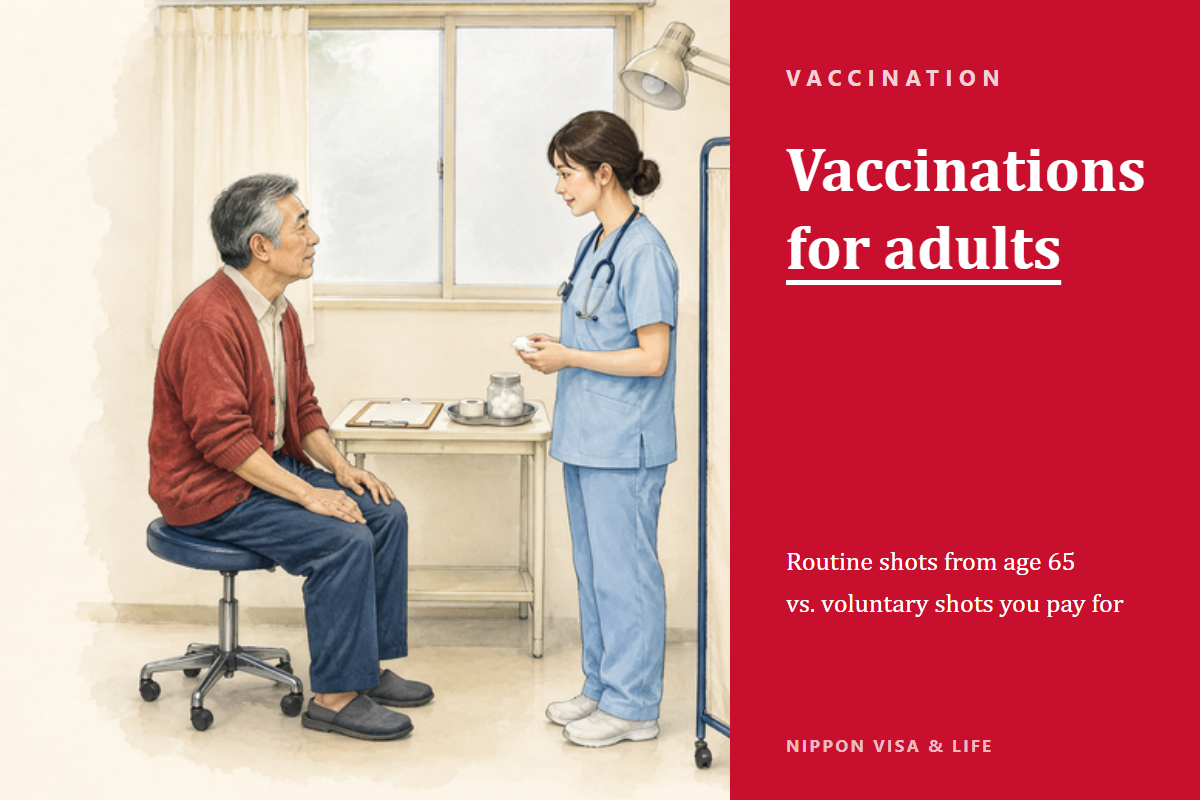
In Japan, vaccinations for adults are either “routine vaccinations” (定期接種, teiki sesshu) set by law or “voluntary vaccinations” (任意接種, nin’i sesshu) that you choose to get yourself. Routine vaccinations for adults are mainly for people aged 65 and over, and the city, ward, town or village (municipality) pays part of the cost. Whether you are eligible and how much you have to pay yourself should be checked on the website or at the counter of the municipality where you are registered as a resident.
This article explains the vaccination system and how to get vaccinated. It does not tell you which vaccines you should get. Please talk with a doctor to decide whether to get vaccinated. For children’s vaccinations, see Children’s Vaccinations in Japan: Free Routine Vaccinations, Types, Timing, How to Get Them and What to Bring. For the basics of medical care in general, see When You Are Sick or Injured in Japan: The Basics of Hospitals, Ambulances, Medicine, Medical Insurance and Where to Get Advice.
The Short Answer: The Difference Between Routine Vaccinations and Voluntary Vaccinations
| Routine vaccinations (those for people aged 65 and over and others are Category B) | Voluntary vaccinations | |
|---|---|---|
| What kind of vaccination | Vaccinations set by the Immunization Act (予防接種法) | Vaccinations that are not routine vaccinations, including vaccinations received outside the eligible age or period |
| Cost | The municipality pays part. How much you pay yourself differs by municipality | As a rule, you pay the full cost yourself. The price differs by medical institution |
| Whether to get it | There is no obligation to make an effort to get it. People who want it get it | People who want it get it |
| If health damage occurs | The relief system under the Immunization Act | It may be covered by the Relief System for Adverse Drug Reactions or other systems |
- The routine vaccinations for people aged 65 and over and others (the 4 below) are placed by law in a category called “Category B diseases” (B類疾病). For Category B vaccinations, there is no obligation to make an effort to get them. They are vaccinations that eligible people get if they wish.
- You get routine vaccinations through the municipality where you are registered as a resident. Example: In Yokohama City, the condition for eligibility is being registered as a resident in Yokohama City.
- If you get a vaccination after the eligible age or period has passed, it becomes a voluntary vaccination (you pay the full cost).
Types of Routine Vaccinations Adults Can Get and Who Is Eligible
According to the Ministry of Health, Labour and Welfare, the routine vaccinations for people aged 65 and over and others are the following 4. Other vaccinations are also routine vaccinations, such as the RSV vaccine for pregnant women (from week 28 to week 36 of pregnancy), but this article does not cover them.
| Vaccine | Who is eligible | Number of times |
|---|---|---|
| Influenza | People aged 65 and over, and others | Once every fiscal year |
| COVID-19 | People aged 65 and over, and others | Every fiscal year (from October in fiscal year 2026) |
| Pneumococcal (for older adults) | People aged 65, and others | Once |
| Shingles (帯状疱疹, taijo hoshin) | People who turn 65 in that fiscal year, and others | Once for the live vaccine, twice for the recombinant vaccine |
- “Others” includes people aged 60 to 64 who have a disability in the function of the heart, kidneys or respiratory system and whose daily self-care is extremely limited, and people whose immune function is impaired by HIV so that they can hardly carry out daily life (for shingles, among people aged 60 to 64, only people with an impairment caused by HIV are eligible).
- How eligibility is decided differs by vaccine. For shingles, it is decided by the age you turn within the “fiscal year” (from April 1 to March 31 of the following year). Example: In Yokohama City, for the pneumococcal vaccine, you are eligible from your 65th birthday to the day before your 66th birthday. Please check your municipality’s information to see whether you are eligible.
Influenza: Once Every Fiscal Year
- The routine vaccination is once every fiscal year.
- The Ministry of Health, Labour and Welfare says it is desirable to get it before the flu season starts.
- The vaccination period is decided by each municipality.
COVID-19: From October in Fiscal Year 2026
- For fiscal year 2026, local governments have been giving the routine vaccination since October 2026.
- As a rule, there is a fee.
Pneumococcal: Only Once per Person
- The routine vaccination is once. From April 2026, the vaccine used changed to the “20-valent pneumococcal conjugate vaccine (PCV20).” The people who are eligible have not changed.
- People who have had pneumonia or a pneumococcal infection in the past are also eligible for the routine vaccination.
- You can get it as a routine vaccination only once in your life. If someone who already got it as a routine vaccination gets a second dose, it becomes a voluntary vaccination (you pay the full cost).
Shingles: A Routine Vaccination Since Fiscal Year 2025
- It became a routine vaccination from fiscal year 2025. People who turn 65 in that fiscal year are eligible.
- For the 5 years from fiscal year 2025 to fiscal year 2029, people who turn 70, 75, 80, 85, 90, 95 or 100 in that fiscal year are also eligible (a transitional measure: a rule that temporarily widens who is eligible).
- There are 2 types of vaccine, the “live vaccine” and the “recombinant vaccine,” and you get one of the 2 types. The live vaccine is given once, and the recombinant vaccine is given twice, at least 2 months apart.
- Decide which vaccine to get after talking with a doctor.
How to Get a Routine Vaccination: Notices, Reservations and What to Bring
- Check the information from your municipality: Some municipalities send eligible people a notice and a pre-vaccination questionnaire (予診票, yoshinhyo: a form on which you write about your physical condition and other things before the vaccination). For influenza and some other vaccines, some municipalities do not send questionnaires to your home but keep them at medical institutions.
- Find a medical institution that gives the vaccination and make a reservation: The municipality’s website has a list of participating medical institutions. A reservation may be required, so ask the medical institution first.
- What to bring on the day: The pre-vaccination questionnaire, and something that shows your address, name and date of birth (such as your My Number card or driver’s license; whatever is listed in your municipality’s information). People aged 60 to 64 who are eligible should also bring a document that shows the degree of their disability (such as a physical disability certificate, 身体障害者手帳).
- See a doctor for a check (予診, yoshin: pre-vaccination examination) before getting the vaccination. If you have a fever that day, for example, you may not be able to get it.
- Pay your share of the cost at the medical institution. People who are exempt from the cost give the document for that to the medical institution.
- Keep the “vaccination certificate” (予防接種済証, yobo sesshu sumisho). Example: In Yokohama City, for the second dose of the recombinant shingles vaccine, you bring the vaccination certificate from the first dose.
In some municipalities, if you get vaccinated at a medical institution that is not participating, it is not treated as a routine vaccination. As a rule, get vaccinated at a medical institution listed in your municipality’s information. If you want to get vaccinated at another medical institution, talk to your municipality first.
Examples of Out-of-Pocket Costs: The Case of Yokohama City (Fiscal Year 2026)
The amount you pay yourself differs by municipality. Here, as an example, we show Yokohama City’s amounts for fiscal year 2026 (based on Yokohama City’s page updated on November 1, 2026).
| Vaccine | Out-of-pocket cost in Yokohama City |
|---|---|
| Influenza (for older adults) | 2,300 yen |
| Pneumococcal (PCV20) | 5,000 yen |
| Shingles (live vaccine) | 4,000 yen |
| Shingles (recombinant vaccine) | 10,000 yen per dose (20,000 yen for 2 doses) |
- Example: In Yokohama City, people in households where every member, including themselves, is exempt from municipal tax, people receiving public assistance (生活保護, seikatsu hogo) and others are exempt from the out-of-pocket cost if they give the required documents to the medical institution.
- Example: In Yokohama City, the period for the routine influenza vaccination is until December 31, 2026, and for shingles it is until March 31, 2027. After the period ends, you pay the full cost yourself.
- To find the amounts in your municipality, search with words such as “(name of your municipality) 高齢者 インフルエンザ 予防接種” or “(name of your municipality) 帯状疱疹ワクチン” and check your municipality’s website.
Adult Vaccinations That Are Not Covered as Routine Vaccinations (Voluntary Vaccinations)
People who are not eligible for routine vaccinations can also get vaccinated at medical institutions. These are voluntary vaccinations.
- As a rule, you pay the full cost yourself, and the price differs by medical institution.
- Whether voluntary vaccinations are offered differs by medical institution. Ask the medical institution where you want to get vaccinated directly.
- Some municipalities have their own programs that help pay for voluntary vaccinations.
- Example: In Yokohama City, women who wish to become pregnant, their partners, family members living with them and others can get a rubella antibody test (a blood test) for free and the measles-rubella combined vaccine for 3,300 yen per dose (this program can be used only once; you cannot get the vaccine while pregnant).
Pre-Vaccination Questionnaires in Foreign Languages and Places Where You Can Ask Questions in Foreign Languages
- The Public Interest Incorporated Foundation Vaccination Research Center (予防接種リサーチセンター) has translated the pre-vaccination questionnaire forms set out in national notices into 17 languages, including English, Chinese, Korean, Vietnamese, Portuguese, Thai, Indonesian, Tagalog and Nepali, and makes them available online.
- Some municipalities use the foreign-language questionnaires as samples to help you understand the content. Example: In Yokohama City, residents are told to look at the English or Chinese sample and always copy their answers onto the official questionnaire.
- Example: In Yokohama City, the Yokohama City Vaccination Call Center (phone 045-330-8561; 9:00 to 17:00; closed on Saturdays, Sundays, national holidays and the New Year holidays) answers questions about the city’s routine vaccinations in Japanese, English, Chinese, Korean, Vietnamese and Nepali. It does not answer questions about reservations at medical institutions or vaccine stock.
- For how to find medical institutions where you can be seen in a foreign language, see How to Find a Hospital in Japan Where You Can Be Seen in a Foreign Language: Searching for Medical Institutions on Medical Information Net (Navii) and the JNTO Website, Phone Services That Guide You to Medical Institutions, Medical Interpreters and Multilingual Medical Questionnaires.
When You Have Trouble and Frequently Asked Questions
What If the Pre-Vaccination Questionnaire Does Not Arrive or You Have Just Moved Here?
If the questionnaire does not arrive, or if you have moved from another municipality, ask the vaccination section of the municipality where you live (such as a public health center, 保健所 or 保健センター). Example: In Yokohama City, people who do not have a questionnaire because they moved in or for another reason receive one at the Health and Welfare Division (福祉保健課) of their ward office, bringing an identity document.
Can You Get the Same Vaccination Twice in One Fiscal Year?
The routine influenza vaccination is once every fiscal year. Example: In Yokohama City, if you get it twice, you pay the full cost of the second one yourself. The routine pneumococcal vaccination is only once in your life. If you do not know whether you got it before, look for your vaccination certificate or ask at your municipality’s counter.
What If You Feel Unwell Because of Side Effects?
If you have symptoms that worry you after the vaccination, contact the medical institution where you were vaccinated.
- If health damage occurs from a routine vaccination and the Minister of Health, Labour and Welfare recognizes that it was caused by the vaccination, the municipality pays medical costs and other benefits under the relief system of the Immunization Act. For the procedure, consult the municipality where your resident record (住民票, juminhyo) was registered when you were vaccinated.
- For voluntary vaccinations, you may be covered by the Relief System for Adverse Drug Reactions of the Pharmaceuticals and Medical Devices Agency (PMDA), an incorporated administrative agency.
Primary Sources Referenced in Article Creation
- Ministry of Health, Labour and Welfare “Vaccination and Vaccine Information”
- Ministry of Health, Labour and Welfare “Influenza Vaccine (Seasonal)”
- Ministry of Health, Labour and Welfare “About COVID-19 Vaccines”
- Ministry of Health, Labour and Welfare “Pneumococcal Vaccine for Older Adults”
- Ministry of Health, Labour and Welfare “RSV Vaccine”
- Ministry of Health, Labour and Welfare “Shingles Vaccine”
- Ministry of Health, Labour and Welfare “Relief System for Health Damage from Vaccinations”
- e-Gov Laws and Regulations Search “Immunization Act”
- Vaccination Research Center “Pre-Vaccination Questionnaires in Foreign Languages”
- Yokohama City “Routine Influenza Vaccination for Older Adults”
- Yokohama City “Pneumococcal Vaccine for Adults (Routine Vaccination)”
- Yokohama City “Shingles Vaccination (Including the Transitional Measure for Fiscal Years Reiwa 7 to 11)”
- Yokohama City “Yokohama City Rubella Prevention Program (Rubella Vaccination and Antibody Testing for Women Who Wish to Become Pregnant and Others)”
This article is a translation of the original Japanese version.