This article was written by the NIPPON VISA & LIFE editorial team based on information from public organizations such as the national government and local governments. Rules and fees may differ depending on the city, ward, town or village where you live.
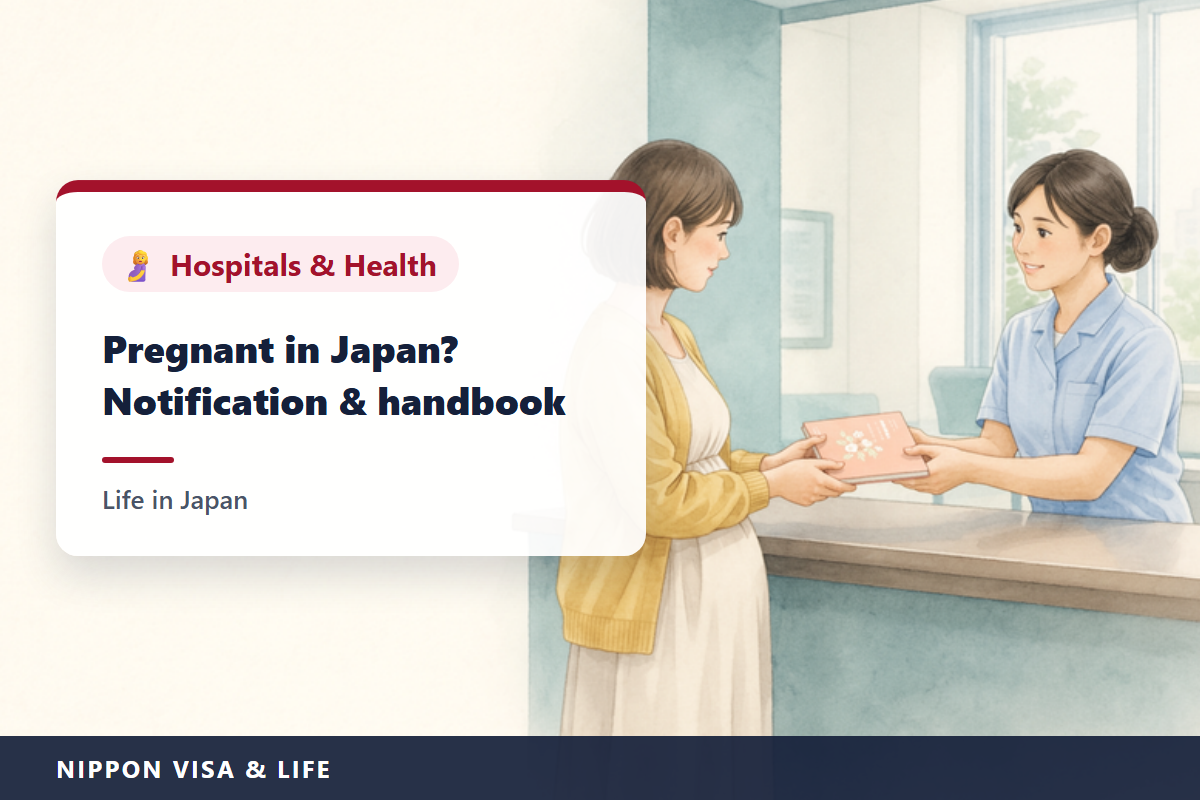
When you find out you are pregnant in Japan, first see an obstetrician-gynecologist, and then submit a pregnancy notification (妊娠の届出, ninshin no todokede) at the counter of the city, ward, town or village where you live. When you submit the notification, you receive a Maternal and Child Health Handbook (母子健康手帳, boshi kenko techo) and checkup vouchers (受診票, jushinhyo; also called subsidy tickets) used to subsidize the cost of prenatal checkups. You can also apply for the Support Benefit for Pregnant Women (妊婦のための支援給付, a cash benefit) at the relevant counter of the municipality where your resident record (juminhyo) is registered.
This article explains the procedures from pregnancy until childbirth. Procedures for raising children in general are summarized in The Basics of Raising Children in Japan: Pregnancy and Birth Procedures, Child Allowance, Checkups and Vaccinations, Nursery Schools and Kindergartens, Elementary and Junior High School, and the basics of going to a hospital are summarized in When You Are Sick or Injured in Japan: The Basics of Hospitals, Ambulances, Medicine, Medical Insurance and Where to Get Advice.
The Short Answer: The Flow of Procedures from Finding Out You Are Pregnant to Childbirth
- When you find out you are pregnant, or think you might be pregnant, see a doctor at an obstetrics and gynecology hospital or clinic as early as possible
- After you are diagnosed as pregnant, submit a pregnancy notification at the counter of the city, ward, town or village where you live
- At the counter, receive the Maternal and Child Health Handbook and the prenatal checkup vouchers. At that time, you will have an interview with a public health nurse or other staff
- Apply to your city, ward, town or village for the Support Benefit for Pregnant Women
- Use the vouchers to have regular prenatal checkups (health checkups during pregnancy)
- Look for a hospital or midwifery home where you will give birth, and book your delivery
| What to do | Where | What you receive / what you can do |
|---|---|---|
| Diagnosis of pregnancy | Obstetrics and gynecology hospital or clinic | You find out whether you are pregnant and your expected due date |
| Pregnancy notification | Counter of the city, ward, town or village where you live | Maternal and Child Health Handbook, prenatal checkup vouchers, interview with a public health nurse or other staff |
| Application for the Support Benefit for Pregnant Women | Relevant counter of the municipality where your resident record is registered | 50,000 yen after you are certified for the benefit for pregnant women. From 8 weeks before your expected due date, the number of babies you are carrying × 50,000 yen |
| Prenatal checkups | Hospital, clinic or midwifery home | Checks on the health of the mother and baby during pregnancy. The city, ward, town or village subsidizes part of the cost |
The Pregnancy Notification: When, Where and What to Bring
The Pregnancy Notification Is Submitted to the City, Ward, Town or Village by the Pregnant Person
Under Japanese law (the Maternal and Child Health Act, 母子保健法), a pregnant person is required to submit a pregnancy notification to the city, ward, town or village promptly. The city, ward, town or village gives a Maternal and Child Health Handbook to the person who submitted the notification.
The name of the counter where you submit the notification differs depending on the city, ward, town or village. You can find the counter by searching the city, ward, town or village website for “妊娠届” (pregnancy notification) or “母子健康手帳” (Maternal and Child Health Handbook).
Submit the Pregnancy Notification After You Are Diagnosed at a Hospital
For example, Chiba City advises people to submit the notification after being diagnosed as pregnant at a hospital or midwifery home. If you have only had a positive result on a pregnancy test bought at a store, do not submit the notification yet; first see a doctor at a hospital.
What to Bring When You Submit the Pregnancy Notification (Example: Chiba City)
What to bring differs depending on the city, ward, town or village. As an example, Chiba City gives the following guidance.
- Something that shows your expected due date and the name of the hospital or midwifery home where you were diagnosed
- You need to write your Individual Number (My Number) on the pregnancy notification form
- When the pregnant person submits the notification herself: a document that confirms her Individual Number (such as a My Number Card) and an identity document (such as a My Number Card, driver’s license or passport)
- When a representative submits the notification: a document that confirms the pregnant person’s Individual Number (a copy is acceptable), the representative’s identity document, and a document showing that the person is acting as a representative (such as a letter of attorney)
Check what to bring for your city, ward, town or village on its website or at the counter.
The Maternal and Child Health Handbook: A Handbook Used from Pregnancy Until Your Child Is Small
What Is the Maternal and Child Health Handbook?
The Maternal and Child Health Handbook is a handbook that records the health of the mother and child.
Always bring it when you have prenatal checkups, checkups for your child (infant health checkups) and vaccinations. At each checkup, the doctor, midwife or other staff write down the necessary information in it.
The Maternal and Child Health Handbook Is Also Available in Foreign Languages
On the Children and Families Agency’s “Maternal and Child Health Handbook Information Support Site” (母子健康手帳情報支援サイト), you can download the Maternal and Child Health Handbook (multilingual versions) and leaflets in 10 languages. The languages are English, Chinese, Korean, Vietnamese, Portuguese, Nepali, Tagalog, Indonesian, Spanish and Thai.
The Children and Families Agency advises that when you submit the pregnancy notification, you should also ask at the counter whether you can receive a Maternal and Child Health Handbook in a foreign language. Whether one is available differs depending on the city, ward, town or village.
The Interview When You Submit the Pregnancy Notification
When you receive the Maternal and Child Health Handbook, you have an interview with a public health nurse or other staff. In the interview, you are told about various classes, and you can also talk about your worries or problems. Parenting classes (両親学級), where you can learn about pregnancy, childbirth and child-rearing, are held by cities, wards, towns and villages and by medical institutions. Even after you receive the handbook, you can talk to a public health nurse or other staff at your city, ward, town or village about worries during pregnancy.
If you are worried about explanations in Japanese, it is a good idea to ask the counter in advance whether an interpreter or materials in foreign languages are available.
Prenatal Checkups: The Recommended Number of Checkups and the Cost Subsidy (Checkup Vouchers)
What Are Prenatal Checkups?
Prenatal checkups (妊婦健診, ninpu kenshin; health examinations for pregnant women) are checkups to regularly check the health of the mother and baby during pregnancy. In addition to measuring weight and blood pressure and testing urine, blood tests and ultrasound examinations are also performed. What is tested differs depending on the policy of the medical institution and the judgment of the doctor in charge.
The Recommended Number of Prenatal Checkups
Under the national standards, the following number of checkups is considered desirable depending on the stage of pregnancy. In total, there are about 14 checkups before childbirth.
| Stage of pregnancy | Recommended interval between checkups |
|---|---|
| From the start of pregnancy to week 23 of pregnancy | Once every 4 weeks |
| From week 24 to week 35 of pregnancy | Once every 2 weeks |
| From week 36 of pregnancy until childbirth | Once a week |
The Cost Subsidy and How to Use the Checkup Vouchers
You can receive a subsidy for the cost (public subsidy) of prenatal checkups from the city, ward, town or village where you live. In many cities, wards, towns and villages, you receive checkup vouchers (subsidy tickets) when you submit the pregnancy notification, and when you hand one in at the hospital counter at a checkup, the city, ward, town or village pays a set amount.
As an example, Chiba City gives vouchers for 14 prenatal checkups during pregnancy as a separate booklet attached to the Maternal and Child Health Handbook. If the actual checkup fee is higher than the subsidy amount, you pay the difference at the hospital counter. The subsidy amount, the number of checkups covered and the hospitals where you can use the vouchers differ depending on the city, ward, town or village, so read the explanation that comes with the vouchers you receive.
When You Have Prenatal Checkups at a Hospital in Another Prefecture, Such as When Returning to Your Family Home to Give Birth
The range of hospitals where you can use the checkup vouchers differs depending on the city, ward, town or village. Example: Chiba City’s vouchers can, as a rule, be used at medical institutions and midwifery homes in Chiba Prefecture. Chiba City advises people who will have checkups at a hospital outside the prefecture, for example when returning to their family home to give birth (里帰り, satogaeri), to contact the city in the month before the checkup. If you plan to have checkups in your home country or in another prefecture, ask the counter of the city, ward, town or village where you live before the checkup.
The Support Benefit for Pregnant Women: A Cash Benefit for Pregnant People
The Benefit Amount and When You Can Apply
Since fiscal year 2025 (Reiwa 7), the Support Benefit for Pregnant Women has been provided to pregnant people as a system based on law. It is a system that combines a cash benefit with consultations (interviews) about childbirth and child-rearing.
| Application | When you can apply | Benefit amount |
|---|---|---|
| (1) Application for certification for the benefit for pregnant women | After pregnancy is confirmed at a medical institution (after the baby’s heartbeat is confirmed) | 50,000 yen |
| (2) Notification of the number of babies you are carrying | From the day 8 weeks before your expected due date | Number of babies you are carrying × 50,000 yen |
For example, a person pregnant with twins receives 100,000 yen (2 babies × 50,000 yen) in (2).
Where to Apply for the Support Benefit for Pregnant Women
You apply at the counter in charge of the “Support Benefit for Pregnant Women” in the municipality where your resident record is registered. When you apply at the counter, you can talk about worries or problems related to pregnancy and childbirth. After childbirth, too, you can be introduced to systems and services you can use through these consultations.
Depending on the city, ward, town or village, you may be able to choose to receive the benefit as coupons or in another form instead of cash.
In Cases Such as Miscarriage or Stillbirth
Cases such as miscarriage or stillbirth are also covered by this benefit. In that case, you can submit the notification to the city, ward, town or village from the day a medical institution or other body confirmed the miscarriage or other event.
The Maternal and Child Health Handbook and Checkup Vouchers When You Move
If you move to another city, ward, town or village during pregnancy, in addition to submitting your address notification (moving-out notification and moving-in notification) to the city, ward, town or village, check how your prenatal checkup vouchers will be handled.
- Checkup vouchers: vouchers from your previous city, ward, town or village may not be usable after you move. Example: Hamamatsu City says that if you move out of Hamamatsu City, you can no longer use Hamamatsu City’s vouchers, and that people who move into Hamamatsu City receive new vouchers at the city counter
- People who move into Chiba City can exchange their vouchers for new ones by bringing their Maternal and Child Health Handbook and the vouchers from their previous city, ward, town or village (the unused ones) to the counter
At the counter of the city, ward, town or village you have moved to, say “I am pregnant and have just moved here” (妊娠中で、転入しました) and ask about the procedures. If you have not yet finished applying for the Support Benefit for Pregnant Women, also talk to the counter at the place you moved to.
Finding a Hospital or Midwifery Home Where You Will Give Birth
Look for the hospital or midwifery home (birth facility) where you will give birth early, and book your delivery. On the Ministry of Health, Labour and Welfare’s “Shussan Navi” (出産なび), you can look up information on birth facilities in your area (costs, services and so on). The Children and Families Agency advises choosing a facility that suits you by considering how easy it is to get there from home, the cost, support from the staff and other factors.
The cost of childbirth and the Lump-sum Childbirth and Childcare Allowance (出産育児一時金) paid by health insurance are explained in The Basics of Raising Children in Japan: Pregnancy and Birth Procedures, Child Allowance, Checkups and Vaccinations, Nursery Schools and Kindergartens, Elementary and Junior High School.
When You Have Trouble with Pregnancy Procedures: Frequently Asked Questions
Is it OK to submit the pregnancy notification before going to a hospital?
For example, Chiba City advises people to submit the notification after being diagnosed as pregnant at a hospital or midwifery home. The Support Benefit for Pregnant Women is also a system you can apply for after pregnancy (the baby’s heartbeat) is confirmed at a medical institution. First see a doctor at a hospital.
Can I do the pregnancy procedures even if I do not understand Japanese well?
Yes, you can. In the interview when you submit the notification, you can talk to a public health nurse or other staff about your problems. Also ask at the counter whether a Maternal and Child Health Handbook in a foreign language is available. Some cities, wards, towns and villages also have consultation counters for foreign residents (multilingual consultation counters).
What should I do after my child is born?
After your child is born, there are procedures such as the birth notification (出生届), obtaining a status of residence (在留資格) if your child does not have Japanese nationality, enrolling in health insurance, and applying for the child allowance. Some procedures have deadlines, so read The Basics of Raising Children in Japan: Pregnancy and Birth Procedures, Child Allowance, Checkups and Vaccinations, Nursery Schools and Kindergartens, Elementary and Junior High School and check them before you give birth. For status of residence procedures, check the guidance of the Immigration Services Agency (出入国在留管理庁).
Where You Can Get Advice About Pregnancy and Related Procedures
- The counter of your city, ward, town or village: at the counter where you submitted the pregnancy notification (its name differs depending on the city, ward, town or village), you can talk to a public health nurse or other staff about worries during pregnancy
- Foreign Residents Support Center / Immigration Information Center (外国人在留総合インフォメーションセンター, Immigration Services Agency): you can get advice about immigration procedures and other matters
- Portal Site for Supporting Foreign Residents’ Daily Lives (外国人生活支援ポータルサイト, Immigration Services Agency): provides information you need to live safely and securely in Japan. You can read the “Guidebook on Living and Working” (生活・仕事ガイドブック), which is also available in easy Japanese (やさしい日本語)
Primary Sources Referenced in Writing This Article
- Children and Families Agency “Maternal and Child Health Handbook Information Support Site”: If You Are a Foreign National and Become Pregnant in Japan
- Children and Families Agency “Maternal and Child Health Handbook Information Support Site”: For Foreign Nationals (Multilingual Maternal and Child Health Handbooks)
- Children and Families Agency “Maternal and Child Health Handbook”
- Children and Families Agency “Initiatives on Prenatal Checkups”
- Children and Families Agency “Integrated Implementation of Accompanying Consultation Support and Financial Support for Pregnant and Postpartum Women (Comprehensive Consultation Support Program for Pregnant Women and Others, and the Support Benefit for Pregnant Women)”
- Children and Families Agency “Guide to the Support Benefit for Pregnant Women” (PDF)
- e-Gov Laws and Regulations Search “Maternal and Child Health Act”
- Chiba City “Please Tell Me About Health Examinations for Pregnant Women”
- Hamamatsu City “Information for Those Who Applied via Mynaportal (Issuance of Health Checkup Vouchers for Pregnant and Postpartum Women, Infant Health Checkup Vouchers, etc.)”
- Ministry of Health, Labour and Welfare “Shussan Navi”
- Immigration Services Agency “Portal Site for Supporting Foreign Residents’ Daily Lives”
- Immigration Services Agency “Foreign Residents Support Center / Immigration Information Center, etc.”
This article is a translation of the original Japanese version.