This article was written by the NIPPON VISA & LIFE editorial team based on information from public organizations such as the national government and local governments. Rules and fees may differ depending on the city, ward, town or village where you live.
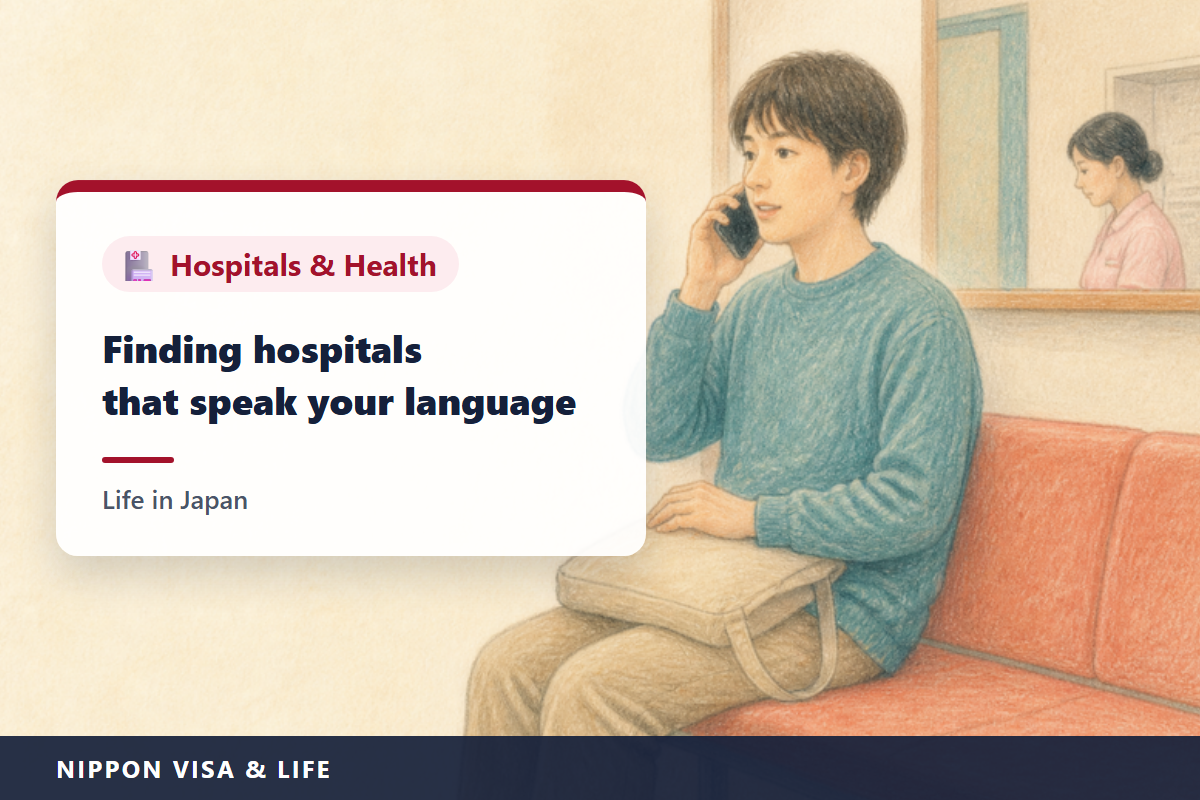
In Japan, you can search for hospitals and clinics where you can be seen in a foreign language on the Ministry of Health, Labour and Welfare’s “Medical Information Net (Navii)” or on the website of the Japan National Tourism Organization (JNTO). When you find one, call before you go and check which languages they can speak and their consultation hours. If you cannot find one yourself, you can ask your city, ward, town or village, or an international association, for help.
The Short Answer: How to Find a Hospital Where You Can Be Seen in a Foreign Language
- If it seems life-threatening, do not search. Call 119 for an ambulance
- On Navii or the JNTO website, search for medical institutions by the language you want and your area
- If you cannot find one, ask your city, ward, town or village, an international association, or your prefecture’s phone information service
- Before you go, call the medical institution and check the language, consultation hours and other details
- Bring your My Number health insurance card or similar document, and money
For calling 119 in a foreign language, read How to Call an Ambulance in Japan: How to Dial 119, What to Say, and Where to Get Advice When You Are Unsure (#7119). The overall procedure at a hospital is summarized in When You Are Sick or Injured in Japan: The Basics of Hospitals, Ambulances, Medicine, Medical Insurance and Where to Get Advice.
4 Ways to Find a Hospital Where You Can Be Seen in a Foreign Language
| Method | Organization that runs it | When it is useful |
|---|---|---|
| Medical Information Net (Navii) | Ministry of Health, Labour and Welfare | When you want to find a place near you among hospitals, clinics, dental clinics and pharmacies all over Japan |
| JNTO’s search for medical institutions | Japan National Tourism Organization | When you want to search by language or medical department on a screen in a foreign language |
| List of medical institutions that accept foreign patients | Ministry of Health, Labour and Welfare and Japan Tourism Agency | When you want to see a list of medical institutions selected by prefectures |
| Consultation desks | Cities, wards, towns and villages, international associations and others | When you cannot search by yourself, or want to ask about information for your area |
Searching on Medical Information Net (Navii)
Navii is a Ministry of Health, Labour and Welfare website where you can search for hospitals, clinics, dental clinics and pharmacies all over Japan.
- With the “Foreign languages” (外国語) item under “Search in Detail” (じっくり探す), you can search for medical institutions that can respond in foreign languages
- “Find a Pharmacy” (薬局を探す) also has a “Foreign languages” item
- You can also search by medical department and location
- The screen display can be switched between Japanese, English, Chinese (Simplified and Traditional) and Korean
(Source: Ministry of Health, Labour and Welfare “Medical Information Net (Navii)”, Ministry of Health, Labour and Welfare “About the Medical Function Information Provision System (Medical Information Net (Navii))”)
Searching on the JNTO Website
The JNTO website is intended for foreign nationals traveling in Japan. However, the Immigration Services Agency’s “Guidebook on Living and Working” also introduces it as a website where you can search for medical institutions in foreign languages.
- You can search by selecting an area, language and medical department. You can also search from your current location
- The languages you can select are English, Chinese, Korean, Portuguese, Spanish and others
- The website is displayed in Japanese, English, Chinese (Simplified and Traditional) and Korean
- Up to 30 search results are displayed
(Source: Japan National Tourism Organization (JNTO) “Guide for When You Feel Ill”, Ministry of Health, Labour and Welfare “About the List Compiling Information on Medical Institutions That Accept Foreign Patients”, Immigration Services Agency “Guidebook on Living and Working” Chapter 6: Medical Care 1-2)
Viewing the List of Medical Institutions That Accept Foreign Patients
The Ministry of Health, Labour and Welfare and the Japan Tourism Agency publish information on medical institutions selected by prefectures as an Excel list. A partly revised version dated September 30, 2026 is available (checked on November 2, 2026).
In the list, the following 2 categories are “core medical institutions” (拠点的な医療機関) that prefectures selected with their regional medical systems in mind.
| Category | What kind of medical institution it is |
|---|---|
| Category 1 | A medical institution that can handle emergency patients who need to be hospitalized (at least 1 in each prefecture) |
| Category 2 | A medical institution that can accept foreign patients, including clinics and dental clinics (at least 1 in each secondary medical area, 二次医療圏, a regional unit that provides general inpatient care) |
The JNTO website also has information on medical institutions. However, the Ministry of Health, Labour and Welfare’s page said that the JNTO website “will be updated at a later date” (checked on November 2, 2026). If you want to see the latest information, look at the Ministry of Health, Labour and Welfare’s list as well.
(Source: Ministry of Health, Labour and Welfare “About the List Compiling Information on Medical Institutions That Accept Foreign Patients”, Ministry of Health, Labour and Welfare “Explanation of the List of Medical Institutions”)
Asking for Help at a Consultation Desk or by Phone
People who cannot speak Japanese can ask for help at the following places.
- The city, ward, town or village where you live
- The international association in your area
- NPOs (some may offer consultations in foreign languages)
When you are looking for a medical institution, you can also ask a Medical Safety Support Center (医療安全支援センター). There are about 400 of them, in prefectures, cities that have a public health center (保健所) and special wards. Check with the center whether you can consult in a foreign language.
Some prefectures also guide people to medical institutions by phone. On your prefecture’s website, search for “外国語 医療機関 案内” (foreign language, medical institution, guide).
Example: Tokyo (checked on November 2, 2026)
- Guide to medical institutions where you can be seen in a foreign language, and explanations of Japan’s medical system: 03-5285-8181
- Languages: English, Chinese, Korean, Thai and Spanish
- Hours: 9:00 to 20:00, every day
- The consultation is free, and you pay the cost of the call yourself
When a family member or friend is visiting Japan as a traveler, that person can call JNTO’s “Japan Visitor Hotline” (050-3816-2787. 24 hours. English, Chinese and Korean) themselves and be referred to medical institutions where they can be seen in a foreign language. This hotline takes direct inquiries from people traveling in Japan. It is not a hotline that a person living in Japan can call on someone else’s behalf.
(Source: Immigration Services Agency “Guidebook on Living and Working” Chapter 6: Medical Care 1-2, as an example Tokyo Metropolitan Government Bureau of Public Health “Medical Information Service for Foreign Patients”, Japan National Tourism Organization (JNTO) “Guide for When You Feel Ill”)
What to Check by Phone Before You Go to a Hospital
The JNTO website advises you to contact the medical institution in advance whenever possible if you want to be seen. Details such as the hours for each language must be checked with the medical institution. It is reassuring to ask about the following.
- Whether you can be examined in the language you want to speak
- The days and hours when they can respond in that language
- Whether you need an appointment
- Whether you can use an interpreter
- The approximate cost
If you do not know which medical department to go to, the “Main Symptoms and Medical Departments” table on the JNTO website can help.
(Source: Japan National Tourism Organization (JNTO) “Guide for When You Feel Ill”)
When You Want to Use a Medical Interpreter
Some prefectures have set up medical interpreter systems.
Example: Aichi Prefecture (“Aichi Medical Interpretation System” (あいち医療通訳システム). Checked on November 2, 2026)
- At registered medical institutions in the prefecture, services such as sending an interpreter and telephone interpreting are available
- Languages for sending an interpreter: English, Chinese, Portuguese, Spanish, Filipino, Vietnamese, Thai, Indonesian, Nepali, Malay, Arabic, Korean and Burmese
- It can be used when the medical institution decides it is necessary. Patients cannot directly ask the secretariat to send an interpreter or arrange similar services
- As a rule, there is a charge (example: for sending an interpreter, the patient pays 1,500 yen or 2,500 yen for 2 hours, depending on the content)
To find out whether your prefecture has a similar system, search for “医療通訳” (medical interpreter) on your prefecture’s website, or ask an international association.
(Source: as an example Aichi Medical Interpretation System Promotion Council “For Patients (People Who Want to Go to a Hospital)”)
Multilingual Materials You Can Use to Explain Your Symptoms
If you are not confident in your language skills, the following materials may help.
- JNTO’s pointing sheets: PDFs for showing your symptoms and how strong your pain is by pointing with your finger
- JNTO’s medical information entry sheets: PDFs for writing down your own medical information, such as the treatment you are receiving now, the medicines you are taking and any allergies
- The Ministry of Health, Labour and Welfare’s “Multilingual Explanatory Materials for Foreigners”: These include medical questionnaires for each department (forms with questions where you write your symptoms and other details), such as internal medicine, pediatrics, obstetrics and gynecology, and dentistry, as well as consultation application forms. They are available in 13 languages: English, Chinese, Korean, Portuguese, Spanish, Ukrainian, Hindi, Indonesian, Nepali, Tagalog, Thai, Vietnamese and Arabic. Japanese is also written on them
The Ministry of Health, Labour and Welfare’s materials were made for medical institutions to use. Their use is not mandatory, so not every hospital necessarily uses them.
(Source: Japan National Tourism Organization (JNTO) “Guide for When You Feel Ill”, Ministry of Health, Labour and Welfare “List of Multilingual Explanatory Materials for Foreigners”)
What to Bring to the Hospital
When you are seen in a foreign language too, bring your My Number health insurance card, eligibility certificate or similar document, and money. For what to show at reception, the medical questionnaire and how payment works, read How to See a Doctor in Japan: Choosing Between Hospitals and Clinics, What to Show at Reception, the Medical Questionnaire, Paying, and Getting Your Medicine at a Pharmacy.
Common Problems When You Are Seen in a Foreign Language
What If You Feel Sick at Night or on a Holiday?
You can search for places that can see you at night or on holidays using “Holiday and night medical institutions” on Navii. For how to search and phone advice lines, read If You Get Sick at Night or on a Holiday in Japan: How to Find a Clinic Open Now and Phone Advice Lines (#7119 and #8000).
Can You Go to a Hospital That Is Not on the List of Medical Institutions That Accept Foreign Patients?
The Ministry of Health, Labour and Welfare’s explanation says that the list does not prevent medical institutions that are not on it from seeing foreign patients.
(Source: Ministry of Health, Labour and Welfare “Explanation of the List of Medical Institutions”)
Can a Medical Institution Be Unable to Respond in a Language Listed for It on the JNTO Website?
The JNTO website says that, depending on the situation, a medical institution may not be able to respond in a particular language. You may also be referred to another medical institution, depending on how serious your illness or injury is. Call and check before you go.
(Source: Japan National Tourism Organization (JNTO) “Guide for When You Feel Ill”)
Primary Sources Referred to in Writing This Article
- Ministry of Health, Labour and Welfare “Medical Information Net (Navii)”
- Ministry of Health, Labour and Welfare “About the Medical Function Information Provision System (Medical Information Net (Navii))”
- Ministry of Health, Labour and Welfare “About the List Compiling Information on Medical Institutions That Accept Foreign Patients”
- Ministry of Health, Labour and Welfare “Explanation of the List of Medical Institutions”
- Ministry of Health, Labour and Welfare “List of Multilingual Explanatory Materials for Foreigners”
- Japan National Tourism Organization (JNTO) “Guide for When You Feel Ill”
- Immigration Services Agency “Guidebook on Living and Working” 8th edition (Chapter 6: Medical Care)
- Tokyo Metropolitan Government Bureau of Public Health “Medical Information Service for Foreign Patients”
- Aichi Medical Interpretation System Promotion Council “For Patients (People Who Want to Go to a Hospital)”
This article is a translation of the original Japanese version.