This article was written by the NIPPON VISA & LIFE editorial team based on information from public organizations such as the national government and local governments. Rules and fees may differ depending on the city, ward, town or village where you live.
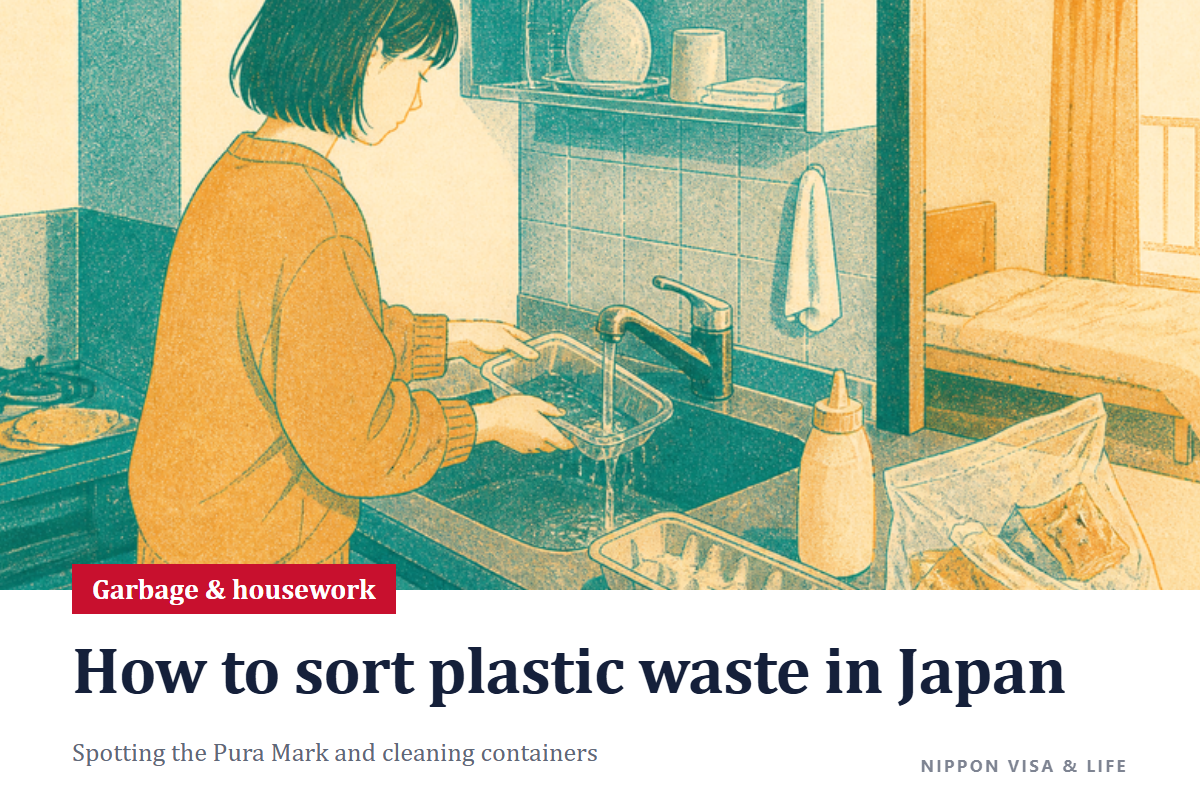
In Japan, some municipalities (cities, wards, towns and villages) collect plastic containers and packaging with the Pura Mark (プラマーク), such as snack bags and egg cartons, as recyclables. Use up the contents, clean off any dirt, and put the items in the bag or other container set by your municipality. How items without the Pura Mark, such as buckets and toothbrushes, are handled differs by municipality.
The overall rules for sorting garbage are summarized in How to Sort and Put Out Garbage in Japan: Basic Rules for Burnable, Recyclable and Oversized Garbage.
4 Steps for Putting Out Plastic Garbage
- Check the sorting rules of the municipality where you live: Check whether items without the Pura Mark can also be put out as recyclables, or whether they are burnable garbage.
- Use up the contents and clean off any dirt: Rinse the item lightly or wipe it with a cloth or similar.
- Put the items in the set bag or container: For example, Yokohama City uses clear or semi-transparent bags, so that the contents can be seen.
- Put them out by the set time on the set collection day: For example, in Yokohama City it is by 8:00 a.m. on the morning of the collection day, and in Shinjuku Ward it is by 8:00 a.m. The time differs by municipality.
(Source: Shinjuku Ward “How to Put Out Resource Plastics”, Yokohama City “Detailed Guide to Putting Out Plastic Resources”)
How to Recognize the Pura Mark, and Examples of Items That Have It
The Pura Mark (プラマーク, the identification mark for plastic containers and packaging) is a mark found on containers that held a product and on packaging that wrapped a product. Before you throw an item away, look for the mark in the following image on the container or packaging.

Sources: Illustration by the Japan Containers and Packaging Recycling Association, shown in Kaizuka City’s guidance
The Pura Mark is on plastic containers and packaging that you no longer need after using the product. Kaizuka City’s guidance gives the following examples.
- Bags from snacks, ramen and similar products
- Meat and fish trays
- Egg cartons
- Bottles from detergent and similar products
- Styrofoam cushioning (the filling put in a box to protect a product)
On the other hand, plastic products that are themselves the item being sold, such as buckets, hangers and small storage boxes, do not have the Pura Mark. In this article, we call these “product plastics” (製品プラスチック).
(Source: Kaizuka City “Only Items with the Pura Mark Can Be Put Out as Plastic Garbage”)
How to Put Out Product Plastics Without the Pura Mark Differs by Municipality
On April 1, 2022, a new law on resource circulation for plastics (the Act on Promotion of Resource Circulation for Plastics, プラスチックに係る資源循環の促進等に関する法律) came into force. Under this law, some municipalities collect product plastics together with containers and packaging. Other municipalities collect product plastics as burnable garbage.
As examples, the table below shows the differences among 4 cities and wards.
| City or ward | How product plastics are handled | Size that can be put out as recyclables | Bag or container to use |
|---|---|---|---|
| Yokohama City | Items made only of plastic are put out as “Plastic Resources” (プラスチック資源) in the same bag as items with the Pura Mark | Longest side under 50 cm | Clear or semi-transparent bag |
| Shinjuku Ward | Items made only of plastic are put out as “Resource Plastics” (資源プラスチック) together with items with the Pura Mark | Roughly 30 cm or less on each side | Container with a lid, or a plastic bag that lets the contents be seen |
| Katsushika Ward | Items made only of plastic material are put out on the weekly recyclables day | Each side 30 cm or less | Container that can be closed with a lid, or a plastic bag that lets the contents be seen (semi-transparent bags are also allowed) |
| Kaizuka City (guidance updated in September 2022) | Cannot be put out as recyclables. Put them out as burnable garbage (可燃ごみ, kanen gomi), and put out items that do not fit in burnable garbage as oversized garbage (粗大ごみ, sodai gomi) | — | Container and packaging plastics go in a clear or semi-transparent bag |
The same item may be put out differently when you live in a different place. For example, buckets are listed as an example of Plastic Resources in Yokohama City, but in Kaizuka City’s guidance they are burnable garbage, as items without the Pura Mark. If you move, check the rules of your new municipality.
(Source: Ministry of the Environment “Promulgation of the Enforcement Order and Other Rules of the Act on Promotion of Resource Circulation for Plastics, and the Guide to Separate Collection of Waste Plastic-Use Products”, Yokohama City, Shinjuku Ward, Katsushika Ward “Separate Collection of Product Plastics”, Kaizuka City)
Items You Must Not Mix In with Plastic Garbage
The following are examples of items that municipalities tell you not to put in plastic garbage, even if they are made of plastic. Which items this applies to and the correct way to put them out differ by municipality.
| Items you must not mix in | Reason, and examples of the guidance on how to put them out |
|---|---|
| Power banks, heated tobacco products, products with rechargeable batteries inside, lighters | They cause fire accidents in garbage trucks and recycling facilities. Do not mix them in with plastic garbage (Shinjuku Ward) |
| Items with blades, such as disposable razors, slicers and peelers | They are dangerous because workers at the facilities remove foreign objects by hand. In Kaizuka City they are non-burnable garbage |
| Syringes and injection needles | Shinjuku Ward advises returning syringes used for home medical care to the pharmacy where you bought them. Kaizuka City advises returning items with injection needles or similar attached to the medical institution |
| Items containing materials other than plastic, such as metal (hangers and clothespins containing metal, rubber gloves, etc.) | In Yokohama City they are put out on the burnable garbage day |
| Thick, hard items (cutting boards, etc.) | In Yokohama City they are put out on the burnable garbage day |
| Items that become 50 cm or longer when spread out (plastic string, sheets, etc.) | In Yokohama City they are put out on the burnable garbage day |
| Items that are too large (clothes storage cases, etc.) | In Yokohama City they are oversized garbage. For how to put them out, read How to Put Out Oversized Garbage in Japan: Basics of Applying, Disposal Tickets (Stickers), and the Day and Place to Put It Out |
How to put out batteries and lighters is summarized in How to Throw Away Spray Cans, Batteries and Lighters in Japan: Disposing of Dangerous Waste Such as Lithium-Ion Batteries and Gas Canisters.
(Source: Shinjuku Ward, Kaizuka City, Yokohama City)
How to Clean Dirt Off Plastic Garbage
Plastic that is still dirty cannot be recycled. However, you do not need to wash it carefully. The Japan Containers and Packaging Recycling Association advises that it is enough to rinse items lightly with water and let them dry, and that you do not need to scrub them with a brush or detergent, or force stickers off.
Shinjuku Ward introduces the following tips.
- As soon as possible: If you wash or wipe an item soon after using up the contents, the dirt comes off more easily.
- Natto containers: If you soak them in water for a while, the sticky residue comes off more easily.
- Sauce and shampoo bottles, mayonnaise and toothpaste tubes: Put water in through the opening, close the cap and shake well.
- Oily trays: Wiping with a cloth or similar removes oil better than washing.
- Cooking oil bottles: You do not need to wash them. It is enough to remove the cap and leave the bottle upside down on a cloth or similar overnight.
(Source: Shinjuku Ward “How to Clean Dirt Off Resource Plastics”, Japan Containers and Packaging Recycling Association “Points to Note When Sorting and Putting Out Waste”)
Common Questions About Putting Out Plastic Garbage
How Should You Put Out Plastic When the Dirt Will Not Come Off?
Shinjuku Ward and Kaizuka City advise putting out items that are very dirty or whose dirt will not come off as burnable garbage (可燃ごみ, kanen gomi). Also check the guidance of the municipality where you live.
Can You Put Out PET Bottles Together with Plastic Garbage?
As a basic rule, the body of a PET bottle is put out separately from plastic garbage. Shinjuku Ward explains that the caps and labels of PET bottles are container and packaging plastics, but the body is not. Kaizuka City also advises separating the body from the cap and label, in different bags. For details, read How to Throw Away PET Bottles, Cans and Glass Bottles in Japan: Removing Caps and Labels, Rinsing, and Whether to Crush Them.
Can You Put Plastic Garbage Out in a Colored Bag?
In municipalities that require clear or semi-transparent bags, you may not be able to use bags that hide the contents. Kaizuka City advises that if you put other plastic garbage in a colored bag, it cannot be collected. Yokohama City advises against double-bagging, because it interferes with recycling.
(Source: Shinjuku Ward, Shinjuku Ward “How to Clean Dirt Off Resource Plastics”, Kaizuka City, Yokohama City)
How to Find the Plastic Garbage Rules of the Municipality Where You Live
- Search online: Search with the name of your municipality, for example “○○市 プラスチック 出し方” (○○ city, plastic, how to put out).
- Look at your municipality’s website or the garbage guide it distributed: Check the section on how to put out plastic.
- Use a sorting search service: For example, Yokohama City has “MIctionary” (ミクショナリー), where you can look up how to sort garbage.
- Ask the office in charge: Ask the section in charge of garbage and recycling, or the sanitation office (in Yokohama City, the ward’s collection office).
Some municipalities provide guidance in foreign languages. For example, Shinjuku Ward publishes its flyer on Resource Plastics in English, Chinese (Simplified), Korean, Vietnamese, Nepali and Burmese.
(Source: Shinjuku Ward, Yokohama City)
Primary Sources Referred to in Writing This Article
- Ministry of the Environment “Promulgation of the Enforcement Order and Other Rules of the Act on Promotion of Resource Circulation for Plastics, and the Guide to Separate Collection of Waste Plastic-Use Products”
- Japan Containers and Packaging Recycling Association “Points to Note When Sorting and Putting Out Waste”
- Yokohama City “From April 2025: Detailed Guide to Putting Out Plastic Resources”
- Shinjuku Ward “How to Put Out Resource Plastics”
- Shinjuku Ward “How to Clean Dirt Off Resource Plastics”
- Katsushika Ward “Separate Collection of Product Plastics (Plastic Products Without the Pura Mark) Began in April of Reiwa 7”
- Kaizuka City “Only Items with the Pura Mark Can Be Put Out as Plastic Garbage (Plastic ‘Products’ Are Not Covered)”
This article is a translation of the original Japanese version.