This article was written by the NIPPON VISA & LIFE editorial team based on information from public organizations such as the national government and local governments. Rules and fees may differ depending on the city, ward, town or village where you live.
Clothes sold in Japan have laundry care symbols (care labels: the small symbols on the tag of your clothes) that show how to wash them. You can read them as a combination of 5 basic shapes and numbers, lines, dots and ×. The symbols show the upper limit, meaning “up to this level is OK.”
→ How to Sort and Put Out Garbage in Japan: Basic Rules for Burnable, Recyclable and Oversized Garbage
The Short Answer: How to Read Laundry Care Symbols
- Look at the tag on the inside of the clothes. The symbols are lined up in 1 or 2 rows in this order: “washing → bleaching → drying → ironing → professional cleaning.”
- Use the shape to tell “what the symbol is for” (see the table below).
- Read the temperature from the number or dots (・) inside, the strength from the lines (ー) below, and “do not do this” from the ×.
- If there are words (additional instructions) such as “use a laundry net” near the symbols, follow them too.
| Shape | Meaning |
|---|---|
| Washtub (basin) shape | Washing at home (washing machine, hand wash) |
| Triangle | Bleaching (whether bleach can be used) |
| Square | Drying (dryer, how to hang to dry) |
| Iron shape | Ironing |
| Circle | How a professional cleaning shop cleans it |
Laundry care symbols are designed so they can be used the same way around the world, and the symbols do not contain Japanese or other letters.
What the Numbers, Lines, Dots and × Mean
| What is added | Meaning | Example |
|---|---|---|
| Number (30, 40, etc.) | Upper limit of the washing water temperature (°C) | “40” means up to 40°C |
| Line below (ー) | The more lines, the gentler the wash. No line = normal, ー = gentle, = (2 lines) = very gentle | 1 line under the washtub = gentle wash |
| Dot (・) | The more dots, the higher the temperature (dryer, iron) | “・・・” on the iron means up to 210°C |
| × | That method cannot be used | × on the washtub = cannot be washed at home |
Washing more strongly than the symbol shows, or washing or ironing at a higher temperature, may damage your clothes.
List of Symbols (Consumer Affairs Agency Table)
You can check all the symbols and their meanings in the Consumer Affairs Agency’s table.
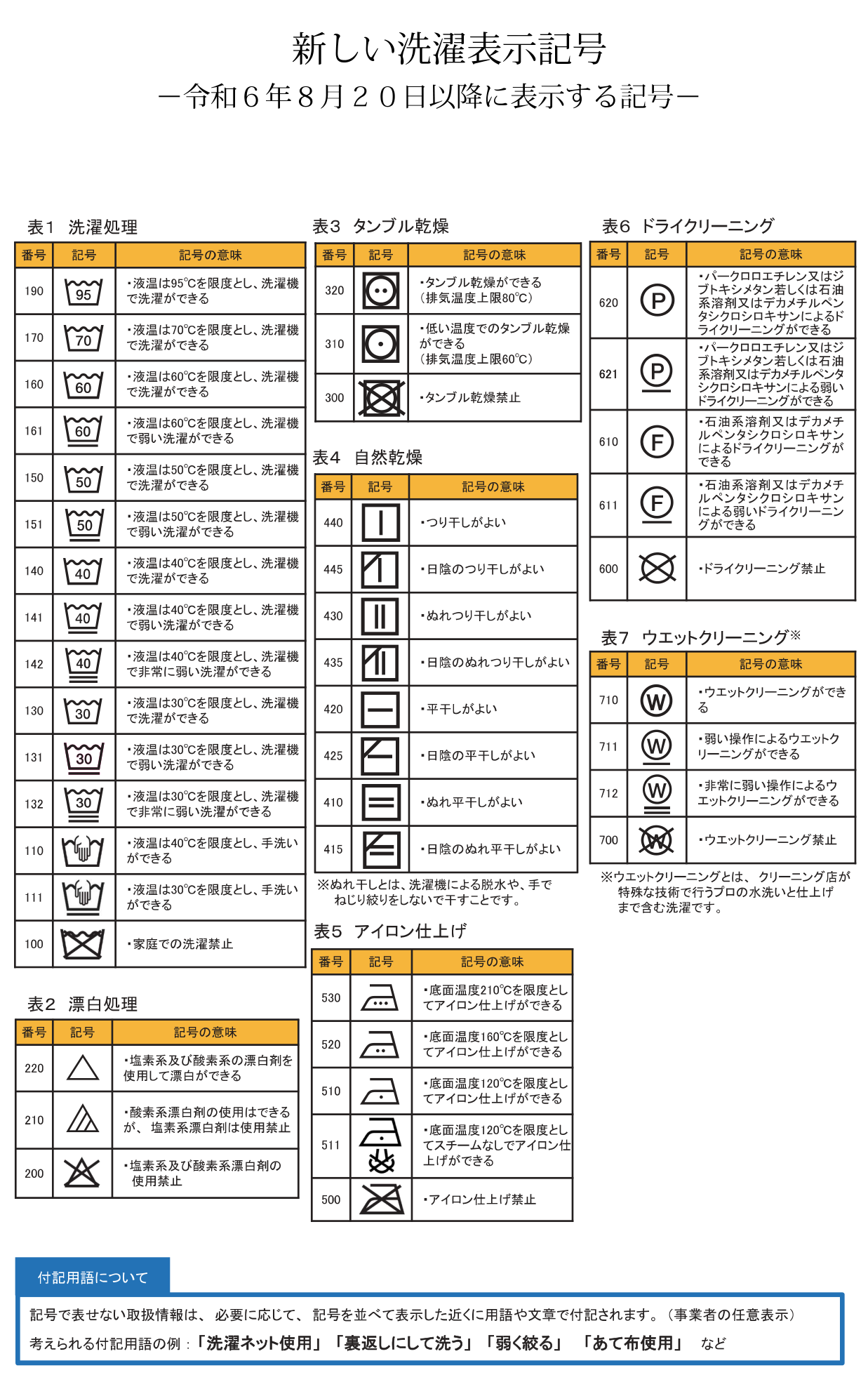
Sources: Consumer Affairs Agency, “Revision of the Textile Goods Quality Labeling Regulations under the Household Goods Quality Labeling Act,” Reference: “New laundry care symbols”
From here, we explain how to read each type of symbol.
Washing at Home (Washtub Shape)
| Symbol | Meaning |
|---|---|
| Number inside the washtub (95, 70, 60, 50, 40, 30) | Can be washed in a washing machine with water up to that temperature |
| 1 line under the washtub | Wash gently in a washing machine |
| 2 lines under the washtub | Wash very gently in a washing machine |
| Hand inside the washtub | Hand wash. No line means up to 40°C; 1 line below means up to 30°C |
| × on the washtub | Cannot be washed at home |
- For a washtub with “40,” wash in water at 40°C or below.
- The hand wash symbol means washing by hand, such as by pressing the clothes gently in water. The leaflet from the Consumer Affairs Agency and the Ministry of Economy, Trade and Industry advises you to check your washing machine’s manual or the manufacturer’s website to see whether you can wash it with a setting such as the washing machine’s “hand wash course.”
- Clothes with × on the washtub cannot be washed at home. However, if there is a W symbol inside a circle, a professional cleaning shop can wash it with water.
(Sources: Consumer Affairs Agency and Ministry of Economy, Trade and Industry, “Care labels on clothing” (leaflet, PDF), Consumer Affairs Agency, “New laundry care symbols” (PDF))
Bleaching (Triangle)
| Symbol | Meaning |
|---|---|
| Triangle only | Both chlorine bleach and oxygen bleach can be used |
| 2 diagonal lines inside the triangle | Only oxygen bleach can be used (chlorine bleach cannot be used) |
| × on the triangle | Bleach cannot be used |
There are chlorine bleaches and oxygen bleaches. The leaflet from the Consumer Affairs Agency and the Ministry of Economy, Trade and Industry says that oxygen bleach can be used on most colored and patterned clothes.
Drying (Square): Dryers and How to Hang Clothes
Dryer (Circle Inside a Square)
Tumble drying means drying clothes with warm air while turning them inside a dryer.
| Symbol | Meaning |
|---|---|
| Circle inside a square, 2 dots (・・) | A dryer can be used (upper limit of exhaust temperature 80°C). Set the heater to “high” or similar |
| Circle inside a square, 1 dot (・) | A dryer can be used at a low temperature (upper limit of exhaust temperature 60°C). Set the heater to “low” or similar |
| Circle inside a square, × | A dryer cannot be used |
Clothes with the × symbol should be hung to dry without using a dryer.
Natural Drying (How to Hang Clothes)
| Symbol | Meaning |
|---|---|
| 1 vertical line inside a square | Line drying (hang on a hanger or similar to dry) |
| 2 vertical lines inside a square | Drip line drying (hang to dry without spinning out the water) |
| 1 horizontal line inside a square | Flat drying (spread out on a flat place to dry) |
| 2 horizontal lines inside a square | Drip flat drying (dry flat without spinning out the water) |
| Diagonal line in the upper left | Dry in the shade |
- If the line is vertical, hang the clothes; if it is horizontal, dry them flat.
- Drip drying means drying without spinning out the water in a washing machine or wringing the clothes out by twisting them with your hands.
- The diagonal line stands for a roof and means dry in the shade.
- If clothes have 2 drying symbols, you can dry them with either of the methods shown.
(Sources: Consumer Affairs Agency and Ministry of Economy, Trade and Industry, “Care labels on clothing” (leaflet, PDF), Consumer Affairs Agency, “New laundry care symbols” (PDF))
Ironing (Iron Shape)
| Symbol | Meaning |
|---|---|
| 3 dots (・・・) | Iron soleplate temperature up to 210°C |
| 2 dots (・・) | Up to 160°C |
| 1 dot (・) | Up to 120°C |
| 1 dot, with a steam mark crossed with × below | Up to 120°C. Steam cannot be used |
| × on the iron | Cannot be ironed |
If it says “use a pressing cloth,” place a thin cloth on the clothes and iron over it.
How a Professional Cleaning Shop Cleans It (Circle)
The circle symbols show how a professional cleaning shop, not you at home, should clean the clothes. You do not use them when washing at home, but they are a guide when you take clothes to a cleaning shop.
| Symbol | Meaning |
|---|---|
| P inside a circle | Can be dry cleaned (solvents such as perchloroethylene) |
| F inside a circle | Can be dry cleaned (petroleum-based solvents, etc.) |
| × on the circle | Cannot be dry cleaned |
| W inside a circle | Can be wet cleaned (washing with water done by a cleaning shop using special techniques) |
| W inside a circle with × | Cannot be wet cleaned |
For each of these, a line below (ー, =) means a gentler method.
(Sources: Consumer Affairs Agency and Ministry of Economy, Trade and Industry, “Care labels on clothing” (leaflet, PDF), Consumer Affairs Agency, “New laundry care symbols” (PDF))
Words Written Near the Symbols (Additional Instructions)
Things that cannot be shown by symbols alone are sometimes written in short words near the symbols. These are examples from the leaflet of the Consumer Affairs Agency and the Ministry of Economy, Trade and Industry.
| Words | Meaning |
|---|---|
| 洗濯ネット使用 (use a laundry net) | Put the clothes in a laundry net before washing |
| 弱く絞る (wring gently) | Spin out the water in the washing machine for only a short time, or remove the water by pressing the clothes between towels or similar |
| あて布使用 (use a pressing cloth) | Place a thin cloth on the clothes and iron over it |
| 裏返しにして洗う (wash inside out) | Turn the clothes inside out before washing |
| 同系色と一緒に洗う (wash with similar colors) | Wash together with clothes of similar colors |
Common Problems and Frequently Asked Questions
Did the symbols change in August 2024?
To match the revision of the international standard (ISO) for care labeling of clothing, the Japanese standard (JIS L 0001) was revised on August 20, 2024 (Reiwa 6). The main changes were:
- 2 symbols were added: the symbol for hand wash up to 30°C and the symbol for ironing up to 120°C, no steam
- The temperatures for the iron dots changed: 3 dots went from 200°C to 210°C, 2 dots from 150°C to 160°C, and 1 dot from 110°C to 120°C
- The types of solvents that can be used under the dry cleaning symbols increased
Clothes labeled by August 19, 2025 (Reiwa 7) can still be sold with the previous labels. Because of this, stores may have a mix of clothes with the new labels and clothes with the previous labels.
What if I cannot tell whether a label is new or old?
Under Japanese law (the Household Goods Quality Labeling Act), the name and contact information of the company or other party that put on the label must also be shown, for example by sewing it onto the clothes. If you cannot tell whether a label is the new one or the previous one, you can contact them.
What if my clothes were ruined in the wash, or I have a problem with a shop?
For problems with a cleaning shop or with clothes you bought, if you call the Consumer Hotline (188), you will be guided to a nearby consultation office such as a Consumer Affairs Center. Consultation is free, but you pay the call charges.
(Source: Consumer Affairs Agency, “Consumer Hotline”)
Primary Sources Referenced in This Article
- Consumer Affairs Agency, “New laundry care symbols”
- Consumer Affairs Agency and Ministry of Economy, Trade and Industry, “Care labels on clothing” (leaflet, 2nd edition, August 2024, PDF)
- Consumer Affairs Agency, “Revision of the Textile Goods Quality Labeling Regulations under the Household Goods Quality Labeling Act: Laundry care symbols on clothing are changing” (August 20, Reiwa 6, PDF)
- Consumer Affairs Agency, “Consumer Hotline”
This article is a translation of the original Japanese version.