This article was written by the NIPPON VISA & LIFE editorial team based on information from public organizations such as the national government and local governments. Rules and fees may differ depending on the city, ward, town or village where you live.
In Japan, if you feel strong shaking or long, slow shaking near the sea, or if a tsunami warning or similar is issued, move away from the sea and rivers immediately and escape to the highest place you can. As a rule, evacuate on foot. Tsunami waves come many times, so do not go back until the warning or advisory is lifted.
The Short Answer: What to Do When There Is a Risk of a Tsunami
- If you feel strong shaking near the sea or a river, or shaking that is weak but slow and lasts a long time, escape immediately without waiting for a warning
- Even if you do not feel shaking, escape immediately when a tsunami warning or similar is issued, or when your city, ward, town or village issues an evacuation instruction
- Move away from the coast and rivers (especially river mouths) and go to a higher place, such as high ground or a tsunami evacuation building
- As a rule, evacuate on foot, not by car
- Check the latest information on TV, radio, your smartphone, etc.
- Do not go back to the coast or rivers until the tsunami warning or advisory is lifted
(Sources: Immigration Services Agency, “Guidebook on Living and Working,” Chapter 10, 2-3 Tsunami (PDF), Cabinet Office, Fire and Disaster Management Agency and Japan Meteorological Agency, “Earthquake? Tsunami! Evacuate Now!” (PDF))
The Differences Between a Major Tsunami Warning, a Tsunami Warning and a Tsunami Advisory
The Japan Meteorological Agency aims to issue major tsunami warnings, tsunami warnings and tsunami advisories about 3 minutes after an earthquake (about 2 minutes for some earthquakes). They are issued for each of the 66 areas (tsunami forecast regions) the country is divided into, and they also announce the expected tsunami height and the expected time the first wave will arrive.
| Type | When it is issued | Expected height announced | What happens and what to do |
|---|---|---|---|
| Major tsunami warning | When the maximum expected tsunami height exceeds 3 m in the highest places | Over 10 m, 10 m, 5 m (for a huge earthquake, first announced as “huge”) | Wooden houses are completely destroyed or washed away, and people are caught in the tsunami’s flow. People near the sea or along rivers should immediately evacuate to a safe place such as high ground or an evacuation building |
| Tsunami warning | When it is over 1 m and 3 m or less | 3 m (for a huge earthquake, first announced as “high”) | The tsunami reaches low-lying land and causes flooding (land going under water). People are caught in the flow. People near the sea or along rivers should immediately evacuate to a safe place such as high ground or an evacuation building |
| Tsunami advisory | When it is 0.2 m or more and 1 m or less, and there is a risk of damage | 1 m (even for a huge earthquake, there is no announcement in words) | In the sea, people are caught in fast currents. People in the sea should get out of the water immediately and move away from the coast |
A major tsunami warning is one of the “emergency warnings” (information calling for the highest level of caution). For a huge earthquake of more than about magnitude 8, the first announcement uses the words “huge” and “high,” and is later updated with numbers. If “huge” is announced, a huge tsunami like the one in the Great East Japan Earthquake may come. Evacuate immediately, as far as you possibly can.
The image below is part of a leaflet by the Cabinet Office, the Fire and Disaster Management Agency and the Japan Meteorological Agency. The upper table shows the types of warnings and the expected tsunami heights, and the lower part shows evacuation signs and the tsunami flag.
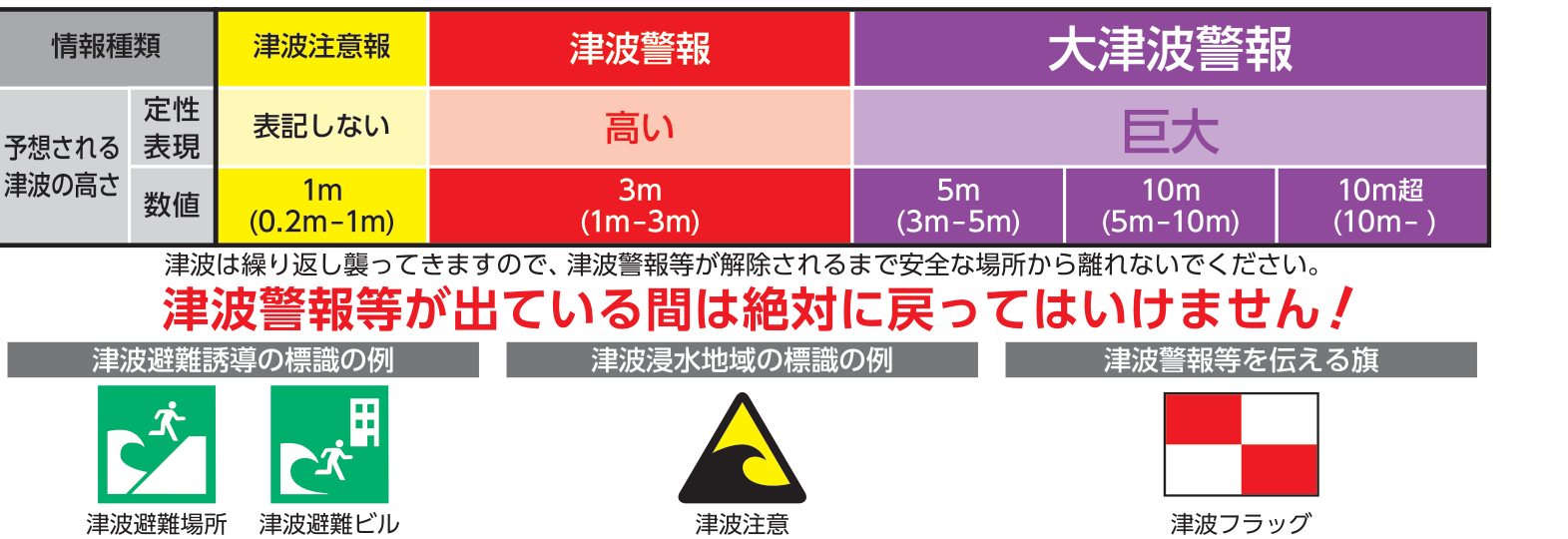
Sources: Cabinet Office, Fire and Disaster Management Agency and Japan Meteorological Agency, “Earthquake? Tsunami! Evacuate Now!”
Do Not Go into the Sea Even During an Advisory
The Japan Meteorological Agency says that even a tsunami about 20 to 30 cm high can sweep people away in fast currents. Where a tsunami advisory has been issued, swimming in the sea and rock fishing (fishing from rocky areas on the coast) are dangerous. Get out of the sea immediately and move away from the coast.
(Source: Japan Meteorological Agency, “Protecting yourself from tsunami”)
Things to Be Careful About When You Escape
If You Wait Until You See the Tsunami, It Is Too Late
Tsunami waves are very fast, and if you start escaping after you see one, you will not make it in time. The Japan Meteorological Agency also gives the following information.
- A tsunami does not always start with the “draw-back” (the sea water pulling back). The idea that “you only need to escape when the tide goes out” is a serious mistake
- If the epicenter is close to land, the warning may not be issued before the tsunami arrives. If you feel strong shaking, or shaking that is weak but long, start evacuating immediately
- A large tsunami may come even when there is no shaking, or when the shaking is hard to feel
- Even if you are away from the sea, a tsunami may come up along a river
(Sources: Japan Meteorological Agency, “Protecting yourself from tsunami”, Japan Meteorological Agency, “About tsunami warnings and advisories, tsunami information and tsunami forecasts”, Cabinet Office, Fire and Disaster Management Agency and Japan Meteorological Agency, “Earthquake? Tsunami! Evacuate Now!” (PDF))
Aim for “a Higher Place”
Depending on the shape of the coast and other factors, a tsunami may be higher than expected in a particular place. Do not think “I am safe here”; aim for a higher place. Places to go are high ground (land higher than the surrounding area), tsunami evacuation buildings (tall buildings you can escape into during a tsunami) and tsunami evacuation sites.
Go to an “Evacuation Site,” Not an “Evacuation Shelter”
The Cabinet Office, the Fire and Disaster Management Agency and the Japan Meteorological Agency call on people to remember that “where you should head for is an evacuation site, not an evacuation shelter.”
- Evacuation site (hinan basho): a place you escape to in order to save your life from a danger that is coming now
- Evacuation shelter (hinanjo): a place where people who cannot return home live for a while after a disaster
Evacuation sites are designated for each type of disaster, and some cannot be used during a tsunami. Check the tsunami evacuation sites near your home on your city, ward, town or village’s hazard map (a map showing places that are dangerous in a disaster). How to look them up is explained in How to Find Evacuation Sites, Evacuation Shelters and Hazard Maps in Japan: What to Check for Your Address Before a Disaster.
(Sources: Cabinet Office, Fire and Disaster Management Agency and Japan Meteorological Agency, “Earthquake? Tsunami! Evacuate Now!” (PDF), Japan Meteorological Agency, “About tsunami warnings and advisories, tsunami information and tsunami forecasts”, Geospatial Information Authority of Japan, “Data on designated emergency evacuation sites and designated evacuation shelters”)
As a Rule, Escape on Foot
If you escape by car, you may not be able to evacuate well because of traffic jams and similar problems. The Cabinet Office, the Fire and Disaster Management Agency and the Japan Meteorological Agency call on people to evacuate on foot as a rule.
Do Not Go Back Until It Is Lifted
Tsunami waves come again and again. Later waves may be higher, and it can take several hours or more from when the sea level starts to change until the highest wave arrives. A tsunami may also continue for half a day or more than a day.
- Even after a tsunami has come, keep evacuating until the warning or advisory is lifted
- While a tsunami warning or similar is in effect, do not go back to the coast or rivers (the leaflet by the Cabinet Office, the Fire and Disaster Management Agency and the Japan Meteorological Agency also strongly calls for this)
- The announced “expected arrival time of the first wave” is the earliest time a tsunami will arrive in that area. Even within the same area, the tsunami may arrive more than 1 hour later in some places
- While the observed tsunami is small, the Japan Meteorological Agency may announce “being observed” instead of a number. Do not stop evacuating just because it is small
(Sources: Japan Meteorological Agency, “Protecting yourself from tsunami”, Japan Meteorological Agency, “About tsunami warnings and advisories, tsunami information and tsunami forecasts”, Cabinet Office, Fire and Disaster Management Agency and Japan Meteorological Agency, “Earthquake? Tsunami! Evacuate Now!” (PDF))
“Tsunami Flags” at Beaches and Signs in Town
Tsunami Flags
A tsunami flag is a flag with a red and white checkered pattern (a square divided into 4) that tells people a major tsunami warning, a tsunami warning or a tsunami advisory has been issued. It has been used at beaches and similar places since June 2020 (Reiwa 2). It lets people see the warning with their eyes, including swimmers who cannot hear sirens well because of the sound of the waves or the wind, and people who are deaf or hard of hearing.
- If you see a tsunami flag at a beach or near the coast, start evacuating immediately
- Besides waving the flag, people may also be informed by other methods, such as hanging it on a building
- According to a Japan Meteorological Agency survey (June 30, 2026 Reiwa 8), 328 (82%) of the 399 cities, wards, towns and villages that have beaches have introduced it
(Sources: Japan Meteorological Agency, “Tsunami flag”, Immigration Services Agency, “Guidebook on Living and Working,” Chapter 10, 2-3 Tsunami (PDF))
Evacuation Signs
Near the sea, there are “tsunami caution” signs (a yellow triangle with a picture of a wave) showing that a tsunami may come, and green signs showing tsunami evacuation sites and tsunami evacuation buildings (the lower part of the image above). When you go near the sea, check where the signs are and the route to the evacuation site. On the coast, look at the signs and use the evacuation openings or evacuation stairs in the seawall (a high wall along the coast) to move to a high place.
(Sources: Ministry of Land, Infrastructure, Transport and Tourism, “How can you protect yourself from a tsunami?”, Cabinet Office, Fire and Disaster Management Agency and Japan Meteorological Agency, “Earthquake? Tsunami! Evacuate Now!” (PDF))
How to Receive Tsunami Information
You can find out about tsunami warnings and similar information in the following ways.
| Method | Details |
|---|---|
| TV and radio | Broadcast when a warning is issued |
| Mobile phones and smartphones | Mobile phone companies send major tsunami warnings and tsunami warnings by “emergency alert mail” (kinkyū sokuhō mēru). Check each company’s website for which models can receive it and the settings |
| Disaster prevention radio, sirens and bells | Announced through speakers in town and similar means |
| Tsunami flags | Announced with flags at beaches and similar places |
| Japan Meteorological Agency website | You can see warnings currently in effect and tsunami information issued in the last 30 days |
| Safety tips (app) | A free app for foreign travelers. It sends notifications of tsunami warnings, earthquake early warnings and more, and also shows flowcharts of what to do in a disaster |
The Japan Meteorological Agency also provides information on heavy rain, earthquakes and other events in multiple languages (Japan Meteorological Agency, “Multilingual information”).
(Sources: Japan Meteorological Agency, “Protecting yourself from tsunami”, Japan Meteorological Agency, “About tsunami warnings and advisories, tsunami information and tsunami forecasts”, Immigration Services Agency, “Guidebook on Living and Working,” Chapter 10 (PDF))
Things You Can Prepare in Advance
- Check places near your home, workplace and school where a tsunami may come, using the hazard map and the shape of the surrounding land
- Check where tsunami evacuation sites and tsunami evacuation buildings are, and safe routes to them. Look up not just one evacuation site but also places that are even higher
- Actually walk the evacuation route. Take part in local disaster drills
- Talk with your family and the people around you about what to do in an emergency
Stockpiling (storing) food and water and the emergency grab bag are covered in Preparing for Disasters in Japan: Stockpiling Food and Water (3 Days to 1 Week) and What to Put in an Emergency Grab Bag.
(Sources: Japan Meteorological Agency, “Protecting yourself from tsunami”, Ministry of Land, Infrastructure, Transport and Tourism, “How can you protect yourself from a tsunami?”)
Common Problems and Frequently Asked Questions
I do not live near the sea. Does this matter to me?
You may go near the sea for travel, swimming or work. The Japan Meteorological Agency also says that a tsunami may come up along a river even in places away from the sea. Before you go out, check the tsunami evacuation sites on the hazard map of your destination.
If the shaking is small, is it OK not to escape?
Even if the shaking is weak, if it is slow and lasts a long time, move away from the coast and river mouths immediately. Even if you do not feel shaking, evacuate immediately when a tsunami warning or an evacuation instruction is issued.
If the first wave is small, can I go home?
No. Later waves may be higher. Do not go near the coast or rivers until the warning or advisory is lifted.
What should I do first in an earthquake?
How to protect yourself while the ground is shaking is explained in What to Do When an Earthquake Hits in Japan: During the Shaking, After the Shaking Stops, and Everyday Preparation.
Primary Sources Referenced in This Article
- Japan Meteorological Agency, “Protecting yourself from tsunami”
- Japan Meteorological Agency, “About tsunami warnings and advisories, tsunami information and tsunami forecasts”
- Japan Meteorological Agency, “Tsunami flag”
- Cabinet Office, Fire and Disaster Management Agency and Japan Meteorological Agency, leaflet “Earthquake? Tsunami! Evacuate Now!” (PDF, May of Reiwa 3)
- Ministry of Land, Infrastructure, Transport and Tourism, “For tsunami disaster prevention 6. How can you protect yourself from a tsunami?”
- Geospatial Information Authority of Japan, “Data on designated emergency evacuation sites and designated evacuation shelters”
- Immigration Services Agency, “Guidebook on Living and Working” (PDF), Chapter 10 Emergencies and Disasters
- Japan Meteorological Agency, “Multilingual information”
This article is a translation of the original Japanese version.