This article was written by the NIPPON VISA & LIFE editorial team based on information from public organizations such as the national government and local governments. Rules and fees may differ depending on the city, ward, town or village where you live.
If the electricity goes out in your home in Japan, first check whether it is only inside your home or whether the neighborhood is also dark. If it is only your home, check the breaker. If the neighborhood is also dark, check the power company’s outage information. If the water stops, check whether the sewer can be used before flushing the toilet. You can get drinking water at water supply points opened by your city, ward, town or village and others.
The Short Answer: What to Do During a Power Outage or Water Outage
During a power outage
- Check whether all the electricity in your home has gone out, or only part of it
- Check whether neighbors’ homes and streetlights are also dark
- If the neighborhood is also dark → check the outage information of the power company (general transmission and distribution operator). If it is only your home or only part of it → check the breaker
- During the outage, turn off electrical appliances and unplug them from the outlet
- If you leave your home, turn off the breaker (to prevent fires when the electricity comes back)
During a water outage
- Check the water outage information from your city, ward, town or village or the waterworks bureau
- After a disaster, check whether the water supply and sewer can be used before flushing the toilet
- If you do not have enough drinking water, get water at a water supply point opened by your city, ward, town or village or the waterworks bureau (bring a container for the water)
(Sources: Agency for Natural Resources and Energy, “Learning again: what to do and what not to do during a power outage”, Fire and Disaster Management Agency, “Beware of electrical fires when power is restored” (PDF))
During a Power Outage: Tell Whether It Is Only Your Home or the Whole Area
| What you see | What it may mean | What to do |
|---|---|---|
| All the electricity in your home is out, and the neighborhood is also dark | An outage in the whole area | Check the outage information of the power company (general transmission and distribution operator), and contact it if necessary |
| The neighbors have electricity | Your home’s breaker has tripped, the line that brings electricity into your home is cut, a problem with the building’s equipment, etc. | Check the breaker. If that does not fix it, contact the power company or an electrician |
| Only some rooms in your home are dark | The breaker has tripped, etc. | Check the breaker |
How to Reset the Breaker
The breaker (distribution board) is a box with a row of switches. According to TEPCO Power Grid, it is usually in the entrance, the washroom or the kitchen, but it may also be in a hard-to-find place, such as inside the shoe cabinet. Check where it is in advance. The Agency for Natural Resources and Energy explains how to check when the breaker has tripped as follows.
- Check that nothing flammable is covering electrical appliances or electric heating devices (such as heaters), and that cords are not damaged
- Turn all the breakers to “OFF” (切)
- Turn on the “ampere breaker” (some homes do not have one), then the “earth leakage circuit breaker” (rōden shadanki), in that order
- Turn on the “safety breakers” one at a time
- If the earth leakage circuit breaker automatically goes back to “OFF” when you turn on a safety breaker, there may be an electrical leak (electricity leaking out). Turn off the breaker and contact an electrician or similar
(Sources: Agency for Natural Resources and Energy, “Learning again: what to do and what not to do during a power outage”, TEPCO Power Grid, “When the electricity suddenly goes out”)
How to Find Outage Information
For an outage in a whole area, the website of the area’s power company (general transmission and distribution operator) shows the areas without power, the date and time the outage started, and the status of restoration (getting power back). Outage information is published by the general transmission and distribution operator of each region. This may be a different company from the one you have your electricity contract with (the electricity retailer). For example, TEPCO Power Grid does not accept inquiries about electricity contracts and asks people to contact the electricity retailer they have a contract with. Find out the general transmission and distribution operator for the area where you live in advance.
| Region | Company that publishes outage information (general transmission and distribution operator) |
|---|---|
| Hokkaido | Hokkaido Electric Power Network |
| Tohoku | Tohoku Electric Power Network |
| Tokyo (Kanto) | TEPCO Power Grid |
| Chubu | Chubu Electric Power Grid |
| Hokuriku | Hokuriku Electric Power Transmission & Distribution |
| Kansai | Kansai Transmission and Distribution |
| Chugoku region | Chugoku Electric Power Transmission & Distribution |
| Shikoku | Shikoku Electric Power Transmission & Distribution |
| Kyushu | Kyushu Electric Power Transmission and Distribution |
| Okinawa | Okinawa Electric Power Company |
Links to each company’s website, social media and app (only some companies have one) are collected in the “List of outage information” on the Agency for Natural Resources and Energy’s page.
(Sources: Agency for Natural Resources and Energy, “Learning again: what to do and what not to do during a power outage”, TEPCO Power Grid, “When the electricity suddenly goes out”)
What to Be Careful About During an Outage and When the Power Comes Back
Preventing Electrical Fires When Power Returns
An electrical fire when power returns (tsūden kasai) is a fire that starts when the electricity comes back after an outage, from electrical appliances that fell over, broke or got wet, or from heaters touching something flammable. The Fire and Disaster Management Agency gives the following advice.
- During the outage, turn off electrical appliances and unplug them from the outlet
- If you leave your home during the outage, turn off the breaker
- When the electricity comes back, check carefully that appliances have not been damaged by water leaks or similar, that wiring and cords are not damaged, and that there is nothing flammable nearby before using them
- Even if nothing looks wrong, wiring inside the walls or the inside of an appliance may be damaged, and a fire may start a long time after the electricity comes back. If you notice anything unusual, such as smoke, turn off the breaker immediately and call the fire department (119)
NITE (National Institute of Technology and Evaluation) advises unplugging products with heaters, especially electric stoves (cooking) and electric heaters, during an outage. After the electricity comes back, check that the products look normal before turning on the breaker, then plug them into the outlet one at a time and use them while watching how they work. If you notice a strange sound or smell, stop using the product and consult the manufacturer or the store where you bought it.
(Sources: Fire and Disaster Management Agency, “Beware of electrical fires when power is restored” (PDF), NITE, “Beware of CO poisoning from generators during outages and electrical fires after restoration!” (PDF))
Do Not Use a Generator Indoors
The exhaust gas from a generator (a machine that makes electricity with an engine) contains carbon monoxide (a poisonous gas with no color or smell). There have been accidents in which people died after using a generator indoors during a power outage.
- Do not use a generator indoors (NITE and the Agency for Natural Resources and Energy strongly advise this)
- Even outdoors, using one inside a car or a tent is as dangerous as indoors, or more so
- Use it in a well-ventilated place away from windows and doorways, so that the exhaust gas does not come inside
(Sources: NITE, “Beware of CO poisoning from generators during outages and electrical fires after restoration!” (PDF), Agency for Natural Resources and Energy, “Learning again: what to do and what not to do during a power outage”)
Stay Away from Fallen Power Lines and Utility Poles
Power lines cut by a disaster and fallen utility poles may cause electric shock (electricity flowing through your body). If you find them, do not go near them or touch them, and contact the power company (general transmission and distribution operator). Solar panels that are damaged or have been under water also keep making electricity while the sun is shining on them, so do not go near them carelessly.
Food in the Refrigerator and Freezer
The Ministry of Agriculture, Forestry and Fisheries gives the following guidance about refrigerators and freezers during a power outage.
| Item | Details |
|---|---|
| Door | Open and close it as little as possible until the electricity comes back |
| Approximate time food stays cold (if you do not open the door) | Refrigerator: about 4 hours; freezer: about 1 to 2 days (depends on the temperature and the amount of food inside) |
| Food past this time | Throw away meat, fish and ready-made side dishes (sōzai) |
| Frozen food | Do not refreeze food that has completely thawed |
During a Water Outage
Check Water Outage Information
Your city, ward, town or village or the waterworks bureau announces where the water is cut off and when it will be fixed. How they announce it (website, app, social media, etc.) differs by area. For example, the Bureau of Waterworks, Tokyo Metropolitan Government publishes water information during disasters on its website, its app and X. To find the name of the waterworks bureau for your area, it is easier to search for “(name of your city, ward, town or village) 水道局 断水”.
Check Before Flushing the Toilet
After a disaster, water facilities may be damaged so that no water comes out, or sewer facilities may be damaged so that dirty water cannot be flushed away. The Tokyo Metropolitan Government advises checking before using the toilet after a disaster.
- Check the information from your city, ward, town or village or the waterworks bureau
- Check that water pipes are not damaged, that there are no water leaks, and that water comes out of the tap
- If your apartment building or similar has a water storage tank (a tank that stores water), check that it has no cracks or similar
- In areas where you have been told not to use the sewer, do not flush water down the toilet
If you live in an apartment building, also check the notices from the building’s management company or management association. When you cannot flush, use a portable toilet (a toilet where you relieve yourself into a bag placed over the toilet bowl). How to prepare portable toilets is explained in Preparing for Disasters in Japan: Stockpiling Food and Water (3 Days to 1 Week) and What to Put in an Emergency Grab Bag.
(Sources: Bureau of Public Health, Tokyo Metropolitan Government, “Checks before using the toilet” (PDF), Government Public Relations Online, “Preparing for disasters in advance”)
Get Water at a Water Supply Point
When the water is cut off because of a disaster or similar, your city, ward, town or village or the waterworks bureau opens places where water is handed out (water supply points). Your city, ward, town or village or the waterworks bureau announces the locations and opening times.
Example: In Tokyo, when the water is cut off because of a disaster or similar, water is handed out at “Disaster Water Supply Stations” (Saigaiji Kyūsui Stēshon). There is roughly one within a radius of about 2 km anywhere in Tokyo, and you can check their locations and whether they are open with the Bureau of Waterworks app and other means.
- Bring a clean container for the water (such as a plastic water tank)
- A cart or backpack for carrying it is useful
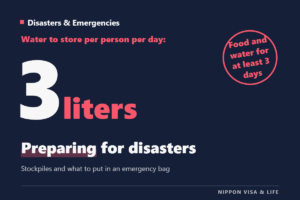
- The guideline for the amount of water a person needs is 3 liters per person per day
Drinking Water After the Water Comes Back
The Ministry of Agriculture, Forestry and Fisheries advises using tap water after a water outage or flooding only after the local government says it is safe to drink. Do not drink well water or use it for cooking until it has been tested for water quality. For questions about well water, consult your local government (public health center).
Things You Can Prepare in Advance
- Check where the breaker (distribution board) is and how to operate it
- Find out the general transmission and distribution operator for the area where you live and its outage information page
- Check the locations of water supply points on the website of your city, ward, town or village or the waterworks bureau
- Store tap water. The Bureau of Waterworks, Tokyo Metropolitan Government advises filling a clean container with a lid right to the top with water from the tap, and storing it without passing it through a water purifier or boiling it (the effect of chlorine disinfection lasts about 3 days if stored at room temperature away from direct sunlight, and about 10 days in the refrigerator). You can also store water in plastic water tanks or keep the bathtub filled, to use for the toilet and cleaning
For more on stockpiling (storing) food and water, see Preparing for Disasters in Japan: Stockpiling Food and Water (3 Days to 1 Week) and What to Put in an Emergency Grab Bag.
(Sources: Bureau of Waterworks, Tokyo Metropolitan Government, “Disaster countermeasures of the Bureau of Waterworks, Tokyo Metropolitan Government” (PDF), Agency for Natural Resources and Energy, “Learning again: what to do and what not to do during a power outage”)
Common Problems and Frequently Asked Questions
Who should I call when the power goes out?
First, check the outage information on the website of the power company (general transmission and distribution operator). If the whole area is without power, it is usually shown there. If only your home is without power and checking the breaker does not fix it, contact the power company or an electrician. Contact details are in the “List of contacts and how to contact” on the Agency for Natural Resources and Energy’s page.
Should I unplug electrical appliances during an outage?
Yes. The Fire and Disaster Management Agency advises turning off electrical appliances and unplugging them from the outlet during an outage. This is to prevent fires from damaged appliances or heaters when the electricity comes back.
What if there is a burning smell or smoke after the power comes back?
Turn off the breaker immediately and call the fire department (119). How to call 119 is explained in How to Call an Ambulance in Japan: How to Dial 119, What to Say, and Where to Get Advice When You Are Unsure (#7119).
Can I use electrical appliances that got wet?
NITE warns that water, mud or salt may remain inside electrical appliances that got wet, and that they may catch fire when electricity flows through them. After the electricity comes back, use only products that were not damaged by flooding or similar. Even then, check how they look and use them one at a time. If you notice a strange sound or smell, stop using the product and consult the manufacturer or the store where you bought it.
What if it is dangerous to stay at home because of an earthquake or heavy rain?
Follow the evacuation information from your city, ward, town or village. When you leave your home to evacuate, turn off the breaker. How to find evacuation sites is explained in How to Find Evacuation Sites, Evacuation Shelters and Hazard Maps in Japan: What to Check for Your Address Before a Disaster.
Primary Sources Referenced in This Article
- Agency for Natural Resources and Energy, “Learning again: what to do and what not to do during a power outage”
- TEPCO Power Grid, “When the electricity suddenly goes out”
- Fire and Disaster Management Agency, “Beware of electrical fires when power is restored” (PDF)
- NITE (National Institute of Technology and Evaluation), “Beware of CO poisoning from generators during outages and electrical fires after restoration!” (PDF; announced jointly with the Ministry of Economy, Trade and Industry and the Consumer Affairs Agency)
- Ministry of Agriculture, Forestry and Fisheries, “To everyone in areas affected by power outages, water outages and flooding from heavy rain: be careful of food poisoning”
- Bureau of Public Health, Tokyo Metropolitan Government, “Checks before using the toilet” (PDF)
- Bureau of Waterworks, Tokyo Metropolitan Government, “Disaster countermeasures of the Bureau of Waterworks, Tokyo Metropolitan Government” (PDF)
- Government Public Relations Online, “(Disaster Prevention Special) ACTION01 Preparing for disasters in advance”
This article is a translation of the original Japanese version.