This article was written by the NIPPON VISA & LIFE editorial team based on information from public organizations such as the national government and local governments. Rules and fees may differ depending on the city, ward, town or village where you live.
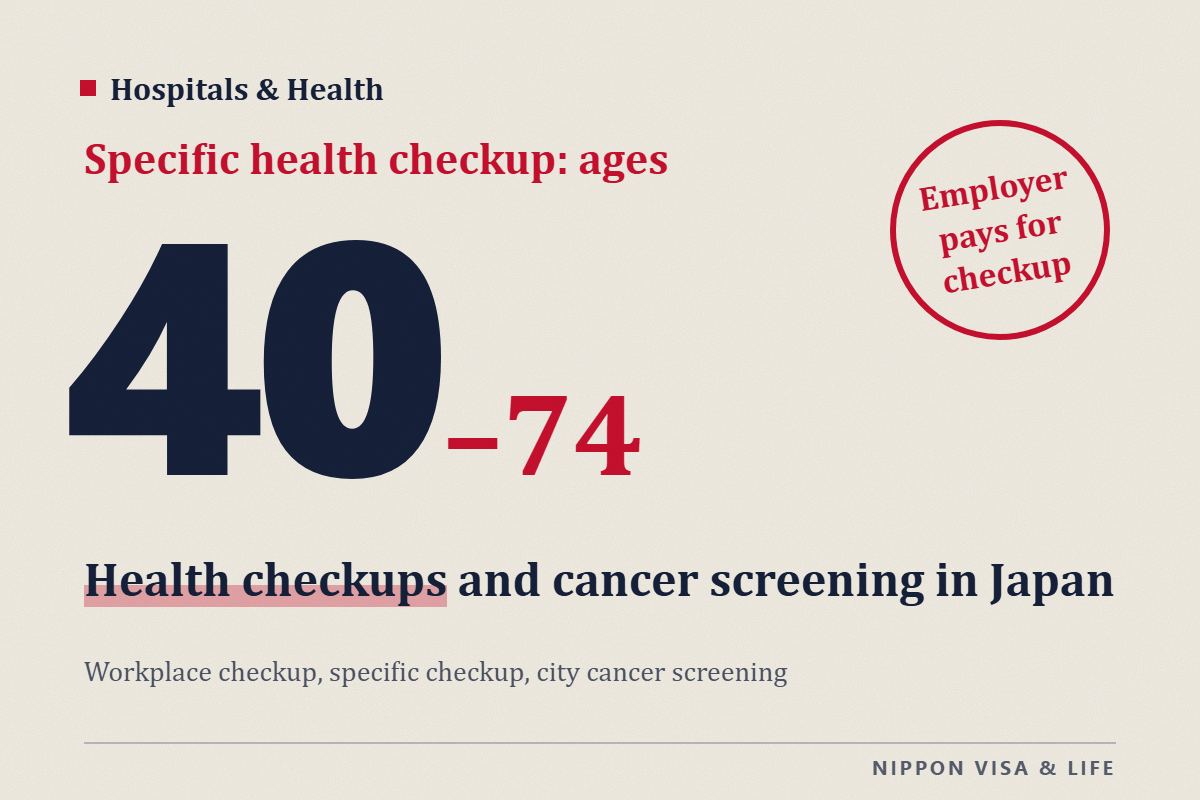
In Japan, there are 3 main kinds of health checkups: the workplace health checkup (会社の健康診断), the specific health checkup (特定健診, tokutei kenshin — a health checkup for people aged 40 to 74), and cancer screening from your city, ward, town or village (市区町村のがん検診). People employed by a company (part-time workers and arubaito workers who meet certain conditions) must take the workplace health checkup. The company pays for it. For cancer screening, check who is eligible and how to apply in the notices or on the website of the city, ward, town or village where you live.
For an overview of how to use hospitals, see When You Are Sick or Injured in Japan: The Basics of Hospitals, Ambulances, Medicine, Medical Insurance and Where to Get Advice.
The Short Answer: Check Which Health Checkups Apply to You
| Type | Who is eligible | Who carries it out | Cost |
|---|---|---|---|
| Workplace health checkup | People employed by a company (part-time workers and arubaito workers who meet certain conditions) | The company | Paid by the company |
| Specific health checkup | People aged 40 to 74 | The health insurance you are enrolled in (for National Health Insurance, your city, ward, town or village) | Ask the health insurance you are enrolled in |
| Cancer screening | People of the ages set for each type | Your city, ward, town or village (sometimes also your workplace or health insurance) | In many cities, wards, towns and villages, you pay only part of the cost |
- If you work for a company, take the health checkup that the company tells you about.
- If you are aged 40 to 74, you can take the specific health checkup from the health insurance you are enrolled in. Ask your health insurance how to take it. If you take the workplace health checkup, those results are used.
- For cancer screening, check the eligible ages and how to apply in the notices or on the website of your city, ward, town or village.
- If your results say “detailed examination needed” (要精密検査) or “re-examination needed” (要再検査), get a detailed examination at a medical institution.
(Source: Ministry of Health, Labour and Welfare, “Cancer Screening”, Ministry of Health, Labour and Welfare, “About Specific Health Checkups and Specific Health Guidance”, Immigration Services Agency (ISA), “Guidebook on Living and Working”)
The Workplace Health Checkup
When do you take it?
A company must have a doctor give a health checkup to workers when it hires them, and after that once within every 1 year. Workers must take that health checkup.
(Source: e-Gov Laws and Regulations Search, “Industrial Safety and Health Act,” Article 66, e-Gov Laws and Regulations Search, “Ordinance on Industrial Safety and Health,” Articles 43 and 44)
Are part-time and arubaito workers included?
Not only regular full-time employees, but also dispatched workers, contract employees, part-time workers and arubaito workers who meet both of the following 2 conditions are included.
- You work under a contract with no fixed term (if your contract has a fixed term, you are expected to work for 1 year or more, or you have worked for 1 year or more through renewals)
- Your working hours per week are three-quarters (3/4) or more of the scheduled weekly working hours of regular workers doing the same job at the same workplace
(Source: Immigration Services Agency, “Guidebook on Living and Working,” Chapter 3, 3-1)
What does it cost?
The cost of health checkups that the law requires companies to carry out is to be paid by the company.
What tests are done?
The items for the once-a-year health checkup (regular health checkup) are set by a legal ordinance.
| Item | What it involves |
|---|---|
| Medical interview | You are asked about past illnesses, your work, and how you feel now |
| Body measurements | Height, weight, waist circumference (around the belly), eyesight and hearing |
| Chest X-ray | An X-ray picture of your chest is taken |
| Blood pressure | Your blood pressure is measured |
| Blood test | Checks for anemia, liver function, fats in the blood (such as cholesterol) and blood sugar |
| Urine test | Checks whether there is sugar or protein in your urine |
| Electrocardiogram (ECG) | Checks how your heart is working |
Some items, such as height, chest X-ray, blood test and electrocardiogram, may be skipped when a doctor decides they are not necessary based on standards set by the national government.
(Source: e-Gov Laws and Regulations Search, “Ordinance on Industrial Safety and Health,” Article 44)
What happens with the results?
- The company must inform the people who took the health checkup of their results.
- The company is to make efforts to provide health guidance (advice on things like your lifestyle) from a doctor or public health nurse to people who especially need to take care of their health.
(Source: e-Gov Laws and Regulations Search, “Industrial Safety and Health Act,” Articles 66-6 and 66-7)
The Specific Health Checkup (Ages 40 to 74)
- The specific health checkup is a health checkup to prevent lifestyle-related diseases (diseases related to lifestyle habits such as diet and exercise, for example high blood pressure and diabetes). It focuses on metabolic syndrome (a condition in which fat around the belly is combined with abnormal blood pressure, blood sugar or blood fats).
- It is for people aged 40 to 74, and taking it once a year is recommended.
- It is carried out by the health insurance you are enrolled in (your city, ward, town or village for National Health Insurance; a health insurance society or similar for company health insurance). Ask the health insurance you are enrolled in how to take it and how much it costs.
- If you took the workplace health checkup, those results are used instead of the specific health checkup (for the parts that correspond to the specific health checkup items).
- If the results show that you have a high risk of lifestyle-related diseases and that changing your lifestyle is likely to prevent them, you can receive specific health guidance (特定保健指導, support for reviewing your lifestyle) from a public health nurse, registered dietitian or similar professional.
(Source: Ministry of Health, Labour and Welfare, “About Specific Health Checkups and Specific Health Guidance”, e-Gov Laws and Regulations Search, “Act on Assurance of Medical Care for Elderly People,” Articles 20 and 21)
For how to join National Health Insurance, see How to Join and Leave National Health Insurance in Japan: Who Must Join, the 14-Day Notification, What to Bring, Premiums and Reductions.
Cancer Screening from Your City, Ward, Town or Village
What cancer screenings are there?
Cities, wards, towns and villages carry out cancer screening based on the law. The national government recommends the following 5 types of cancer screening.
| Type | What the test involves | Eligible age | How often |
|---|---|---|---|
| Stomach cancer | Medical interview, plus either a stomach X-ray or a stomach endoscopy (gastroscopy) | 50 and over (for the time being, the stomach X-ray may also be given from age 40) | Once every 2 years (for the time being, the stomach X-ray may also be given once a year) |
| Cervical cancer | Medical interview, visual examination, cervical cell test and internal (pelvic) examination | In your 20s | Once every 2 years |
| Cervical cancer | Medical interview, visual examination, cervical cell test and internal (pelvic) examination | 30 and over | Once every 2 years |
| Cervical cancer | Medical interview, visual examination and HPV test alone (HPV testing as a stand-alone method) | 30 and over | Once every 5 years (people at high risk of cancer take it again after 1 year) |
| Lung cancer | Questions (medical interview) and a chest X-ray | 40 and over | Once a year |
| Breast cancer | Questions (medical interview) and a breast X-ray (mammography) | 40 and over | Once every 2 years |
| Colorectal cancer | Medical interview and a stool test (checks whether there is blood in the stool) | 40 and over | Once a year |
For cervical cancer screening for people aged 30 and over, the test method differs depending on the city, ward, town or village. Check with the city, ward, town or village where you live.
What if you are younger than the eligible age?
The Ministry of Health, Labour and Welfare recommends getting cancer screening after you reach the eligible age. This is because few people younger than the eligible age get cancer, and the benefits of screening for them have not been confirmed. Also, people who are being treated for that cancer or for a precancerous condition are not eligible for that cancer screening.
(Source: Ministry of Health, Labour and Welfare, “Cancer Screening”)
Cost and how to apply
- In most cities, wards, towns and villages, the city, ward, town or village pays most of the cost of cancer screening, and the person being screened pays only part of it.
- Your company or the health insurance you are enrolled in may also offer cancer screening. When you receive the notice for the workplace health checkup, check whether cancer screening is included, and check the test details, eligible age and how often it is given.
- How to apply, the cost and the medical institutions where you can get screened differ depending on the city, ward, town or village. Check the public newsletter or notices from your city, ward, town or village, or search the internet for “(name of your city, ward, town or village) がん検診” (cancer screening). If you are not sure, ask the health section of your local government office (such as the public health center, 保健センター).
(Source: Ministry of Health, Labour and Welfare, “Cancer Screening”)
Health Checkups for Children
Cities, wards, towns and villages give free health checkups to children aged 1 year and 6 months and to children aged 3. These include examinations of growth and development, height and weight measurements, and advice on child-raising. For health checkups during pregnancy (prenatal checkups, 妊婦健康診査), when you submit a pregnancy notification, you receive checkup vouchers or subsidy vouchers that let you get checkups with public funding. For details, contact the city, ward, town or village where you live.
(Source: Immigration Services Agency, “Guidebook on Living and Working,” Chapter 4, 1-1 and 4-2)
What to Do in These Situations
What if your results say “detailed examination needed”?
Get a detailed examination (精密検査) at a medical institution. With cancer screening, you only find out whether you have cancer after you have also taken the detailed examination. According to the Ministry of Health, Labour and Welfare, even when a detailed examination is judged necessary, only a very small number of people are actually diagnosed with cancer. However, if you do not take it because “I have no symptoms,” there is a risk that cancer, if present, will be found late.
(Source: Ministry of Health, Labour and Welfare, “Cancer Screening”)
Can you take it at a hospital you choose yourself, instead of one the company chose?
Yes. If you take a health checkup with the same content as the workplace health checkup from another doctor and submit a document proving the results to the company, it counts as having taken the workplace health checkup. Ask your company how the cost is handled.
(Source: e-Gov Laws and Regulations Search, “Industrial Safety and Health Act,” Article 66, Paragraph 5)
What if you had a health checkup just a short time ago?
For the health checkup at the time of hiring, if fewer than 3 months have passed since you had a health checkup by a doctor and you submit a document proving the results, the same items can be skipped.
(Source: e-Gov Laws and Regulations Search, “Ordinance on Industrial Safety and Health,” Article 43)
If you were once told “no abnormalities,” do you no longer need to take it?
No. Even if a cancer screening finds “no abnormalities,” cancer can develop a few years later. Keep taking screenings at the set intervals.
(Source: Ministry of Health, Labour and Welfare, “Cancer Screening”)
Where to Get Help
- About the workplace health checkup: First ask the person in charge at your company. If you want advice about working conditions, the Ministry of Health, Labour and Welfare has the “Consultation Dial for Foreign Workers” (外国人労働者向け相談ダイヤル, a telephone consultation service in foreign languages; the days and hours are set for each language).
- About the specific health checkup: The health insurance you are enrolled in (for National Health Insurance, the counter at your city, ward, town or village office)
- About cancer screening and health checkups for children: The health section of the city, ward, town or village where you live (such as the public health center)
(Source: Immigration Services Agency, “Guidebook on Living and Working,” Chapter 3, Ministry of Health, Labour and Welfare, “Consultation Services for Foreign Workers”)
Primary Sources Referenced in This Article
- Ministry of Health, Labour and Welfare, “Cancer Screening”
- Ministry of Health, Labour and Welfare, “About Specific Health Checkups and Specific Health Guidance”
- Ministry of Health, Labour and Welfare, “Who should pay for health checkups, the worker or the employer?”
- Immigration Services Agency, “Guidebook on Living and Working”
- e-Gov Laws and Regulations Search, “Industrial Safety and Health Act”
- e-Gov Laws and Regulations Search, “Ordinance on Industrial Safety and Health”
- e-Gov Laws and Regulations Search, “Act on Assurance of Medical Care for Elderly People”
- Ministry of Health, Labour and Welfare, “Consultation Services for Foreign Workers”
This article is a translation of the original Japanese version.