This article was written by the NIPPON VISA & LIFE editorial team based on information from public organizations such as the national government and local governments. Rules and fees may differ depending on the city, ward, town or village where you live.
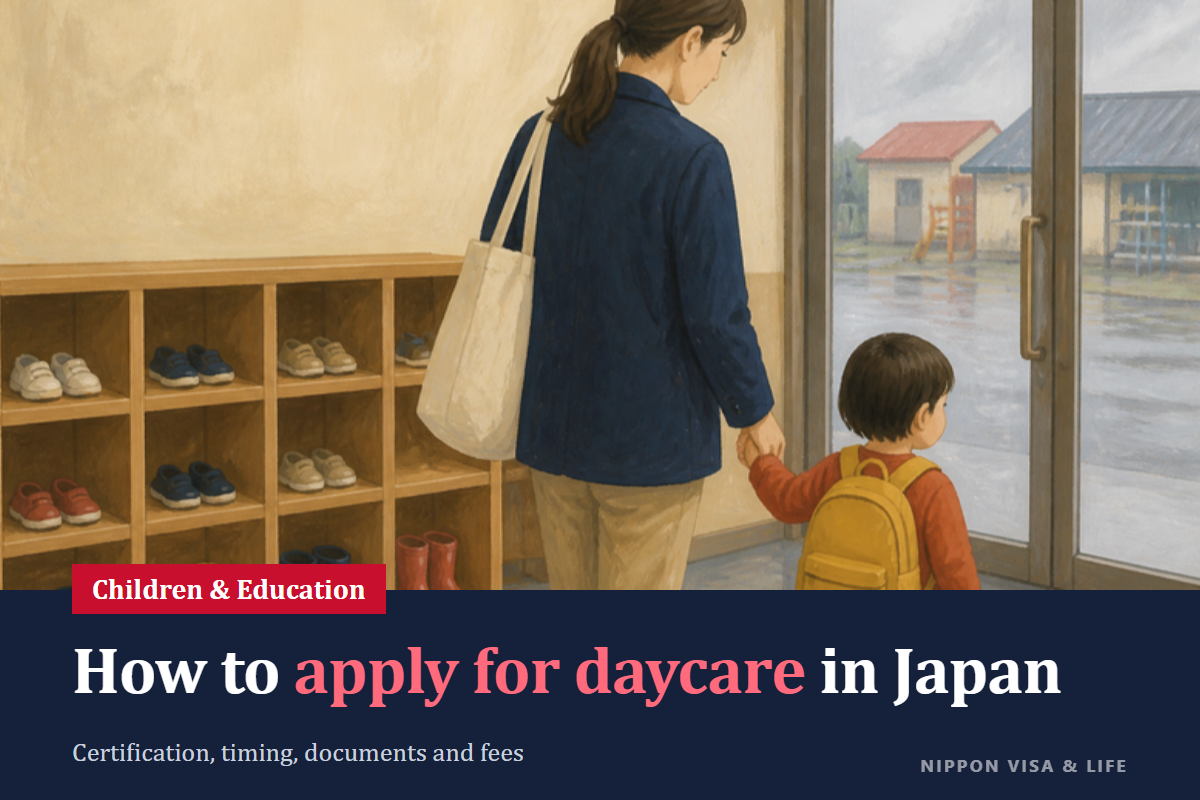
To enter a nursery school (保育園 hoikuen / 保育所 hoikusho) in Japan, you apply to the city, ward, town or village where you live, not to the nursery school itself. The city, ward, town or village first recognizes that your child “needs childcare,” and then decides which nursery school your child will attend. If you want your child to start in April, some cities, wards, towns and villages accept applications around autumn of the previous year, so check the information from your city, ward, town or village early.
The Short Answer: Steps to Enter a Nursery School
- Get the application guide (利用案内, riyo annai) and application form from the website or office of the city, ward, town or village where you live
- Decide the order of the nursery schools you want (some cities, wards, towns and villages recommend visiting the nursery schools before you apply)
- Apply to the city, ward, town or village for “childcare certification (Certification No. 2 or No. 3)” and, at the same time, apply to use a facility
- The city, ward, town or village checks whether your child needs childcare and issues a certificate
- The city, ward, town or village decides which nursery school your child will attend based on the situation of the applicants (利用調整, riyo chosei: placement adjustment)
- Once the nursery school is decided, you sign a contract with the nursery school and your child starts attending
This process applies to nursery schools, the childcare part of centers for early childhood education and care (認定こども園, nintei kodomoen), and community-based childcare. For kindergartens (幼稚園, yochien), you apply directly to the kindergarten.
For an overview of child-raising procedures (pregnancy notification, birth registration, checkups, school and so on), see The Basics of Raising Children in Japan: Pregnancy and Birth Procedures, Child Allowance, Checkups and Vaccinations, Nursery Schools and Kindergartens, Elementary and Junior High School.
(Sources: Children and Families Agency “Understanding the ‘New System for Children and Child-Rearing Support'”)
Nursery Schools and Other Childcare Options
Facilities for children who have not yet entered elementary school include the following.
| Facility | Child’s age | Parents who can use it | Where to apply |
|---|---|---|---|
| Nursery school (hoikusho / hoikuen) | 0 to 5 years old | Parents who cannot care for the child at home, for example because they work | City, ward, town or village |
| Center for early childhood education and care (nintei kodomoen) | 0 to 5 years old | For ages 0 to 2, parents who cannot care for the child at home. For ages 3 to 5, no restrictions | For the childcare part, the city, ward, town or village |
| Community-based childcare (small-scale childcare, etc.) | 0 to 2 years old | Parents who cannot care for the child at home | City, ward, town or village |
| Kindergarten (yochien) | 3 to 5 years old | No restrictions | Directly to the kindergarten |
- Community-based childcare cares for children aged 0 to 2 in smaller groups than nursery schools (which as a rule have 20 or more children). It includes home-based childcare (家庭的保育, “hoiku mama”) for up to 5 children, small-scale childcare for 6 to 19 children, and workplace childcare that uses a company’s childcare facility
- Because community-based childcare is only up to age 2, a “partner facility” (連携施設: a nursery school, kindergarten or center for early childhood education and care) may be set as the place the child attends from age 3
- Facilities that have not received approval under the Child Welfare Act are called “unlicensed childcare facilities” (認可外保育施設, ninkagai hoiku shisetsu). These also include babysitters and daycare rooms (託児所, takujisho)
- The usual childcare time at a nursery school is 8 hours a day. Some nursery schools also provide childcare at night or on holidays
Which facilities and services are available differs depending on the city, ward, town or village where you live.
(Sources: Children and Families Agency “Understanding the ‘New System for Children and Child-Rearing Support'”, Immigration Services Agency “Guidebook on Living and Working” Chapter 4, 4-5)
Who Can Apply: Types of “Childcare Certification” and Reasons
Types of Certification
| Certification | Child | Facilities that can be used |
|---|---|---|
| Certification No. 1 | Ages 3 to 5, does not need childcare | Kindergarten, center for early childhood education and care |
| Certification No. 2 | Ages 3 to 5, needs childcare | Nursery school, center for early childhood education and care |
| Certification No. 3 | Ages 0 to 2, needs childcare | Nursery school, center for early childhood education and care, community-based childcare |
To enter a nursery school, you need Certification No. 2 or No. 3.
Reasons Recognized as Needing Childcare
A parent needs to meet one of the following.
- Working (full-time, as well as part-time, night work, work done at home, etc.)
- Pregnant, or before or after giving birth
- Has an illness or disability
- Providing nursing care or care for a family member who lives with them or who is in hospital for a long time
- Recovering from a disaster
- Looking for work (including preparing to start a business)
- Attending school (including vocational training at a vocational training school, etc.)
- At risk of abuse or DV (domestic violence: violence from a spouse or partner)
- On childcare leave, and an older child who already attends a nursery school needs to continue attending
- Other cases the city, ward, town or village recognizes as similar to these
Hours of Childcare
The certification also decides how many hours of childcare your child can receive.
- Standard childcare hours (保育標準時間): up to 11 hours (intended for people who work full-time)
- Short childcare hours (保育短時間): up to 8 hours (intended for people who work part-time)
When the reason is work, the minimum working hours for “short childcare hours” is set by the city, ward, town or village between 48 and 64 hours a month. Even with an 11-hour certification, if you go beyond the usual childcare time set by the nursery school, there is a separate fee for extended childcare.
(Sources: Children and Families Agency “Understanding the ‘New System for Children and Child-Rearing Support'”)
When to Apply
The application period and deadline are set by the city, ward, town or village. Some cities, wards, towns and villages accept applications for April entry all at once around autumn of the previous year.
Example: Miyakojima Ward, Osaka City
| Application | Period / deadline |
|---|---|
| Entry from April of Reiwa 9 (distribution of application forms) | September 4 to October 15, Reiwa 8 |
| Entry from April of Reiwa 9 (submission and interview) | October 1 to October 15, Reiwa 8 (an online reservation is required) |
| Entry during the year (from November, Reiwa 8) | By October 5, Reiwa 8 |
The application period in this example has already ended.
- For April entry, people who have already applied and are waiting are also asked to apply again
- There is an interview when you apply, and the parent goes with the child
- Applications by mail are not accepted
- Applicants are asked to visit all of the nursery schools they want
To find the period in your city, ward, town or village, search on its website for “保育所 入所 申込” or “保育施設 利用申込,” or check at the child-raising section. If you plan to move, also check the application period of the city, ward, town or village you will move to.
What You Need
The documents you need differ depending on the city, ward, town or village. The application guide from the city, ward, town or village mainly lists items such as the following.
- Application form (the form for applying for childcare certification and for applying to use a facility)
- A document showing why your child needs childcare (an “employment certificate” for people who work, a medical certificate for people who are ill, etc.)
- Other documents listed in the information from the city, ward, town or village
The employment certificate (就労証明書, shuro shomeisho) is a document your employer fills in for you. The Children and Families Agency provides a standard format (a form set by the national government), and as a rule cities, wards, towns and villages are supposed to use this format. Ask your employer early so that it is ready before the application deadline.
People on childcare leave may be asked for a copy of the nursery school application form when they go through the procedure to extend their childcare leave. Some cities, wards, towns and villages advise you to make a copy before you apply.
(Sources: Children and Families Agency “Information on the ‘Employment Certificate'”, Miyakojima Ward, Osaka City “Applications to Use Childcare Facilities and Services for Fiscal Reiwa 9”)
How the Nursery School Is Decided (Placement Adjustment)
When there are more applicants than places, the city, ward, town or village decides which nursery school each child will attend by ranking applicants according to its own standards, based on things such as the parents’ situation. This is called “placement adjustment” (利用調整, riyo chosei).
- On the application form, you write the nursery schools you want in order of preference
- Single-parent families, families receiving public assistance (welfare), families where the person who supports the household has lost their job, families with a child who has a disability, and others may be judged to need priority
- Even if you apply, your child may not be able to enter the nursery school you want
(Sources: Children and Families Agency “Understanding the ‘New System for Children and Child-Rearing Support'”)
Childcare Fees and Free Childcare
Childcare fees are set by the city, ward, town or village within an upper limit set by the national government. They are calculated based on the parents’ income (such as the amount of municipal resident tax).
Free Childcare (How Childcare Fees Become Free)
| Child’s age | Nursery schools, centers for early childhood education and care, community-based childcare, etc. |
|---|---|
| Classes for ages 3 to 5 | Free |
| Classes for ages 0 to 2 | Free for households exempt from resident tax |
- As a rule, the free period for ages 3 to 5 is the 3 years from April 1 after the child turns 3 until the child enters elementary school
- In classes for ages 0 to 2, counting the oldest child who uses a nursery school or similar as the first child, the second child is half price and the third child and later are free. For households equivalent to an annual income of less than 3,600,000 yen, children are counted regardless of the first child’s age
- Even when childcare is free, parents pay for taking the child to and from the nursery school, food ingredients (such as school meal fees) and events. However, for households equivalent to an annual income of less than 3,600,000 yen, and for the third child and later in all households, the cost of side dishes, snacks and similar is waived
When Using Unlicensed Childcare Facilities or Kindergarten Extended Care
| What you use | Upper limit of the free amount (per month) |
|---|---|
| Unlicensed childcare facilities, etc. (classes for ages 3 to 5) | Up to 40,300 yen |
| Unlicensed childcare facilities, etc. (classes for ages 0 to 2, households exempt from resident tax) | Up to 45,700 yen |
| Kindergarten extended care (預かり保育, azukari hoiku) (classes for ages 3 to 5) | Up to 12,300 yen |
| Kindergartens not covered by the Child and Child-Rearing Support System | Up to 28,000 yen |
To receive free childcare at an unlicensed childcare facility or for extended care, you need to apply to the city, ward, town or village and receive “certification of the need for childcare.” For unlicensed childcare facilities, this is for people who have not been able to use a nursery school or similar, and only facilities that meet the national standards and have notified the prefecture are covered.
Check the information from the city, ward, town or village where you live for details on childcare fees. For the allowance that people raising children can receive, see How to Apply for and Receive the Child Allowance in Japan: Amounts, Payment Months, Applying Within 15 Days, and Moving or Living Abroad.
(Sources: Children and Families Agency “About Free Early Childhood Education and Care”, Children and Families Agency “Understanding the ‘New System for Children and Child-Rearing Support'”)
Troubles and Frequently Asked Questions
What should I do if my child could not get a place at a nursery school?
Check the next steps (such as whether you can apply again to other nursery schools) in the notice of the result or the information from the city, ward, town or village. While you wait, there are other childcare options such as the following.
- Unlicensed childcare facilities: these may be covered by free childcare (see the table above)
- Temporary childcare (一時預かり, ichiji azukari): a nursery school or similar looks after your child temporarily, for example when you have urgent business or short part-time work
- Family Support Center (ファミリー・サポート・センター): people who want someone to look after their child and people who want to help both become members, and they help each other with taking children to and from places and looking after them
- Childcare for All Children System (こども誰でも通園制度, kodomo daredemo tsuen seido): a new system that lets children attend, for example by the hour, within a set number of hours a month, regardless of whether the parents work. It has been carried out in cities, wards, towns and villages nationwide since fiscal 2026. Check the eligible ages, hours and facilities with your city, ward, town or village
(Sources: Children and Families Agency “Understanding the ‘New System for Children and Child-Rearing Support'”, Children and Families Agency “Childcare for All Children System”, Immigration Services Agency “Guidebook on Living and Working” Chapter 4, 4-7)
I am not working now. Can I apply?
Looking for work is also one of the reasons a child needs childcare. However, the order of priority in placement adjustment depends on the standards set by the city, ward, town or village. Before you apply, check at the office of your city, ward, town or village.
We both work, but we want our child to go to kindergarten
Even if both parents work, if you want your child to receive kindergarten education, you get Certification No. 1 and use a kindergarten or a center for early childhood education and care. You apply for kindergarten directly to the kindergarten.
Where can I ask for advice?
First, consult the child-raising section of the city, ward, town or village where you live. Cities, wards, towns and villages and others have a “user support” (利用者支援, riyosha shien) service that gives information and introductions so you can choose the facilities and child-raising support that suit you. For how to find the right section at the city office, also see Procedures at the City Office After You Arrive in Japan: The Basics of the Moving-in Notification, My Number, National Health Insurance, National Pension and Resident Tax.
(Sources: Children and Families Agency “Understanding the ‘New System for Children and Child-Rearing Support'”)
Primary Sources Used for This Article
- Children and Families Agency “Understanding the ‘New System for Children and Child-Rearing Support'”
- Children and Families Agency “About Free Early Childhood Education and Care”
- Children and Families Agency “Information on the ‘Employment Certificate'”
- Children and Families Agency “Childcare for All Children System”
- Immigration Services Agency “Guidebook on Living and Working”
- Miyakojima Ward, Osaka City “Applications to Use Childcare Facilities and Services for Fiscal Reiwa 9”
This article is a translation of the original Japanese version.