This article was written by the NIPPON VISA & LIFE editorial team based on information from public organizations such as the national government and local governments. Rules and fees may differ depending on the city, ward, town or village where you live.
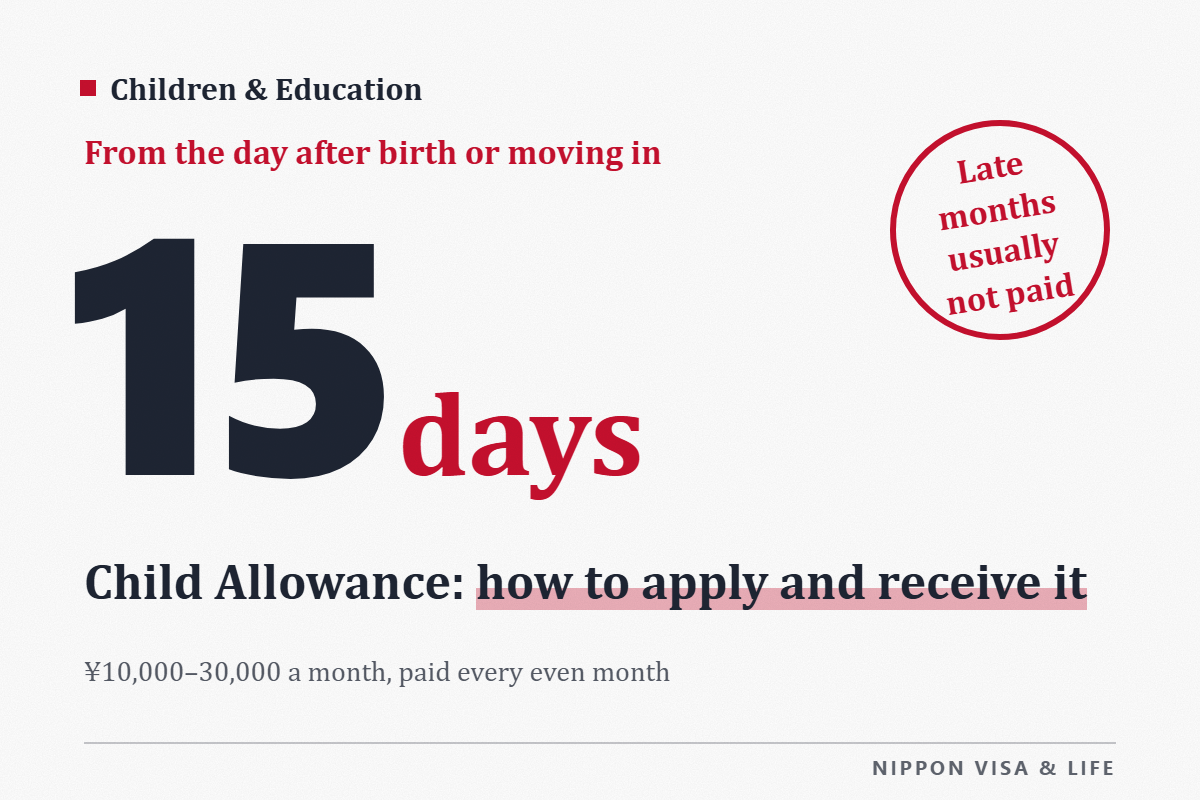
The Child Allowance (児童手当, jido teate) in Japan is a national allowance that people raising children up to high-school age can receive. When a child is born, or when you move in from another city, ward, town or village, you apply to the city, ward, town or village where you live within 15 days from the next day. If you apply late, as a rule you cannot receive the allowance for the months you were late.
The Short Answer: How to Start Receiving It
- A child is born, or you move in from another city, ward, town or village
- Within 15 days from the next day, submit the “Application for Certification” (認定請求書, nintei seikyusho: the application form) at the office of the city, ward, town or village where you live
- Once the city, ward, town or village certifies you, as a rule the allowance is paid from the month after the month you applied
- In even-numbered months (February, April, June, August, October and December), the amount for the 2 months up to the previous month is paid into your bank account
- When your address or name changes, for example, notify the city, ward, town or village
If you are a public servant, you apply to your workplace, not to the city, ward, town or village.
For an overview of child-raising procedures (pregnancy notification, birth registration, checkups, nursery schools, school and so on), see The Basics of Raising Children in Japan: Pregnancy and Birth Procedures, Child Allowance, Checkups and Vaccinations, Nursery Schools and Kindergartens, Elementary and Junior High School.
(Sources: Children and Families Agency “Guide to the Child Allowance System”, Children and Families Agency “Child Allowance Q&A”)
Who Can Receive It and How Much
Children Covered
Children from age 0 until the first March 31 after their 18th birthday (up to high-school age). The parents or others raising these children receive the allowance.
The national government’s guide for foreign residents (Guidebook on Living and Working) explains that you can receive it when both the child and the person raising the child live in Japan. For the rules when someone lives abroad, see “When Living Abroad” below.
Amount (Monthly Amount per Child)
| Child’s age | First and second child | Third child and later |
|---|---|---|
| Under 3 years old | 15,000 yen | 30,000 yen |
| From 3 years old up to high-school age | 10,000 yen | 30,000 yen |
For example, if you have 1 child under 3 years old (first child), 30,000 yen for 2 months is paid in each even-numbered month.
How “Third Child and Later” Is Counted
“Third child and later” means the third and later children, counting from the oldest. When counting, in addition to children up to high-school age, older children up to the first March 31 after they turn 22 (such as university students) are also included. However, for that older child, the parent or other person must provide care equivalent to custody (care that amounts to raising the child) and also pay the child’s living expenses. In that case, you submit the “Confirmation Form on Care Equivalent to Custody and Payment of Living Expenses.”
Even if you have 3 or more children, they are not always counted as “third child and later.” If you are not sure, check at the office of your city, ward, town or village.
(Sources: Children and Families Agency “Guide to the Child Allowance System”, Children and Families Agency “How to Count the ‘Third Child and Later'” (PDF), Children and Families Agency “Overview of the Child Allowance System” (PDF), Immigration Services Agency “Guidebook on Living and Working” Chapter 4, 3-4)
How to Apply
Deadline
| Situation | Application deadline | Where to apply |
|---|---|---|
| A child is born | Within 15 days from the day after the birth | The city, ward, town or village where you live |
| You moved to another city, ward, town or village | Within 15 days from the day after the planned moving-out date | The city, ward, town or village you moved to |
| You stopped being a public servant (for example, you retired) | Within 15 days from the next day | The city, ward, town or village where you live |
- As a rule, the allowance is paid from the month after the month you applied
- If the birth or move was near the end of the month and you apply in the next month, the allowance is paid from the month you applied, as long as it is within 15 days from the next day
- If you apply late, as a rule you cannot receive the allowance for the months you were late
When Giving Birth at Your Family Home (Satogaeri Shussan)
Even when you are staying somewhere else temporarily to give birth (such as your parents’ home), you apply to the city, ward, town or village where you live. Even if you submitted the birth registration in another city, ward, town or village, you still need to apply for the Child Allowance separately.
What You Need
The application form is the “Application for Certification.” If you are already receiving the allowance and the amount increases because a child is born, you submit the “Application for Certification of Revised Amount” (額改定認定請求書, gaku kaitei nintei seikyusho).
The national government’s guide lists items such as the following.
| Who | What to submit |
|---|---|
| Company employees and similar (employed persons) | A My Number Card registered for use as a health insurance card, a health insurance eligibility certificate, a copy of a pension enrollment certificate, etc. |
| People who did not have a resident record (juminhyo) in their current city, ward, town or village on January 1 of that year (the previous year if applying in January to April) | The “Income Certificate for the Child Allowance” issued by the city, ward, town or village where you lived before |
| People who include an older child up to the end of the school year in which they turn 22 in the count | Confirmation Form on Care Equivalent to Custody and Payment of Living Expenses |
- In addition, you may need something that shows a bank account in the applicant’s name, etc.
- As a rule, the bank account for payment can only be an account in the name of the person who receives the allowance. It cannot be an account in the name of the child or spouse
- Some cities, wards, towns and villages let you apply online using your My Number Card
What you need may differ depending on the city, ward, town or village. Before going to the office, search for “児童手当” on your city, ward, town or village’s website, or call the child-raising section to check.
(Sources: Children and Families Agency “Guide to the Child Allowance System”, Children and Families Agency “Child Allowance Q&A” Q2, Q3, Q5, Q6 and Q13)
After You Start Receiving It
Payment Months
Every year in February, April, June, August, October and December, the amount for the 2 months up to the previous month is paid. For example, in June, the amounts for April and May are paid. Check the payment date in the information from your city, ward, town or village.
Current Status Notification (現況届, genkyo todoke)
In the past, a “Current Status Notification (a form telling the office that you still meet the conditions for receiving the allowance)” was required every June. From the June 2022 (Reiwa 4) payment, as a rule you no longer need to submit it.
However, people like the following still need to submit it. Also submit it when your city, ward, town or village sends you a notice. If you do not submit it, you will no longer be able to receive the allowance from the June payment onward.
- People who are discussing divorce and living separately from their spouse
- People receiving the allowance in a city, ward, town or village different from the address on their resident record because of violence from their spouse or similar reasons
- People who were told by their city, ward, town or village to submit the Current Status Notification, etc.
Nursery Fees and Other Costs May Be Deducted
Some cities, wards, towns and villages deduct nursery school fees from the allowance. Also, some cities, wards, towns and villages deduct school lunch fees and similar costs from the allowance if the person receiving it requests it. Whether this is done differs by city, ward, town or village, so check their information.
(Sources: Children and Families Agency “Guide to the Child Allowance System”, Children and Families Agency “Child Allowance Q&A” Q4 and Q11)
When You Need to Notify the Office
In the following cases, notify the city, ward, town or village where you live (public servants notify their workplace).
- When there is no longer a child covered, for example because you stopped raising the child
- When the address of the recipient, spouse, child or older child changes (including moving to another city, ward, town or village, or moving abroad)
- When the name of the recipient, spouse, child or older child changes
- When you gain or lose a spouse who raises the child with you
- When the pension the recipient belongs to changes (including when you become a public servant)
- When you are designated as a “parent-designated person” (父母指定者) by parents living abroad (see “When Living Abroad” below)
When you move to another city, ward, town or village, you need to apply again at your new city, ward, town or village. For other moving procedures, see Checklist for Moving Within Japan: Moving-out and Moving-in Notifications, Residence Card, Electricity, Gas and Water, and Mail Forwarding.
(Sources: Children and Families Agency “Guide to the Child Allowance System”, Children and Families Agency “Child Allowance Q&A” Q4 and Q6)
When Living Abroad
| Situation | Child Allowance |
|---|---|
| The child lives abroad | As a rule, the allowance for that child is not paid |
| The child lives abroad to study and meets all of the conditions below | The allowance for that child can also be received |
| The parents live abroad and the child lives in Japan with grandparents or others | If the parents designate the person living with the child in Japan as a “parent-designated person,” that person can receive it |
Conditions for receiving it while the child studies abroad (when all are met):
- The child lived in Japan continuously for more than 3 years up to the day before the day they stopped having an address in Japan
- The child lives abroad to receive education and does not live with the parents
- It is within 3 years from the day the child stopped having an address in Japan
In cases such as returning from a short study abroad and going to study abroad again within 3 years, the allowance may be received even if condition 1 is not met. For details, consult your city, ward, town or village.
When your family returns to your home country, or when only your child will live in your home country, you need to notify the city, ward, town or village of the change of address (moving abroad).
(Sources: Children and Families Agency “Guide to the Child Allowance System”, Children and Families Agency “Child Allowance Q&A” Q8 and Q9)
Troubles and Frequently Asked Questions
I forgot to apply. Can I receive it retroactively?
As a rule, you cannot receive the allowance for the months you were late. As soon as you notice, apply to the city, ward, town or village where you live.
Can I receive it if I am not a Japanese national?
The national government’s guide for foreign residents (Guidebook on Living and Working) explains that you can receive it if both the child and the person raising the child live in Japan. A child of foreign nationality born in Japan also needs status of residence (在留資格) procedures. If the child has not acquired a status of residence after 60 days have passed since birth, the child’s resident record may be deleted and the child may not be able to receive government services such as the Child Allowance. For the procedures, see The Basics of Raising Children in Japan: Pregnancy and Birth Procedures, Child Allowance, Checkups and Vaccinations, Nursery Schools and Kindergartens, Elementary and Junior High School.
Which parent receives it, the father or the mother?
The parent or other person who raises the child and supports the child’s living receives it. When the parents live separately, for example because they are discussing divorce, the allowance is paid with priority to the person who lives with the child. If you are not sure who receives it, consult the office of your city, ward, town or village.
It is hard to ask for advice in Japanese
Individual questions about the allowance are handled by the city, ward, town or village where you live (public servants: their workplace). First, consult the child-raising section of your city, ward, town or village. For how to find the right section at the city office, also see Procedures at the City Office After You Arrive in Japan: The Basics of the Moving-in Notification, My Number, National Health Insurance, National Pension and Resident Tax.
(Sources: Children and Families Agency “Guide to the Child Allowance System”, Children and Families Agency “Child Allowance Q&A” Q2 and Q6, Immigration Services Agency “Guidebook on Living and Working” Chapter 4, 2-1 and 3-4)
Primary Sources Used for This Article
- Children and Families Agency “Guide to the Child Allowance System”
- Children and Families Agency “Child Allowance Q&A”
- Children and Families Agency “More Support for Child-Raising! Child Allowance”
- Children and Families Agency “Overview of the Child Allowance System” (PDF)
- Children and Families Agency “How to Count the ‘Third Child and Later'” (PDF)
- Immigration Services Agency “Guidebook on Living and Working”
This article is a translation of the original Japanese version.